Accurate asset data, correctly integrated into business systems, is essential for NATO interoperability. Unfortunately, manual processes, lack of training, and variations in data formats or management systems often result in “bad” data, which hinders the ability of NATO partners to share assets.
THE RESULTS
How UID Solutions Help Your Organisation Achieve NATO Interoperability
Seamless collaboration among member nations is the goal of NATO interoperability standards. The foundation of NATO interoperability in asset management is high-quality data combined with an Automatic Identification Technologies (AIT) strategy. Data cleansing and the adoption of Unique Identification (UID) facilitates machine-readable information exchange and standardises data keys across defense organisations’ information systems, enhancing overall data management and interoperability.
For your organisation, UID within this framework will ensure that you follow NATO interoperability standards. Adhering to NATO UID standards (STANAG 2290 –NATO Unique Identification of Items — UID) ensures assets can be shared, tracked, maintained, and be ready to deploy across NATO partners. This form of asset identification creates a centralised tracking system that can be integrated across multiple platforms and geographic locations, providing military personnel with accurate, real-time data on asset movements and status, especially during critical joint missions.
Interoperability can manifest in a variety of ways. For example, in-transit visibility (ITV) is essential for enhancing logistical efficiency, accountability, and interoperability in NATO operations. To achieve this, a structured workflow can be created that leverages UID, transport package (TP) tracking, advanced systems integration, and collaborative mechanisms to achieve transparent asset movement through NATO supply chains.
The Benefits of Asset Identification and Data Cleansing
Risk Reduction
Accurate asset data that complies with NATO interoperability standards supports effective resource deployment that can determine mission success.
Readiness
Interoperability supports resource sharing among NATO partners, enhancing overall mission readiness and fostering ease of collaboration, whether in conflict zones or during training exercises.
Informed Decision Making
Centralised asset tracking and data create a strategic advantage, ensuring that joint NATO operations run smoothly.
Accurate asset data is essential for NATO interoperability
Camcode Global’s NATO Interoperability Expertise
At Camcode Global, our asset identification and data cleansing solutions adhere to NATO Asset Tracking Standards, specifically, STANAG 2290 and ISO 55000, ensuring interoperability and high data quality. As a NATO and Partners for Peace (PfP) approved partner, our solutions leverage the STANAG 2290/S2000 framework and the benefits of UID to enhance asset tracking efficiency across the lifecycle and support interoperability between NATO nations.
Adherence to NATO interoperability standards creates the conditions necessary for efficient asset and transaction management in joint missions, supporting efficient collaboration and mission success.
LET’S DISCUSS YOUR MILITARY ASSET IDENTIFICATION AND DATA INTEGRITY GOALS
NATO Interoperability: What It Means for UK and European Defence Suppliers
What NATO Interoperability Means in Practical Terms
NATO defines interoperability as the ability of Allied forces to operate together coherently, effectively and efficiently in support of shared tactical, operational and strategic objectives.
For defence suppliers, achieving interoperability requires more than simply supplying equipment that meets a technical specification. The asset itself—and the data associated with it—must be identifiable, traceable and understandable across different NATO nations, organisations, supply chains and information systems.
From Camcode Global’s perspective, asset interoperability begins with a trusted digital and physical identity.
An asset manufactured in one country may be received, maintained, deployed, transferred or supported by another NATO nation. Throughout that lifecycle, its identity must remain consistent. The unique identifier applied to the physical asset must correspond to accurate technical, configuration and logistics data within the systems used to manage it.
This requires alignment across four areas:
Asset Identification: The correct unique identifier, serial number, part number, NSN, UII or other required identification structure must be assigned to the asset.
Physical Marking and AIT: The identifier must be applied using an appropriate label, nameplate, data plate, direct-part mark, RFID tag or other Automatic Identification Technology (AIT) capable of surviving the asset’s intended operational environment.
Asset Data: The information associated with the asset must be accurate, complete, structured and linked to the correct physical item.
System Integration: Identification and asset data must be capable of being captured and exchanged between ERP, maintenance, logistics, inventory and asset-management systems used by suppliers and NATO nations.
For UK and European defence suppliers, these requirements frequently appear within contracts, procurement specifications and quality requirements through a combination of NATO STANAGs, Allied Publications, national defence standards and commercial identification standards.
Depending on the programme, these requirements may define:
How assets must be uniquely identified and serialized
How items are codified within the NATO Codification System
Which identifiers and data elements must appear on labels, nameplates or data plates
How DataMatrix, barcode, RFID, NFC or other AIT technologies must be used
How identification data must be structured, validated and exchanged
How physical markings must perform throughout the operational life of the asset
How asset information must integrate with ERP, maintenance, logistics and supply-chain systems
How identification requirements must flow down through OEMs, subcontractors and suppliers
Interoperability Is More Than a Compliant Label
A compliant label is only one component of NATO interoperability.
True interoperability requires the physical asset, its unique identifier, its supporting data and the systems managing that information to remain synchronized throughout the asset lifecycle.
If an identifier is correctly marked but the associated ERP data is inaccurate, interoperability is compromised. If the data is correct but the physical mark cannot be reliably captured in an operational environment, interoperability is compromised. Likewise, if suppliers and defence organisations structure or interpret the same asset information differently, effective cross-national visibility and traceability become difficult.
Camcode Global helps defence organisations and their suppliers address these challenges by connecting asset identification, UID implementation, durable marking, AIT technologies, data cleansing and enrichment, validation, and ERP integration into a coordinated asset-data framework.
The objective is not simply to identify an asset. It is to ensure that the asset can be accurately identified, captured, understood and managed throughout its lifecycle—regardless of which NATO nation, supplier or information system is interacting with it.
This guide provides procurement, quality, engineering, logistics and asset-management professionals with a practical overview of the requirements that support NATO interoperability, including unique asset identification, NATO codification, durable marking, AIT technologies, asset-data quality, system integration and the standards that connect them.
How NATO and National Standards Come Together at the Asset Level
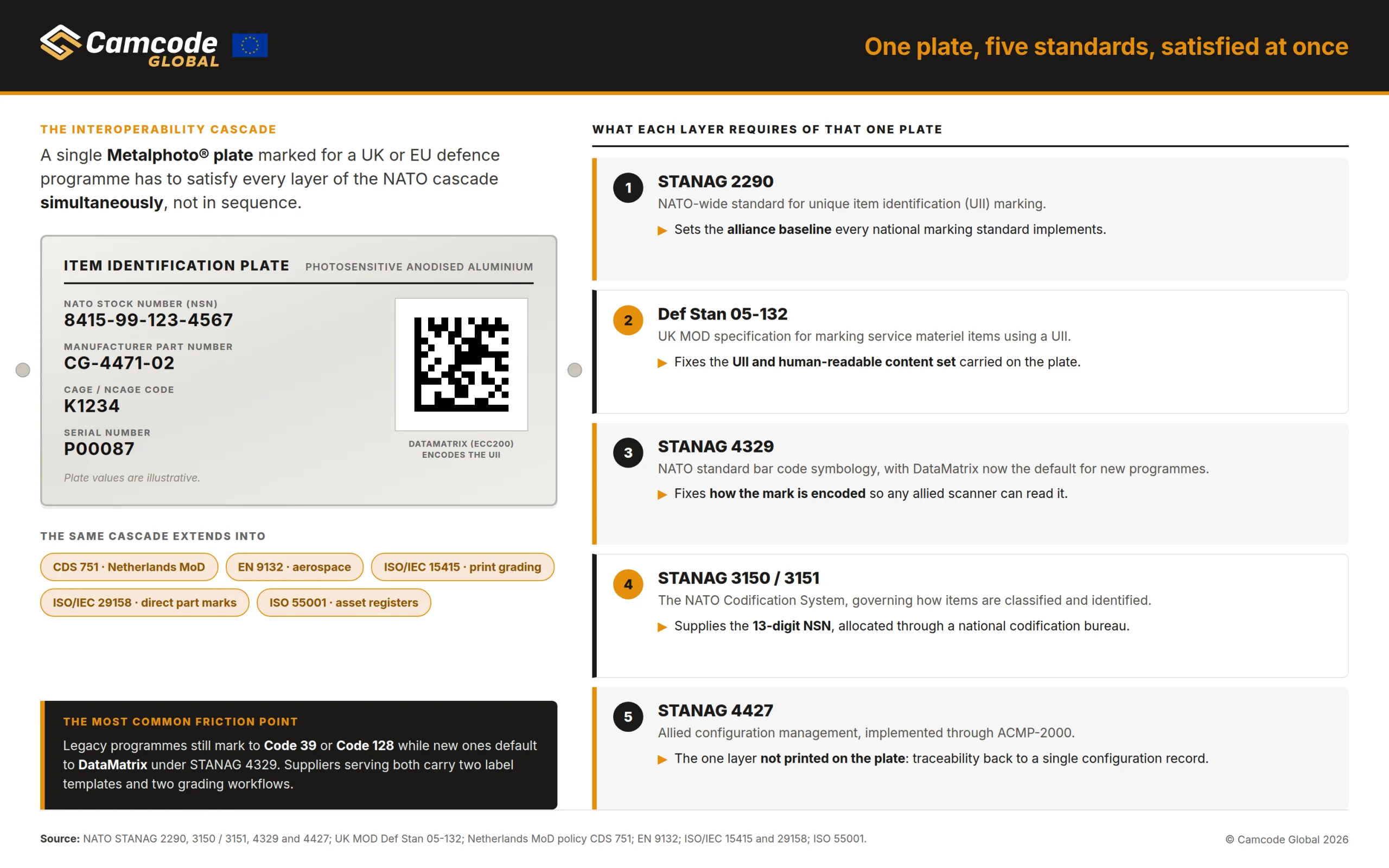
For defence suppliers, interoperability rarely means complying with a single standard. A single asset, nameplate, data plate or UID label may need to satisfy NATO requirements, national defence standards, contract-specific marking rules and data requirements simultaneously.
For example, a durable Metalphoto® nameplate or data plate produced for a UK defence asset may need to:
Meet the UK Ministry of Defence requirements for Unique Item Identification under DEF STAN 05-132, including the required machine-readable and human-readable identification information. DEF STAN 05-132 specifically works in conjunction with NATO STANAG 2290 and other related marking requirements.
Carry a Unique Item Identifier (UII) structured in accordance with STANAG 2290 – NATO Unique Identification of Items, providing a standardized identity that can be used across participating NATO nations.
Include or associate the asset with a NATO Stock Number (NSN) where codification is required under the NATO Codification System and ACodP-1 – NATO Manual on Codification.
Meet applicable packaging, environmental and marking requirements such as DEF STAN 81-41, where those requirements are flowed into the contract.
Match the manufacturer’s part number, serial number, NSN, UII and other identifying information to the authoritative records within the customer’s ERP, maintenance, logistics or asset-management system.
The important point is that NATO establishes a common interoperability framework, but individual nations implement and supplement that framework through their own defence policies and standards.
Common NATO Framework
Across NATO programmes, suppliers may encounter several common standards and publications:
STANAG 2290 – Unique Identification of Items: Establishes NATO’s framework for UID and the standardized structure of the UII.
ACodP-1 – NATO Manual on Codification: Governs implementation of the NATO Codification System, including item identification, classification, NATO data exchange and NSN-related processes.
These NATO requirements can then be supplemented by national requirements.
United Kingdom
For UK Ministry of Defence programmes, suppliers may encounter:
DEF STAN 05-132 – Marking of Service Materiel Items Using a Unique Item Identifier (UII)
DEF STAN 81-41 – Packaging of Defence Materiel, including applicable package-marking requirements
STANAG 2290
STANAG 4329 / AAITP-09
ACodP-1 / NATO Codification System
Applicable DEFCONs, DEFFORMs and programme-specific Integrated Logistic Support requirements
DEF STAN 05-132 specifically establishes UK MOD requirements for UII marking and references STANAG 2290 as part of that framework.
Netherlands
For Netherlands Ministry of Defence programmes, CCG commonly works within requirements associated with:
CDS-751 – Netherlands MoD UID Policy
STANAG 2290
STANAG 4329 / AAITP-09
ACodP-1 / NATO Codification System
Applicable configuration-management and asset-data requirements
NL MoD requirements governing the relationship between the physical UID and the authoritative asset record within systems such as SAP/S4-HANA
CCG has implemented CDS-751-aligned UID solutions for the Netherlands MoD in programmes where individual asset identification and associated data are subsequently integrated into SAP/S4-HANA.
Canada
For Canadian Department of National Defence programmes, applicable requirements may include:
DAOD 3038-0 – Materiel Identification
D-02-002-001/SG-001 – Identification Marking of Canadian Military Property
A-LM-505-702/JS-001 – Standard Marking, Barcoding and Data Plates
DAOD 3034-0 – Configuration Management for Defence Systems
ACodP-1 / NATO Codification System
Applicable NATO UID and interoperability requirements
Australia
Australian Defence suppliers may encounter:
DEF(AUST) 1000C – Australian Defence Force Packaging Standard
Particularly Part 5 – Marking of Packages
Part 12 – Automatic Identification Technology Labelling and Marking
Applicable NATO, coalition and programme-specific UID requirements
Contract-specific asset identification, packaging and data requirements
DEF(AUST) 1000C Part 12 specifically addresses the standardized application of AIT to Australian Defence materiel and packaging.
United States
Where UK or European suppliers manufacture equipment for U.S. DoD programmes, additional requirements may include:
MIL-STD-130 – Identification Marking of U.S. Military Property
MIL-STD-129R – Military Marking for Shipment and Storage
U.S. DoD Item Unique Identification (IUID) requirements
Applicable Data Matrix, verification and registration requirements
Programme and contract-specific marking requirements
MIL-STD-130 establishes identification-marking requirements for U.S. military property, including human-readable and machine-readable identification, while MIL-STD-129 addresses military marking for shipment and storage.
Other NATO Nations
Belgium, Latvia, France and other NATO nations may apply STANAG 2290, NATO Codification, NATO AIT and configuration-management principles through their national policies, procurement requirements and individual contracts.
The exact implementation can differ by nation. This is why suppliers should not assume that meeting one country’s UID requirement automatically satisfies another country’s contract.
Where Camcode Global Fits
This is the interoperability challenge Camcode Global is designed to address.
CCG does not look at the label or data plate as an isolated product. We evaluate the complete chain connecting:
Contract Requirement → Asset Data → Identifier → UID/UII Structure → Marking Method → AIT Capture → Verification → ERP / Asset System → Lifecycle Traceability
The objective is to ensure that:
The correct asset is being identified.
The correct identifier and data structure are being used.
The physical label, nameplate, data plate or direct-part mark is appropriate for the asset and operating environment.
The DataMatrix, barcode, RFID or other AIT technology can be reliably captured.
The physical identifier corresponds to accurate and validated asset data.
The information can be consumed by the customer’s SAP, ERP, logistics, maintenance or asset-management system.
The resulting identification supports traceability throughout the asset’s operational lifecycle.
Not every asset will require every standard listed above. The final requirement is determined by the contract, customer, nation, asset class, operational environment and applicable defence policy.
For Camcode Global, NATO interoperability is therefore not simply about producing a compliant label. It is about creating a trusted connection between the physical asset, its unique identity and the digital information used to manage it.
When those elements are correctly aligned, equipment can be identified, scanned, received, maintained, transferred and tracked consistently as it moves between manufacturers, suppliers, defence organisations, information systems and NATO nations.
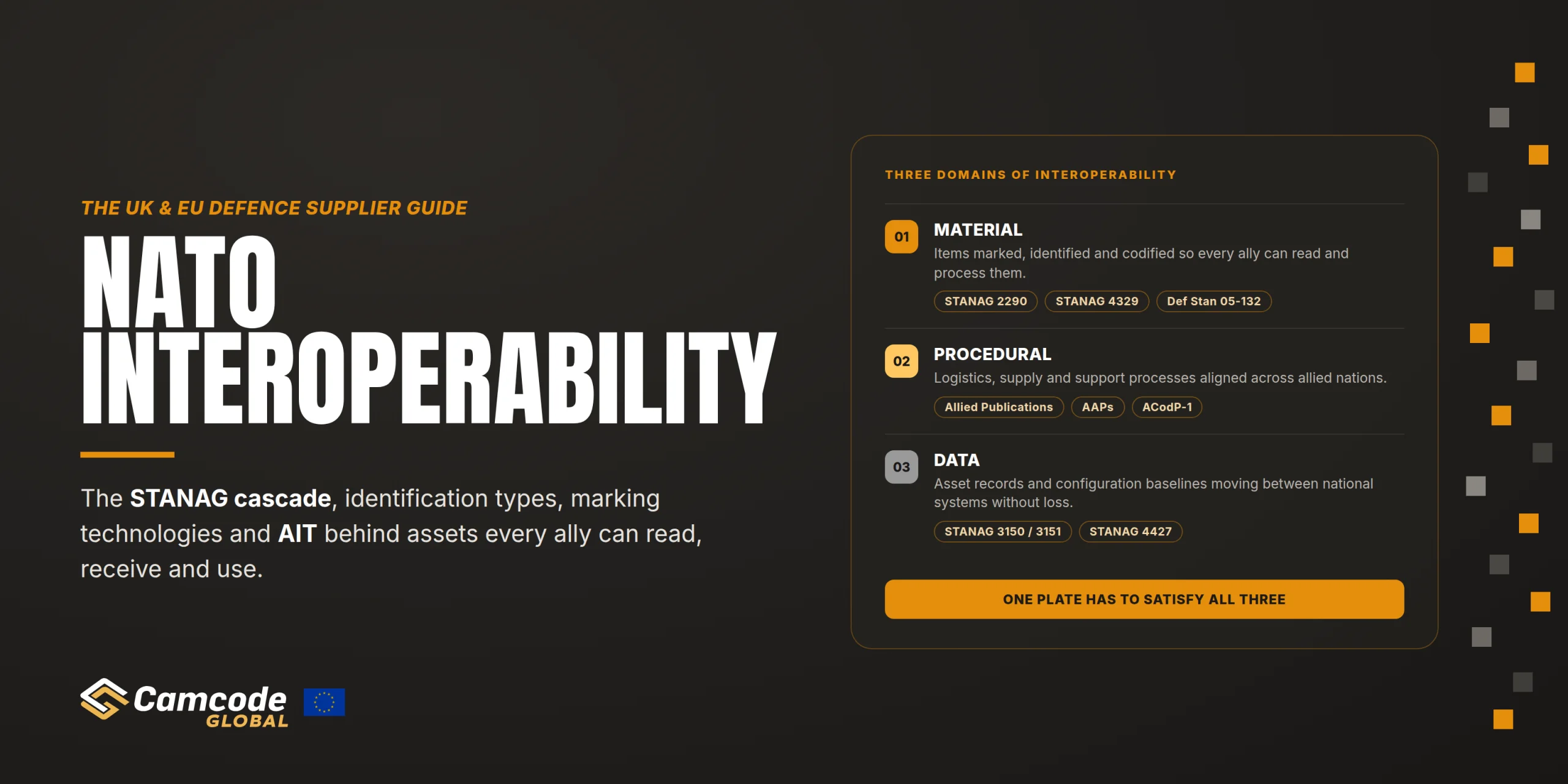
The Three Domains of NATO Interoperability
For defence suppliers, NATO interoperability is not achieved through a single label, standard, software system or technology. It depends on the alignment of three interconnected domains:
The Physical Asset – how equipment is identified, marked and captured
The Operational Process – how that equipment is received, managed, maintained and transferred
The Asset Data – how the asset’s identity and technical information are structured, validated and exchanged between systems
From Camcode Global’s perspective, true interoperability exists when the physical asset, its unique identity, the processes used to manage it and the authoritative digital record all remain connected throughout the asset lifecycle.
1. Material and Asset Interoperability
Material interoperability begins with the physical asset.
Equipment manufactured or supplied by one nation must be capable of being correctly identified, received, inventoried, maintained, transferred and supported by another. This requires more than placing a serial number on a component. The asset must carry the correct identification information in the correct structure, using a marking and AIT solution appropriate for the equipment and its operational environment.
Depending on the nation, programme, contract and asset type, applicable requirements may include:
STANAG 2290 – NATO Unique Identification of Items, establishing the NATO framework for unique item identification
AUIDP-1 – NATO Guidance on Unique Identification of Items, supporting implementation of NATO UID requirements
STANAG 4329 / applicable NATO AIT guidance, governing barcode and machine-readable identification requirements
STANAG 4427 and the Allied Configuration Management Publications (ACMPs) for configuration-management principles and lifecycle traceability
ACodP-1 and the NATO Codification System for NATO item identification and codification
UK DEF STAN 05-132 for UII marking of UK Service materiel
Netherlands MoD CDS-751 for Dutch defence UID implementation
Canadian DND DAOD 3038-0 and D-02-002-001/SG-001 for materiel identification and marking
Australian DEF(AUST) 1000C, including applicable AIT, packaging and marking requirements
U.S. MIL-STD-130 for identification marking of U.S. military property
U.S. MIL-STD-129 for military marking of shipments and storage
Other national, environmental, packaging and programme-specific requirements flowed down through the contract
For Camcode Global, material interoperability means determining the complete physical identification solution:
Asset → Identifier → Marking Content → Symbology → Material → Marking Method → Verification → AIT Capture
2. Procedural and Logistics Interoperability
A correctly marked asset delivers limited value if the organisations handling it do not have compatible processes for using that identification.
Procedural interoperability connects the physical identifier to the business and logistics processes that depend on it.
Across NATO and national defence organisations, common standards, Allied Publications, national policies and contractual requirements establish processes governing activities such as:
Procurement and supplier UID flow-down
Materiel receipt and acceptance
NATO codification
Asset registration and serialization
Inventory and warehouse management
Configuration identification and control
Maintenance, repair and overhaul
Packaging, shipping and transportation
Equipment issue and return
Deployment and redistribution
Asset transfer between organisations or nations
Lifecycle and disposal activities
For defence suppliers, this means the identification solution must support how the customer actually manages the asset, not merely reproduce information from a drawing or purchase order.
For example, a DataMatrix symbol may be technically compliant, but interoperability can still fail if:
The identifier was not properly established before production
The same serial number exists against multiple part numbers
The UID is not registered or loaded into the required system
The NSN is associated with the wrong manufacturer or part number
The asset is marked differently from the information provided in the Advanced Shipping Notice or ERP record
Receiving personnel cannot capture the identifier with their existing AIT equipment
The supplier’s UID structure is incompatible with the customer’s required business process
Configuration changes are not reflected in the associated asset records
This is why CCG approaches UID and AIT implementation as an operational process, rather than simply a marking exercise.
When properly implemented, the identifier becomes a tool for improving asset visibility, inventory accuracy, maintenance traceability, configuration control and operational readiness.
3. Data and Systems Interoperability
The third domain is the information behind the physical asset.
An asset can be correctly manufactured and physically marked, but it is not truly interoperable if the associated data is incomplete, duplicated, incorrectly structured or inconsistent between systems.
The NATO Codification System provides an important common foundation for this interoperability. STANAG 3150 and STANAG 3151 form the basis of the NATO Codification System, establishing common approaches to supply classification and item identification. ACodP-1 provides the rules and procedures supporting implementation across participating nations.
This creates a common logistics language built around information such as:
NATO Stock Number (NSN)
NATO Supply Classification
Approved Item Name
NCAGE Code
Manufacturer
Manufacturer Part Number
Serial Number
Unique Item Identifier (UII)
Technical characteristics
Reference and codification data
However, codification represents only one part of the asset-data environment.
Modern defence organisations also need asset information to move reliably between:
Supplier systems
Procurement platforms
SAP and other ERP systems
Maintenance-management systems
Warehouse-management systems
Configuration-management systems
Asset-management platforms
NATO and national codification systems
AIT and data-capture devices
Data warehouses, analytics platforms and digital-twin environments
The physical identifier therefore needs to serve as the connection between the asset in the field and the authoritative digital record used to manage it.
CCG Connects All Three Domains
The three domains cannot be treated independently.
Material Interoperability
Can the physical asset be correctly identified and captured?
Procedural Interoperability
Can NATO nations, defence organisations and suppliers use that identity within their logistics and asset-management processes?
Data and Systems Interoperability
Can the information associated with that identity be accurately understood and exchanged between systems?
Camcode Global works across all three.
Our role is to connect:
Defence Policy & Contract Requirements → Asset Data → NATO Codification → UID / UII → Durable Marking → AIT → Validation → ERP Integration → Lifecycle Traceability
This is the foundation of practical NATO asset interoperability.
The goal is not simply to place an identifier on an asset. It is to create a trusted connection between the physical asset, its unique identity, the processes used to manage it and the digital systems that support it throughout its lifecycle.
When these three domains are aligned, defence equipment can be more consistently identified, received, tracked, maintained, transferred and supported across suppliers, systems, organisations and national borders.
The Identification Architecture Behind NATO Interoperability
NATO interoperability begins with establishing the correct identity for the asset, item of supply, product, package or shipment being managed. Applying a barcode or data plate is not enough—the identifier must accurately represent the object, align with the applicable defence or commercial standard and connect to the supporting asset, logistics and configuration data.
UK and European defence suppliers frequently need to manage several identification schemes at the same time. Camcode Global helps determine which identifiers are required, what each identifier represents and how they must be connected across the physical asset, its marking and the customer’s information systems.
NATO Stock Number
A NATO Stock Number—or NSN—is a 13-digit identifier assigned through the NATO Codification System to an item of supply. It identifies a standardized type of materiel based on its form, fit and function; it does not uniquely identify each individual serialized asset.
The NSN connects the item of supply to codification information such as its approved item name, classification, technical characteristics, manufacturer references and approved sources of supply. Manufacturer part numbers are associated with the relevant manufacturer’s NCAGE Code, allowing equivalent items from different manufacturers to be linked to the same item of supply where appropriate.
From a Camcode Global perspective, NSN implementation includes more than placing the number on a label. It requires verifying that the NSN, part number, manufacturer, NCAGE Code and technical description all refer to the correct item and are accurately represented within the customer’s master data.
Unique Item Identifier
A Unique Item Identifier—or UII—identifies one individual asset and distinguishes it from every other item. Unlike an NSN, which identifies an item of supply, the UII provides persistent item-level identity and traceability throughout the asset’s lifecycle.
UII requirements may be implemented through NATO STANAG 2290, US DoD IUID requirements or national defence policies such as UK Def Stan 05-132 and Netherlands CDS-751. Depending on the applicable requirement, the UII may be constructed from data elements such as:
Camcode Global supports UII implementation by establishing serialization rules, validating identifier construction, generating compliant marking data, applying or supplying durable UID labels and connecting the resulting identifier to asset-management and ERP records.
Manufacturer Part Numbers, Serial Numbers and NCAGE Codes
Part numbers and serial numbers remain essential to defence asset identification, but they are only interoperable when their context is clear.
A part number identifies an item according to a manufacturer’s design or production system. A serial number distinguishes one item from other items produced under that numbering structure. An NCAGE Code identifies the organization responsible for the part number or other reference.
The same serial number may be reused by different manufacturers, and the same part number may exist under different enterprises. Camcode Global therefore evaluates the complete identifier combination rather than relying on a serial number or part number alone.
GS1 Identification Keys
Defence supply chains increasingly interact with commercial, industrial and healthcare systems that use GS1 identification standards. The appropriate GS1 key depends on what is being identified:
These identifiers are not interchangeable. A GIAI identifies an asset, a GTIN identifies a trade item and an SSCC identifies a logistics unit. Camcode Global helps customers select the correct key, structure the data properly and encode it within the appropriate GS1 barcode, DataMatrix or RFID application.
A UDI includes a device identifier and production information used to support the identification and traceability of regulated medical devices. GS1 is one of the issuing entities recognized for assigning UDI-compliant identifiers, but UDI is a regulatory identification framework rather than a separate GS1 identification key.
For deployable hospitals, medical logistics units and military medical equipment, these regulatory identifiers may need to coexist with NSNs, serial numbers, national asset identifiers and internal ERP records.
National and Organization-Specific Asset Identifiers
National ministries of defence, military services, prime contractors and individual programmes may maintain their own equipment codes, property numbers, reference numbers or internal asset identifiers.
These identifiers may remain operationally important even when an NSN or UII is introduced. Simply replacing or deleting them can break links to historic maintenance, configuration, financial or supply records.
Camcode Global develops cross-reference and migration strategies that preserve legacy relationships while establishing a standards-aligned primary identifier. This allows organizations to modernize their identification systems without losing asset history or operational traceability.
How Camcode Global Creates an Interoperable Identification Structure
Camcode Global brings these identifier schemes together through an integrated asset-identification and Asset Data Optimization process that includes:
Reviewing contractual, NATO and national identification requirements
Determining which identifier applies to each asset, item, package or logistics unit
Cleansing and enriching part, serial, manufacturer, NCAGE and NSN data
Establishing serialization and UII construction rules
Mapping legacy and national identifiers to standards-aligned identifiers
Designing and producing durable labels, nameplates and data plates
Selecting appropriate barcode, DataMatrix, RFID, NFC or other AIT technologies
Verifying symbol quality, readability and data structure
Connecting physical markings to ERP, maintenance, warehouse and asset-management systems
Supporting registration, governance and long-term identifier control
Selecting the correct identifier is therefore only the first step. The identifier must also be accurately constructed, applied through a durable marking method, captured by the customer’s AIT equipment and connected to complete, trustworthy asset data.
This alignment between the asset, identifier, physical mark, capture technology and supporting system record is what enables Camcode Global to deliver practical NATO interoperability and total asset visibility.
The Standards Stack UK and European Suppliers Routinely Encounter
Below is a working reference breaking down the standards most commonly cited in UK and European NATO-aligned supplier tenders:
Standard
What it governs
Scope
STANAG 2290
Unique identification (UII) marking; the 13-digit NSN it carries is allocated through the NATO Codification System
NATO alliance-wide
STANAG 4427
Allied Configuration Management Documentation, implemented through ACMP-2000
NATO alliance-wide
STANAG 4329
NATO bar code symbology, including the growing dominance of DataMatrix for new programmes
NATO alliance-wide
STANAG 3150 / 3151
The NATO Codification System, governing how items are classified and identified
NATO alliance-wide
Def Stan 05-132
UK MOD specification for marking for identification of items of supply
UK defence contracts
Netherlands MoD policy CDS 751
Dutch Ministry of Defence marking and UID governance policy for equipment entering Dutch defence inventory
Netherlands defence contracts
EN 9132
DataMatrix marking for aerospace components, cascading STANAG-aligned identification into the aerospace supply chain
Aerospace (UK/EU, cross-sector with defence)
ISO/IEC 29158 (originally published as ISO/IEC TR 29158, before that AIM DPM-1-2006)
Direct part mark (DPM) readability and quality grading
International; referenced by UK MOD and EU OEMs
ISO 55001
Asset management systems: unique identification as a system requirement
International; civilian and defence asset registers
EU Medical Device Regulation 2017/745
UDI as a requirement for device identification across the EU, registered in EUDAMED
EU medical device supply chains, incl. deployable medical equipment
EU Falsified Medicines Directive (2011/62/EU)
GS1 DataMatrix on pack-level pharmaceutical identifiers
EU pharmaceutical supply chains
MIL-STD-130
US DoD marking specification
US-only (see note below)
National standards, as well as sector standards, add additional layers above these. UK suppliers must also conform to Defence Logistics Manual (DEFLOGMAN) as well as the D-LM-008 series of standards. French, German, Italian and other European national standards also add further national rules for the identifiers they use within the NATO standard. AAP-6 (Glossary of NATO terminology) and ACodP-1 (NATO Manual on Codification, which explains how nations should codify items and maintain their national codification bureaus) are often cited when definitions of contractual wording and procedure are required respectively. STANAG 4280 (defence packaging requirements) is used to dictate how marked items are to be packaged when being shipped to another ally.
A note on MIL-STD-130.MIL-STD-130 is a United States Military standard. Buyers in the UK and EU will not request MIL-STD-130 specifically; however, the durability evidence required by MIL-STD-130 is commonly used to substantiate compliance with the nearest equivalent UK and EU standards: namely Def Stan 05-132, Netherlands MoD policy CDS 751 and NATO STANAG 2290, which has been adopted into EN 9132. Specs across the military, aerospace, rail and energy sectors typically request this lifetime. This is why the standard is referenced on UK and EU supplier data sheets despite having no official recognition in British or European procurement.
What Each Standard Requires in Practice
The table above tells you which standard applies. What follows is what each one actually demands from the label content, the marking method and (where relevant) a registry submission, so a supplier can treat it as a practical checklist rather than only a reference list.
UK MOD Def Stan 05-132
Depending on the equipment, contract and marking category, the required information may include the NSN, manufacturer’s part number, serial number (where applicable), the manufacturer’s NCAGE or CAGE code, contract or lifecycle information, and both human-readable text and machine-readable data.
The marking material and attachment method must remain suitable for the asset’s expected lifecycle and operating environment, and additional requirements may be imposed through the contract, equipment specification or supporting MOD policy.
NATO STANAG cascade (2290 / 4329 / 3150-3151 / 4427)
NATO identification is delivered through several linked publications rather than a single standard. STANAG 3150 and 3151 form the NATO Codification System and govern the assignment of NSNs; STANAG 2290 establishes the unique identification of individual items; STANAG 4329 addresses machine-readable marking and data-carrier requirements; and STANAG 4427, implemented through the ACMP series, maintains traceability between the physical asset, its configuration and its authoritative data record.
An NSN identifies a standardized item of supply, while a UID identifies one specific serialized item. Both may appear on the same label or nameplate because they serve different purposes.
Netherlands MoD CDS-751
Depending on the contract and asset category, CDS-751 may require the NSN and item-master information, part and serial numbers, manufacturer or enterprise identifiers, NATO UID data structured in accordance with STANAG 2290, human-readable and machine-readable information, DataMatrix marking, and durable marking appropriate for the asset and environment.
Suppliers should evaluate the specific CDS-751 contractual requirements rather than assuming every asset requires the same label content or construction.
Canadian DAOD 3038-0 (Materiel Identification)
Supported by DAOD 3038-0, NATO Codification System policies, departmental instructions and contract-specific marking requirements, the Canadian requirement may call for the NSN, part and serial numbers, manufacturer identification, item-level unique identification, human-readable and machine-readable data, permanent marking applied before delivery, and data compatible with Canadian inventory, maintenance and materiel-management systems.
Aerospace EN 9132
Supports DataMatrix marking of aerospace parts and assemblies, defining the approved marking location, symbol size and cell dimensions, verification of symbol quality, control of the marking process, and confirmation that the mark does not affect the component’s form, fit, function or structural integrity. It is typically applied alongside customer drawings, engineering specifications and AS/EN quality-management requirements.
EU MDR UDI (Regulation 2017/745)
Requires a Unique Device Identifier composed of a UDI-DI (identifying the device model or version) and UDI-PI (production information such as serial number, lot number, manufacturing date or expiry date), encoded through an approved issuing entity’s data structure and barcode symbology (GS1 DataMatrix is one common implementation but not the only recognised issuing framework) and maintained in EUDAMED in line with the device’s classification and implementation schedule.
EU Falsified Medicines Directive
Requires applicable prescription medicines to carry a two-dimensional symbol at pack level containing the product code, a unique serial number, batch or lot number, expiry date and, where required, national reimbursement information, verified against the applicable national medicines verification system connected to the wider European network.
ISO 55001 and asset registers
Treats unique identification as a prerequisite for the rest of an asset management system to function, which is why it increasingly appears alongside NATO and national marking requirements in UK and EU procurement and audit questions, regardless of sector.
Camcode Global evaluates the complete set of contractual, national and industry requirements before defining the label content, identifier structure, marking technology and data-capture process for a programme. This is what allows one identification solution to support multiple schemes at once without creating duplicate, conflicting or unusable asset data.
Camcode Global’s Marking Technologies for NATO-Aligned Programmes
Interoperability is reliant on the physical mark lasting long enough, and being read reliably enough, for every ally in the supply chain to interact with it. Selecting the identifier is only one part of achieving that; the identifier must also be applied using a marking method that remains readable and securely attached throughout the asset’s expected service life.
Camcode Global provides a range of permanent and durable marking solutions selected according to the asset’s material, surface condition, operating environment, lifecycle, production volume, attachment requirements and required data-capture technology, and produces across the entire spectrum of marking technologies. Choosing the most appropriate one for the asset and its requirements is key to an interoperability-ready programme:
An inorganic image is created beneath the surface of the metal, providing excellent durability to meet the broadest spectrum of NATO and national performance standards. Metalphoto® is well suited to high- to medium-volume programmes and can be produced in various sizes, thicknesses, colours and attachment configurations. It is the most commonly used solution to meet MIL-STD-130 equivalent durability requirements outlined by Def Stan 05-132, CDS 751 and STANAG 2290.
Typical applications:
Small arms and weapon ancillaries
Ships and marine equipment
Aircraft and aerospace
Engines and engine components
Complex or crew-served weapons systems
Communications equipment
Nameplates, data plates and equipment identification plates
Assets exposed to chemicals, sunlight, abrasion or severe weather
Laser Markables (Steel, BlackPlus, or Acrylic)
Durable etched or bonded images depending on substrate; however, the marking process is slower and more labour-intensive than other methods. Laser marking is ideal for low-volume, on-site applications where real-time marking is necessary, and is particularly valuable for decentralised or field operations because labels can be produced at the point of use.
Typical applications:
Small arms and weapon ancillaries
Aircraft and aerospace components
Engines and mechanical assemblies
Communications equipment
Complex or crew-served weapon systems
Maintenance, repair and overhaul operations
On-site UID implementation programmes
Thermal Transfer
An image created by the transfer of ink onto the material, with durability varying by material, facestock, ribbon, adhesive and laminate. Thermal transfer meets moderate- to high-volume needs and allows for on-site printing at depots, warehouses, hospitals, production facilities and field locations when real-time marking is necessary.
Typical applications:
Soft and hard body armour
Hospital equipment
Direct circuit board marking
General asset identification and tracking
Suppressor marking
Warehouse and logistics operations
Packaging and shipment identification
High-temperature applications (500°C–1200°C)
Ink Jet
Ink jet printed images with durability dependent on the material and any overlay applied. Ink jet is ideal for moderate- to high-demand volume production requiring variable data, colour or graphics.
Typical applications:
Soft and hard body armour
Ballistic and bump helmets
Hospital equipment
General asset tracking
Equipment branding and instructional labelling
Packaging and logistics applications
Cut-Through, Stamped and Engraved Plates
CNC-punched, mechanically engraved or stamped plates offer good durability but can present readability issues and lower data density compared with modern barcode and DataMatrix technologies, so the design must be carefully controlled to avoid damaged, obstructed or poorly sized characters. Best suited to low quantities.
Typical applications:
Heavy equipment
Ships and marine assets
Vehicles and chassis marking
Industrial machinery
Large equipment identification plates
Woven and Printed Fabric Tags
Sewable, woven, printed or heat-sealed tags for intermediate-life fabric assets, used when a plate or rigid label is not possible. Construction and attachment method are selected according to expected laundering, abrasion, chemical exposure, temperature and handling conditions.
Typical applications:
Parachutes
Military apparel
Webbing and load-bearing equipment
Soft armour and textile carriers
Bags, covers and other fabric-based assets
Direct Part Marking (DPM)
Laser etched, laser engraved, dot peen, chemical etching or other controlled marking applied directly onto the part rather than through a separate label or plate. DPM is used where attaching a label is not possible or where the identifier must remain with the component throughout its lifecycle. The marking process must be assessed carefully to ensure it does not damage the part, alter its performance or affect applicable certifications. DPM readability standards are benchmarked against ISO/IEC 29158, the standard used by UK MOD and EU OEMs.
Typical applications:
Risers and bridging equipment
Caustic or harsh chemical environments
Surgical and medical instruments
Aircraft and aerospace components
NFC
A passive radio frequency identification protocol that is read when within approximately 4cm of the tag, with the added advantage that most smartphones can read it. NFC is useful for applications where a barcode cannot be placed on the asset or where alternate actions are desired each time the tag is scanned.
Typical applications:
Communications equipment
Hospital equipment
General asset tracking
It is worth noting that RFID and NFC are data-carrier technologies rather than physical marking methods in their own right. They are incorporated into a label, tag, nameplate or other identification product and used alongside a human-readable identifier or a machine-readable barcode, rather than replacing the substrate or attachment method that carries them.
Selecting the Correct Marking Method
Camcode Global evaluates the complete application before recommending a marking technology: the asset, its environment, the identifier structure, the marking material, the attachment method and the required capture technology, together. Important factors include:
Asset substrate and surface finish
Temperature range and exposure duration
Chemicals, fuels, oils and cleaning agents
Ultraviolet exposure and weather conditions
Abrasion, impact and handling
Available marking area and required service life
Attachment method
Barcode, RFID or NFC reading requirements
Production volume and point-of-use needs
Applicable defence, industry and customer standards
Using an incompatible material, adhesive or marking method for the environment is the number one cause of early label failure and subsequent re-identification expense on NATO-aligned programmes. Camcode Global evaluates the complete application (the asset, environment, identifier structure, marking material, attachment method and capture technology) to provide an identification solution that remains usable and readable throughout the asset’s operational lifecycle.
Automatic Identification and Data Capture Technologies That Support Interoperable Data
Marking places the identifier on the asset, but a durable mark or direct part mark is only useful once its data can be captured accurately and transferred into the systems that manage the asset. Automatic Identification Technologies (AIT), or Automatic Identification and Data Capture (AIDC), is how we actually read and move that identifier through the supply chain, reducing manual data entry and connecting physical assets with records maintained in SAP, ERP, EAM, inventory, maintenance and logistics systems.
Camcode Global selects and deploys the appropriate technology based on the required read range, asset environment, data volume, system architecture, security requirements and operational workflow. NATO’s in-transit visibility vision relies on it working seamlessly across all allies. Camcode Global’s AIT solutions include:
Linear and Two-Dimensional Barcodes
Barcodes provide a reliable and cost-effective method of capturing asset, item, packaging and shipment information. Camcode Global supports linear and two-dimensional symbologies, including Code 39, Code 128, GS1-128, QR Code, PDF417 and DataMatrix (the symbology specified under STANAG 4329).
The selected symbology can encode identifiers and data elements such as a UII, serial number, NSN, GTIN, GIAI, SSCC or Unique Device Identifier (UDI). DataMatrix is the backbone of serialised identification for defence UID work because it can encode significant amounts of data in a small area and can be applied through either a label or Direct Part Marking.
Typical applications:
Item Unique Identification and serialization
NATO and national defence asset identification
Packaging and shipment identification
Maintenance and repair processes
Warehouse and inventory management
Medical device and healthcare identification
Tool, equipment and component tracking
Passive RFID
Passive RFID tags do not require an internal power source. They receive energy from an RFID reader and transmit the encoded information back to the system. Passive RFID is appropriate when assets must be identified without direct line of sight, when multiple items need to be captured simultaneously, or when barcode scanning would be inefficient.
Typical applications:
Warehouse inventory
Tool and equipment accountability
Arms-room and controlled-inventory management
Asset issue and return processes
Supply-chain and shipment visibility
Medical and hospital equipment tracking
Active RFID
Active RFID tags carry their own power source and can transmit over longer distances than passive tags. They are generally used for higher-value assets, containers, vehicles or equipment that must be detected across a larger area, and may also support sensor information, location events and automated entry or exit records.
RTLS provide ongoing visibility into the location and movement of assets within a defined environment. Depending on the application, RTLS solutions may use active RFID, Bluetooth Low Energy, ultra-wideband, Wi-Fi or other technologies. The appropriate choice depends on the required accuracy, facility layout, asset value and operational need.
Typical applications:
Frequently moved tools and equipment
Hospital and medical assets
Maintenance, repair and overhaul facilities
Warehouses and distribution centres
High-value or mission-critical equipment
Production and work-in-progress tracking
Optical Character Recognition (OCR)
OCR converts printed, stamped or engraved characters into structured digital data. Camcode Global uses OCR as part of asset data capture and cleansing programmes to reduce manual transcription and accelerate the collection of part numbers, serial numbers, manufacturer information and other asset attributes, including legacy weapon serial numbers. OCR results must be validated, since worn plates, damaged marks, inconsistent formatting and similar characters can create recognition errors.
Typical applications:
Asset surveys and physical inventories
Data cleansing and enrichment
Legacy nameplate and data-plate capture
Part-number and serial-number collection
SAP and ERP record validation
Migration from legacy asset-management systems
GPS and GNSS Asset Tracking
GPS and other Global Navigation Satellite System technologies can be combined with cellular, satellite or radio communications to track assets moving between facilities, regions or countries. These technologies are most appropriate for mobile assets operating outside controlled facilities that require location updates over a wide geographic area, providing in-transit visibility past a particular site boundary and into end-to-end supply chain visibility.
Typical applications:
Vehicles and mobile platforms
Containers and transport equipment
Deployable systems
International shipments
High-value assets moving between sites
Supply-chain and in-transit visibility
NFC-Enabled Asset Identification
NFC is a short-range RFID technology that can often be read using compatible smartphones and tablets. It can be incorporated into an asset label or tag to provide access to equipment records, maintenance instructions, inspection forms, digital manuals or other authorised information. This identification technology is useful wherever a barcode cannot be placed on the asset or where alternate actions are desired each time the tag is scanned.
Typical applications:
Maintenance and inspection workflows
Medical and communications equipment
Tools and test equipment
Access to digital asset records
Field-service applications
Equipment authentication
Smart Cards, Credentials and Identity-Based Technologies
Smart cards and other electronic credentials connect an asset transaction to the individual performing it, and may be used to control access, record equipment issue and return, or establish accountability for sensitive assets. Biometric technologies may also be integrated where a higher level of identity verification is required, depending on the customer’s security, privacy and information-assurance requirements.
Typical applications:
Controlled equipment issue and return
Arms-room accountability
Tool-control programmes
Restricted inventory access
Operator authorisation
Sensitive asset transactions
Sensor-Enabled Asset Monitoring
Sensors collect information about an asset’s condition and operating environment, such as temperature, humidity, shock, vibration, pressure, movement or other conditions. Sensor data can be associated with the asset’s unique identifier to build a more complete lifecycle and condition history alongside its physical identity.
Typical applications:
Temperature-sensitive materials
Medical and pharmaceutical equipment
Shock-sensitive components
Ammunition and controlled inventory
Storage and transportation monitoring
Predictive maintenance programmes
Electronic Article Surveillance (EAS)
EAS provides theft deterrence and perimeter monitoring for controlled, sensitive or high-value inventory. EAS is generally used as a security control rather than a complete asset-identification solution, and where required it can be layered alongside UID, barcode, RFID or inventory-management technologies rather than replacing them.
Connecting the Physical Asset to Enterprise Systems
Camcode Global does more than supply scanners, labels or tags for a NATO-aligned programme. We evaluate the complete asset-identification workflow, including:
The identifier and required data structure
The physical label, tag or direct mark
The barcode, RFID or other data carrier
The reader, scanner or mobile device
Data validation and business rules
Integration with SAP, ERP, EAM and logistics systems
Reporting, analytics and asset-visibility requirements
By combining the correct identifier, durable marking method and appropriate capture technology, Camcode Global helps defence and industrial organisations improve data accuracy, reduce manual processes and maintain asset visibility from procurement and receipt through maintenance, deployment and disposal.
Where UK and EU Suppliers Most Often Hit Interoperability Friction
There are a few recurring friction points we commonly see in our supplier engagement work:
Symbology choice. Many legacy programmes use Code 39 or Code 128 linear barcodes, while all new programmes default to DataMatrix according to STANAG 4329. Suppliers supporting both must maintain two templates for label design as well as two separate grading workflows.
NSN allocation lag. An item can’t be marked or shipped until it has an NSN. The time lag between supplier submission of data and allocation by the Bureau creates recurring schedule risk.
National variation in mark content. In addition to NSN, national standards for human readable content, such as Def Stan 05-132 (UK), Netherlands MoD policy CDS 751 (Netherlands), MIL-STD-130 (US), and equivalent French, German, and Italian standards, are similar but not identical.
Configuration management interpretations. STANAG 4427 establishes the policy, but how strictly the audit clauses are applied varies by customer.
Re-identification on transfer. When equipment is transferred between NATO countries (e.g., UK to Canada, US to UK) the requirements in the receiving country for re-identification may differ from those of the originating country.
Cross-sector regulatory overlap. When aerospace components move under EN 9132 and deployable medical equipment moves under EU MDR 2017/745 or the EU Falsified Medicines Directive, they must comply with both their own sector-specific marking and registration regimes (EUDAMED for MDR, GS1 DataMatrix pack-level identifiers for FMD) in addition to the NATO marking cascade.
Fragmentation between configuration management systems and asset management systems (parallel registers which fall out of synchronization) continues to be a common source of audit observations for allied suppliers.
Camcode Global’s Seven-Step Process for NATO-Aligned Asset Identification
A common process is how a global, standards-based marking programme maintains cohesion across multiple countries. Every NATO-aligned engagement Camcode Global completes undergoes our proprietary seven-step Data Cleansing, Asset Identification, and Data Optimisation Process, which was designed from the ground up to ensure compliance with NATO STANAGs related to interoperability and in-transit visibility:
Asset Identification & AIT Consultation. We evaluate your programme and make recommendations on how best to streamline your processes to meet the necessary standards and frameworks (STANAG 2290, 4329, 4427, Def Stan 05-132, CDS 751, EN 9132, and others as applicable), increase asset utilization, improve processes for maximum efficiency and compliance, implement technology and automation, and streamline asset supply chain management.
Engineering Services. The engineering team develops the marking specification, or factsheet, defining how the asset is identified in both data and physical marking terms. This includes field verification of a data subset, definition of business rules and data governance, and selection of the most suitable marking technology from Camcode’s range of solutions: Metalphoto®, laser markables, thermal transfer, ink jet, cut through, woven fabric, direct part mark or NFC.
Data Remediation, Reconciliation & Verification. Using Camcode Global’s proprietary offline and online data collection software helps eliminate mistakes and human error. It works within the required standards and frameworks, easily integrates with your current ERP system and asset management software, and offers extensive reporting and analytics.
AIT Product Manufacture & Procurement. Physical products (barcodes (1D, 2D, QR, GTIN, SSCC, UDI), RFID, sensors, GPS tags, OCR-compatible marks, RTLS tags, NFC, EAS, and biometric and smart card solutions) are manufactured or procured based on the data and material specification developed in step two.
AIT Product Installation. NATO Security Cleared installation teams apply products in the field following the marking specification, with Camcode’s proprietary software ensuring accurate association between the physical mark and its corresponding data record. All installations comply with relevant regulatory and NATO requirements.
Data Reporting & Migration. With markings in place, a tailored reporting system provides operational insight, detects discrepancies, and maintains high-quality master data, reducing the time and effort required for ongoing reconciliation and improving processes over time.
Asset Life Cycle Management Advisory (ALCMA). Delivered through Camcode Global’s KPMG partnership, ALCMA manages assets through their full life cycle, from planning and acquisition through maintenance, optimisation, and disposal. ALCMA focuses on performance, cost reduction, and compliance with industry and NATO standards.
See The Framework for full detail on each stage, and The Results for how the process has performed for defence organisations across the alliance.
Building an Interoperability-Ready Marking Programme
A pragmatic approach for UK and European suppliers:
Design the label content set for the worst case scenario. A Metalphoto® plate that includes an NSN, manufacturer’s part number, CAGE/NCAGE code (the supplier code issued by national codification bureaus), serialisation, DataMatrix and human-readable equivalents of the above will meet the majority of NATO interoperability requirements.
Select substrates with durability evidence aligned to NATO testing. MIL-STD-130 cascade data is considered by many to be the gold standard throughout NATO, despite being a US-only standard.
Use DataMatrix everywhere moving forward. It’s accepted in STANAG 4329, and the majority of allies are phasing out older linear barcodes.
Maintain a single configuration register. STANAG 4427, implemented through the Allied Configuration Management Publication 2000 (ACMP-2000), requires one repository for this data. Multiple registers will create conflicting IDs and audit results.
Set up DataMatrix grading at point of mark.ISO/IEC 15415 print-quality grading or ISO/IEC 29158 (direct part marks) are the most widely used acceptance criteria cascaded down through Defence Standard (Def Stan), MIL-STD, and other national standards.
Layer AIT deliberately, not by default. Barcodes remain the interoperable baseline; add RFID, RTLS, or GPS tagging only where the operational case (in-transit visibility, bulk reads, non-line-of-sight) justifies the added infrastructure.
How NATO Interoperability Sits Alongside UK and EU Civilian Standards
For UK and EU suppliers who also work civil markets, the NATO interoperability stack overlaps with civilian standards in useful ways:
GS1 General Specifications: the civilian rulebook for identifiers and machine-readable encodings. GS1 GIAI is increasingly used alongside NSN in UK government commercial templates.
ISO 55001: the asset management standard. It treats unique identification as a system requirement, and NATO configuration management practices cascade cleanly into ISO 55001 alignment.
EU MDR 2017/745andEU IVDR 2017/746, alongside theEU Falsified Medicines Directive (2011/62/EU): medical device, in vitro diagnostic device, and pharmaceutical UDI schemes are each separate from NATO identification but share GS1 DataMatrix encoding, which is why dual-content marking is common on deployable medical equipment.
ISO 10007: civilian configuration management, the broader analogue of STANAG 4427.
A UK supplier already operating to GS1 General Specifications and ISO 10007 will already have much of the documentation infrastructure NATO interoperability expects.
Frequently Asked Questions
Is NATO interoperability a single certification?
No. It is a suite of standards that collectively result in interoperable capability. When called out in contracts, suppliers are normally certified to the individual standards those contracts specify, rather than “NATO interoperability” broadly.
How do UK suppliers register for NATO supplier work?
Why does this guide mention MIL-STD-130 if it’s a US-only standard?
We reference it because it serves as the de facto industry standard for environmental durability requirements, and UK and EU suppliers see it everywhere on data sheets and customer meetings even though it has no official recognition in UK or European government procurement. MIL-STD-130 is a US Military standard; UK and EU buyers will not request MIL-STD-130, but the environmental proofing it dictates is often leveraged as evidence to meet the closest UK/EU equivalents: Def Stan 05-132, Netherlands MoD policy CDS 751, and NATO STANAG 2290 (as adopted through EN 9132).
Does Canada have a UID-specific standard similar to STANAG 2290?
Not officially yet. As of publication, Canada’s published standard is DAOD 3038-0 (Materiel Identification). While Canada’s Department of National Defence and Canadian Armed Forces have announced a UID specific DAOD currently harmonized with STANAG 2290 to be titled 30 10-1, it had yet to be published as an active DAOD at time of publication. Until such time as DAOD 30-10-1 is published, DAOD 30.38-0 is the standard to follow.
What is Netherlands MoD policy CDS 751?
Netherlands MoD policy CDS 751 is the marking and UID governance policy of the Dutch Ministry of Defence. CDS 751, together with Def Stan 05-132 (UK) and STANAG 2290, are the national standards which a NATO compliant marking programme must meet for equipment entering defence inventory.
Does EN 9132 only apply to aerospace suppliers?
Although the core scope of EN 9132 is indeed DataMatrix marking of aerospace components, its broad cascading of STANAG-aligned marking principles means that it is widely cited on cross-sector defence-aerospace projects, often becoming as de facto closest EU and UK equivalent to MIL-STD-130 durability benchmark documents used in the US.
How does NATO interoperability work for dual-use civilian and defence work?
By using layered marking. One physical mark can contain NATO content (NSN, CAGE) as well as civilian GS1 content (GTIN, GIAI) on the same substrate. Camcode commonly creates dual-content plates for UK & EU suppliers supplying both estates.
Does anything change if you are shipping from a UK supplier to a non-NATO ally (Japan, South Korea, Australia)?
Most have implemented the NATO codification system voluntarily, so Australia, Japan and South Korea all have national codification bureaus that run under NATO guidelines. This makes it very simple for UK suppliers.
How Camcode Global Supports NATO Interoperability Programmes
Camcode Global has advised and supplied AIT solutions (ID labels, plates, laser markable products, RFID and DPM) to defence, infrastructure and manufacturing customers throughout the UK and Europe for over 60 years. Metalphoto® plates and high-performance polyester labels are specified by many of our customers on MOD, NSPA and NATO supplier contracts.
Within NATO-aligned defence work specifically, Camcode Global has been a NATO-approved provider for over 12 years, and holds a NATO Support and Procurement Agency (NSPA) Enabling Contract (LS-SU/4600004170) that simplifies procurement access for defence organisations across Europe and Oceania. Our UK and European customer base spans defence primes, SMEs, and refurbishers working national MOD contracts, NSPA frameworks, and US-led NATO programmes.
We advise on substrate and marking technology choice across our full range (Metalphoto®, laser markables, thermal transfer, ink jet, cut through, woven fabric, direct part mark, and NFC) content layout, DataMatrix grading, and dual-scheme plate design that satisfies NATO interoperability cascades. Through our partnership with KPMG, we also extend into Physical Asset Data Management, ERP integration and migration, data analytics, and Asset Life Cycle Management Advisory, so the interoperability programme doesn’t stop once the mark is applied.
See The Framework for full detail on our seven-step process, and The Results for how it has performed for defence organisations across the alliance.
Meet the marking and governance requirements of standards such as CDS-751, DEF STAN 05-132, MIL-STD-130, DEF(AUST) 1000C, and DAOD 3038-0 with a fully integrated, all-in-one mobile laser marking cart solution. Produce and mark assets on-site after data has been verified — ensuring:
Small-run, on-demand UID production
Durable, permanent 2D Data Matrix marking
Alignment with SAP S/4HANA data governance
Elimination of external lead times UID mark verification
Thank You
We have received your request. We will reach out to you soon.