If you supply equipment, parts, or systems to a NATO member state, you may be required to meet Unique Identification (UID) standards.
Common policies include: Def Stan 05-132, DEF 1000C, STANAG 2290, MIL-STD-130 and CDS-751.
Don’t Leave Compliance to Chance
UID compliance is not optional — it's essential for contract fulfilment, and ongoing partnerships
By contacting us, you can:
Confirm if your product requires UID marking
Identify the exact applicable standard (e.g., MIL-STD-130, Def Stan 05-132, STANAG 2290, CDS-751)
Ensure your marking and reporting meet government and military acceptance criteria
Avoid costly rework, penalties, or supply chain disruptions
Compliance Made Easy
We make it simple to understand your requirements
With our tools and expertise, we help you:
Interpret policies to ensure compliance with the regulations of each country you supply to.
Provide all required documentation, including Marking Specifications/Factsheets, and validation reports.
Ensure that your marks meet each country’s data requirements.
If needed, supply labor to apply marks to your assets in accordance with national regulations.
Return correctly formatted, concatenated data for submission to the appropriate authorities.
Take the First Step Toward Guaranteed Compliance.
Compliance isn’t just a checkbox — it’s a critical part of building trust with military and defense partners
By understanding and following the correct UID standards now, you protect your contracts, safeguard your reputation, and ensure the smooth acceptance of your products.
UID Label Compliance: Meeting Multiple Schemes Across UK, EU, US, and Canadian Defence Programmes
Organizations supporting multinational defence programmes often face complex asset identification requirements. A single asset may need to comply with multiple contractual standards, identification structures, marking specifications, and automatic identification and data capture technologies. When these requirements are not properly aligned, suppliers can experience rejected labels, unreadable marks, incomplete asset records, interoperability issues, and audit or contractual non-compliance.
Achieving UID compliance involves more than simply producing a label. The identifier must be structured correctly, the appropriate label material or direct-marking method must be selected for the asset and its operating environment, and the barcode, RFID, NFC, or other AIT technology must integrate with the customer’s data, ERP, and asset-management systems.
This is a common challenge for UK and European suppliers supporting NATO, national defence, and multinational procurement programmes.
This guide is intended for procurement, quality, engineering, logistics, and asset-management teams whose contracts include UID, serialization, traceability, or asset-identification requirements. It explains the identifier schemes and standards most commonly encountered, the available identification and marking technologies, and the factors that must be considered when selecting a compliant solution.
It also outlines Camcode Global’s seven-step approach to UID implementation. From requirements analysis and data validation through identifier construction, material selection, label production, verification, system integration, and ongoing programme support, Camcode Global provides a complete asset identification and traceability solution from initial assessment through final implementation.
What “UID Label Compliance” Actually Means
A UID-compliant label does more than display a unique number. It must meet all applicable contractual, technical, and operational requirements for identifying, marking, capturing, validating, and, where required, registering an asset.
This typically means that the label must:
contain the correct unique identifier in the required data structure;
encode the identifier using the specified barcode or other symbology;
use a label material, adhesive, or direct-marking method suitable for the asset and its operating environment;
meet applicable print-quality, verification, and durability requirements;
be readable by the required automatic identification technology; and
be validated and registered in the appropriate authoritative system when required.
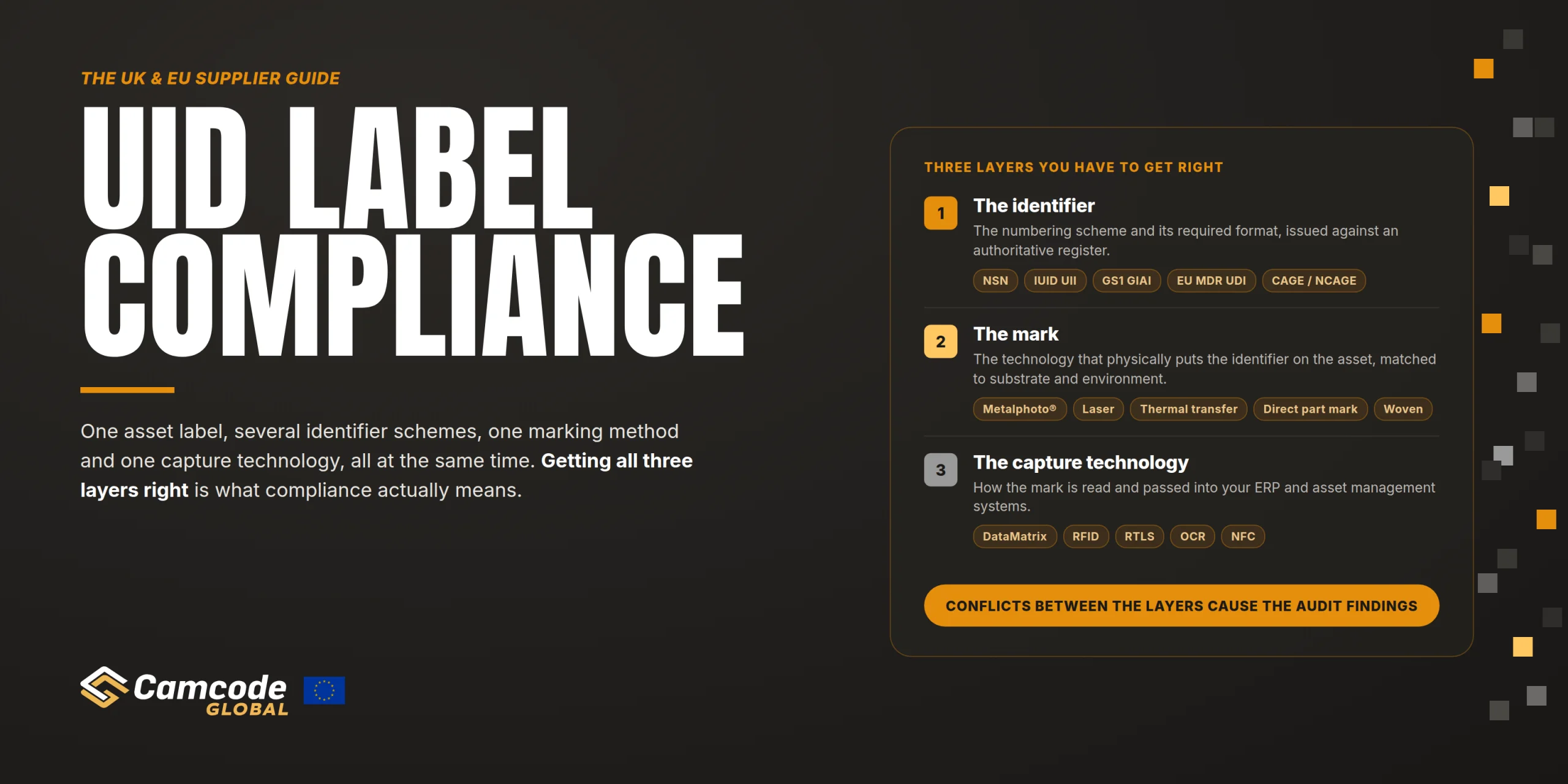
Achieving UID compliance depends on correctly aligning three distinct but interconnected layers:
1. The Identifier
The identifier is the unique data assigned to the asset. It must follow the required numbering scheme, syntax, data qualifiers, and formatting rules established by the applicable contract, customer, or defence standard.
2. The Physical Mark
The physical mark is how the identifier is permanently applied to the asset. This may include a durable barcode label, nameplate, data plate, laser mark, dot-peen mark, chemical etching, or another approved marking method. The selected solution must withstand the asset’s expected environmental, operational, and maintenance conditions.
3. The Capture Technology
The capture technology is how the identifier is read and transferred into the organization’s systems. Depending on the programme, this may include barcode scanners, RFID, NFC, mobile devices, or other automatic identification and data capture technologies integrated with ERP, maintenance, logistics, or asset-management platforms.
Camcode Global helps customers align all three layers. We assess the applicable requirements, validate the asset data, construct the correct identifier, select the appropriate marking solution, verify the finished mark, and support its integration and registration within the customer’s systems.
Identifier Types: What Goes Into the Label
Before a label, nameplate or tag can be produced, the required identifiers and data elements must be defined. These identifiers must align with the applicable policy, data standard, issuing authority and downstream system in which the asset will be managed.
In multinational defence programmes, a single asset may need to carry several identifiers to support codification, item-level traceability, ownership, maintenance, supply-chain management and interoperability across different national systems.
Common identifier types include:
NATO Stock Number (NSN):
A 13-digit supply classification identifier assigned through the NATO Codification System in accordance with STANAG 3150 and STANAG 3151. The NSN identifies a standardized item of supply, rather than an individual serialized asset, and is widely used throughout NATO and allied supply chains.
Unique Item Identifier (UII/IUID):
A globally unique, permanent identifier assigned to an individual item. IUID is used by the U.S. Department of Defense and is governed by requirements including DFARS 252.211-7003 and MIL-STD-130. Where required, the associated item data is registered in the DoD IUID Registry.
NATO UID:
An item-level identifier structured in accordance with STANAG 2290 and AUIDP-1. NATO UID supports the unique identification and lifecycle traceability of individual assets across participating NATO nations and systems.
GS1 Global Individual Asset Identifier (GIAI):
A globally unique asset identifier created using an organization’s GS1 Company Prefix. GIAI can support asset identification and interoperability across commercial, government, healthcare and defence supply chains.
GS1 Global Trade Item Number (GTIN):
An identifier used to identify products or trade items. A GTIN identifies the type of item being supplied and may be combined with a serial number to provide item-level identification.
UK Ministry of Defence Identifiers:
The UK MOD may use internal equipment, inventory and logistics identifiers alongside NSNs, serial numbers and UID data. The required identifier structure depends on the applicable Defence Standard, platform, contract and logistics information system.
Packaging may require identifiers such as the GS1 Serial Shipping Container Code, GTIN, lot number, batch number, expiration date or serial number. These identifiers support shipment visibility, packaging hierarchy and supply-chain traceability.
CAGE and NCAGE Codes:
CAGE and NCAGE codes identify the organization responsible for manufacturing, supplying or controlling an item. They are frequently used as enterprise identifiers within UID constructs and other defence identification schemes.
Internal or Proprietary Asset Identifiers:
Organizations may use their own asset identification structures when they maintain controlled allocation rules, prevent duplication and preserve a reliable, persistent record. These identifiers must also be compatible with the organization’s ERP, EAM, maintenance or asset-management systems.
Selecting the correct identifier is not simply a label-design decision. It requires an understanding of the asset, contractual requirements, applicable standards, issuing authority, authoritative registry and the systems that will consume and maintain the data.
Camcode Global helps organizations define the appropriate identifier structure, validate the underlying asset data, create compliant label formats and integrate the resulting identifiers into defence, logistics and enterprise asset-management systems.
Mark Types: How Camcode Global Physically Marks the Identifier
Selecting the correct identifier is only one part of achieving UID compliance. The identifier must also be applied to the asset using a marking method that remains readable and securely attached throughout the asset’s expected service life.
Camcode Global provides a range of permanent and durable marking solutions selected according to the asset’s material, surface condition, operating environment, lifecycle, production volume, attachment requirements and required data-capture technology.
Photosensitive Anodized Aluminum — Metalphoto®
Metalphoto® uses a photographic image sealed beneath the anodized surface of the aluminum. This creates a highly durable, sub-surface image that can withstand abrasion, chemicals, ultraviolet exposure, temperature changes and harsh operating environments.
Metalphoto is well suited to medium- and high-volume programmes and can be produced in various sizes, thicknesses, colors and attachment configurations.
Typical applications include:
Small arms and weapon ancillaries
Aircraft and aerospace components
Ships and marine equipment
Engines and mechanical components
Communications and electronic equipment
Crew-served and complex weapon systems
Nameplates, data plates and equipment identification plates
Assets exposed to chemicals, sunlight, abrasion or severe weather
Laser-Markable Label Materials
Laser-markable materials use a laser to create a permanent image within or on the surface of a specially designed label substrate. Available materials may include stainless steel, engineered polymers, acrylics and other laser-reactive constructions.
Laser marking is particularly valuable for decentralized or on-site operations because labels can be produced in real time. It is generally best suited to low- and medium-volume applications or situations requiring serialized labels to be produced at the point of use.
Typical applications include:
Small arms and weapon ancillaries
Aircraft and aerospace components
Engines and mechanical assemblies
Communications equipment
Complex weapon systems
Maintenance, repair and overhaul operations
On-site UID implementation programmes
Thermal-Transfer Labels
Thermal-transfer printing uses a ribbon to transfer the printed image onto a compatible label material. The durability of the finished label depends on the selected facestock, ribbon, adhesive, laminate and protective construction.
Thermal transfer is a flexible and cost-effective option for medium- and high-volume production. It can also support on-demand printing at depots, warehouses, hospitals, production facilities and field locations.
Typical applications include:
Soft and hard body armor
Medical and hospital equipment
General asset identification and tracking
Electronics and circuit-board identification
Warehouse and logistics operations
Packaging and shipment identification
Assets requiring real-time, on-site label production
Specialized high-temperature label constructions may also be used where the application requires resistance to elevated temperatures. The material must be individually validated against the asset’s actual temperature range and exposure duration.
Digitally Printed and Inkjet Labels
Digitally printed or inkjet-produced labels provide a flexible option for applications requiring variable data, color, graphics or moderate-to-high production volumes. Durability depends on the printing process, substrate, adhesive and any protective laminate or overcoat applied.
Typical applications include:
Soft and hard body armor
Ballistic and bump helmets
Medical equipment
General asset identification
Equipment branding and instructional labels
Packaging and logistics applications
Cut-Through, Stamped and Engraved Plates
Cut-through, mechanically engraved, stamped or CNC-produced plates create characters or openings directly within a metal plate. These methods can provide durable identification for large industrial assets but may offer limited data density compared with modern barcode and Data Matrix technologies.
The design must be carefully controlled because damaged, obstructed or poorly sized characters can affect readability.
Typical applications include:
Heavy equipment
Ships and marine assets
Vehicles and chassis
Industrial machinery
Large equipment identification plates
Woven and Printed Fabric Tags
Fabric tags are designed for textile-based assets where rigid labels or metal plates cannot be applied. They may be woven, printed, heat-sealed or sewn directly onto the asset.
The tag construction and attachment method must be selected according to expected laundering, abrasion, chemical exposure, temperature and handling conditions
Typical applications include:
Parachutes
Military apparel
Webbing and load-bearing equipment
Soft armor and textile carriers
Bags, covers and other fabric-based assets
Direct Part Marking
Direct Part Marking, or DPM, applies the identifier directly to the asset rather than using a separate label or plate. Common methods include laser etching, laser engraving, dot peen, chemical etching and other controlled marking processes.
DPM is appropriate where a separate label cannot be securely attached or where the identifier must remain with the component throughout its lifecycle. The marking process must be assessed carefully to ensure it does not damage the part, alter its performance or affect applicable certifications.
Data Matrix marks created through DPM may be verified using the grading principles established in ISO/IEC 29158.
Typical applications include:
Aircraft and aerospace components
Surgical and medical instruments
Bridging and engineering equipment
Metal components exposed to chemicals or abrasion
Components for which an attached label is unsuitable
High-value serialized parts
RFID- and NFC-Enabled Tags
RFID and NFC are data-carrier technologies rather than physical marking methods by themselves. They can be incorporated into a label, tag, nameplate or other identification product and used alongside a human-readable identifier or machine-readable barcode.
NFC is a short-range form of radio-frequency identification that can often be read using compatible smartphones and tablets. RFID technologies can support longer read ranges, bulk inventory activities and automated asset visibility, depending on the selected frequency and system configuration.
Typical applications include:
Communications and electronic equipment
Medical and hospital assets
Tools and test equipment
Inventory and maintenance operations
General asset tracking
Applications requiring access to digital records or instructions
Selecting the Correct Marking Method
The asset’s operating environment and surface condition must be evaluated before a marking technology is selected. Important factors include:
Asset substrate and surface finish
Temperature range and exposure duration
Chemicals, fuels, oils and cleaning agents
Ultraviolet exposure and weather conditions
Abrasion, impact and handling
Available marking area
Required service life
Attachment method
Barcode, RFID or NFC reading requirements
Production volume and point-of-use needs
Applicable defence, industry and customer standards
Using an incompatible material, adhesive or marking method is a common cause of premature label failure and unreadable identifiers.
Camcode Global evaluates the complete application—including the asset, environment, identifier structure, marking material, attachment method and capture technology—to provide an identification solution that remains usable throughout the asset’s operational lifecycle.
Automatic Identification and Data Capture Technologies Camcode Global Deploys
A durable label or direct part mark is only useful when its data can be captured accurately and transferred into the systems that manage the asset.
Automatic Identification and Data Capture, or AIDC, technologies form the capture layer of Camcode Global’s asset identification solutions. These technologies read the identifier, reduce manual data entry and connect physical assets with records maintained in SAP, ERP, EAM, inventory, maintenance and logistics systems.
Camcode Global selects and deploys the appropriate technology based on the required read range, asset environment, data volume, system architecture, security requirements and operational workflow.
Linear and Two-Dimensional Barcodes
Barcodes provide a reliable and cost-effective method of capturing asset, item, packaging and shipment information.
Camcode Global supports linear and two-dimensional symbologies, including Code 39, Code 128, GS1-128, QR Code, PDF417 and Data Matrix. The selected symbology can encode identifiers and data elements such as a UII, serial number, NSN, GTIN, GIAI, SSCC, lot number or production information.
Data Matrix is commonly used for defence UID applications because it can encode significant amounts of data in a small area and can be applied through either a label or Direct Part Marking.
Typical applications include:
Item Unique Identification and serialization
NATO and national defence asset identification
Packaging and shipment identification
Maintenance and repair processes
Warehouse and inventory management
Medical device and healthcare identification
Tool, equipment and component tracking
Passive RFID
Passive RFID tags do not require an internal power source. They receive energy from an RFID reader and transmit the encoded information back to the system.
Passive RFID is appropriate when assets must be identified without direct line of sight, when multiple items need to be captured simultaneously or when barcode scanning would be inefficient.
Different RFID technologies and frequencies may be selected depending on the asset, material, operating environment and required read range.
Typical applications include:
Warehouse inventory
Tool and equipment accountability
Arms-room and controlled-inventory management
Asset issue and return processes
Supply-chain and shipment visibility
Medical and hospital equipment tracking
Active RFID
Active RFID tags contain their own power source and can transmit over longer distances than passive RFID tags. They are generally used for higher-value assets, containers, vehicles or equipment that must be detected across a larger area.
Active RFID may also support sensor information, location events and automated entry or exit records.
Typical applications include:
Containers and transport assets
Vehicles and mobile equipment
High-value defence assets
Yard, depot and facility tracking
In-transit visibility
Automated perimeter and gateway monitoring
Real-Time Location Systems
Real-Time Location Systems, or RTLS, provide ongoing visibility into the location and movement of assets within a defined environment.
Depending on the application, RTLS solutions may use active RFID, Bluetooth Low Energy, ultra-wideband, Wi-Fi or other technologies. The appropriate technology depends on the required accuracy, facility layout, asset value and operational need.
Typical applications include:
Frequently moved tools and equipment
Hospital and medical assets
Maintenance, repair and overhaul facilities
Warehouses and distribution centers
High-value or mission-critical equipment
Production and work-in-progress tracking
Optical Character Recognition
Optical Character Recognition, or OCR, converts printed, stamped or engraved characters into structured digital data.
Camcode Global can use OCR as part of asset data capture and cleansing programmes to reduce manual transcription and accelerate the collection of part numbers, serial numbers, manufacturer information and other asset attributes.
OCR results must be validated because worn plates, damaged marks, inconsistent formatting and similar characters can create recognition errors.
Typical applications include:
Asset surveys and physical inventories
Data cleansing and enrichment
Legacy nameplate and data-plate capture
Part-number and serial-number collection
SAP and ERP record validation
Migration from legacy asset-management systems
GPS and GNSS Asset Tracking
GPS and other Global Navigation Satellite System technologies can be combined with cellular, satellite or radio communications to track assets moving between facilities, regions or countries.
These technologies are most appropriate for mobile assets that operate outside controlled facilities and require location updates over a wide geographic area.
Typical applications include:
Vehicles and mobile platforms
Containers and transport equipment
Deployable systems
International shipments
High-value assets moving between sites
Supply-chain and in-transit visibility
NFC-Enabled Asset Identification
Near Field Communication, or NFC, is a short-range RFID technology that can often be read using compatible smartphones and tablets.
NFC can be incorporated into an asset label or tag to provide access to equipment records, maintenance instructions, inspection forms, digital manuals or other authorized information.
Typical applications include:
Maintenance and inspection workflows
Medical and communications equipment
Tools and test equipment
Access to digital asset records
Field-service applications
Equipment authentication
Smart Cards, Credentials and Identity-Based Technologies
Smart cards and other electronic credentials can connect an asset transaction to the individual performing it. They may be used to control access, record equipment issue and return, or establish accountability for sensitive assets.
Biometric technologies may also be integrated where an organization requires a higher level of identity verification. Their use depends on the customer’s security, privacy and information-assurance requirements.
Typical applications include:
Controlled equipment issue and return
Arms-room accountability
Tool-control programmes
Restricted inventory access
Operator authorization
Sensitive asset transactions
Sensor-Enabled Asset Monitoring
Sensors can collect information about an asset’s condition and operating environment. Depending on the application, sensors may monitor temperature, humidity, shock, vibration, pressure, movement or other conditions.
Sensor data can be associated with the asset’s unique identifier to create a more complete lifecycle and condition history.
Typical applications include:
Temperature-sensitive materials
Medical and pharmaceutical equipment
Shock-sensitive components
Ammunition and controlled inventory
Storage and transportation monitoring
Predictive maintenance programmes
Electronic Article Surveillance
Electronic Article Surveillance, or EAS, can provide theft deterrence and perimeter monitoring for controlled, sensitive or high-value inventory.
EAS is generally used as a security control rather than as a complete asset-identification solution. Where required, it can be incorporated alongside UID, barcode, RFID or inventory-management technologies.
Connecting the Physical Asset to Enterprise Systems
Camcode Global does more than supply scanners, labels or tags. We evaluate the complete asset-identification workflow, including:
The identifier and required data structure
The physical label, tag or direct mark
The barcode, RFID or other data carrier
The reader, scanner or mobile device
Data validation and business rules
Integration with SAP, ERP, EAM and logistics systems
Reporting, analytics and asset-visibility requirements
By combining the correct identifier, durable marking method and appropriate capture technology, Camcode Global helps defence and industrial organizations improve data accuracy, reduce manual processes and maintain asset visibility from procurement and receipt through maintenance, deployment and disposal.
What Each Identification Scheme Requires
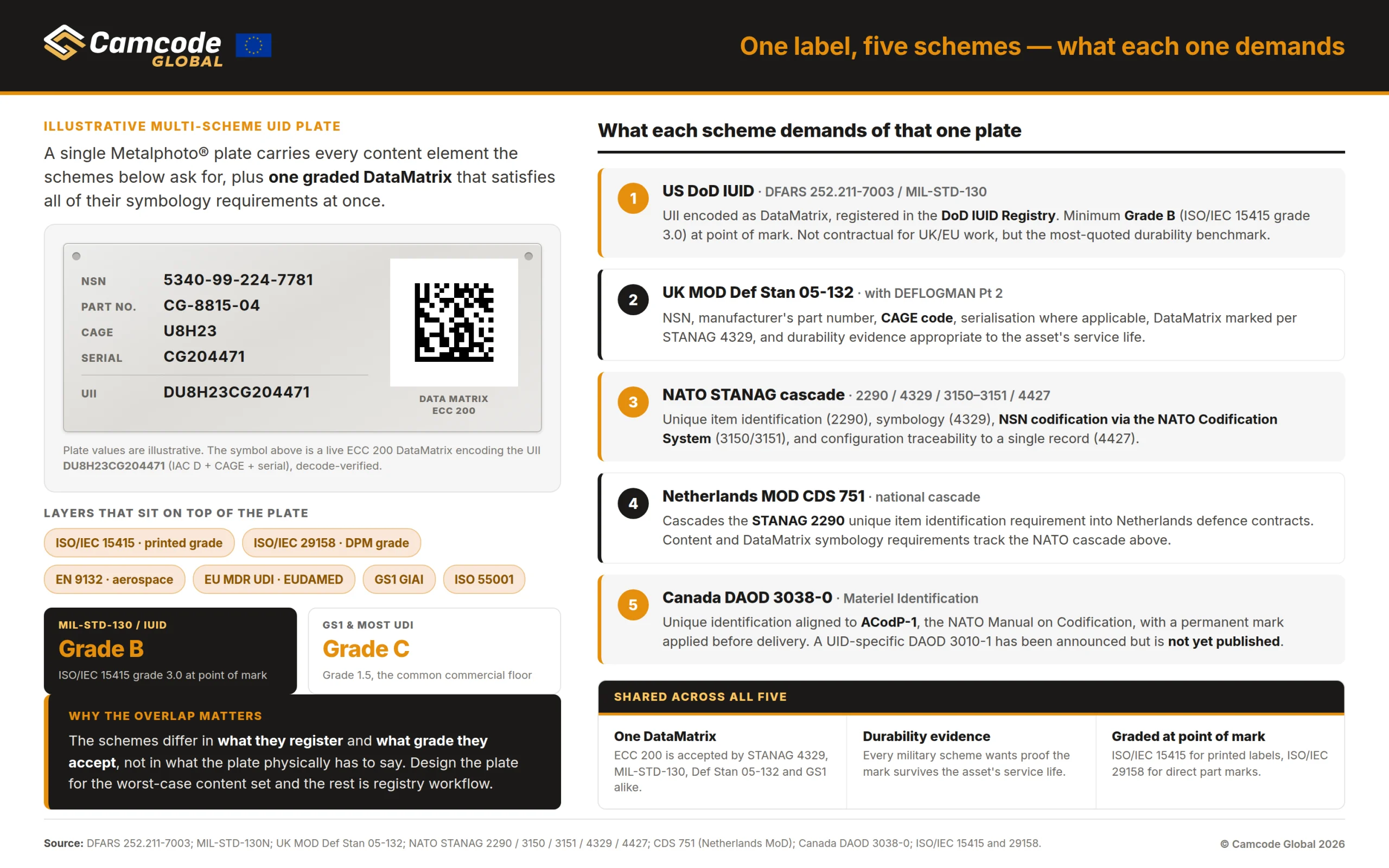
UK and European suppliers may need to produce a single label, nameplate or direct part mark that satisfies several national, NATO, customer and industry requirements at the same time.
Although many schemes use similar technologies, each one may define different requirements for the identifier structure, encoded data, marking method, symbol quality, durability, verification and registry submission.
U.S. Department of Defense IUID
U.S. DoD Item Unique Identification requires a globally unique Unique Item Identifier, or UII, to be assigned to an individual item.
The UII is typically encoded in a Data Matrix symbol in accordance with MIL-STD-130 and the applicable contract requirements. Items meeting the reporting criteria must also have their associated data submitted to the DoD IUID Registry.
Requirements may include:
A compliant UII construct
Human-readable and machine-readable information
Data Matrix marking
Verification of symbol quality
A marking method suitable for the item’s operating environment and expected service life
Submission to the DoD IUID Registry, where contractually required
Printed Data Matrix symbols are generally verified using ISO/IEC 15415, while Direct Part Marks are evaluated using ISO/IEC 29158. The required acceptance grade should be confirmed against the applicable revision of MIL-STD-130 and the contract.
UK MOD Defence Standard 05-132
Defence Standard 05-132 establishes requirements for the identification marking of UK defence materiel.
Depending on the equipment, contract and marking category, the required information may include:
NATO Stock Number
Manufacturer’s part number
Serial number, where applicable
Manufacturer or enterprise identifier, such as a CAGE or NCAGE code
Contract, date or other lifecycle information
Human-readable text
Machine-readable data, where required
The marking material and attachment method must remain suitable for the asset’s expected lifecycle and operating environment. Additional requirements may be imposed through the contract, equipment specification or supporting MOD policy.
NATO Identification Requirements
NATO asset identification may involve several related standards and publications rather than one standalone requirement.
The applicable framework may include:
STANAG 3150 and STANAG 3151: NATO codification and the assignment of NATO Stock Numbers
STANAG 2290: Unique identification of individual items
STANAG 4329: Machine-readable marking and data-carrier requirements
Applicable lifecycle and configuration-management standards: Requirements for maintaining traceability between the physical asset, its configuration and its authoritative data record
A NATO Stock Number identifies a standardized item of supply. A UID identifies a specific serialized item. Both may therefore appear on the same label or nameplate because they serve different purposes.
Netherlands Ministry of Defence CDS-751
CDS-751 defines identification and marking requirements used within Netherlands Ministry of Defence procurement and asset-management activities.
Depending on the contract and asset category, it may require:
NATO Stock Number and item-master information
Part and serial numbers
Manufacturer or enterprise identifiers
NATO UID data structured in accordance with STANAG 2290
Human-readable and machine-readable information
Data Matrix marking
Durable marking appropriate for the asset and environment
Suppliers must evaluate the specific CDS-751 contractual requirements rather than assuming that every asset requires the same label content or construction.
Canadian Department of National Defence Requirements
Canadian defence materiel identification requirements are supported by DAOD 3038-0, NATO Codification System policies, departmental instructions and contract-specific marking requirements.
Depending on the programme, the required solution may include:
NATO Stock Number
Part and serial numbers
Manufacturer identification
Item-level unique identification
Human-readable and machine-readable data
Permanent marking applied before delivery
Data compatible with Canadian inventory, maintenance and materiel-management systems
The required identifier, data structure and marking method should be confirmed against the contract and applicable Department of National Defence technical instructions.
Aerospace Data Matrix Marking — EN 9132
EN 9132 supports Data Matrix marking of aerospace parts and assemblies.
It defines requirements for applying and evaluating machine-readable marks on aerospace components. The standard may be used alongside customer drawings, engineering specifications, AS/EN quality-management requirements and part-specific marking instructions.
Requirements may include:
Defined Data Matrix content
Approved marking location
Specified symbol size and cell dimensions
Verification of symbol quality
Control of the marking process
Confirmation that the mark does not affect the component’s form, fit, function or structural integrity
EU Medical Device Regulation UDI
The EU Medical Device Regulation requires applicable medical devices and packaging levels to carry a Unique Device Identifier.
UDI is generally composed of:
UDI-DI: The Device Identifier identifying the device model or version
UDI-PI: Production information such as the serial number, lot number, manufacturing date or expiry date
The information may be encoded using an approved issuing entity’s data structure and barcode symbology. GS1 Data Matrix is one common implementation, but GS1 is not the only recognized issuing framework.
UDI data must also be maintained and submitted to the applicable regulatory database in accordance with the device classification and implementation schedule.
EU Falsified Medicines Directive
The Falsified Medicines Directive requires applicable prescription medicines to carry safety features at the individual pack level.
The two-dimensional symbol generally contains:
Product code
Unique serial number
Batch or lot number
Expiry date
National reimbursement information, where required
The pack identifier is verified against the applicable national medicines verification system connected to the wider European verification network.
An internally controlled individual asset reference
The issuing organization is responsible for ensuring that the identifier is unique and is not reassigned. The GIAI may be encoded in an appropriate GS1 data carrier, including GS1 Data Matrix, GS1 QR Code, GS1-128 or RFID, depending on the application and system requirements.
The Practical Takeaway
Data Matrix is widely used across defence, aerospace, healthcare and regulated supply chains because it can encode a significant amount of information within a small marking area.
However, using a Data Matrix symbol does not by itself make a label compliant.
Compliance depends on the complete solution:
Correct identifier structure
Correct data syntax and data identifiers
Approved barcode or data-carrier symbology
Suitable label, nameplate or Direct Part Marking method
Verified symbol quality
Environmental and lifecycle durability
Registration with an authoritative registry, where required
Accurate integration with the customer’s ERP, asset-management or regulatory system
Registry submission is commonly required for programmes such as U.S. DoD IUID, EU medical-device UDI and pharmaceutical serialization. Other schemes may rely on national codification systems, customer asset registers or the issuing organization’s own controlled database.
Camcode Global evaluates the complete set of contractual, national and industry requirements before defining the label content, identifier structure, marking technology and data-capture process. This allows one identification solution to support multiple schemes without creating duplicate, conflicting or unusable asset data.
Designing a Single Label for Multiple Schemes
Here’s a practical design approach for UK and European suppliers working multi-scheme programmes:
1. Pre-plan plate real estate for the worst case. A UID label that can fit NSN, manufacturer’s part number, CAGE, serial, IUID UII, GS1 GIAI, EU UDI content and human-readable equivalents will meet requirements for nearly every UID compliance scheme.
2. Select mark type to fit substrate and environment. Metalphoto® anodised aluminium for long-life outdoor and serialised work; thermal transfer or ink jet for high-volume soft goods; DPM where labeling with a UID sticker isn’t possible; NFC or RFID where line-of-sight scanning is impractical.
3. Format machine-readable content as DataMatrix. This conforms to every standard: STANAG 4329, MIL-STD-130, Def Stan 05-132, CDS 751, EN 9132, DAOD 3038-0, EU MDR UDI, GS1 General Specifications, etc.
4. Grade and assess every mark at the point of application. ISO/IEC 15415 (printed) or ISO/IEC TR 29158 (DPM) to the level required by each scheme: Grade B (3.0) for MIL-STD-130/IUID, Grade C (1.5) for GS1 and most UDI contexts.
5. Augment with appropriate AIT capture technology. Barcode/DataMatrix scanning for discrete point-of-use reads; RFID or RTLS if you need distance or bulk-read capability; OCR if you need to digitise legacy serials.
6. Document your registry submission workflow. Any scheme that requires data registry (IUID Registry, EUDAMED, UK MHRA UDI, FMD national hubs) should have its own defined submission step built into your supplier quality system.
Where UID Label Compliance Programmes Fail
Through working with suppliers across UK and Europe, we’ve noticed some common failure patterns including:
1. Content shortcuts. Trying to create a label that meets the requirements for two schemes but doesn’t contain all of the necessary content for both (i.e., NSN-only marking that doesn’t meet IUID standards or vice versa).
2. Substrate or mark type not suited to the asset’s lifecycle. A premium polyester label on an outdoor industrial asset may be compliant at the point of mark but fail within five years.
3. Symbology grade not verified. A DataMatrix that looks good but doesn’t hit the minimum grade requirement and causes decode failures downstream.
4. Registry gaps. The label exists and the mark is present, but the associated IUID Registry, EUDAMED, or UDI record is incomplete or missing.
5. Capture technology mismatch. Specifying RFID or NFC without validating that the receiving site has readers capable of leveraging that tech, or expecting 1D scanners to read 2D DataMatrix content.
6. Re-identification not propagated. The asset gets a configuration change, but the mark and/or registry aren’t updated to reflect that change.
Early-life (within the first few years of service) label or tag failure is one of the leading root causes of identification-related audit observations. Therefore, selecting the correct mark-type is just as critical as the identifier content itself.
Camcode Global’s Seven-Step Data Cleansing, Asset Identification, and Data Optimisation Process
A sustainable UID label compliance program does not begin and end with label design. In fact it’s a repeatable process. That’s why Camcode Global has created a comprehensive seven-step process. Our process has been developed through years of working with NATO defence customers on interoperability and in-transit visibility projects and guarantees compliance with NATO STANAGs from your very first consultation through lifecycle management. See The Framework for details on each stage of the process and The Results for examples of the defence, infrastructure and manufacturing organisations that have already benefited.
Step 1: Asset Identification and AIT Engagement
After determining the scope of your project, our experts will recommend how you can adapt your processes to meet applicable standards/frameworks, better utilise assets, streamline processes to be efficient and compliant, leverage technology and automation, and improve your asset supply chain management.
Step 2: Engineering Services
Our engineering team creates the marking specification, sometimes referred to as a factsheet, that outlines how an identified asset will be marked, both from a data perspective and physical marking. Once field verification of sample assets is complete, business rules and data governance are determined, and the appropriate physical mark type is selected from the numerous mark-types available.
Step 3: Data Remediation, Reconciliation and Verification
Camcode Global’s proprietary offline and online data capture software ensures compliance with standards and frameworks, simplifies and optimises processes to reduce human error, allows for integrations with existing databases and produces detailed reports and analytics.
Step 4: AIT Product Manufacture and Procurement
AIT products can range from barcodes (1D, 2D, QR Codes, GTIN, SSCC, UDI), RFID, Sensors, GPS, Optical Character Recognition, RTLS, NFC, EAS, Biometrics or other technology determined by the data and specifications created during step two above.
Step 5: Installation
Our NATO Security Cleared installation teams will install the AIT product following marking spec/factsheet directions, and our in-house software associates the correct data with the product to be installed on the appropriate asset. All installations are done in compliance with regulations and NATO standards.
Step 6: Reporting and Migration of Data
Now that your product is marked, customizable reporting allows you to review critical business operations. Quickly identify discrepancies and experience simplified data management. Gain best-in-class master data quality, spend less time reconciling data and continue to streamline your processes.
Step 7: Asset Life Cycle Management Advisory (ALCMA)
KPMG’s Asset Life Cycle Management Advisory (ALCMA) solutions support you in managing assets from planning and acquisition all the way through maintenance, optimisation and disposal, with an emphasis on improving asset performance, lowering costs and meeting industry standards and regulations such as ISO 55001.
A Compliance Workflow That Holds Up at Audit
UK and European suppliers can follow this outline of a defensible UID label compliance workflow, built on Camcode Global’s seven-step process:
Define and list every UID compliance scheme cascaded by the contract.
Identify where content overlaps occur (NSN works for UK MOD, NATO and most allies; CAGE/NCAGE applies to manufacturer identification globally across schemes).
Select the mark type and substrate to fit the entire set of content and operate reliably on the asset throughout its lifecycle.
Format your label template to reserve space for every element of content you’ll need to populate.
Set up variable-data printing to populate every element from one authoritative production record.
Grade every applied mark with an ISO/IEC 15415 or 29158 verifier.
Select the appropriate AIT capture technology for identifying your assets in the field.
Submit every required registry record before or at the same time as despatch.
Retain per-item grading and registry evidence in the supplier’s quality record.
Build a re-identification trigger that updates label, registry and configuration records to re-identify assets.
Frequently Asked Questions
Can one Metalphoto® plate be used for IUID, Def Stan 05-132 and DAOD 3038-0 compliance?
Yes, if designed with the content properly laid out. A plate which includes NSN, manufacturer’s part number, CAGE/NCAGE, serial, IUID UII and a graded DataMatrix will normally meet all three standards.
Do all UID compliance schemes require a registered identifier?
No. IUID, EU MDR UDI and EU FMD are registry submission schemes. UK MOD NSN-based marking doesn’t require a separate UID-style registry to run in parallel; the act of allocating an NSN covers this requirement.
What grading threshold should we target?
For MIL-STD-130/IUID, Grade B (ISO/IEC 15415 grade 3.0) at time of mark. Grade C (grade 1.5) is the most common minimum acceptance level for GS1 and many UDI and commercial use cases. Higher grades allow for more scanning tolerance as marks age.
How do we achieve UID compliance for refurbished parts?
Using direct part marking (laser etch or dot peen DataMatrix), graded to ISO/IEC 29158. The mark will persist on the part through multiple overhauls. The registry record would be changed to reflect each change in configuration.
Does GS1 compliance cascade into defence UID work?
GS1 GIAI is becoming more widely accepted as a valid identifier alongside NSN in UK and EU government commercial contract templates. For defence-specific work (Def Stan, MIL-STD, DAOD, STANAG), NSN-based schemes will remain the dominant form of identification; GS1 is used where there is a requirement for crossover with civilian industry.
How Camcode Global Supports UID Label Compliance
Camcode Global manufactures Metalphoto® plates, premium polyester labels, thermal transfer and ink jet labels, cut-through plates, woven fabric tags, NFC tags, and direct part marking outputs carrying UID-compliant content for UK and European defence, aerospace, healthcare, and government customers. Our AIT capability spans barcodes and QR codes, passive and active RFID, RTLS, OCR, GPS tags, biometrics and smart cards, sensor technology, and electronic article surveillance, all integrated with your ERP systems through our proprietary data cleansing and reporting software.
As a NATO-approved provider for over 12 years and holder of a NATO Support and Procurement Agency (NSPA) Enabling Contract, we routinely design multi-content labels that satisfy IUID, Def Stan 05-132, CDS 751, STANAG cascades, EN 9132, DAOD 3038-0, EU MDR UDI, EU FMD, and GS1 schemes on a single substrate, delivered through our seven-step Data Cleansing, Asset Identification, and Data Optimisation Process, with Asset Life Cycle Management Advisory provided by KPMG.
Meet the marking and governance requirements of standards such as CDS-751, DEF STAN 05-132, MIL-STD-130, DEF(AUST) 1000C, and DAOD 3038-0 with a fully integrated, all-in-one mobile laser marking cart solution. Produce and mark assets on-site after data has been verified — ensuring:
Small-run, on-demand UID production
Durable, permanent 2D Data Matrix marking
Alignment with SAP S/4HANA data governance
Elimination of external lead times UID mark verification
Thank You
We have received your request. We will reach out to you soon.