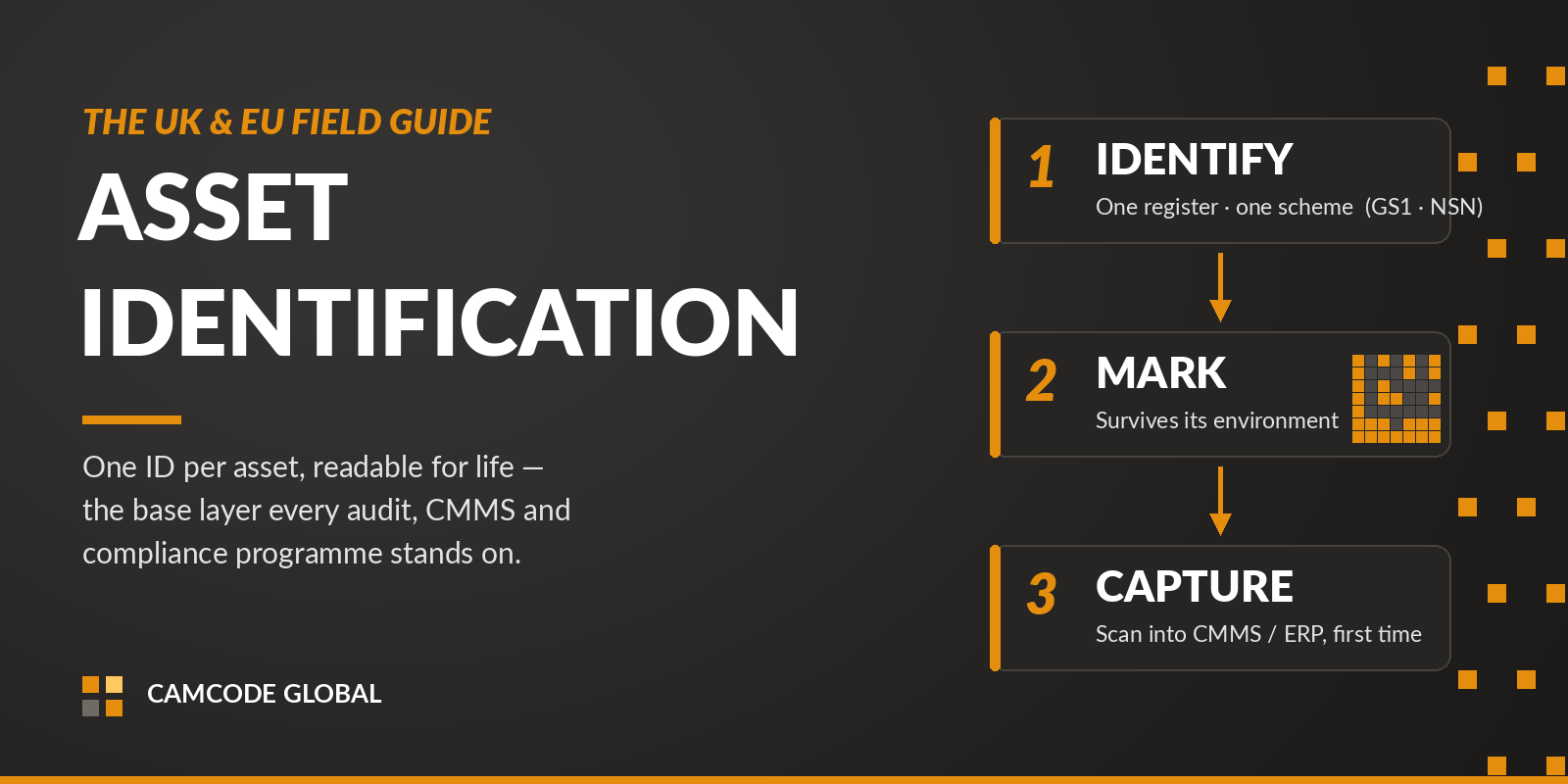
A weak foundation underpins the management of the UK’s built environment. SFG20’s 2026 State of Facilities Management Report found that 85% of facilities management organisations did not have an accurate asset register. 38% of respondents either never update their asset register, or aren’t aware of how often it is updated, and almost 10% of organisations do not have one at all. Asset identification, if done properly, bridges that gap.
Asset identification is the practice of assigning every tangible asset that is important to your business a unique machine-readable identifier, then maintaining the readability of that identifier for the lifetime of the asset. We believe it should be considered the base layer upon which any tracking, maintenance, audit or compliance initiative is built. Get your asset identification right, and every downstream process/tool (CMMS data, calibration records, ISO 55001 audits, MoD asset registers) will produce quality information you can trust. When the identity is mishandled, even superior software will inevitably produce flawed results.
In this guide, we’ll discuss how asset identification works on the ground, the standards UK and EU teams should be aware of, the decisions that will affect how long your labels last and the top questions we receive from procurement, facilities and defence-supply professionals.
 CAMCODE GLOBAL
Self-assessment
Asset identification readiness checklist
Which label material fits your environment?
How this is calculated & sources used
Checklist compiled from ISO 55001 requirements, UK / EU defence and regulatory marking standards, and Camcode Global’s UK / EU client onboarding experience. Tiering reflects what audit findings most commonly flag.
Sources actually used:
• BS ISO 55001:2024 — Asset management system requirements (second edition, July 2024)
• ISO/IEC 29158:2020 — Direct Part Mark quality guideline
• STANAG 4427 — Configuration management / STANAG 4329 — NATO bar code symbologies
• Def Stan 05-132 — Marking of Service Materiel using a UII
• EU MDR 2017/745 (UDI) / Falsified Medicines Directive 2011/62/EU
• Metalphoto® — 20+ year expected exterior life
What Asset Identification Actually Means
In its simplest form asset identification is a durable, unique identifier (the ID) that is permanently affixed to the physical object in a machine-readable form. The ID may be a 2D barcode label, a linear barcode label, an RFID tag, a directly marked DataMatrix code or a human-readable serial number. The method of attachment to the asset can be a metal photo label, an anodised aluminium plate, a polyester label or a laser etch right into the part itself.
What distinguishes true asset identification from a sticker with a number on it is that the identification is managed: it is issued against a register, it is unique within that of the chosen issuing entity’s scope and it persists throughout the working life of the asset. British Standards Institution’s BS ISO 55001: 2014 (Asset Management) considers unique identification a requirement for the rest of the management system to work.
Where Asset Identification Sits in UK and EU Compliance
Regulations or industry standards that demand unique identification include:
- NATO assets: The basis for all NATO UID marking is STANAG 2290 (NATO Unique Identification of Items), which specifies how the Unique Item Identifier (UII) is built, and how items are marked with it. National UID standards such as the UK’s Def Stan 05-132 are built on top of it. It is used in conjunction with STANAG 4427 (Allied Configuration Management Documentation) and STANAG 4329 (NATO Bar Code Symbology): serialized assets transiting alliance supply chains must be marked with UID.
- Netherlands Ministry of Defence: CDS 751 is the UID policy of the Netherlands Ministry of Defence (MoD). It establishes guidelines for uniquely identifying defence equipment, such as ballistics plates.
- UK Ministry of Defence Logistics:Def Stan 05-132 defines marking requirements for all contract defence equipment supplied to UK MOD.
- Aerospace and rail: EN 9132 (DataMatrix marking for aerospace) and EN 15380-2 (rail vehicle structuring) prescribe identification schemes for safety-critical components.
- Medical devices sold in Europe: EU Medical Device Regulation 2017/745 encompasses UDI as a requirement for device identification throughout the European Union. This is an EU requirement only, distinct from the US Food and Drug Administration's UDI rule though it is similar in concept (FDA's UDI rule is a separate requirement that only applies in the US). They are not mutually compliant: complying with EU MDR means registering your devices in the EU's EUDAMED database, while complying with US FDA UDI means registering your devices in the FDA's GUDID database.
- Pharmaceuticals: EU Falsified Medicines Directive (2011/62/EU) requires GS1 DataMatrix applied to singular pack-level identifiers.
If your organization operates within any of these sectors, or others like them, asset identification is no longer optional but a firm regulatory mandate that may be subject to audit.
The Three Layers of an Asset Identification Programme
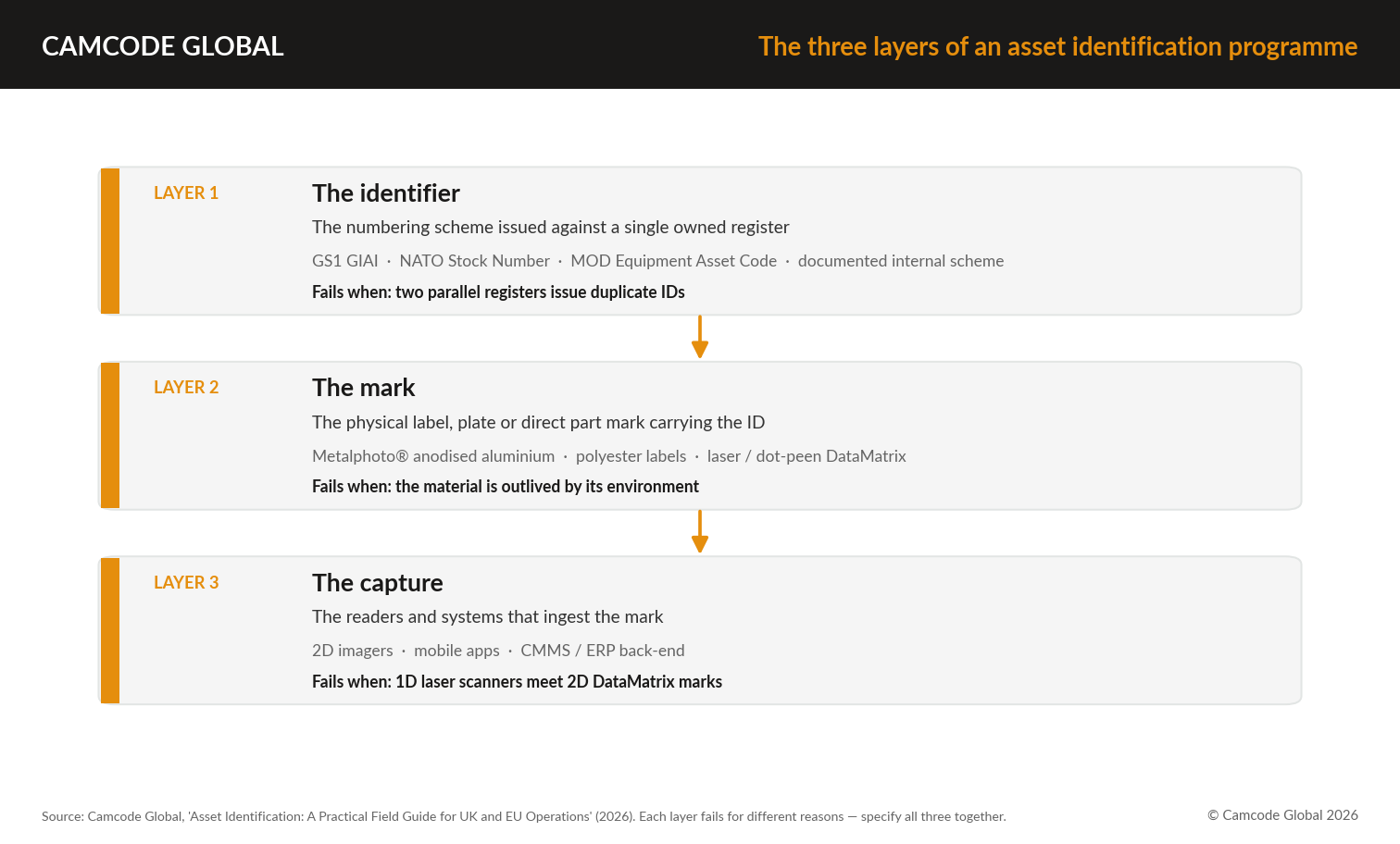
We categorize identification into three layers because each layer can fail due to different circumstances.
Layer 1: The identifier. The numbering scheme itself. Is it an Item Unique Identification (IUID) number, Unique Device Identification (UDI) number, Unique Identifier (UID), GS1 GIAI (Global Individual Asset Identifier), NATO Stock Number, a MOD (Ministry of Defence) Equipment Asset Code, an internal asset code or something else? It’s important the scheme chosen fits in with how the data will be consumed downstream. For example, increasing numbers of UK government departments will require GS1-standard identifiers to comply with the Department of Health and Social Care’s Scan4Safety programme or the Cabinet Office’s commercial templates.
Layer 2: The mark. This layer includes technologies used for surface marking the physical label, plate, or direct part marking (DPM). Metalphoto® anodised aluminium labels, polyester labels and laser-etched DataMatrix all fall under this category. Your best choice will depend on the substrate material you are using, temperature range it will be subjected to, any chemical exposure and desired service life, as well as whether you’re repairing or refurbishing the part.
Layer 3: Capture, registration and integration. After an asset has been marked, capturing that identifier in the field is the next step. Capture is everything that occurs moving forward through the asset’s lifespan. Scanners, mobile apps, fixed readers, and backend systems that field personnel, technicians, and auditors utilise to scan the mark on a day-to-day basis. DataMatrix will fail 100% of the time when scanned with a 1D laser scanner, because it’s incapable of reading 2D symbols. Accuracy of scanning will decrease, even when using known compatible hardware/software pairings, in realistic settings (low light, damaged labels, skewed angles) based on Scandit's recommendations for enterprise scanning tests. That performance gap widens when hardware and labels are selected in isolation of one another. Defining both the data hand-off format and the capture environment upfront is how you prevent integration rework and read misses that can't be resolved by label quality alone.
Once assets are marked, most programmes require the output ID and asset information to be compiled into a UID/IUID registration file. Some government programmes also require the unique identifier and associated asset data to be submitted to a government UID registry as part of the acceptance process.
Usually delivered as a formatted flat file (e.g., Excel, CSV), this file lists the unique identifier and associated asset data for import into whatever CMMS or EAM the organisation utilises, such as SAP, Oracle, or IBM Maximo. That’s the one-time integration to populate the customer’s system of record.
Selecting the Appropriate Label Material
Failures and successes in asset identification programmes often come down to material selection. Here’s a simple framework we go through with our UK and EU customers:
- Office equipment that spends all its life indoors, or IT equipment that will be replaced within 12-24 months: self-adhesive polyester labels, with permanent adhesive. Usually issued with a tamper-evident overlay.
- Warehouse equipment and logistics assets: polyester or vinyl labels. With cold-temp adhesive if the asset will regularly move between ambient temperatures and refrigerated storage rooms.
- Industrial machinery, outdoor Mobile Elevating Work Platforms (MEWPs), scaffolding, etc.: Metalphoto® laser engraved anodised aluminium tags. These conform to a military standard (MIL-STD-130) of 20+ years’ service life when exposed to the outdoor environment. Note: MIL-STD-130 is a US Military specification. UK and EU purchasers will not ask for MIL-STD-130 itself but the proof of durability that MIL-STD-130 requires is often used to demonstrate compliance with the closest UK/ EU equivalent standards, primarily Def Stan 05-132, Netherlands MoD policy CDS 751, and NATO STANAG 2290 (as adopted through EN 9132). Military, aerospace, rail and energy specifications typically ask for this lifespan.
- Defence and aerospace serialised assets: Metalphoto® labels or direct part marking (dot peen or laser), encoding a DataMatrix symbol which complies with Def Stan 05-132, STANAG 2290, STANAG 4329, and, where applicable, Netherlands MoD policy CDS 751.
- Returnable transit items (kegs, gas bottles, cages, etc.): chemically resistant anodised aluminium labels or direct-marked barcodes, or surface mounted UHF RFID hard tags.
The purchase price of a Metalphoto® label (£2-£6 typically) is a one-off expense. A cheap polyester or polycarbonate label that fails after three to five years in a harsh environment incurs more than just the cost of a replacement label. Consideration must also be given to the labour involved to find the asset, remove the old label and apply and register the new one. In reality, this costs many times the price of the label itself. Specifying correctly from the start is far cheaper over any asset’s working life.
Choosing the Right Automatic Identification Technology (AIT)
Selecting the right automatic identification technology (AIT) comes down to one fundamental requirement: whatever identifier is chosen must remain readable throughout the life of the asset and satisfy all environmental, operational and contractual needs of the programme. Substrate, desired service life, production volumes, operating environment, approval needs and how the asset will be identified in the field are just some of the factors that will affect your decision.
Applied labels or nameplates are often the most practical and economical option. Where labels are not suited to the operating environment, then another option may be required, such as applying the identifier directly to the component.
Laser-etched and dot-peen marks are typical forms of DataMatrix direct part marking (DPM). ISO/IEC TR 29158 (formerly AIM DPM-1-2006) standardizes laser and dot-peened marks, and defines the grading scale for readability used by UK MOD programmes and European aerospace and defence OEMs.
Stamp (ink) marking is another option for direct part marking offered by Camcode Global. When the material, thickness and operating environment allow, stamp marking can be a faster and more economical alternative to laser etching or dot-peen. It's ideal for aerospace applications because, like laser etching, an ink mark (as opposed to an attached label or nameplate) typically does not require the additional airworthiness approval necessary for items physically attached to an aircraft.
Direct part marking is not always appropriate. Verification can be difficult, the equipment required for marking is expensive and some substrates such as heat treated steel and coated aluminium alloys cannot be reliably marked without damaging the substrate. For these reasons, we typically recommend direct part marking only if testing has proven that an applied label cannot provide the necessary durability.
As no one technology fits all applications, Camcode Global's portfolio of AIT solutions is extensive and can be tailored to suit the asset and its environment.
- Photosensitive anodised aluminium (Metalphoto®) technology is commonly applied to high- and medium-volume production run weapons, small arms, weapon ancillaries, aircraft, ships, engines, communications equipment and other defence-related assets. The sub-surface image is highly resistant to chemicals, heat, abrasion and UV exposure.
- Laser-markable steel, BlackPlus, and acrylic plates are ideal for low production runs and field marking when identifiers must be produced on demand. Typical applications include weapons systems, aircraft parts, engines, and communications equipment that will see extreme operating conditions.
- Thermal transfer and inkjet offer cost-effective options for medium- to high-volume asset marking. Thermal transfer labels allow you to print on demand and stand up to harsh conditions. Inkjet asset marking is ideal for armour, helmets, hospital equipment and general asset marking.
- Cut-through CNC punched plates are typically used for heavy equipment, low-quantity/high-wear applications where a permanent mechanical label is needed, such as with chassis and ship hulls.
- Woven fabric labels, which are heat-sealed or sewn into the fabric, are used whenever conventional labels cannot be applied. Typical applications include parachutes, uniforms, and other fabric assets.
- NFC tags allow smartphones to read items at close proximity when barcodes cannot be used, or when the system is required to perform an action every time the tag is scanned. NFC tags are ideal for communications equipment, hospital equipment, and general asset tracking.
In addition to physical marking technology, Camcode Global offers other forms of AIT for data capture, such as passive/active RFID, GPS asset tracking, optical character recognition (OCR), real-time location systems (RTLS), biometrics, smart cards, sensor technologies and electronic article surveillance (EAS). These technologies work in conjunction with leading enterprise platforms including SAP, Oracle and IBM Maximo to extend asset visibility beyond traditional barcode identification.
Rather than recommending a single marking method, our engineers will assess the substrate of the asset, expected service life, application environment, production quantities and labeling needs to suggest the AIT that will meet your organisation’s contractual needs and expected long term performance.
Building an Asset Identification Programme: What Good Looks Like
Of all UK and EU clients we've worked with, high-performing programmes tend to have five things in common:
- A single source of truth. One central asset register that is owned by a named individual, and where there are documented rules about how IDs are issued. When programmes maintain two distinct asset registers, often one for finance and another for operations, they invariably end up with duplicated IDs.
- Standards-aligned identifiers. Choose an identifier scheme that will meet your customers’ contractual and business needs. This could be a GS1 Global Individual Asset Identifier (GIAI) for commercial and public-sector asset management applications. It could be a UID/IUID for defence programmes, constructed in line with NATO STANAG 2290 and national standards such as Def Stan 05-132 or NL MoD CDS 751. If you have an internal numbering scheme, ensure it is robustly governed and documented and can map consistently to all applicable standards. Free-text identifiers or ad-hoc schemes rarely survive supplier changes, acquisitions, or long-term asset lifecycle management.
- Material specifications matched to the environment. Failure of labels and tags is probably the most frequent (and most preventable) reason why long-term asset programmes suffer from identification issues. In recognition of the fact that loss of marks was a common theme in asset management audits, the updated version of ISO 55001 from BSI in 2024 includes more stringent requirements around lifetime integrity of identification. A durable Metalphoto® plate or laser DPM mark, selected and specified right at the start will likely outlive the asset itself. A polyester label on a pipe in a plant room environment will almost certainly fail within five years. Getting the substrate specification right when commissioning will ensure that your identification is still working correctly at the first audit.
- Verification at point of mark. Each Metalphoto® plate or DPM mark is quality scanned by grade before the asset goes into service.
- Re-identification rules. Define when and how an asset should be reidentified if refurbished, transferred or stripped to component level in a documented process.
Frequently Asked Questions
Do I have to use GS1 to track assets in the public sector (UK)?
No, not necessarily, but you must if the product is supplied by the NHS as part of the Scan4Safety programme. Many central government commercial templates are also now GS1 as default. GS1 UK has published asset identification guidance under the GIAI (Global Individual Asset Identifier) standard.
How is MIL-STD-130 different from Def Stan 05-132?
MIL-STD-130 is a US-only standard: US DoD spec for marking US military property. They have no authority over UK/EU defence contracts. Outside of the US, MIL-STD-130 is frequently used as an unofficial 'guiding standard' because of the robust requirements demanded by the spec. Def Stan 05-132 is the UK MOD specification for Marking for Identification of Items of Supply. It pertains to UK defence contracts. Both documents specify the use of DataMatrix as the preferred 2D symbology, but the encoding rules differ, as does the human-readable portion.
How long should you expect an asset label to last when correctly applied?
Twenty plus years is the anticipated life of Metalphoto® anodised aluminium when exposed to outdoor conditions. Asset numbers are tested to MIL-STD-130, so we know they will last. (MIL-STD-130 is a US test standard. We use it as a rigorous benchmark; we don't require you to meet it.) For defence contracts within the UK and Europe, the equivalent tests would be listed under Def Stan 05-132 and STANAG 4329. Expect between 3 and 7 years from polyester labels depending on exposure to UV radiation and chemicals.
Do we need RFID, or are barcodes enough?
Barcodes (DataMatrix in particular) continue to be the backbone of serialised asset identification due to the fact that they cost nothing to read with any smartphone or imager. RFID starts to become attractive when you need to read assets from a distance, multiple at a time or without line of sight (examples: reusable transit items, tool cribs, healthcare instrument trays). They're not mutually exclusive: many of our customers in the UK run hybrid programs.
Who is the authority issuing the numbers?
NSPA (NATO Support and Procurement Agency) and national codification bureaus issue NATO Stock Numbers for assets that fall under NATO. GS1 UK will issue the company prefix to be used for commercial GS1 identifiers. The organisation then serials themselves under that prefix. For internal only asset codes, the organisation themselves are effectively the issuing authority. This isn't a problem as long as they have rules about how numbers are allocated and keep a record of them.
Working with Camcode Global
Camcode Global has been advising and delivering AIT technologies including ID labels, plates, laser markable solutions, RFID, and direct part marking (DPM) for defence, infrastructure and manufacturing customers around the UK and Europe for over six decades. Metalphoto® plates and high-performance polyester labels are specified by dozens of our clients in MOD, NSPA and NATO supplier contracts.
This level of success is seldom the result of simply knowing which label material to use. It’s an outcome achieved by running every project through a rigorous process: consultation to determine how to future-proof your programme by aligning with the right standards, creating the marking specification through engineering, data remediation and verification, manufacture and procurement of the product, installation on site by security-cleared engineers, data reporting/migration, then advice on managing the asset lifecycle. That’s Camcode Global’s seven-step process we use with UK and European clients. See The Framework for details on each stage, and The Results for the successful defence, infrastructure and manufacturing companies who have benefitted from it.
Whether you are looking at scoping a new asset identification programme, rolling out an existing programme to multiple sites or bringing a legacy register up to speed with ISO 55001 requirements, our consultants can guide you through your options and implement this best practice process in your environment. Contact us today to speak to a Camcode consultant about your consultation options.