GS1 is the not-for-profit organisation that maintains the GTIN, GLN, GIAI, SSCC and supporting identifier schemes that are used in UK/EU retail, healthcare, logistics, and increasingly defence supply chains. GS1 UK’s 2024 annual report states that almost 60,000 UK companies/businesses have an active GS1 company prefix (59,464 members at 30 June 2024). GS1 standards support Scan4Safety in the NHS, the EU Falsified Medicines Directive, and large parts of EU medical device UDI.
This guide is designed for UK and EU-based teams seeking a practical level of understanding around what GS1 is, which schemes apply to asset/product identification and how GS1 aligns with defence and sector specific identifier programmes.
 Camcode Global
GS1 identifier lookup
How this is compiled & sources used
Lookup compiled from the GS1 General Specifications, EU MDR / IVDR / FMD, and NHS Scan4Safety programme guidance.
Sources used: GS1 General Specifications; EU MDR 2017/745 and IVDR 2017/746; EU Falsified Medicines Directive 2011/62/EU; NHS Scan4Safety guidance.
What GS1 Is
GS1 is the global independent standards organization responsible for trade identification and communication standards. Founded in 1974 (as the Uniform Code Council), GS1 today licenses its services through national member organisations, including GS1 UK. GS1’s responsibilities include:
- Setting global standards for uniquely identifying products, locations, assets, services and parties.
- Issuing company prefixes to organisations via national GS1 organisations.
- Publishing the GS1 General Specifications, which defines how GS1’s identifiers can be constructed, encoded, interpreted and applied.
- Maintaining the symbology standards (jointly with ISO/IEC) for barcodes and GS1 DataMatrix.
- Operate or interoperate with global data exchange networks (Global Data Synchronisation Network (GDSN), the GS1 Registry).
The Main GS1 Identifier Schemes UK and EU Operators See
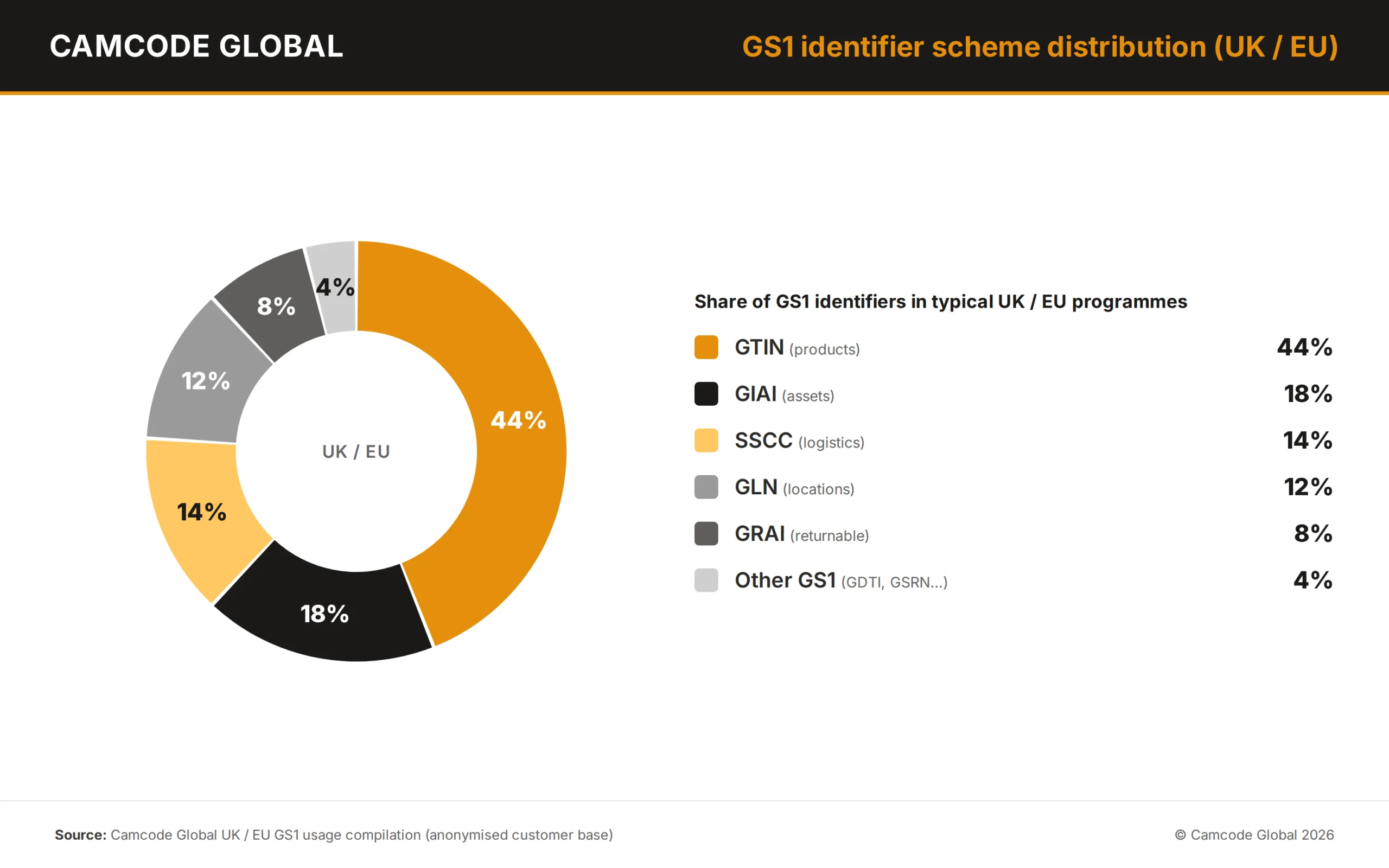
Relevant GS1 Identifier schemes for UK/EU operators include:
- GTIN (Global Trade Item Number). The barcode you see on products in stores; essentially the basis of consumer-facing identifiers.
- GLN (Global Location Number). Identifies physical and legal addresses within supply chains.
- GIAI (Global Individual Asset Identifier). Identifies individual assets (equipment, machinery, fixed assets) owned within an organisation’s purview. Utilised in Scan4Safety applications, government asset registers and being adopted for defence purposes.
- GRAI (Global Returnable Asset Identifier). Identifies returnable containers/items used in transit (kegs, gas bottles, totes, pallets etc.).
- SSCC (Serial Shipping Container Code). Identifies logistical units (case, pallet) being shipped.
- GDTI (Global Document Type Identifier). Identifies documents, such as permits and certificates.
- GSRN (Global Service Relation Number). Identifies service relationships between provider and recipient.
Covering the majority of operational use cases in the UK/EU are the first four: GTIN, GLN, GIAI, GRAI.
How GS1 Identifiers Are Structured
A GS1 identifier is made up of:
- A GS1 Company Prefix assigned to the organisation by GS1 (or in the UK, by GS1 UK). The length varies according to the prefix licence held.
- A reference/serial number assigned by the organisation against its own prefix.
- A check digit calculated from the previous digits.
The combination will be globally unique if the organisation allocates references correctly in its prefix. The check digit is the normal MOD 10 algorithm.
GS1 identifiers can be encoded in numerous symbologies:
- GS1-128 (linear barcode), supply chain, logistics.
- GS1 DataMatrix (2D), medical devices, pharmaceuticals, healthcare, increasingly assets.
- GS1 QR Code: consumer engagement, healthcare.
- EAN/UPC: retail consumer goods.
- GS1 DataBar: small/fresh foods, coupons.
GS1 DataMatrix is by far the most popular symbology used for UK/EU asset and compliance work. This is due to data density, damage tolerance and suitability for EU MDR UDI and EU FMD.
How GS1 Fits With Defence and Sector Identifiers
GS1 is one of a number of identifier schemes UK and EU organisations will come across:
- NATO Stock Number (NSN): defence; centrally allocated through national codification bureaus to participating NATO nations via the NATO Codification System. UK and EU (i.e., NATO member) defence organisations use this scheme, rather than the US-specific scheme (IUID) below.
- IUID UII: US Department of Defense (DoD)-mandated, supplier-driven enterprise identifier used in the US defence supply chain. This is a US process (scheme and implementation), not one that is used in the UK/EU. UK and EU defence organisations are not mandated to use IUID but rather NSN (above) through the NATO Codification System. UK/EU suppliers who wish to sell into US DoD programmes will need to support IUID as well as their NATO/GS1 identifiers.
- EU UDI: medical devices; built on GS1 or HIBCC.
- Internal asset codes: specific to individual organisations. These should map to a GS1 GIAI where there is a need to interoperate with other organisations.
GS1 also operates a range of defence, aerospace and asset-management standards which UK and EU stakeholders should be aware of, where GS1 membership is not the key scheme being used. Please see our UID label compliance guide for full details.
- STANAG 2290, STANAG 4427 and STANAG 4329: STANAG 2290 (NATO Unique Identification of Items) dictates the UID marking used throughout NATO, including how the Unique Item Identifier (UII) is constructed and applied to items. It is used in conjunction with STANAG 4427 (Allied Configuration Management Documentation) and STANAG 4329 (NATO Bar Code Symbology) for serialized assets that move through NATO supply chains. A GS1 GIAI may also be applied to the same physical mark as a STANAG UID without issue.
- Def Stan 05-132: UK Ministry of Defence specification for marking articles of supply, based around STANAG 2290. Contracts for UK defence procurement will generally require Def Stan 05-132 marking instead of GS1 identifiers alone, although both will be supported side-by-side on the same asset.
- Netherlands MoD policy CDS 751: national UID policy document produced by the Dutch Ministry of Defence. Built upon STANAG 2290, it specifies how defence equipment should be uniquely identified when supplying equipment on Netherlands MoD contracts.
- EN 9132: EN 9132 is the European aerospace standard equivalent for DataMatrix part marking. It is also the means by which STANAG 2290-style UID gets rolled out to aerospace/rail components outside of strictly defence contracts.
- MIL-STD-130: this is a US Military specification. Please note: MIL-STD-130 is a US Military specification. Although UK & EU buyers will not require MIL-STD-130 per se, the evidence of survivability that complying with MIL-STD-130 requires will generally be leveraged as proof of compliance with the nearest UK/EU equivalents, namely Def Stan 05-132, Netherlands MoD policy CDS 751 and NATO STANAG 2290, adopted by NATO countries via EN 9132. Military, aerospace, rail and energy specifications often request this life expectancy. We include it here because it is also often the durability requirement for GS1-marked assets used in defence and aerospace supply chains, even though GS1 does not require it.
- ISO 55001: ISO 55001, the global standard for asset management, considers unique identification a prerequisite for the rest of the asset management system to function. A GS1 GIAI, or another well governed identification scheme, fulfils this requirement for most organisations in the UK and Europe.
The identification schemes are interoperable in that they allow the same physical item to have multiple identifiers applied to it. For example, a Metalphoto® plate can include an NSN, a GS1 GIAI and an internal asset identifier all within the same physical label layout.
GS1 Compliance Cascades
UK and EU regulations and industry schemes that cascade GS1 obligations:
- NHS Scan4Safety: mandates GS1 GTIN, GLN, GIAI on medical products.
- EU Falsified Medicines Directive (2011/62/EU): along with its Delegated Regulation (EU) 2016/161, mandates that a unique identifier placed within a 2D Data Matrix code on the packaging of prescription medicines sold in European Union member states and European Economic Area (EEA) countries; GS1 is by far the most widely-used of several allowed coding standards. Note that this requirement does not apply to prescription medicines sold in the UK, including Northern Ireland. FMD safety features were disapplied UK-wide from 1 January 2025 under the Windsor Framework, meaning that UK packs can now bear an optional 2D barcode using any coding scheme.
- EU MDR 2017/745 / IVDR 2017/746: accepts GS1 (or HIBCC, IFA) for UDI.
- NHS eProcurement Strategy (Department of Health): mandates GS1 (and PEPPOL) coding for NHS trusts and their suppliers, embedded via the NHS Standard Contract and the NHS Terms and Conditions for the Supply of Goods and the Provision of Services.
- Various retailer / wholesaler requirements: GS1-128 and GS1 DataMatrix for each item and logistics markings.
When running a new identification programme in UK/EU marketplaces, GS1 will normally be your best option unless there is an industry-specific requirement.
Frequently Asked Questions
Where can I apply to get a GS1 company prefix?
In the UK from GS1 UK (gs1uk.org). Membership is charged on a sliding scale depending on size of your company and number of digits in your prefix. Card payments receive instant membership (and GS1 Company Prefix) issuance.
Is GS1 compulsory in UK/EU healthcare?
Effectively yes, via NHS Scan4Safety, EU MDR/IVDR UDI cascades and EU FMD. Suppliers to UK NHS or EU public health systems need to consider GS1 harmonisation.
Can I use GS1 identifiers for internal use?
Yes, GS1 GIAI in particular is intended for asset identification within your own organisation. Applying GS1 identifiers internally will future-proof your programme to be ready for external interoperability should you choose this option later, avoiding a re-labelling exercise.
Does GS1 own DataMatrix?
No. DataMatrix is an open ISO/IEC 16022 symbology. GS1 has prescribed how DataMatrix should be used to encode GS1 identifiers (GS1 DataMatrix), but does not own the symbology itself.
What is the difference between GS1 and HIBCC?
HIBCC (Health Industry Business Communications Council) is a US-based alternative healthcare identification standard mainly used by US healthcare suppliers. It is not a UK or EU scheme. It is listed on EU MDR/IVDR as an accepted UDI issuing agency alongside GS1, so you may see it referenced in EU documents, but it is by far the less common option and GS1 is the de facto standard for UK/EU operators. HIBCC is essentially only something you need to consider if you have a supply chain which specifically asks for it.
What does GS1 have to do with ISO 55001?
ISO 55001 mandates unique identification of assets as a basis for any asset management system. GS1 GIAI is the identification scheme chosen by most UK/EU organisations to meet that mandate instead of developing their own internal scheme.
Are GS1 identifiers going to replace STANAG 22.90, Def Stan 05-132 or MIL-STD-130?
No. GS1 GIAI is an industrial, commercial and public-sector asset identifier. STANAG 2290, Def Stan 05-132, Netherlands MoD policy CDS 751 and (in the US) MIL-STD-130 are military item marking specifications. One asset can bear a GS1 GIAI, a NATO UII and an internally-used code on the same physical mark, and Camcode Global commonly customises marking specifications to meet multiple standards simultaneously.
How Camcode Global Supports GS1-Based Programmes
GS1 identification is only as good as the processes involved in creating it: accurate prefix assignment, verified reference and master data, appropriate symbology, and physical markings that remain scannable for the lifetime of the asset. Camcode Global provides this through our proven 7-step asset identification, data cleansing and data optimisation process, which includes AIT consultation, engineering and marking-spec creation, data remediation and verification, production of the product, installation, data reporting, and comprehensive advisory services for the entire life cycle of the asset.
The same technology already backs GS1, NATO STANAG 2290 and national defence marking standards used in supply chains serving UK & EU customers. This means organisations required to use GS1 identifiers together with NSN, EU UDI or other sector-specific schemes can deploy them together on a single asset. There is no system conflict or need for a costly and time consuming second re-labelling exercise.
Camcode Global manufactures Metalphoto® plates, premium polyester labels, and direct-part-marking outputs carrying GS1 GIAI, GTIN, GLN, GS1-128, and GS1 DataMatrix content for customers in the UK and European healthcare, defence, government and industrial markets. We grade every machine-readable mark to ISO/IEC 15415 and ISO/IEC 29158 standards prior to shipment.
Our consulting team recommends prefix structure, symbology and content layout for any GS1-based identification program. Our experience is supported by the same process and NATO-approved partner status our defense programs are built on. Learn how our framework operates or view our achievements for organizations who manage GS1 and associated identification programs.
The Physical Marks We Manufacture
Like any data carrier, the lifespan of a GS1 identifier is only as long as the mark that holds it. To suit substrate, environment and service-life requirements, we can produce:
- Photosensitive anodised aluminium (Metalphoto®): our most durable option, ideal for high- and medium-volume production assets with exposure to chemicals, heat, abrasion and UV.
- Laser-markable steel, BlackPlus and acrylic plates: ideal for low volume and on-demand field marking of extreme condition assets.
- Thermal transfer and inkjet labels: affordable print-on-demand labels for medium- to high-volume assets.
- Cut-through CNC punched plates: a durable mechanical mark suitable for heavy machinery and high-wear environments such as chassis and hulls.
- Woven fabric labels: secured with heat-sealing or stitching directly to fabric assets such as parachutes and uniforms where regular labels can’t be applied.
- NFC tags: when close-proximity smartphone reading is required, or the system you are implementing needs to trigger an action with every scan.
- Direct part marking (DPM): laser engraving, dot-peen or stamp (ink) marking applied directly onto the component. It’s graded to readability standards set out in ISO/IEC TR 29158 (formerly AIM DPM-1-2006). Stamp marking is recognised as a quicker, cheaper alternative where the substrate permits, and, like laser engraving, doesn’t carry the risk of triggering additional airworthiness approvals that attached labels can incur on aircraft.
AIT Beyond the Physical Mark
GS1 barcodes and DataMatrix are capable of fulfilling the majority of your UK/EU asset identification requirements but Camcode Global’s range of automatic identification technology (AIT) solutions provides the following additional options:
- Passive and active RFID: Read multiple assets remotely or without line-of-sight.
- GPS asset tracking: Continuously track location of high value/mobile assets.
- Optical character recognition (OCR): Capture human-readable serials with a machine readable mark.
- Real-time location systems (RTLS): Deliver high-frequency location data indoors.
- Biometrics and smart cards: Usually deployed for access control and to provide accountability of assets to staff members.
- Sensor technologies: Monitor condition as well as identifying assets.
- Electronic article surveillance (EAS): Loss-prevention solution for high-value/portable assets.
Available for integration into enterprise applications like SAP, Oracle and IBM Maximo, these technologies enable visibility into assets beyond barcode reads only. Our engineers understand there is no one-size-fits-all approach, and will consider your substrate, service life, environment, production volumes and labeling requirements to determine the best mix of AIT technologies to satisfy your contractual and operational needs.
Ready to build or optimise your GS1 identification programme? Talk to a Camcode Global specialist about a consultation tailored to your standards, sector, and supply chain.