NATO allies agreed in June 2025 to invest 5% of GDP in defence and security spending by 2035. That includes at least 3.5% toward direct core defence requirements and NATO Capability Targets, and up to 1.5% toward wider defence- and security-related investment (protecting critical infrastructure and networks, civil preparedness, building back stronger defence industrial bases, etc.). European allies and Canada already increased their defence investment by nearly 20% between 2024 and 2025. Every vehicle, generator and container bought against the core 3.5% arrives with a marking annex attached. A specification first qualified in 1965 keeps turning up inside those annexes: GG-P-455, a US Federal Specification. It’s not a military standard, an ISO standard or a NATO STANAG, but a distinct document type with its own designation format and its own custodial authority.
GG-P-455 is just one piece of a much larger puzzle. At Camcode Global, we mark assets with eight different mark types, use every Automatic Identification and Data Capture (AIT) technology available and design labels and plates to embed over a dozen different identifier types across NATO, UK, Netherlands, European Union and United States – and Canadian – defence and regulated-industry programmes.
Within this larger framework, we’ll examine GG-P-455: the identifiers it defines, the mark types it associates with, the capture technologies used to interpret it, and the entire collection of standards found in parallel marking annexes, concluding with the seven-step process Camcode Global applies to every undertaking.
Procurement teams encounter it in one of two ways. Either a tender names it directly or it names a test method derived from it. Here’s a guide to what GG-P-455 includes, what it doesn’t and how it’s used in a vehicle contract.

Grade A is qualified to 7,000 abrasion cycles, 720 hours of salt spray fog and 400 hours of accelerated weathering. Grade B stops at 200 cycles and 150 hours on both environmental clauses.
In a climate-controlled interior with minimal handling, Grade B’s 200 abrasion cycles and 150 hours of exposure may be sufficient. The uplift to Grade A is usually small next to the cost of re-marking an asset mid-life.
Coloured Type II material relies on dyes whose heat and colour fastness varies by product, so it is generally restricted to indoor or short-term outdoor service. If the plate lives outside, reconsider monochrome Type I.
GG-P-455B classes material of 0.010 inch or thinner as foil. Foil is usually adhesive-applied. GG-P-455 does not test the adhesive. Specify the adhesive performance separately.
| GG-P-455B clause | What it covers | Your requirement |
|---|---|---|
| 4.6 | Abrasion, Taber CS-17 wheels at 1000 g load | 7,000 cycles |
| 4.9 | Salt spray fog | 720 hours |
| 4.10 | Accelerated light and weather resistance, the climate test | 400 hours |
How this is calculated
An important note on US standards in this guide. GG-P-455 is itself a US Federal Specification. A number of the test methods, identifier schemes and marking standards referenced alongside it throughout this guide (MIL-STD-130, MIL-STD-202H, ASTM B117, FED-STD-191, DFARS 252.211-7003) are also originally US standards. They’re included here because they are relentlessly prevalent throughout UK and EU contracts and marking annexes: as named durability benchmarks customers call out directly, as test methods when there is no published national equivalent, or else as the closest near-match published comparison to a UK/EU requirement. None are binding on their own merits for work in the UK or EU, and this guide flags that distinction where it’s relevant, particularly in the standards landscape table below, and the note on MIL-STD-130 specifically.
What GG-P-455 actually is
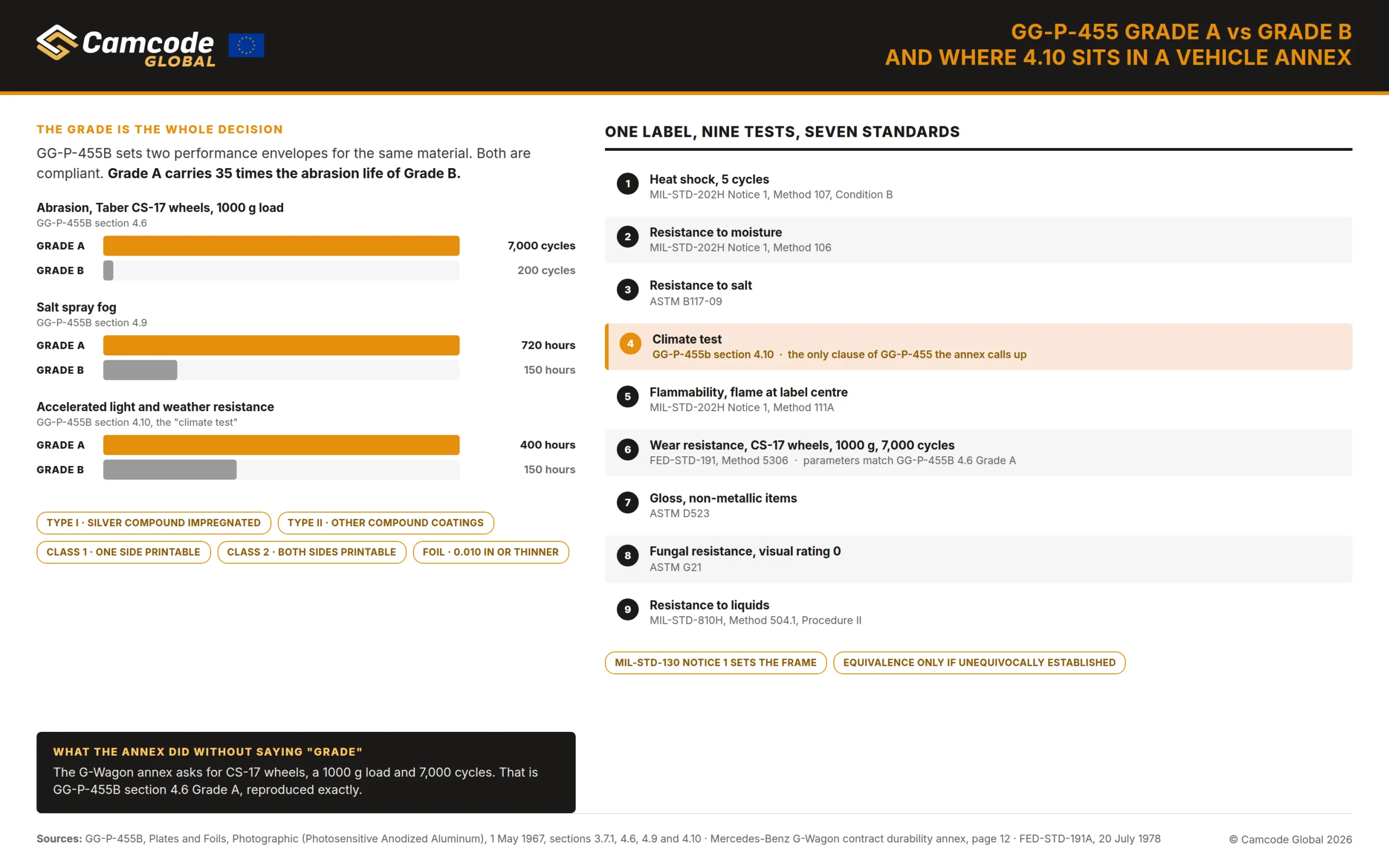
Figure 1. GG-P-455 Grade A versus Grade B, plus where section 4.10 sits inside a vehicle marking annex. Sources: Federal Specification GG-P-455B, 1 May 1967, sections 3.7.1, 4.6, 4.9 and 4.10 (https://metalphoto.com/wp-content/uploads/downloads/2015/04/GG-P-455B.pdf); Mercedes-Benz G-Wagon contract durability annex, page 12; FED-STD-191A, 20 July 1978 (https://law.resource.org/pub/us/cfr/ibr/003/fedspec/FED-STD-191A.PDF).
GG-P-455 is a US Federal Specification titled Plates and Foils, Photographic (Photosensitive Anodized Aluminum). Its latest revision is GG-P-455B, issued on 1 May 1967, which updated the version dated 15 June 1965. The preparing activity, the Navy Publications and Forms Center (NPFC), still lists the specification as active and most current, with the latest notice recorded against it in 2019.
The material was developed by Horizons Incorporated in the years after World War II and is sold under the Metalphoto® brand, according to a Recognition Review profile. The process embeds a silver image within the anodic layer, rather than on top of it. This makes it different from normal anodised aluminium as a substrate for asset identification. The image is then sealed beneath the oxide layer, leaving nothing exposed on the surface to scratch or wear away. This is what gives the marking its durability.
The key point to remember if you’re reading a tender is that GG-P-455 is not a marking standard. MIL-STD-130, Def Stan 05-132 and STANAG 2290 tell a supplier what information to put on a plate and how to construct a unique item identifier (UII). GG- P-455 makes no mention of content. It specifies the durability requirement.
UK and NATO marking standards that reference GG-P-455 state the durability requirement but do not specify a material. MIL-STD-130N, clause 4.3, reads:
“Direct identification marking and identification plates, identification bands, identification tags, or identification labels used shall be as permanent as the normal life expectancy of the item and be capable of withstanding the environmental tests and cleaning procedures specified for the item to which it is affixed.”
MIL-STD-130N, clause 4.3, 17 December 2007.
STANAG 2290 (Edition 2), Annex B clause 5.e, uses effectively the same sentence for NATO materiel. Both leave it to the supplier to work out what substrate passes those tests. GG-P-455 provides a more measurable standard, specifying testing durations instead of relying on qualitative language.
Types, grades and classes
GG-P-455B classifies materials across three categories, so if a tender specifies only “GG-P-455” then they have under-specified the requirement.
Types. Type I are silver compound impregnated. Type II are all other compound coatings, which is where coloured material sits. Type II dyes can have varying levels of heat and colour fastness, so coloured plates are usually suitable only for indoor, or short-term outdoor use.
Grades. There is an A and B grade for each type. The difference between the two is significant.
Classes. Class 1 can be printed on one side, Class 2 both sides. The spec also sets a thickness boundary: at or below 0.010 inch thick, material is classed as foil, not sheet.
Most specification errors occur in grading. Section 3.7.1 and its associated test clauses set out very different performance requirements:
| Requirement | Grade A | Grade B |
| Abrasion, Taber CS-17 wheels at 1000 g load (4.6) | Not less than 7,000 cycles | 200 cycles |
| Salt spray fog (4.9) | 720 hours | 150 hours |
| Accelerated light and weather resistance (4.10) | 400 hours | 150 hours |
A plate that meets Grade B still complies with GG-P-455. However, a Grade B plate has only one-thirty-fifth the abrasion life of Grade A. Specifying “GG-P-455 Type I Class 1 Grade A” removes that ambiguity.
What section 4.10 tests
Section 4.10 of GG-P-455B, the accelerated light and weather resistance test, is most commonly cited by name (usually as “climate test”) in European contracts. Processed plates are exposed to artificial sunlight and rain, then evaluated for readability of the image. To pass as Grade A material, the image must survive 400 hours of exposure. To pass as Grade B material, it must survive 150 hours.
The samples, consisting of four completely processed 4 x 5 inch plates imprinted with a 70% black image, are masked with a 1.5 inch wide strip of black electrical tape. The plates are exposed in a weatherometer that is equipped with copper-clad sunshine electrodes and Corex D filters and is operated with water spray. The acceptance criterion is that there shall be no deterioration of the image area and no pronounced loss of readability.
The purpose of the masked strip is to leave a section of unexposed reference so that the tester can compare the densities of weathered and unweathered image on the same plate. It’s a test of legibility, not corrosion resistance. Salt fog is covered in Section 4.9.
How a Mercedes-Benz G-Wagon contract uses it
Camcode Global’s material appears in the durability annex of a Mercedes-Benz G-Wagon contract. It’s a good example since it demonstrates GG-P-455 handling a specific task within a larger context, rather than encompassing the whole requirement.
The annex notes that the requirements listed in MIL-STD-130 Notice 1 refer to a multitude of other standards, then sets out the tests the label must withstand. It adds an equivalence clause: other standards may be substituted only where it has been clearly demonstrated that their testing procedures are equivalent and will result in qualitatively equivalent test results. That’s a strict clause that places the burden of proof on the supplier.
The tests themselves, applied to the label affixed to a test surface by the adhesive layer or mechanical attachment being offered:
- Heat shock: MIL-STD-202H Notice 1, Method 107, Condition B, five cycles
- Resistance to moisture: MIL-STD-202H Notice 1, Method 106
- Resistance to salt: ASTM B117-09
- Climate test: GG-P-455b, 4.10
- Flammability: MIL-STD-202H Notice 1, Method 111A, flame aimed at the centre of the label, with the acceptance criterion being that no visible portion of the flame may contact the label.
- Wear resistance: FED-STD-191, Method 5306, standard abrasion wear tester, CS-17 wheels, 1000 gram load, 7,000 cycles
- Gloss for non-metallic items: ASTM D523
- Fungal resistance: ASTM G21, visual rating of 0 (no growth)
- Resistance to liquids: MIL-STD-810H, Method 504.1, Procedure II, with the eight-hour requirement in step 4 replaced by liquid-specific durations
A few observations are relevant at this stage. First, the wear parameters belong to GG-P-455B. A load of 1,000 grams and 7,000 cycles is the Grade A abrasion requirement from section 4.6, reproduced in full. The contract has defined a Grade A envelope by using wording other than “Grade”.
Second, the abrasion test is embedded inside a textile standard. FED-STD-191A, 20 July 1978, is the federal standard for textile test methods. Method 5306 is titled “Abrasion Resistance of Cloth; Rotary Platform, Double-Head (Taber) Method”. The test apparatus is correct: GG-P-455B section 4.6 references a Taber Abraser model 171 with CS-17 Calibrase wheels. The annex has appropriated a cloth abrasion test method to use with a metal plate. Determine at clarification what type of specimen mounting the buyer wants, as the textile method assumes a fabric sample.
Third, GG-P-455 4.10 has only one job here. Salt goes to ASTM B117, liquids go to MIL-STD-810H and fungus goes to ASTM G21. GG-P-455 covers accelerated weathering and legibility, which is precisely the clause it was written for.
Fourth, the attachment types defined in the annex do not correspond to those in GG-P-455. It scopes the nine tests to labels of “types A, B, C”, referring to its own construction taxonomy based on whether a label is adhesive- or mechanically attached, instead of GG-P-455’s Type I vs Type II dichotomy, which instead refers to the type of photosensitive compound used. Confusing the “Type” terminology between these documents is an oversight that can be avoided by a quick cross-reference.
How long GG-P-455 Grade A material lasts in service
GG-P-455 Grade A material is specified to salt fog, accelerated weathering, and sand abrasion testing values. It is qualified to test hours, not years in service: 720 hours salt spray fog (section 4.9), 400 hours accelerated weathering (section 4.10) and not less than 7,000 abrasion cycles (section 4.6). There is no language converting those test hours to years of warranted outdoor life. A service-life figure in years therefore has to come from somewhere else, such as long-term outdoor exposure data or field history. Metalphoto’s 20+ year outdoor rating rests on that kind of evidence. Buyers should ask to see it, together with the GG-P-455 test data, rather than accepting a number on a datasheet. The 2012 Item Unique Identification environmental survivability study by the IUID Center at Naval Surface Warfare Center Corona Division put 47 label types from 15 suppliers through 18 tests such as chipping, pressure washing, sun exposure and immersion in 13 chemicals. Its conclusion was blunt:
“No ‘magic bullet’ or ‘universal solution’ was found.”
IUID Environmental Survivability Testing Report, IUID Center, Naval Surface Warfare Center Corona Division, September 2012.
The environment comes first when selecting materials, not a league table. One plate bolted to a vehicle chassis faces very different service conditions than one mounted inside a workshop. That’s why robust asset identification programmes define the test regime along with the material.
What GG-P-455 does not cover
The specification is nearly 60 years old in its current revision and predates every element of modern item identification. It doesn’t address adhesive performance (for example, the G-Wagon annex outlines this based on the attachment method under test). It doesn’t address marking content (unique item identification numbers fall under MIL-STD-130 in the US, Def Stan 05-132 in the UK). It doesn’t address symbology (see STANAG 4329 or ISO/IEC 16022 for Data Matrix) or print quality grading (ISO/IEC 15415 or ISO/IEC 29158).
Nor does it address the identifier itself. What data goes on the plate, and in what structure, is set by the applicable UID scheme: STANAG 2290 for NATO unique item identification, Netherlands MoD policy CDS 751 where that STANAG cascades into Dutch contracts, or US IUID under MIL-STD-130 and DFARS 252.211-7003. GG-P-455 will accommodate any of them; it takes no position on which one applies.
It also contains obsolete references. GG-P-455B references Federal Test Method Standard No. 151 for salt spray testing, and MIL-STD-105 for sampling. Both have since been withdrawn. If you copy GG-P-455’s entire reference list wholesale into your own tender, you’re also importing these outdated test methods.
Specifying it without creating a testing gap
A workable call-out has five parts:
- Name the type, class and grade. For example, “GG-P-455 Type I Class 1 Grade A” rather than “GG-P-455”.
- Name the marking standard separately. The material specification and the content specification are different documents, which is the first thing a UID label compliance review should establish.
- State which clauses apply if you’re using GG-P-455 selectively. The G-Wagon annex cites 4.10 alone, which is precise and defensible.
- Update dated references. If you want salt spray, cite ASTM B117 directly rather than inheriting Federal Test Method Standard No. 151.
- Ask for test evidence, not a compliance statement. A certificate that repeats the specification number back to you proves nothing about the plate’s durability.
The standards landscape around a GG-P-455 plate
GG-P-455 is rarely found on its own in a marking annex. The table below details the standards we at Camcode Global encounter frequently alongside it, what they actually cover, and whether or not they apply to a photosensitive anodised aluminium plate.
| Standard | What it governs | Relationship to GG-P-455 |
| STANAG 2290 | Structure and content of the NATO Unique Identification (UID) assigned to an individual item. | Defines what data the plate must carry. GG-P-455 defines only what the plate must survive; the two are complementary, not competing, requirements. |
| STANAG 4427 | Allied Configuration Management Documentation (traceability between an asset, its configuration baseline and its authoritative data record). | Doesn’t touch materials at all. It becomes relevant the moment a GG-P-455 plate needs to be re-issued or re-identified after a configuration change. |
| STANAG 4329 | NATO Bar Code Symbology (the machine-readable marking and data-carrier requirements for NATO materiel). | Tells a supplier which symbology (Data Matrix, in practice) to print onto a GG-P-455 plate. GG-P-455 says nothing about symbology at all. |
| Netherlands MoD policy CDS 751 | Identification and marking requirements for Netherlands Ministry of Defence procurement, cascading STANAG 2290 into national contracts. | Same division of labour as STANAG 2290: content, structure and symbology. A GG-P-455 plate is a common substrate choice for CDS 751 work, never a substitute for it. |
| Def Stan 05-132 | UK MOD identification marking content (NSN, part number, serial number, CAGE code, human- and machine-readable data). | The UK content standard most often paired with GG-P-455 Grade A material in vehicle and equipment contracts. Where a UK defence contract is involved, Def Stan 05-132 is the standard that actually applies to what is printed. |
| EN 9132 | Data Matrix marking of aerospace parts and assemblies, including symbol content, placement and verification. | Applies where a GG-P-455 plate (or a direct part mark) is used on an aerospace component. It governs the mark’s content and quality, not the substrate’s ability to survive the environment. |
| EU Medical Device Regulation 2017/745 | Unique Device Identification (UDI-DI and UDI-PI) for medical devices sold in the European Union, registered in EUDAMED. | Rarely intersects with a GG-P-455 plate directly; most medical device UDI is thermal-transfer or ink-jet labelling. Included here because Camcode Global’s identifier work spans defence and regulated commercial sectors, and the same three-layer logic (identifier, mark, capture) applies. |
| EU Falsified Medicines Directive (2011/62/EU) | Pack-level GS1 Data Matrix safety features for prescription medicines, verified against national medicines verification systems. | A labelling content and registry requirement rather than a substrate spec. Noted for completeness across Camcode Global’s identifier portfolio; not a scheme GG-P-455 plates are built for. |
| ISO/IEC TR 29158 (formerly AIM DPM-1-2006) | Readability grading for Direct Part Marks, the scheme referenced by UK MOD and EU OEMs for etched or dot-peened identifiers. | Applies when the identifier is marked directly into metal rather than printed on a GG-P-455 plate. Direct Part Marking and Metalphoto® are alternative answers to the same durability question, graded under different standards. |
| ISO 55001 | Requirements for an asset management system, including the treatment of unique identification as a foundation for reliable asset data. | Sits above the label entirely. It treats a durable, verified identifier (a GG-P-455 plate among them) as a precondition for a conformant asset register, not as a marking specification itself. |
| MIL-STD-130 | US Department of Defense marking content and the construction of the Unique Item Identifier (UII), governed alongside DFARS 252.211-7003. | Note: MIL-STD-130 is a US Military specification. UK and EU purchasers will not ask for MIL-STD-130 itself, but the proof of durability that MIL-STD-130 requires is often used to demonstrate compliance with the closest UK/EU equivalent standards, primarily Def Stan 05-132, Netherlands MoD policy CDS 751, and NATO STANAG 2290 (as adopted through EN 9132). Military, aerospace, rail and energy specifications typically ask for this lifespan, which is why MIL-STD-130 keeps appearing in European tenders that have no contractual link to the US DoD. |
Where GG-P-455 sits among Camcode Global’s mark types
Photosensitive anodised aluminium is just one of eight mark types that Camcode Global produce and install. Choosing one over the others is always a substrate- and environment-driven decision; it’s not about preference. The identifier itself and the standard it needs to comply with remains the same, only the physical carrier alters.
| Mark type | Characteristics | Typical applications |
| Photosensitive anodised aluminium (Metalphoto®) | Sub-surface, inorganic image sealed under the anodic layer. Best for medium-to-high volume; poor for small runs or on-site marking. Flexible size, thickness and attachment options. | Small arms and weapon ancillaries; ships and marine; aircraft and aerospace; engines and components; complex and crew-served weapon systems; communications equipment; chemical, heat or sunlight exposure. |
| Laser-markable materials | Steel, BlackPlus or acrylic. Etched or bonded image, durability depends on substrate. Slower and more labour-intensive than Metalphoto®, but suited to real-time, on-site marking. | Small arms; weapon ancillaries; aircraft and aerospace; engines and components; complex weapon systems; communications equipment; decentralised UID implementation. |
| Thermal-transfer labels | Ink transfer image via ribbon; durability depends on facestock, ribbon, adhesive and laminate. Meets moderate-to-high volume and supports on-demand printing. | Soft and hard armour; hospital equipment; direct circuit-board marking; general asset tracking; suppressor marking; extreme heat (500–1200°C constructions available). |
| Digitally printed and ink-jet labels | Variable data, colour and graphics at moderate-to-high volume. Durability depends on printing process, substrate, adhesive and any protective overlay. | Soft and hard armour; ballistic and bump helmets; hospital equipment; general asset identification; packaging and logistics applications. |
| Cut-through, stamped and engraved plates | CNC-punched or mechanically engraved plates. Good durability but most suitable for low quantities; can present readability issues if characters are damaged or obstructed. | Heavy equipment; ships and marine assets; vehicle chassis marking; large industrial identification plates. |
| Woven and printed fabric tags | Woven, printed, heat-sealed or sewn tags. Moderate durability; construction and attachment must match expected laundering, abrasion and chemical exposure. | Parachutes; military apparel; webbing and load-bearing equipment; soft armor and textile carriers. |
| Direct part marking (DPM) | Laser etched, laser engraved or dot-peened directly into the part. Durable but slow and labour-intensive; the only option when a label cannot be securely affixed. Graded to ISO/IEC TR 29158. | Aircraft and aerospace components; surgical and medical instruments; bridging and engineering equipment; refurbished or high-value serialised parts. |
| NFC-enabled tags | Passive radio-frequency protocol read within roughly 4cm of the tag; readable by most smartphones without a dedicated scanner. | Communications equipment; hospital equipment; general asset tracking; applications needing access to digital records at the point of scan. |
A tender that names GG-P-455 has specified the material for one line item. The other seven mark types remain available for the rest of the asset register, and most multi-scheme programmes use a combination of them.
Identifier types a GG-P-455 compliant plate is built to carry
The plate survives the elements; it is the identifier that makes the plate useful. Based on the contract, a GG-P-455 compliant plate may be required to display one or more of the following types of identifiers.
| Identifier | What it identifies |
| NATO Stock Number (NSN) | A 13-digit supply classification identifier assigned under the NATO Codification System per STANAG 3150 and STANAG 3151. Identifies a standardised item of supply, not an individual serialised asset. |
| Unique Item Identifier (UII / IUID) | A globally unique, permanent identifier for an individual item, used by the U.S. DoD under DFARS 252.211-7003 and MIL-STD-130, registered in the DoD IUID Registry where required. |
| NATO UID | An item-level identifier structured per STANAG 2290 and AUIDP-1, supporting unique identification and lifecycle traceability across participating NATO nations. |
| GS1 Global Individual Asset Identifier (GIAI) | A globally unique asset identifier built from an organisation’s GS1 Company Prefix plus an internally controlled reference. Supports interoperability across commercial, government, healthcare and defence supply chains. |
| GS1 Global Trade Item Number (GTIN) | Identifies the type of item being supplied; combined with a serial number under GS1 rules to give item-level identification. |
| UK Ministry of Defence identifiers | Internal equipment, inventory and logistics identifiers used alongside NSNs, serial numbers and UID data, with the exact structure set by the applicable Defence Standard, platform and contract. |
| EU Medical Device identifiers | The UDI Device Identifier and UDI Production Identifier required under the EU Medical Device Regulation, supporting device identification, production traceability and regulatory reporting. |
| Packaging and logistics identifiers | Identifiers such as the GS1 Serial Shipping Container Code, GTIN, lot number, batch number, expiry date or serial number, supporting shipment visibility and packaging hierarchy. |
| CAGE and NCAGE codes | CAGE and NCAGE codes identify the organisation responsible for manufacturing, supplying or controlling an item, frequently used as enterprise identifiers within UID constructs. |
| Internal or proprietary asset identifiers | Organisation-specific schemes used where controlled allocation rules prevent duplication and the identifier remains compatible with the organisation’s ERP, EAM or maintenance systems. |
Unlike a barcode symbol, a GG-P-455 plate is not capacity constrained by design. Space on the plate, however, is still limited. Camcode Global’s engineers reserve space for the worst-case content scenario during step two of our seven step process (discussed in detail later in this guide), so you’ll never find out halfway through production that your NATO UID and GS1 GIAI cannot both be applied.
AIT capture technologies used alongside GG-P-455 compliant plates
Even a robust, properly identified plate is of little value unless the information contained on that plate can be read and entered into an ERP, EAM or logistics system. Camcode Global offers the following Automatic Identification and Data Capture (AIT) technologies depending on scanning distance, environment, data volume and system architecture.
| AIT technology | Role |
| Linear and 2D barcodes | Code 39, Code 128, GS1-128, QR Code, PDF417 and Data Matrix. Data Matrix is the workhorse for defence UID because it packs significant data into a small marking area and can be printed or direct-part-marked. |
| Passive RFID | No internal power source; reads without line of sight or for multiple items at once. Used for warehouse inventory, tool cribs and arms-room accountability. |
| Active RFID | Battery-powered, longer read range. Used for containers, vehicles and high-value assets that need detection across a wider area, including in-transit visibility. |
| Real-Time Locating Systems (RTLS) | Active RFID, Bluetooth Low Energy, ultra-wideband or Wi-Fi based, providing ongoing location visibility for frequently moved tools, MRO facilities and high-value equipment. |
| Optical Character Recognition (OCR) | Converts printed, stamped or engraved characters into structured data. Used for asset surveys, data cleansing and capturing legacy nameplates that predate barcode marking. |
| GPS and GNSS tracking | Combined with cellular or satellite communications to track mobile assets, containers and deployable systems moving between facilities, regions or countries. |
| NFC | Short-range RFID readable by compatible smartphones and tablets; can surface maintenance instructions or digital records at the point of scan. |
| Smart cards and biometrics | Connect an asset transaction to the individual performing it, used for controlled equipment issue and return and arms-room accountability. |
| Sensor-enabled monitoring | Temperature, humidity, shock, vibration or pressure sensors associated with the asset’s unique identifier to build a condition history and support predictive maintenance. |
| Electronic Article Surveillance (EAS) | A security control rather than a complete identification solution; used for theft deterrence and perimeter monitoring of high-value inventory. |
A GG-P-455 plate engraved with a Data Matrix symbol meets the marking side of this equation. It may or may not require an RFID inlay, NFC chip or nothing more than the printed symbol depending on how the receiving site plans to read it. This is a determination Camcode Global makes during Step One (discussed in detail below), prior to material selection.
Camcode Global’s seven-step process
Selecting the appropriate material, identifier and capture technology means nothing if it’s not implemented through a repeatable process. Camcode Global runs every asset identification programme we do (regardless if the mark type selected is photosensitive anodised aluminium under GG-P-455 or one of the other seven mark types) through our seven-step Data Cleansing, Asset Identification and Data Optimisation Process. Click on The Framework to learn the ins and outs of each step, and visit The Results to see the defence, infrastructure and manufacturing organisations that have seen the benefits of our process.
Step One: Asset Identification and AIT Consultation
Camcode Global’s team evaluates your project scope and make recommendations on how to tailor your processes to meet the relevant standards and frameworks, increase asset utilisation, streamline processes to run more efficiently and compliantly, leverage automation and optimise your asset supply chain.
Step Two: Engineering Services
The engineering team creates the marking specification, also known as factsheet, on how the asset will be marked for identification purposes from both a data and physical-marking perspective. Once field verification has taken place on a sample of assets, business rules and data governance are established and approved, as well as the mark type chosen from eight available types, including photosensitive anodised aluminium under GG-P-455.
Step Three: Data Remediation, Reconciliation and Verification
Camcode Global’s proprietary software allows you to collect data offline or online and guarantees compliance with applicable standards, less human error, database integration, and comprehensive reporting/analytics.
Step Four: AIT Product Manufacture and Procurement
Products are built to specification: barcodes (1D, 2D, QR, GTIN, SSCC, UDI), RFID, sensors, GPS, OCR-readable plates, RTLS tags, NFC, EAS, biometrics or the selected mark type, including GG-P-455 Grade A or B material when required for longevity.
Step Five: AIT Product Installation
Installers that have received NATO Security Clearance install the product to the marking specification. Camcode Global’s software links the appropriate data to each installed asset. All installations are performed in accordance with all regulations and NATO standards.
Step Six: Data Reporting and Migration
After marking is complete, customisable reporting allows transparency of critical operational KPIs, highlights exceptions, and aids in maintaining high-quality master data, minimising reconciliation hours spent on records throughout the asset lifecycle.
Step Seven: Asset Life Cycle Management Advisory (ALCMA)
KPMG’s Asset Life Cycle Management Advisory services help manage the asset from planning and procurement through maintenance, optimisation and disposal, focusing on improving asset performance, reducing costs and meeting compliance requirements like ISO 55001.
Working as NATO approved suppliers for over 12 years, and holders of a NATO Support and Procurement Agency (NSPA) Enabling Contract, Camcode Global have administered this process for defence organisations throughout the UK, Netherlands, United States and Australia. We’ve discovered in excess of 3 million ITAR controlled items for export reporting to US DoD, cleansed over 4 million lines of system data to enhance asset visibility and lifecycle management and validated and corrected over 21% of OEM data to ensure rotary fleets comply with EU airworthiness directives.
Frequently asked questions
Is GG-P-455 still current?
Yes. Revision B of 1 May 1967 is the currently issued revision and preparing activity NPFC still shows it as active and current. It is actually a Federal Specification and not a defence standard. It is named in European vehicle and equipment contracts.
What is the difference between GG-P-455 and MIL-DTL-15024?
GG-P-455 specifies the photosensitive anodised aluminium material. MIL-DTL-15024 specifies finished plates and tags, including their types, sizes and marking. You can specify a plate against both. This is often the case in defence work.
What is the difference between Grade A and Grade B?
Grade A has been tested to 7,000 cycles of abrasion scrubbing, 720 hours of salt spray fog, and 400 hours of accelerated weathering. Grade B is qualified to 200 cycles of abrasion, 150 hours of salt spray fog, and 150 hours of accelerated weathering. Both meet specification, but exterior plates should meet Grade A requirements.
Does GG-P-455 compliance make a label MIL-STD-130 compliant?
No. GG-P-455 controls the substrate. MIL-STD-130 controls what you put on it and how you construct and encode the unique item identifier. If a supplier gives you one instead of the other, they didn’t read the requirement.
Can Type II coloured material be used outdoors?
Only with caution. The dye heat and colour fastness varies among Type II products. That is why coloured plates are normally for indoor or temporary outdoor applications.
Where do I obtain a copy of GG-P-455?
Federal Specifications are public documents. GG-P-455B can be purchased from the standards resellers that offer NPFC documents, or from free specification archives. Make sure you are looking at Revision B, though. Previous revisions are also circulating on the web.
Does Grade A material require Grade A processing?
Yes. Grade A performance requires both the performance of the anodic seal and the base material. The quality of the seal is what determines whether a plate withstands 720 hours of salt fog or not.
If a plate conforms to GG-P-455, does that make it UID-compliant?
No. UID compliance is determined by the entire solution: the proper identifier format (NSN, UII, NATO UID, GIAI or another scheme), approved symbology, appropriately graded mark, and interface with the customer’s registry or ERP system. GG-P-455 only ensures one aspect of that, the durability of the substrate.
If GG-P-455 material won’t survive the asset’s environment, what else can Camcode Global use?
When marking components where no label of any sort can be reliably applied (examples include refurbished parts or parts exposed to continuous abrasion), direct part marking to ISO/IEC TR 29158 specification is typically the solution. Laser-markable substrate materials as well as thermal-transfer labels or woven fabric tags are solutions for scenarios where an asset’s substrate, bulk or budget eliminate Metalphoto® from consideration.
How Camcode Global supports GG-P-455 specifications
Camcode Global produces Metalphoto® plates and foils to GG-P-455 Type I and II, Class 1 and 2, Grade A and B, as well as all seven other mark types (laser-markable materials, thermal transfer, ink jet, cut-through plates, woven fabric tags, direct part marking and NFC tags) for military, aerospace and industrial customers throughout the UK, Europe and North America. All plates are specified against the environment they will actually encounter, graded and tested at the point of application, and manufactured to print whatever identifier is required by the contract, whether NSN, UII/IUID, NATO UID, GS1 GIAI or an internal asset code.
As a NATO-approved provider for over 12 years and holder of a NATO Support and Procurement Agency (NSPA) Enabling Contract, we typically specify GG-P-455 compliant material along with all of the applicable content and symbology standards it’s paired with in real-world deployments (MIL-STD-130, Def Stan 05-132, Netherlands MoD policy CDS 751, NATO STANAG 2290 and 4329, and EN 9132), so Camcode Global considers both simultaneously: the plate that survives the environment and the data that identifies the asset are never treated as separate problems. Delivery runs through our seven-step Data Cleansing, Asset Identification, and Data Optimisation Process, with Asset Life Cycle Management Advisory provided by KPMG.
Talk to a Camcode specialist about specifying GG-P-455 for your programme.