STANAG 2290 Explained: NATO’s Unique Identification of Items (UII) Marking Standard
STANAG 2290 is used as the base standard for all item identification requirements within NATO. STANAG 2290 (Edition 2 published 18 November 2010) provides for the unique identification of an item. This includes its UII and machine readable marking (Data Matrix) on the item or its associated data plate/label, as well as a PDF417 symbol on the first level of packaging. STANAG 2290 is further supported by the publication AUIDP-1. For defence suppliers in the UK and Europe, this standard dictates how the items you provide are identified.
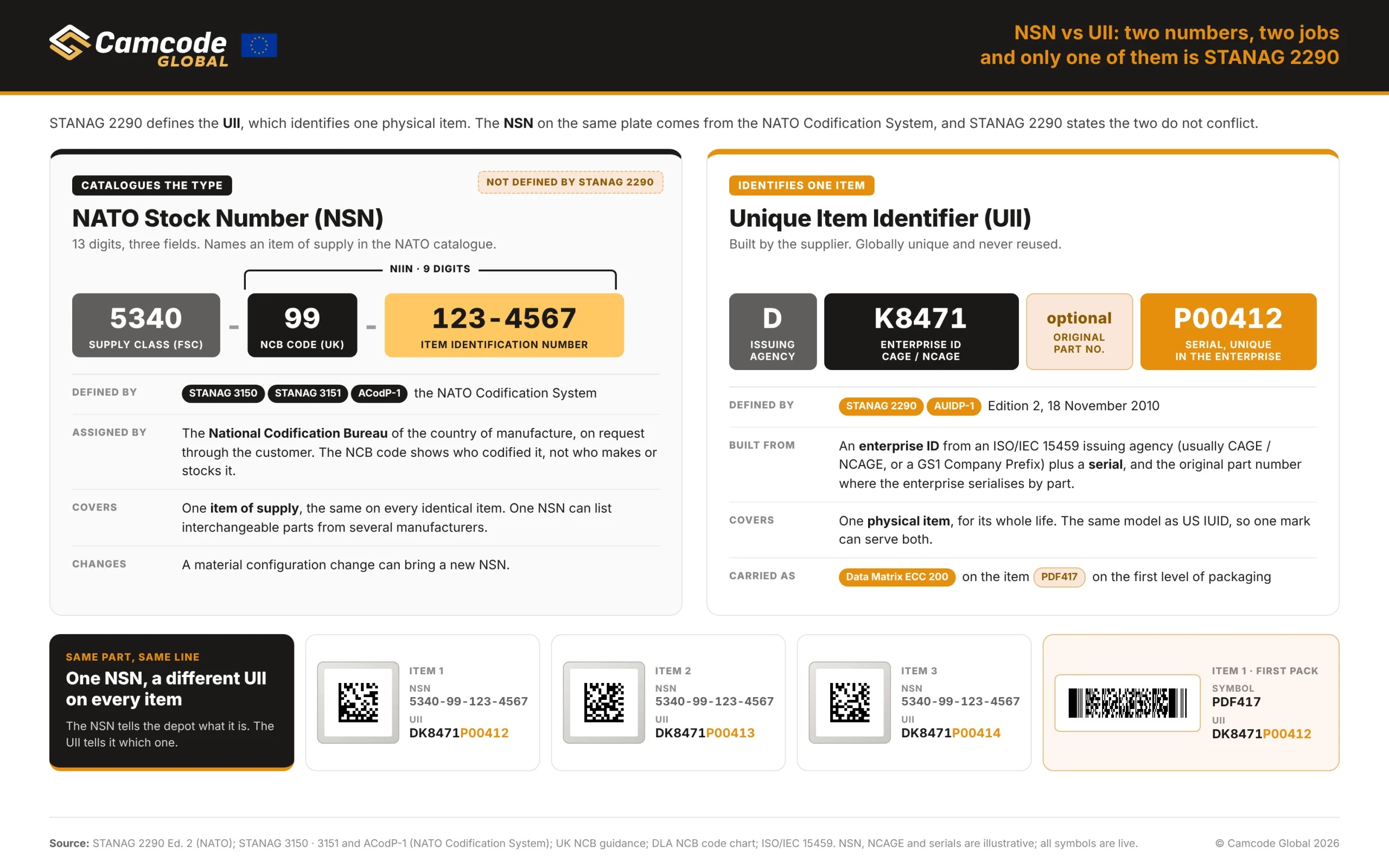
Notably, STANAG 2290 does not specify the use of the NATO Stock Number (NSN). The NSN and its 13 digit format are defined by the NATO Codification System (NCS). This is covered by STANAG 3150, STANAG 3151 and the NATO Codification manual (ACodP-1). STANAG 2290 itself states that the UII does not conflict with the NATO Codification system. Essentially, the NSN categorises an item for the catalogue, and STANAG 2290 dictates how to mark individual serialised items.
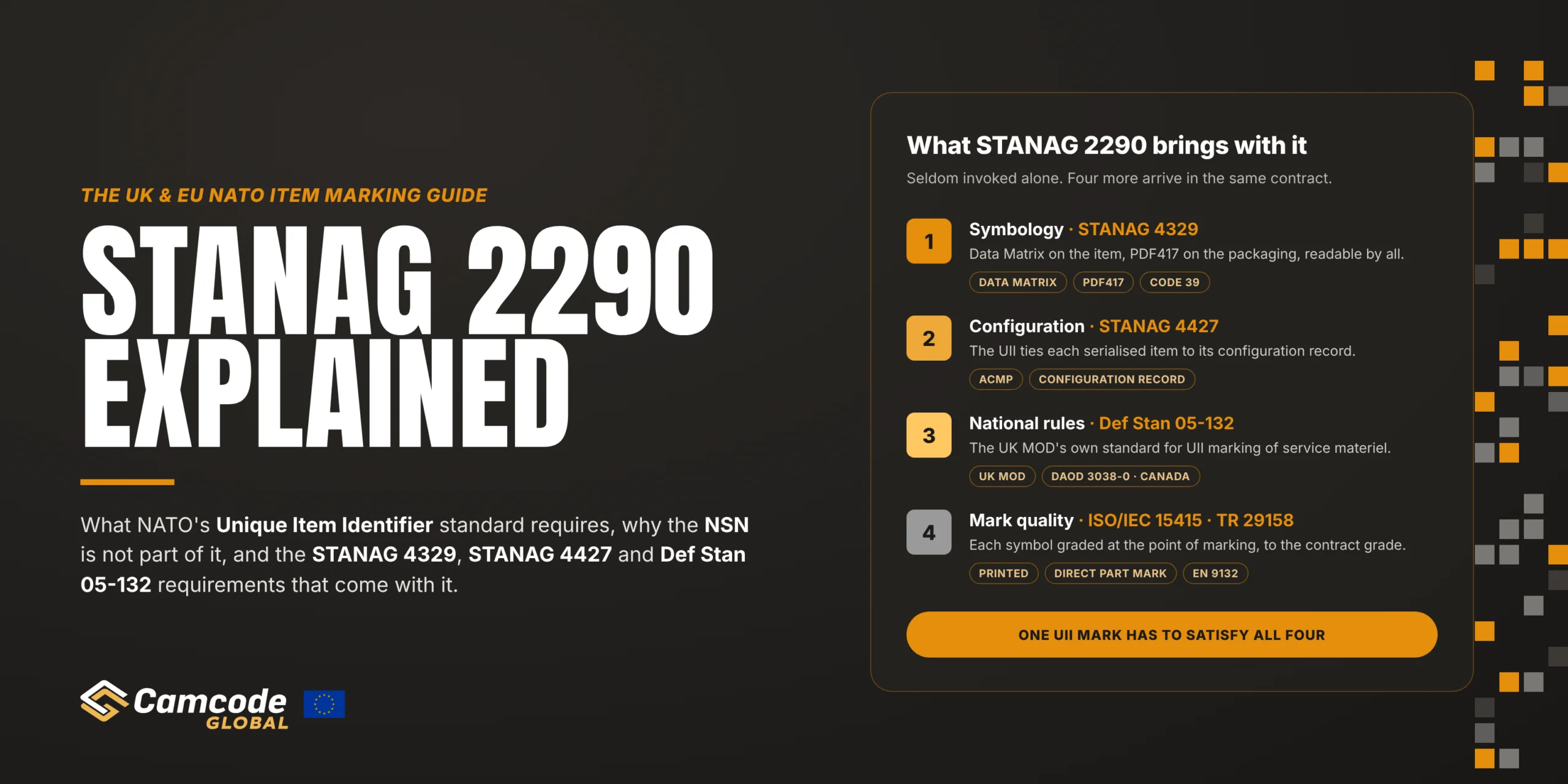
In practice, adhering to STANAG 2290 necessitates compliance with a broader array of standards. Bar-codes are addressed by STANAG 4329, while STANAG 4427 deals with Configuration Traceability, and national governments might issue documents like the UK’s Def Stan 05-132 or the Netherlands MoD’s Policy Document CDS 751. Mark quality, specifically defined by ISO/IEC TR 29158 and EN 9132, is governed by ISO standards, as is asset management under ISO 55001. For products classified as medical, adherence to the EU Medical Device Regulation and the EU Falsified Medicines Directive becomes mandatory. You will also need to decide on an identifier, mark type that will last the life of the item and automatic identification technology (AIT) that the customer will be able to scan.
This article has been written to help those working within Procurement, Quality, Engineering, Logistics and Asset Management within the UK and Europe understand what is required of suppliers who are asked to conform to STANAG 2290. We’ll explore the requirements for meeting this standard, its integration with the NATO Codification System, and its place alongside other standards. We’ll also cover which identifiers, marks, and AITs Camcode Global employs to satisfy this standard, and detail our 7-step process for an effective STANAG 2290 programme from first assessment through lifecycle management.
What STANAG 2290 Defines
An NSN identifies an item of supply, while a UII identifies one physical item throughout its life. Identical items can share an NSN but have distinct UIIs.
STANAG 2290 describes how we identify items with a unique item identifier (UII). Here is what STANAG 2290 covers:
Format and description of the UII.
How to apply a mark to items that contain a Data Machine readable symbol and how to apply a PDF417 to first level packaging.
Associating data to the UII to track items.
Ensuring there is no conflict with the NATO Codification system when identifying an item.
This NATO STANAG mirrors the IUID standard as written by the US Department of Defense. Similar to IUID, the UII consists of various elements of data to create a global unique identifier that will never be duplicated. The enterprise number is assigned from an authorised identification number assigning authority. This is usually your CAGE or NCAGE number but could also be your GS1 Company Prefix or any other number allocated from ISO/IEC 15459. Include the item’s serial number, and if your enterprise incorporates a part number into the serial, then your original part number. This information is usually contained in a Data Matrix symbol encoded in ECC 200 format using ISO/IEC 15434 messaging syntax and ISO/IEC 15418 data qualifiers (e.g., ANSI MH10.8.2 Data Identifier, GS1 Application Identifier or ATA Text Element Identifiers). Since it’s the same construct as IUID, it can be applied to US DoD items as well.
It goes hand in hand with STANAG 3150 Uniform System of Supply Classification and STANAG 3151 Uniform System of Item Identification. Combined, they comprise the NATO Codification System.
STANAG 2290 works alongside STANAG 3150 (Uniform System of Supply Classification) and STANAG 3151 (Uniform System of Item Identification). Together, they make up the NATO Codification System.
The Three Layers of STANAG 2290 Compliance
Having the correct Data Matrix on a plate doesn’t guarantee your mark will meet STANAG 2290. Several key elements can prevent your mark from achieving STANAG 2290 compliance.
The identifier. This is your UII and whatever else you need on your mark per contract requirements (NSN, part number, CAGE/NCAGE number, serial number, GS1, etc.). All must be coded correctly and use the proper constructs and syntax.
The physical mark. Your label, plate, tag, or direct part mark (DPM) must endure the operational environment, remaining affixed and legible, while also achieving a print quality sufficient for accurate scanning to the specified grade.
The capture technology. Your scanning equipment must be capable of reading your mark and feeding that data into your ERP, Logistics, or Asset Management software, such as your ERP, logistics or asset management software, LOGFAS or national MoD inventory systems.
We’ll go over each of these below.
Identifier Types That Appear Alongside a STANAG 2290 UII
Typically, when an item is provided for a NATO programme, it requires more than one identifying detail to be included. Before any label or plate design commences, confirm the necessary identifiers against your contract, relevant standards, the issuing authority, and the system that will process the data.
NATO UII (STANAG 2290)
The item-level identifier is defined in STANAG 2290. It serves to mark a particular item and is recognised across all NATO nations. The data key serves to link the item to its maintenance, configuration and supply documentation.
NATO Stock Number (NSN)
This is a classification number for an item of supply utilised in the NATO codification system (STANAG 3150/3151). It is made up of a 13 digit number. This identifier points to a type of supply, so it’s typically found alongside the UII on the same label. More info about the NSN is covered below.
US DoD Unique Item Identifier (IUID UII)
This is the US equivalent of the NATO UII. The US UID uses the DFARS 252.211-7003 and MIL-STD-130 standard, and your qualifying data will need to be placed on the DoD IUID registry. If your company is UK or EU based, you may also be required to use this UID if providing items to the USA.
CAGE and NCAGE Codes
CAGE and NCAGE codes are used to define the entity who creates, supplies or has control over an item. Most often, this is located within the STANAG 2290 UII construction. It is also a mandatory requirement when codifying items with an NSN.
Manufacturer’s Part Number and Serial Number
These are part of the original part number and serial number allocated to the item and are key UII data elements. These numbers are required to associate the item with the relevant codification record and configuration baseline.
Any prescription medication will have a unique pack identifier as per the EU Falsified Medicines Directive (2011/62/EU). This unique identifier consists of a product code, serial number, batch number and expiry date, all contained in a 2D Data Matrix. This is applicable to defence medical logistics.
UK Ministry of Defence and National Identifiers
Equipment and stock are uniquely identified by the UK Ministry of Defence and national identifiers, which are used in conjunction with the NSN and UII. Within the UK, this is driven by Def Stan 05-132 and will depend on what the asset is fitted to, contract details and how your logistics information system is configured.
Internal or Proprietary Asset Identifiers
Your organisation can leverage its existing identifiers, provided you rigorously prevent duplicates and maintain them in a fixed, accessible record. For broader usability across different platforms and suppliers, these identifiers should map to STANAG 2290, NSN or GS1.
The 13-Digit NSN Format
Even though STANAG 2290 actually deals with the UII, not the NSN, it’s still beneficial to grasp what a NATO Stock Number (NSN) entails since these numbers can sometimes show up on item markings.
An NSN consists of 3 parts that add up to 13 digits:
Federal Supply Class (FSC): A four-digit code indicating the broad supply category. For instance, 5340 represents “Hardware, Commercial,” while 5305 signifies a screw.
National Codification Bureau (NCB) code: This two-digit combination tells you which NATO nation originally assigned the NSN. The UK’s National Codification Bureau code, for example, is 99. The US is designated by 01, Canada by 21, and Germany by 12.
Item identification number: The final seven digits are what identify your item. Along with your NCB code this makes up your NIIN, which stands for National Item Identification Number and is made up of 9 digits.
A 13-digit NSN is formed by the combination of your FSC and NIIN. For instance, “5340-99-123-4567” would signify a hardware item (FSC 5340) assigned an NSN by the UK NCB (NCB 99), followed by a 7-digit item identifier.
STANAG 2290 Within the NATO Codification System
The NATO Codification System as a whole is made up of various national codification bureaus. For UK and European suppliers, this translates to the following.
The UK National Codification Bureau will assign an NSN to items purchased by the UK (NCB 99). Within the system, individual nations each have their own National Codification Bureau. For instance, France (NCB 14), Germany (NCB 12), Italy (NCB 15), and the Netherlands (NCB 17), among others, will each assign an NSN for items they procure.
NSN cross-references between national records can be used to confirm whether an NSN has been allocated to the same item by another bureau.
Non-NATO Sponsored Nations (countries like Australia, Japan, South Korea and Saudi Arabia) also have national codification bureaus operating within this system.
You might discover, as a UK supplier, that your part has been assigned an NSN by numerous national codification bureaus. Each nation will catalogue the item using its own unique NSN, though the UII remains constant as it exclusively designates that singular item.
The Standards Around STANAG 2290
STANAG 2290 is seldom encountered in contracts by itself. The standards detailed below govern the encoding, marking, validation, and management of the UII, with certain industries also mandating compliance. Each standard can influence the required identifier format, data encoding, marking technique, symbol choice, legibility standards, maintenance protocols, and registry submission procedures.
Standard
What it governs
Why it matters for STANAG 2290 work
STANAG 2290 / AUIDP-1
NATO unique identification of items
Defines the UII and its Data Matrix and PDF417 marking
STANAG 3150 / 3151
NATO Codification System
Defines the NSN that often shares the plate with the UII
STANAG 4329
NATO standard bar-code symbologies
Defines the symbologies used to encode the UII
STANAG 4427
Configuration management in the system life cycle
Uses the UII to tie physical items to configuration records
Def Stan 05-132
UK MOD UII marking of service materiel
UK national implementation of UII marking
CDS 751
Netherlands MoD identification and marking policy
Dutch national implementation of STANAG 2290
EN 9132
Aerospace Data Matrix quality for parts marking
Quality requirements for marks on aerospace parts
ISO/IEC TR 29158
Direct part mark quality verification
Grading method for DPM Data Matrix symbols
ISO 55001
Asset management systems
The governance framework the UII data supports
EU MDR 2017/745
Medical device UDI
Applies to military medical devices
EU FMD 2011/62/EU
Medicine pack serialisation
Applies to defence pharmaceutical supply
MIL-STD-130
US item marking and IUID (US only)
Same UII model as STANAG 2290; applies when items flow to US programmes
MIL-STD-129
US shipment and storage marking (US only)
Parallels STANAG 2290’s PDF417 packaging mark; applies to US-bound shipments
GG-P-455
US Federal Specification for photosensitive anodised aluminium (US)
Sets measurable durability for plates carrying the UII
STANAG 4329: NATO Standard Bar Code Symbologies
STANAG 4329 outlines which bar code symbologies are to be used when applying markings to NATO military assets. This standard covers both linear and two-dimensional symbologies. Specifically, Code 39 represents the linear format, while PDF417 and Data Matrix are two-dimensional. This is why you will see your STANAG 2290 UII applied as a Data Matrix on the asset and a PDF417 on the packaging. The symbols need to be usable for application and scanning by every nation involved.
Make sure your symbology, symbol size and quiet zone areas are listed on your contract when creating artwork. Also, ensure that the locations that will be scanning your items can read 2D bar codes.
STANAG 4427: Configuration Management in System Life Cycle Management
STANAG 4427 lays out NATO’s requirements for managing a system’s configuration throughout its entire life cycle. The Allied Configuration Management Publications (ACMP) offer more detailed guidance. You need to know what serialised item is located where and at what modification level it’s at. Your STANAG 2290 UII will allow you to do this. Any modification to that item, whether it’s installed, taken out, fixed, or updated, can be logged using your UII. This is one of many reasons that NATO requires item-level marking with a UII for serialised or configuration-controlled parts.
UK MOD Def Stan 05-132
This standard, Def Stan 05-132 (Marking of Service Materiel Items Using a UII), outlines the UK MoD’s specifications for marking items with a UII. It complements other UK marking requirements and DEFLOGMAN. Under certain contracts, you might find the UII Data Matrix requested alongside the NSN, manufacturer’s part number, serial numbers, or the CAGE/NCAGE code, all with their human-readable versions. It’s crucial that the mark endures for the item’s entire service life and its specific working conditions. This standard governs UK defence contracts, though additional stipulations might be incorporated into your specific contract, equipment specification, or other MOD policies.
Netherlands MoD Policy CDS 751
CDS 751 is the identification marking policy for the Netherlands Ministry of Defence. It outlines the rules for identification marking as they relate to contracts and stockkeeping. Contracts will stipulate that NATO UID information be incorporated. This could necessitate the inclusion of NATO UID data, as outlined in STANAG 2290, the NSN and item-master information, part and serial numbers, manufacturer or enterprise identifiers, human-readable and machine-readable information and durable Data Matrix marking appropriate to the asset and environment.
Camcode supported the Netherlands MoD in developing their UID plan. The Netherlands was among the initial NATO nations to implement UID back in 2009. When labelling assets, consult the contract to determine the Netherlands MoD’s specific CDS 751 requirements.
EN 9132: Aerospace Data Matrix Quality Requirements
EN 9132 outlines the standards for applying Data Matrix symbols to aerospace parts using techniques like dot peen, laser and electro-chemical etching. The requirements are typically used in tandem with customer drawings/specifications and the AS/EN 9100 series. This can consist of what data is required within the Data Matrix symbol, position of marking, size of symbol/cell, ability to verify the quality of the symbol, process control and verifying the data matrix does not affect the part. For defence aerospace programmes, this is typically the standard that dictates the quality of a STANAG 2290 UII applied as a direct part mark.
ISO/IEC TR 29158 (formerly AIM DPM-1-2006)
ISO/IEC TR 29158, previously known as AIM DPM-1-2006, details the process for testing your data matrix when applied as a direct part mark. Because light reflects differently from various materials compared to printed labels, a method based on ISO/IEC 15415 has been created to assess the quality of your printed symbol for Direct Part Marking. The UK Ministry of Defence and most European OEMs employ it for symbol verification.
Your contract must specify your lowest acceptable grade. Many NATO programmes follow the US convention of a minimum grade B (3.0) at the point of marking. Marks lose quality over time through wear, dirt and corrosion, so a mark that starts at a higher grade stays readable for longer.
ISO 55001: Asset Management Systems
ISO 55001 (revised in 2024) sets out the requirement for an asset management system. While no specific marking method is dictated, the standard mandates that asset data must be dependable for lifetime decision-making. Implementing a STANAG 2290 UII ensures each serialised item has a lasting, machine-readable identity, enabling maintenance, configuration, cost, and performance data to be accurately linked to your asset. Camcode Global’s process is designed to align with the ISO 55000 series of standards, as well as with NATO STANAGs and STANRECs.
EU Medical Device Regulation 2017/745
All relevant medical devices and their packaging must display a UDI, comprising both the UDI-DI and UDI-PI under the EU Medical Device Regulation. This information will include the device model and production details like the serial number, lot number, manufacture date and expiration date in both machine and human readable format. Information collected from these UDIs is then submitted to the EU’s EUDAMED database. Any reusable device that requires cleaning, disinfection or sterilisation between uses will typically require a UDI applied as a DPM to your device.
For the defence medical service, there may be a requirement for both the MDR UDI and a STANAG 2290 UII. A single mark can satisfy both requirements with diligent preparation. This regulation is exclusive to the EU, differing from the FDA’s UDI system, so the two are not mutually compliant.
EU Falsified Medicines Directive (2011/62/EU)
Under the Falsified Medicines Directive, prescription medicines subject to this directive and Delegated Regulation (EU) 2016/161 must be packaged with certain safety features. The packaging will include a security seal to indicate tampering and a unique identifier, readable via a 2D code.
This will usually be formatted as a GS1 DataMatrix. The code will contain details like the product code, serial number, batch number and expiry date, along with a national reimbursement number if it’s needed. The code is checked against the EU Medicines Verification system. In the context of supplying defence pharmaceutical and field hospital needs, this information must be incorporated into the supply chain, consistent with NATO requirements.
MIL-STD-130: Identification Marking of U.S. Military Property
MIL-STD-130 is the US Department of Defense standard for marking items delivered to the US military, including Item Unique Identification (IUID). It requires a globally unique UII, typically built from an enterprise identifier (such as a CAGE code), a serial number and, where applicable, the original part number. The UII is encoded in an ECC 200 Data Matrix using ISO/IEC 15434 syntax, with symbol quality verified to ISO/IEC 15415 for printed marks or ISO/IEC TR 29158 for direct part marks. The mark must stay legible and machine-readable for the life of the item. Qualifying item data is registered in the DoD IUID Registry under DFARS 252.211-7003.
STANAG 2290 follows the same UII model, so a correctly constructed mark can often satisfy both. MIL-STD-130 applies only to US DoD contracts, but UK and European suppliers meet it whenever their items flow to US programmes.
MIL-STD-129: Military Marking for Shipment and Storage
MIL-STD-129 is the US DoD standard for marking packaging, containers and shipments. It covers unit, intermediate and exterior container markings and the Military Shipping Label. That label carries linear (Code 39) and two-dimensional (PDF417) bar codes for shipment and item data. Where packaged items carry UIIs, MIL-STD-129 calls for the UII data to be encoded in a 2D symbol on the packaging, so the contents can be identified without opening the container.
This mirrors STANAG 2290’s requirement for a PDF417 symbol on the first level of packaging. Like MIL-STD-130, MIL-STD-129 is a US-only standard. UK and European suppliers encounter it when they ship to US depots or deliver under US contracts, and it is worth planning packaging labels that can satisfy both sets of requirements.
GG-P-455: Photosensitive Anodised Aluminium Plates and Foils
GG-P-455 is a US Federal Specification for photosensitive anodised aluminium plates and foils, the material sold as Metalphoto®. It is not a marking standard. STANAG 2290, Def Stan 05-132 and CDS 751 define what data goes on the plate and how the UII is built. GG-P-455 defines what the plate must survive. That fills a gap in STANAG 2290 itself: Edition 2, Annex B, clause 5.e requires the mark to be as permanent as the item’s normal life expectancy and to withstand its environmental tests, but names no material and sets no test values. GG-P-455 adds measurable figures. Grade A material is qualified to 7,000 abrasion cycles, 720 hours of salt spray fog and 400 hours of accelerated weathering, compared with 200 cycles and 150 hours for Grade B. European vehicle and equipment contracts often cite it, and particularly its section 4.10 climate test, alongside STANAG 2290 and Def Stan 05-132. A precise call-out names the type, class and grade (for example, “GG-P-455 Type I Class 1 Grade A”) and specifies the marking standard separately. For more detail, see GG-P-455 Explained: The Specification Behind Photosensitive Anodised Aluminium Asset Plates.
Note: MIL-STD-129 and MIL-STD-130 are US-only military standards. MIL-STD-130 (Identification Marking of U.S. Military Property) governs item marking and IUID for the US Department of Defense, and MIL-STD-129 (Military Marking for Shipment and Storage) governs US military shipping labels and packaging marks. UK and EU purchasers will not ask for either standard specifically. We mention them for two reasons.
First, the proof of durability that MIL-STD-130 requires is often used to demonstrate compliance with the closest UK and EU equivalents, primarily Def Stan 05-132, Netherlands MoD policy CDS 751 and NATO STANAG 2290, with EN 9132 setting the Data Matrix quality bar for aerospace parts. Military, aerospace, rail and energy specifications typically ask for a service life of 20 years or more. Metalphoto’s long-term outdoor exposure record, backed by GG-P-455 Grade A test data, is one of the most widely recognised ways to evidence it.
Second, UK and European suppliers whose items also flow to US programmes will meet MIL-STD-130 on the item and MIL-STD-129 on the packaging, so it pays to design marks that can satisfy both.
Other Schemes You May Encounter
Suppliers working across several allied programmes may also encounter Canadian DAOD 3038-0 (Materiel Identification), which aligns with NATO codification and item-level identification, and GS1 GIAI, a commercial identifier scheme that can sit alongside the NSN and UII where dual-coded marking is specified. A single plate carrying an NSN, a STANAG 2290 UII / MIL-STD-130 IUID Data Matrix, a GS1 GIAI and human-readable content is a routine deliverable for multi-scheme programmes.
Mark Types: How Camcode Global Applies a STANAG 2290 UII
Choosing the right identifier is only half the job. The UII must be applied using a marking method that stays attached and readable for the item’s whole service life. Camcode Global selects the mark type according to the asset’s material, surface, operating environment, lifecycle, production volume, attachment options and capture technology. Operating environments and attachment surfaces must be defined before a marking technology is selected.
Photosensitive Anodised Aluminium (Metalphoto®)
Metalphoto® seals a photographic image beneath the anodised surface of aluminium, creating a sub-surface image that is extremely durable and meets a wide range of performance requirements. It resists abrasion, chemicals, UV exposure, heat and severe weather. Metalphoto has a proven outdoor service life of more than 20 years, based on long-term exposure testing and decades of field use. It is also qualified to GG-P-455 Grade A, which sets measurable test values for abrasion, salt spray and weathering. It is best for medium- and high-volume requirements rather than very small volumes or on-site marking, and offers flexible size, thickness and attachment options.
Metalphoto material is specified under US Federal Specification GG-P-455, which sets abrasion, salt spray and weathering test values by grade. Contracts that call for STANAG 2290 or Def Stan 05-132 marking often cite GG-P-455 Grade A for the plate itself. See GG-P-455 Explained for how to specify it.
Typical applications include:
Small arms and weapon ancillaries
Ships and marine equipment
Aircraft and aerospace components
Engines and components
Complex and crew-served weapons systems
Communications equipment
Assets exposed to chemicals, heat or sunlight
Laser-Markable Materials
Laser-markable labels and plates in steel, BlackPlus or acrylic carry an etched or bonded image whose durability depends on the substrate. Laser marking is slower and more labour-intensive, so it suits low-volume and on-site applications where real-time marking is needed. Size, thickness and attachment options are flexible, although on-site fabrication may be needed if pre-cut blanks are unavailable. Camcode Global also offers a mobile laser marking cart that lets organisations produce and verify permanent Data Matrix marks on site once the underlying data has been validated, removing external lead times.
Typical applications include:
Small arms and weapon ancillaries
Aircraft and aerospace components
Engines and components
Complex and crew-served weapons systems
Communications equipment
Assets exposed to chemicals, heat or sunlight
Thermal-Transfer Labels
Thermal-transfer printing uses a ribbon to transfer the image onto a compatible facestock, such as polyester or polyimide. Durability depends on the material, ribbon, adhesive and any overlaminate. It can meet moderate- to high-volume demand and supports on-site printing when real-time marking is needed, though size, thickness and attachment options are more limited. Specialist constructions are available for extreme heat (500 °C to 1,200 °C), but these must be validated against the asset’s actual temperature range and exposure duration.
Typical applications include:
Soft and hard armour
Hospital and medical equipment
Direct circuit-board marking
Suppressor marking
General asset tracking
Extreme-heat applications
Inkjet-Printed Labels
Inkjet printing provides a flexible option for variable data at moderate- to high-volume demand. Durability depends on the material and any overlay, and size, thickness and attachment options are limited.
Typical applications include:
Soft and hard armour
Ballistic and bump helmets
Hospital and medical equipment
General asset tracking
Cut-Through Plates
CNC-punched cut-through plates offer good durability but are most suitable for low quantities. They can present readability issues in some applications, and size, thickness and attachment options are limited by the material. Because damaged or obstructed cells affect decoding, plate design and Data Matrix module size must be carefully controlled.
Typical applications include:
Heavy equipment
Ships and marine assets
Vehicle chassis marking
Woven Fabric Tags
Woven fabric tags are sewn or heat-sealed onto textile assets where rigid labels cannot be used. They offer moderate durability and limited attachment options, and the construction must suit expected laundering, abrasion and handling.
Typical applications include:
Parachutes
Apparel
Other woven and fabric assets
Direct Part Marking (DPM)
Laser-etched or dot-peen direct part marks apply the UII to the item itself. They are highly durable, though the marking process is slower and more labour-intensive. DPM is ideal where a label cannot be affixed, or where the identifier must survive repeated overhaul. The process must be assessed to make sure it does not damage the part or affect its certification, and DPM Data Matrix marks are graded using ISO/IEC TR 29158 and, for aerospace parts, EN 9132.
Typical applications include:
Bridging equipment
Harsh chemical environments
Surgical tools and reusable medical devices
Aircraft components
NFC Tags
NFC is a passive radio-frequency identification protocol that requires the reading device to be within about 4 cm of the tag, with the added benefit that most smartphones can read it. NFC tags are ideal where a barcode cannot be affixed, or where the system needs to trigger an action on each scan, such as opening a maintenance record. NFC complements, rather than replaces, the Data Matrix UII required by STANAG 2290.
Typical applications include:
Communications equipment
Hospital and medical equipment
General asset tracking
Selecting the Right Mark Type
Before choosing a mark type, Camcode Global evaluates the asset substrate and surface finish; temperature range and exposure duration; chemicals, fuels, oils and cleaning agents; UV and weather exposure; abrasion, impact and handling; available marking area; required service life; attachment method; reading technology; production volume and point-of-use needs; and the defence, industry and customer standards that apply. An incompatible material, adhesive or marking method is one of the most common causes of premature mark failure and unreadable UIIs.
AIT Solutions Camcode Global Deploys
A durable mark is only useful if its data can be captured accurately and passed into the systems that manage the asset. Automatic Identification Technology (AIT) forms the capture layer of a STANAG 2290 programme. Camcode Global selects and deploys the right technology based on read range, environment, data volume, system architecture, security requirements and operational workflow, and integrates it with ERP and asset-management systems such as SAP.
Barcodes and QR Codes
Linear and 2D barcodes are the backbone of STANAG 2290 marking. Camcode Global supports symbologies including Code 39, Code 128, GS1-128, PDF417, QR Code and Data Matrix, encoding identifiers such as the UII, NSN, serial number, GTIN, GIAI, SSCC and UDI. Data Matrix is the required symbol for the UII on the item because it holds a lot of data in a small area and works on both labels and direct part marks. Barcodes also enable NATO in-transit visibility tools such as the Barcode Routing Hub.
RFID (Passive and Active)
Passive RFID tags draw power from the reader and suit bulk inventory, issue and return, and non-line-of-sight reads in warehouses, arms rooms and tool cribs. Active RFID tags carry their own power source, transmit over longer distances and suit containers, vehicles and high-value assets that must be detected across a wide area. RFID supports NATO in-transit visibility through tools such as the RFID Routing Hub, and works alongside the Data Matrix UII rather than replacing it.
Real-Time Locating Systems (RTLS)
RTLS provides continuous visibility of where assets are and how they move within a defined area such as a depot, MRO facility or hospital. Depending on accuracy and layout needs, RTLS may use active RFID, Bluetooth Low Energy, ultra-wideband or Wi-Fi.
Optical Character Recognition (OCR)
OCR converts printed, stamped or engraved characters into structured data. Camcode Global uses OCR in data capture and cleansing programmes to read legacy nameplates and serial numbers, reducing manual transcription before UIIs are assigned. In Switzerland, for example, Camcode Global has worked on automating weapon serial-number recognition and integrating OCR data into SAP. OCR results are always validated, because worn plates and similar characters can cause recognition errors.
GPS Tags
GPS and other satellite-navigation tags, combined with cellular or satellite communications, track assets moving between sites, regions or countries. They suit vehicles, containers, deployable systems and high-value shipments that need in-transit visibility outside controlled facilities.
Biometrics and Smart Cards
Smart cards and biometric technologies link an asset transaction to the person performing it. They support controlled equipment issue and return, arms-room accountability, tool control and restricted inventory access, subject to the customer’s security and privacy requirements.
Sensor Technology
Sensors record an asset’s condition and environment, such as temperature, humidity, shock, vibration or movement. Linked to the UII, sensor data builds a condition history that supports predictive maintenance and the safe storage of ammunition, medical supplies and sensitive components.
Electronic Article Surveillance (EAS)
EAS provides theft deterrence and exit monitoring for controlled, sensitive or high-value inventory. It is a security control rather than a full identification solution, and is deployed alongside UII, barcode and RFID systems where required.
Near-Field Communication (NFC)
As well as being a mark type, NFC is a capture technology that lets authorised users open digital records, inspection forms or maintenance instructions by tapping a smartphone or tablet against the asset.
Camcode Global’s Seven-Step Data Cleansing, Asset Identification and Data Optimisation Process
Meeting STANAG 2290 is not a one-off labelling exercise. It is a repeatable process that starts with understanding the data and ends with managing the asset through its life. Camcode Global developed its seven-step process through years of NATO defence work on interoperability and in-transit visibility. It combines AIT, the rigorous application of UID to every in-scope asset, and a consulting, implementation, reporting and management method designed to support compliance with ISO and NATO standards, including STANAG 2290.
Step 1: Asset Identification and AIT Consultation
Camcode Global’s specialists assess the project scope and recommend how to align processes with the relevant standards and frameworks, maximise asset utilisation, make processes efficient and compliant, integrate technology and automation, and improve asset supply-chain management. For a STANAG 2290 programme, this is where the contract’s full set of requirements is mapped: which items need a UII, which constructs and issuing agencies apply, which national standards (Def Stan 05-132, CDS 751, DAOD 3038-0) are cascaded, whether medical or aerospace rules (EU MDR, EU FMD, EN 9132) also apply, and which AIT the receiving organisation can read.
Step 2: Engineering Services
Camcode Global’s engineering team develops the marking specification, or factsheet, that defines how each designated asset is identified in terms of both data and physical marking. After verifying a sample of asset data in the field, the team defines business rules and data governance and selects the most suitable physical marking method from the full range of mark types. The factsheet fixes the UII construct, data qualifiers, symbology, symbol size, mark location, material, attachment method and verification grade, so every item is marked consistently.
Step 3: Data Remediation, Reconciliation and Verification
Camcode Global’s proprietary offline and online data-collection software is central to accuracy. It checks data against standards and frameworks, reduces human error, integrates with existing systems and produces detailed reports and analytics. This step reconciles part numbers, serial numbers, NSNs and CAGE/NCAGE codes before any UII is created, which is critical because a UII built on bad data carries that error for the life of the item. Camcode Global has cleansed over 4 million lines of system data for defence customers and has validated and corrected 21% of OEM data to help rotary fleets meet EU regulations and achieve airworthiness.
Step 4: AIT Product Manufacture and Procurement
AIT products are manufactured or procured to the data and material specifications from step two. They may include barcodes (1D, 2D, QR, GTIN, SSCC, UDI), Metalphoto plates and other marked labels, RFID, sensors, GPS, OCR, RTLS, NFC, EAS, biometrics or other technologies.
Step 5: AIT Product Installation
Camcode Global’s NATO security-cleared installation teams follow the procedures defined in the marking specification. Camcode Global’s proprietary software ensures the correct data is associated with each AIT product and the asset it is fitted to, and every mark can be verified at the point of application. All installations comply with relevant regulatory and NATO requirements. Camcode Global has identified over 3 million ITAR items to ensure compliance and meet US DoD reporting obligations.
Step 6: Data Reporting and Migration
With the marks in place, a tailored reporting system provides insight into key operational metrics. Discrepancy detection and streamlined data management help organisations achieve and keep high-quality master data, reduce the time spent reconciling records and improve processes over time. Clean, UII-keyed data can then be migrated into ERP systems such as SAP S/4HANA and connected to NATO logistics tools such as LOGFAS and the NATO Routing Hubs.
Step 7: Asset Life Cycle Management Advisory (ALCMA)
Delivered by KPMG, ALCMA helps organisations manage assets from planning and acquisition through maintenance, optimisation and disposal, with a focus on improving asset performance, reducing costs and meeting standards such as ISO 55001. KPMG’s wider advisory services also cover physical asset data management, supply-chain specialists, data analytics, ERP integration and migration, robotics, AI and low-code implementation, cybersecurity asset management, and ESG.
What the Process Delivers
Defence organisations can struggle to meet NATO’s vision for asset visibility because of inaccurate or outdated data, data that cannot be combined across systems, and a resulting lack of confidence in readiness. The results of Camcode Global’s framework fall into seven areas:
Asset identification. Uniquely identified assets can be tracked for compliance, deployability and supply-chain management, reducing lost assets and improving accountability for high-value and sensitive equipment.
Configuration management. Unique identification tracks each part’s configuration so only the correct parts, with the right updates or modifications, are installed, in line with STANAG 4427.
Asset lifecycle management. Assets can be tracked from manufacture to disposal, including maintenance and upgrades.
BPO automation. Integration with ERP and asset-management systems brings consistency and accuracy to automated business processes.
Digital transformation. Organisations can accelerate digital transformation goals, contributing to safer personnel and better military outcomes.
NATO interoperability. Accurate asset data integrated into business systems lets NATO partners share assets; Camcode Global specialises in STANAG 2290.
Supply chain management. The UID acts as a “digital key” linking engineering, lifecycle, configuration and supply-chain systems, giving clean data from the moment of procurement.
Together these deliver greater efficiency, more reliable records, improved readiness and deployability, system integrity, reduced cost, compliance and personnel risk, and better-informed decisions.
What STANAG 2290 Means for UK and European Suppliers
The practical consequences for UK and European suppliers are:
Marking content. Def Stan 05-132 sets the UK requirement for UII marking and CDS 751 the Dutch requirement, while STANAG 4329 defines the symbologies used. The NSN is commonly included in the human-readable and encoded content for serialised items.
The NSN and UII both flow into NATO logistics systems. The NATO Support and Procurement Agency (NSPA) and national MOD inventory systems use the NSN as a primary key for stock management, and the UII for item-level tracking and configuration.
NSN allocation precedes marking. Suppliers cannot apply the NSN to the mark before the NCB has allocated it.
Supplier data submission supports NSN allocation. The manufacturer’s part number, CAGE/NCAGE and item description go through the supplier’s customer (typically the MOD project office) to the NCB.
Mark quality must be proven. Each Data Matrix should be graded to ISO/IEC 15415 (printed) or ISO/IEC TR 29158 (DPM) at the grade the contract requires, with EN 9132 applying to aerospace parts, and the evidence retained.
Re-codification on configuration change. When an item’s configuration changes materially, a new NSN may be allocated, and the configuration record linked to the UII must be updated. The supplier’s quality system has to track both.
Common Pitfalls Around STANAG 2290 for UK and European Suppliers
Patterns we see include:
NSN allocation lag. New items shipped without the NSN allocated, blocking the marking step.
NCB code confusion. The NSN carries the NCB code of the bureau that allocated it; suppliers sometimes misread this as the country of manufacture.
Incorrect UII construct. Wrong data qualifiers, missing enterprise identifiers or serial numbers that are not unique within the enterprise, producing a UII that cannot be registered.
Mark layout inadequate for the full content set. An NSN takes 13 digits plus dashes, plus the UII, part number, CAGE and human-readable equivalents; smaller plates fill up quickly.
Mark type not suited to the asset’s lifecycle. A polyester label on an outdoor asset may pass inspection on delivery and fail within five years.
Symbol grade not verified. A Data Matrix that looks fine but falls below the required grade causes decode failures downstream.
Capture technology mismatch. Expecting 1D laser scanners to read 2D Data Matrix, or specifying RFID without confirming the receiving site has readers.
Failure to cross-reference manufacturer part numbers. The supplier’s part number and the NSN have to be linked in the codification record; gaps here create configuration audit findings.
Re-codification not propagated. When a new NSN is allocated for a modified item, the existing marked stock has to be tracked or re-marked.
Frequently Asked Questions
Is STANAG 2290 the same as MIL-STD-130?
No. STANAG 2290 is NATO’s standard for the Unique Identification of Items; it defines the UII and machine-readable marking. MIL-STD-130 (Identification Marking of U.S. Military Property) is the US-only equivalent, including IUID. They follow the same UII model, so a correctly constructed mark can often satisfy both, but UK and EU contracts will call for STANAG 2290 and national standards such as Def Stan 05-132 or CDS 751, not MIL-STD-130.
Which standard applies to UK defence contracts?
Def Stan 05-132 is the UK MOD standard for UII marking of service materiel, implementing the STANAG 2290 approach for UK contracts. Additional requirements may come from the contract, the equipment specification and DEFLOGMAN.
What grade should a STANAG 2290 Data Matrix achieve?
Check the contract. Printed symbols are graded to ISO/IEC 15415 and direct part marks to ISO/IEC TR 29158; aerospace parts may also need to meet EN 9132. Many programmes require a minimum of grade B (3.0) at the point of marking, and a higher grade gives more tolerance as the mark ages.
How do I get an NSN allocated for a UK MOD item?
Through the UK MOD project office that has procured the item. The project office submits the supplier-provided data to the UK National Codification Bureau, which allocates the NSN under NATO Codification System rules (ACodP-1).
What is the NCB code for the UK?
99. The UK National Codification Bureau is identified by NCB 99 in NSN cross-references.
Can the same physical item have multiple NSNs?
Yes, when different national bureaus have codified the same item independently. The NATO Codification System maintains cross-references to reconcile the entries. The item’s UII stays the same.
Can one plate satisfy STANAG 2290 and medical device rules?
Often, yes. A deployable medical device may need both an EU MDR UDI and a STANAG 2290 UII. With careful layout and the right mark type (often DPM for reusable devices), both can be carried on one durable mark, but each scheme’s content and registration requirements must be met.
Does STANAG 2290 apply to civilian dual-use items?
Where a civilian item is procured under a defence contract that invokes STANAG 2290 UII marking, yes. The item then carries a UII (and, through codification, an NSN) regardless of its civilian origin.
How Camcode Global Supports STANAG 2290 Programmes
Camcode Global manufactures Metalphoto® photosensitive anodised aluminium plates, laser-markable labels and plates, thermal-transfer and inkjet labels, cut-through plates, woven fabric tags, NFC tags and direct part marks carrying STANAG 2290 UII marking and NSN content alongside CAGE/NCAGE, serialisation and Data Matrix encoding. Its AIT capability spans barcodes and QR codes, passive and active RFID, RTLS, OCR, GPS tags, biometrics and smart cards, sensor technology and electronic article surveillance, integrated with ERP systems through proprietary data-cleansing and reporting software.
As a NATO-approved provider for over 12 years and holder of an NSPA Enabling Contract (LS-SU/4600004170), Camcode Global gives defence organisations a faster route to UID services, data cleansing and asset identification without lengthy procurement processes. It is an active participant in NATO’s Asset Tracking Working Group and Life Cycle Management Group, and has supported defence ministries across Europe and Oceania, including a four-phase STANAG 2290 asset-visibility and data-governance plan for the Latvian Ministry of Defence. Camcode Global routinely designs multi-content marks that satisfy STANAG 2290, Def Stan 05-132, CDS 751, EN 9132, EU MDR, EU FMD and GS1 requirements on a single substrate, delivered through its seven-step process with asset life cycle management advisory from KPMG.
Meet the marking and governance requirements of standards such as CDS-751, DEF STAN 05-132, MIL-STD-130, DEF(AUST) 1000C, and DAOD 3038-0 with a fully integrated, all-in-one mobile laser marking cart solution. Produce and mark assets on-site after data has been verified — ensuring:
Small-run, on-demand UID production
Durable, permanent 2D Data Matrix marking
Alignment with SAP S/4HANA data governance
Elimination of external lead times UID mark verification
Thank You
We have received your request. We will reach out to you soon.