MIL-STD-130 (USA) Explained for UK and European Suppliers Shipping to the US DoD
MIL-STD-130 is the US Department of Defense’s identification marking standard for US military property, currently at Revision N (Change 1, 2012; revalidated by Notice 1 in 2019). For UK and European suppliers shipping serialised items into US DoD or US-led NATO programmes, MIL-STD-130 is the standard that defines how the items themselves must be identified, distinct from MIL-STD-129, which governs the packaging.
This guide explains what MIL-STD-130 requires, how it relates to the UK, European, and NATO equivalents your team already knows, and what to plan for when a contract cascades MIL-STD-130 obligations alongside adjacent identifier schemes, marking methods, and automatic identification and data capture (AIT/AIDC) requirements spanning defence, aerospace, medical device, and pharmaceutical programmes.
MIL-STD-130 supplier readiness checklist | Camcode Global
Note: MIL-STD-130 is a US Military specification. UK and EU purchasers will not ask for MIL-STD-130 itself, but the proof of durability that MIL-STD-130 requires is often used to demonstrate compliance with the closest UK/EU equivalent standards, primarily Def Stan 05-132, Netherlands MoD policy CDS 751 and NATO STANAG 2290. Military, aerospace, rail and energy specifications typically ask for this lifespan, which is why MIL-STD-130 durability data appears throughout this guide even though the standard itself has no formal standing outside the United States.
What MIL-STD-130 Covers
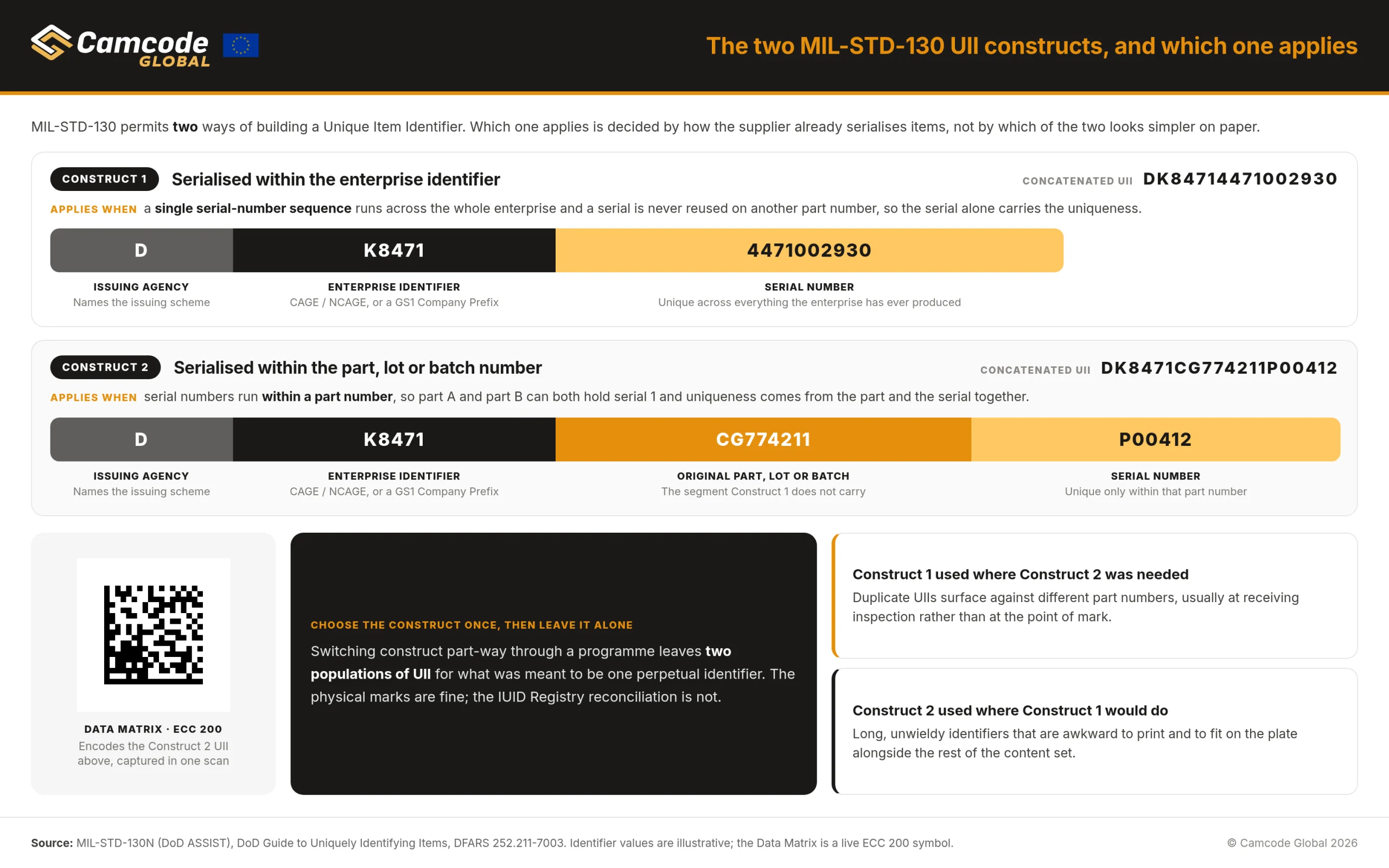
Use Construct 1 when serial numbers are unique across the enterprise. Use Construct 2 when uniqueness depends on combining the serial number with the original part, lot or batch number.
MIL-STD-130 is the United States DoD standard practice for marking of US military property for identification purposes. It covers:
The construction and encoding of Unique Item Identifiers (UII) for serialised assets. A UII is constructed from one of two formats (described in detail later in this document). Each format incorporates an Issuing Agency Code, an enterprise identifier, and a serial number or part/lot/batch reference. MIL-STD-130 defines how these elements should be ordered and formatted to ensure that the resulting UII will be globally unique and machine-parseable.
Pre-defined mark content set: UII, manufacturers part number, CAGE code, serialisation and other content as stipulated by the contract. Whilst the standard covers these four as a base set there are regularly additions requested by contracts such as National Stock Number, contract number, nomenclature or hazard/regulatory markings. MIL-STD-130 covers where mandatory content should be placed in relation to optional content so that as content sets increase a mark remains readable and auditable.
Acceptable marking methods: Labels/plates attached to asset, direct part mark (laser etch, dot peen or electrochemical etch). The standard does not specify one method as required. Instead it defines performance standards (adhesion, readability, operating environment resistance etc.) that any method must adhere to. Hence why Camcode Global are able to offer Metalphoto plates, laser-markable labels and DPM as three equally valid methods of compliance, decided by your asset not the standard.
Symbol selection rules: For new programmes, Data Matrix will be by far the most common choice. MIL-STD-130 allows linear barcodes for legacy purposes but explicitly calls out two-dimensional Data Matrix as the norm for contemporary work since it encodes the full UII and supporting data into a symbology with a relatively small footprint that legacy 1D scanners cannot read. That capture-layer requirement needs to be considered in conjunction with planning the mark itself.
The durability expectations and resultant grade requirements placed on the mark throughout the expected service life of the asset. MIL-STD-130 mandates the mark be readable for the entire time the item is in use, which is several decades for a lot of defence equipment, not merely years. This lengthy service-life expectation is the driver behind substrate selection (Metalphoto’s 20+ year outdoor rating was developed mostly because of this requirement) and is tested against ISO/IEC 15415 (printed marks) or ISO/IEC TR 29,158 (direct part marks) despite MIL-STD-130 not specifying a minimum acceptable grade. Each mark’s grade requirement would be defined by the spec it takes delivery under, MRI procedure, or contract QC specification.
Registration into the DoD IUID Registry throughDFARS 252.211-7003. Marking the item is only part of the requirement. Items that fall under the reporting requirements of DFARS 252.211-7003 need to have the UII and supporting information submitted into the DoD IUID Registry. This allows for an auditable link between the physical marking and an authoritative database maintained by the government. If a marking does not have a record in the Registry, it is incomplete in terms of compliance even if the physical label is flawless.
MIL-STD-130 is to the United States what Def Stan 05-132 is to the UK and DAOD 3038-0 is to Canada. Although they are similar in concept, they are different in practice: each establishes it own data structure, syntax rules and registry (or absence thereof) so a mark made to comply with one will not necessarily comply with another unless carefully laid out to do so.
How MIL-STD-130 Relates to MIL-STD-129
MIL-STD-130 is used to mark the item. MIL-STD-129 is used to mark the package. If you’re a UK or European supplier shipping serialised assets to the US DoD, chances are both standards apply to the same contract. They are easy to confuse because they use the same language (UII, Data Matrix, human-readable content), but apply to two entirely different physical things:
MIL-STD-130 covers the mark affixed to the physical item (Metalphoto plate or DPM label that displays the UII). This is the unique mark which stays with the asset throughout its service life (storage, issue, deployment, maintenance, disposal, etc.). Since this mark must remain associated with the asset for its entire life, it has to meet the durability and grading criteria mentioned above. Also, it is this mark, not the container or wrapper, which will be scanned during all future touch points of that asset.
MIL-STD-129 defines packaging marks, including marking of shipping containers. MIL-STD-129 specifies the mark for three levels of package: unit pack, intermediate pack and exterior pack. The unit pack is the first layer of packaging that is directly applied to the item, typically enclosing one or a few pieces. Intermediate packs bundle together unit packs. Exterior packs are typically the shipping containers. Information encoded typically includes national stock number, contract number, quantity and most importantly a cross-reference to the UII(s) of the contents. The packaging mark is temporary, typically destroyed when the goods are received and put into use, unlike the permanent item mark that will need to survive for multiple decades.
It is common for a shipment to have both a MIL-STD-130 mark on each serialised piece of equipment plus a MIL-STD-129 unit pack label that references those items by UII. Functionally, this creates a data chain: when the receiving depot scans the MIL-STD-129 pack label on arrival, they cross-reference the UIIs listed and verify that scanning each individual item’s MIL-STD-130 mark inside indeed matches what’s on the label. A mismatch (serial number that doesn’t match anything on the label, or label referencing a UII that doesn’t exist) is one of the most common reasons shipments are rejected on receiving inspection. For that reason planning of the two standards should really be done as one connected workflow instead of two independent mark tasks delegated to separate teams.
For UK/European suppliers who are new to US DoD contracts, the biggest misconception is usually believing that compliance with one standard means compliance with the other, or that one label can serve both purposes. It can’t: even if a shipment consists of only a single item, that item requires its own MIL-STD-130 mark separate to the MIL-STD-129 packaging label that it will be wrapped with, as they accompany different objects and are used up by different processes throughout the lifecycle of the asset.
How MIL-STD-130 Compares to UK, European, and NATO Equivalents
Practical equivalents for UK and European suppliers who need to comply with MIL-STD-130 include:
UK Def Stan 05-132: the UK MOD’s standard for identification. Coverage and intent are similar to MIL-STD-130. Rules for content and presentation are not identical.
Canadian DAOD 3038-0 (Materiel Identification): the Canadian DND standard. Based around the NATO codification system standard (ACodP-1).
Netherlands MoD Policy CDS 751: the Netherlands MoD policy for item identification and marking for its own procurement organisations and other asset-management organisations. Depending on the contract and item category, Mod Policy CDS 751 requires the NSN and item-master data, part number and serial number, manufacturer/enterprise identifiers, NATO UID structured according to STANAG 2290, human- and machine-readable content and presentation, and Data Matrix encoding on a durable substrate.
NATO STANAG 2290: NATO standard for Unique Identification of Items (the NATO Stock Number system itself is covered by the NATO Codification System / ACodP-1). NATO STANAG 2290 UID is analogous to the IUID UII; both standards can be used on the same item marking plate.
NATO STANAG 4329: NATO standard for bar code symbologies (AAP-44), maintained by the NATO Standardization Office. MIL-STD-130N doesn’t actually reference STANAG 4329 itself.
NATO STANAG 4427: NATO standard for Allied Configuration Management Documentation. STANAG 4427 doesn’t specify a mark but relies on one: STANAG 4427 configuration records can only be trusted if the physical item has been marked with a persistent identifier that links it back to its authoritative configuration baseline, which is precisely what a STANAG 2290 / IUID mark provides.
EN 9132: the European aerospace standard for Data Matrix marking of parts and assemblies. EN 9132 is essentially how STANAG 2290 and IUID-style UID content gets put on European aerospace parts; it’s used in conjunction with AS/EN quality-management requirements and customer ENG Specs.
Where UK and EU suppliers supply common UK MOD, Netherlands MoD, NATO and US DoD contracts concurrently, the pragmatic solution is to affix one Metalphoto plate which includes NSN + manufacturer’s part number + CAGE / NCAGE + serial + IUID / NATO UID Data Matrix along with human-readable equivalents. Format and place the data correctly on one plate, and you can simultaneously meet the requirements of Def Stan 05-132, CDS 751, STANAG 2290 / 4329, EN 9132 and MIL-STD-130.
The Wider Standards Landscape: Medical Devices, Pharmaceuticals, and Asset Management
Not all UK or European suppliers who are working on defence contracts are working defence contracts exclusively. There are a number of related regulatory regimes which are built upon the same foundational identifying and marking technologies covered by this guide. It will be useful to see where these fit around the defence standards above.
EU Medical Device Regulation 2017/745
EU MDR 2017/745 mandates that medical devices and packaging levels where applicable, sold into the EU market have a Unique Device Identifier (UDI) affixed to the product label (unless legally exempt). The UDI consists of two separate identifiers: a UDI-Device Identifier (DI) that identifies the specific model/version of device, and a UDI-Production Identifier (PI) which identifies production information of that device model being sold (serial number, lot number, expiry date, etc.).
UDI information is uploaded and registered to a database within the EU called EUDAMED. This is an EU-specific requirement only, similar to the US FDA UDI rule. However, they are not mutually compliant systems, meaning a manufacturer supplying to both the EU market and the US market, for example, would need to apply separate UDI content sets on separate device labels.
EU Falsified Medicines Directive (2011/62/EU)
The Falsified Medicines Directive mandates affected prescription medicines to be packaged with safety features at the individual pack level. This typically means a GS1 DataMatrix containing a product code, a unique serial number, batch/lot number and expiry date. The pack identifier is checked with the relevant national medicines verification system that interfaces with the European verification network.
ISO/IEC TR 29158 (formerly AIM DPM-1-2006)
ISO/IEC TR 29158 defines the readability grading scheme for Data Matrix symbols marked using direct part marking (laser etch, dot peen, chemical etch). It’s used by UK MOD and EU aerospace OEMs. ISO/IEC TR 29158 is to DPM symbols what ISO/IEC 15415 is to printed symbols. Every refurbished or DPM item conforming to MIL-STD-130, Def Stan 05-132, CDS 751 or EN 9132 will have been checked against this standard.
ISO 55001
ISO 55001 (Asset Management — Management Systems) considers unique identification to be foundational for the rest of an asset management system to operate. Downstream CMMS data, maintenance histories, audit trails, etc. cannot be trusted if they aren’t attached to a persistent and reliable identifier. This is why the revision to ISO 55000 family of standards led by BSI in 2024 added much stronger requirements around lifetime integrity of identifiers. It also explains why substrate and mark-type selection (discussed later in this guide) should be a compliance decision, not just a procurement one. Camcode Global’s Asset Life Cycle Management Advisory (ALCMA), provided by KPMG, is centred around ISO 55001.
The IUID UII: How It Is Constructed
There are two forms that a MIL-STD-130 mark’s Unique Item Identifier can take:
Construct 1: Issuing Agency Code (IAC) + Enterprise Identifier + Serial Number. This format is possible because the serial number by itself is unique across all items ever produced by the enterprise. The supplier uses only one serial number sequence (or set of sequences managed centrally) and never reuses a serial number across all product lines and part numbers.
Construct 2: Issuing Agency Code (IAC) + Enterprise Identifier + Original Part Number (or lot/ batch) + Serial Number. This format is used when serial numbers do not carry uniqueness across part numbers (i.e., part number A may have serial number 1 and part number B may also have serial number 1). Incorporating the part number (or lot/batch reference) into the UII itself eliminates that conflict, because uniqueness is being derived from the combination of part number and serial number instead of the serial number by itself.
Each component has its own purpose:
Issuing Agency Code (IAC): A short code to indicate which registration scheme issued the enterprise identifier that comes next. This instructs the DoD IUID Registry (and anyone else viewing the mark) how to interpret the next portion of the UII.
Enterprise Identifier: This is the actual identifier assigned to the manufacturing/supplying organisation itself, where you would put the CAGE, NCAGE, or GS1 Company Prefix mentioned above.
Serial Number / Part Number / Lot or Batch: The item-specific piece that, when combined with the enterprise identifier, makes the entire string unique to that one physical piece.
The IAC for UK and European suppliers will usually be based on GS1 (if the supplier is GS1-registered) or CAGE / NCAGE (if defence-registered):
CAGE/NCAGE-based suppliers use their existing defence registration number as the enterprise identifier. The vast majority of existing UK/European defence suppliers will already possess an NCAGE code from previous MOD or NATO contracts, therefore this pathway to IAC usually involves zero registration. The existing code is simply reused as the enterprise identifier within the UII.
GS1-based suppliers use their GS1 Company Prefix. This is generally the preferred route for suppliers who are primarily registered for commercial work rather than defence, or who already use GS1 identifiers for their commercial products and wish to have a single enterprise identifier scheme which covers both.
Which construct applies will depend upon how the item is serialised: Construct 1 when the item is serialised under the enterprise identifier, Construct 2 when serialised under the part, lot or batch number. Experience shows that determining which construct applies is rarely obvious at the start. It depends on how the supplier currently has their production and serialisation records structured, not on which construct appears simplest.
You’ll usually only know you’ve got it wrong when it’s too late: duplicate UIIs appearing against multiple part numbers (Construct 1 was applied when Construct 2 was needed), or excessively long, unwieldy UIIs that are difficult to print when Construct 1 would have sufficed. That’s why Camcode Global’s engineers look at how the supplier serialises items in Step Two of our seven-step process (which we break down in more detail later in this guide), before agreeing the marking specification, not afterwards.
After selecting a construct for a particular part/product line, it must remain unchanged. Changing constructs during a programme results in two populations of UIIs for what was intended to be a singular perpetual identifier, negating the benefit of a globally unique identifier and complicating future IUID Registry reconciliation efforts.
Identifier Types: What a Mark May Need to Carry
Prior to mark designing taking place, the codes that the mark will need to embody must first be established. Especially on multinational defence, aerospace, healthcare and pharmaceutical programmes, each asset can often be required to have multiple identifiers to aid codification, item-level traceability, ownership, maintenance and interoperability between numerous national and organisational platforms.
NATO Stock Number (NSN)
An NSN is a 13-digit supply classification code assigned using the NATO Codification System pursuant to STANAG 3150 and STANAG 3151. The NSN designates a standardised item of supply, not an individual serialised asset.
Unique Item Identifier (UII / IUID)
A unique, permanent item identifier assigned to an individual item. Used by US DoD and governed by DFARS 252.211-7003 and MIL-STD-130. When required, associated item data is registered in the DoD IUID Registry.
NATO UID
A system managed item level identifier compliant with STANAG 2290 and adopted according to AUIDP-1. NATO UID facilitates the unique identification and lifecycle traceability of individual items within and across NATO countries and systems. NATO UID may be presented on the same physical mark as an NSN or IUID UII.
GS1 Global Individual Asset Identifier (GIAI) and GS1 GTIN
GIAI is used to identify an individual asset. It is formed from an organisation’s GS1 Company Prefix, and asset reference which is under that organisation’s control. GS1 GTIN is used to identify what item is being supplied. It can be concatenated with a serial number to provide item level identification. Both are accepted in addition to NSN-based schemes on UK and EU government commercial contract templates.
UK MOD Identifiers
The UK MOD may utilise equipment, inventory and logistics identifiers in addition to NSNs, serial numbers and UID associated data. The mandated identifier composition depends on the relevant Defence Standard, platform, contract and logistics information system.
EU Medical Device Identifiers
Medical devices that are regulated by EU MDR 2017/745 contain Unique Device Identification data (comprising the UDI Device Identifier and UDI Production Identifier) used to support device identification, production traceability and regulatory reporting to EUDAMED.
Packaging and Logistics Identifiers
Packaging may need identifiers like the GS1 Serial Shipping Container Code (SSCC), GTIN, lot number, batch number, expiry date, or serial number to support shipment visibility, packaging hierarchy and supply-chain traceability.
CAGE and NCAGE Codes
Hierarchical codes such as CAGE and NCAGE codes uniquely identify the organisation that manufactures, supplies or controls an item. They are often used as the enterprise identifier as part of UID constructs and other defence identification constructs.
Internal or Proprietary Asset Identifiers
Enterprises may operate their own asset identification system, provided they tightly control allocation rules, avoid duplication and maintain a reliable and persistent record. These IDs should still conform to any ERP, EAM, or consuming asset-management system.
What Goes on a MIL-STD-130 Mark
A typical MIL-STD-130-compliant mark carries:
The IUID UII encoded as a Data Matrix symbol. This is your primary machine-readable payload. It’s the same UII alphanumeric string created using Construct 1 or Construct 2 guidelines, but encoded as a two-dimensional Data Matrix symbol instead of just printed plain-text on its own. This encoding allows a single scan to capture the entire identifier string directly into a system of record without need for manual entry, which is the entire reason we transitioned from human-readable serial labels and tags to UID labels/marks originally.
Human-readable presentation of the UII or associated content. Any machine-readable mark requires a human-readable fallback, both because scanners break/port aren’t always accessible (consider a technician performing a visual inspection in the field) and because some inspection and audit processes explicitly still require eyes-on verification. The human-readable text is not required to repeat every character of the encoded UII exactly. It most commonly displays the UII’s constituent parts (IAC, enterprise identifier, serial) in a more readable format, but should enable someone without a scanner to positively identify the asset.
Manufacturer’s part number. This is provided so the item can be tracked by its commercial or engineering number independent of the UID scheme (inventory management, ordering spares, technical manuals lookup, etc. are activities where people are likely to be working with part numbers rather than serial-level identifiers). Because everybody should be using UII by now anyway, this data field may be redundant with the encoded information.
CAGE code. Identifies which company supplied or otherwise has authority over the part. This is the same code that would normally be used to fill the enterprise identifier component of the UII itself, so having it on the mark in plaintext as well allows someone to verify the manufacturer without having to decode the Data Matrix.
Serial number for serialised assets. This identifies this individual unit from every other unit of the same part number. For Construct 2 parts, this would be the trailing segment appended to the part number or lot/batch designation; Construct 1 parts would have the serial number comprise the entire item unique segment of the UII.
Contract number or programme reference, where applicable. This field is not required on all marks. However, if a contract stipulates it, a contract number links the physical asset back to the procurement action or programme which purchased/specified the item, enabling warranty follow-up, configuration management and programme-level auditing.
Additional regulatory or hazard marks where the asset requires them. This line item serves as a catch-all for any data elements that are driven by regulatory needs outside the UID standard itself, such as warnings about hazardous materials, ITAR/export-control markings, calibration expiration dates, or any other regulatory information that must, for physical reasons, be printed on the same plate or label as the UID information. Trying to fit this content around the required UID content without making the overall mark too cluttered or encroaching on margins needed for scanning the Data Matrix code is one of the more typical layout obstacles vendors encounter, which is why the specification for the mark (created in Step Two of Camcode Global’s seven-step process) plans for the full content set from the beginning instead of retrofitting other marks as an afterthought.
The Data Matrix must be sized for reliable scanning in the environment where the asset will use it, and graded to ISO/IEC 15415 (printed marks) or ISO/IEC TR 29158 (direct part marks, previously AIM DPM-1-2006). Symbols are not sized simply for aesthetic reasons. A symbol sized too small for the intended scanning distance and lighting conditions of its intended operating environment will not decode reliably even if it is printed or etched flawlessly, whilst a symbol sized very generously for ease of reading in a controlled depot environment may not be readable in the field where handheld scanners, difficult lighting conditions or difficult angle off approach may be encountered.
That’s why the symbol grading standards look at factors in addition to whether the code is printed correctly. They grade factors such as contrast, fixed pattern damage and print growth that can be used to predict how the mark will fare in a wide variety of realistic scanning conditions, rather than just ideal conditions at time of manufacturing.
MIL-STD-130 does not mandate a minimum grade. The applicable specification, MRI protocol or contract quality-control document specifies the acceptance grade (usually B or C). This means that the grade a supplier is required to meet is not determined by reading MIL-STD-130. Instead, it must be confirmed against whatever specification the contract calls out, and that requirement may differ from programme to programme even if both specify MIL-STD-130 as the underlying marking standard.
Grade B (ISO/IEC 15415 grade 3.0) is far more commonly used for IUID applications because it allows more tolerance for degradation as the mark ages or wears. Grade C (grade 1.5) requirements are used as an acceptable minimum where suitable. Ensuring you are meeting the correct grade (and keeping proof you met that grade on each item) is what makes the statement “we printed a Data Matrix” a defendable position if the mark is questioned at receiving inspection or audit.
Mark Types Camcode Global Offers
MIL-STD-130 is substrate-agnostic but specifies durability evidence, and the equivalent UK, European, and NATO standards behave the same way: none of them mandate a single material, but all of them expect the chosen mark to survive the asset’s service life. Camcode Global manufactures the full range of marking technologies used across these programmes:
Photosensitive Anodised Aluminium — Metalphoto®
A sub-surface, inorganic image sealed beneath the anodised surface of the aluminium. Metalphoto is extremely durable and meets a wide set of performance requirements. It’s best suited to high- and medium-volume requirements (poor for small volumes or on-site marking) and offers flexible size, thickness, and attachment options.
Typical applications include:
Small arms / weapon ancillaries
Ships / marine
Aircraft / aerospace
Engines / components
Complex / crew-served weapon systems
Communications equipment
Chemical / heat / sunlight exposure
Laser-Markable Materials
Steel, BlackPlus, or acrylic. The etched or bonded image is durable (depending on substrate), but laser marking is slower and more labour-intensive. It’s best for low-volume, on-site applications where real-time marking is required. Laser-markable materials offer flexible size, thickness, and attachment options, though on-site fabrication may be needed if pre-cut blanks aren’t available.
Typical applications include:
Small arms and weapon ancillaries
Aircraft / aerospace
Engines / components
Complex / crew-served weapon systems
Communications equipment
Chemical / heat / sunlight exposure
Thermal Transfer Labels
An ink transfer image whose durability depends on the material. Thermal transfer labels can meet moderate-to-high demand volume, with on-site printing possible for real-time marking needs. Size, thickness, and attachment options are limited.
Typical applications include:
Soft and hard armour
Hospital equipment
Direct circuit board marking
General asset tracking
Suppressor marking
Extreme heat, 500°C–1200°C
Ink Jet / Digitally Printed Labels
An inkjet-printed image whose durability depends on material and overlay. Ink jet / digitally printed labels can meet moderate-to-high demand volume, with limited size, thickness, and attachment options.
Typical applications include:
Soft and hard armour
Ballistic / bump helmets
Hospital equipment
General asset tracking
Cut-Through, Stamped, and Engraved Plates
CNC-punched plates offer good durability and are most suitable for low quantities. These plates can present readability issues in some applications, and size, thickness, and attachment options are limited by material.
Typical applications include:
Heavy equipment
Ships / marine
Chassis marking
Woven Fabric Tags
Woven fabric tags are sewn tags offering moderate durability with limited attachment options (heat seal or sewn). Woven fabric tags are ideal for fabric marking.
Typical applications include:
Parachutes
Apparel
Other woven / fabric assets
Direct Part Marking (DPM)
A laser-etched or dot-peen direct mark that is durable, although the marking process is slower and more labour-intensive. It’s ideal for applications where affixing a label isn’t possible, including refurbished aerospace and defence components. DPM Data Matrix marks are verified using the grading principles in ISO/IEC TR 29158.
Typical applications include:
Bridging
Harsh chemical environments
Surgical tools
Aircraft components
NFC-Enabled Tags
NFC is a passive radio-frequency identification protocol requiring the reading device to be within roughly 4cm of the tag. It has the added benefit of being readable by most smartphones, and is ideal where a barcode can’t be affixed or where the system needs to trigger alternate actions on each scan.
Typical applications include:
Communications equipment
Hospital equipment
General asset tracking
The operating environment and attachment surface must be defined before a marking technology is selected. This is exactly the assessment Camcode Global’s engineering team runs during Step Two of our seven-step process, described later in this guide.
Automatic Identification and Data Capture (AIT) Technologies Camcode Global Deploys
A permanent mark is only valuable if you can read its data quickly and efficiently, and then input that data into the systems that track the asset. Camcode Global evaluates and implements AIT/ AIDC solutions according to read range specifications, asset application, data capacity needs, system architecture and operational workflow.
Linear and Two-Dimensional Barcodes
Camcode Global offers linear and two-dimensional symbologies such as Code 39, Code 128, GS1-128, QR Code, PDF417 and Data Matrix. Data Matrix is the most widely used symbology for defence UID work because it allows a large amount of encoded data to exist in a small space and be applied as a label or with Direct Part Marking.
Passive RFID
Passive RFID tags are powered by the reader and send the encoded information back to the reader system. These tags are ideal where line-of-sight scanning is impossible or multiple tags need to be read simultaneously such as in warehouse inventory management, arms-room accountability or asset issue/return processes.
Active RFID
Active RFID tags carry their own power source and transmit over longer distances than passive RFID. They’re generally used for higher-value assets, containers, vehicles or in-transit visibility across a wider area.
Real-Time Locating Systems (RTLS)
RTLS gives you continuous visibility into the location and movement of assets throughout a specified environment. RTLS can be based on active RFID, Bluetooth Low Energy, ultra-wideband, Wi-Fi or other technologies depending on the level of precision you need and the layout of your facilities.
Optical Character Recognition (OCR)
OCR transforms printed, stamped or engraved characters into structured digital data. It’s useful for data-cleansing applications, retroactive nameplate capture on legacy equipment and validating records in SAP / ERP systems. However, because of wear and damage, results should always be verified. Worn plates and damaged etching will yield character recognition mistakes.
GPS and GNSS Asset Tracking
GPS as well as other Global Navigation Satellite System (GNSS) technologies tied into cellular or satellite communication allow you to track assets that travel from job site to job site, city to city or even cross country. Vehicles, containers, field deployable assets and international shipments can be monitored using these technologies.
NFC-Enabled Asset Identification
In addition to serving as a label type, NFC is also a capture technology itself. Field engineers can use their smartphones to access equipment history, maintenance instructions, and digital user manuals stored on the tag itself.
Biometrics and Smart Cards
Smart cards and other electronic credentials link an asset transaction to the person who performed it. Typically used to manage access, log equipment issue and return, or assign accountability for sensitive assets, biometrics can be incorporated for even stronger proof of identity.
Sensor Technology
Sensors gather contextual condition/environmental data (temperature, humidity, shock, vibration, pressure, motion) associated with the asset’s unique identifier to create a more complete lifecycle and condition history.
Electronic Article Surveillance (EAS)
Electronic article surveillance technology helps with theft deterrence and perimeter control of secured, sensitive, or high-value inventory. EAS is typically a security control layer vs. a stand-alone identification solution and can be applied on top of UID, barcode or RFID technology.
Substrate Choices for MIL-STD-130 Work
MIL-STD-130 specifies what the mark shall withstand, not what material it shall be applied to. That’s an important distinction because it elevates substrate selection to an actual engineering decision rather than merely a compliance checkbox: two suppliers applying the same part number can both be 100% MIL-STD-130 compliant and use entirely different materials if both have the evidence to support their decisions. The most common choices for UK and European suppliers:
Metalphoto Anodised Aluminium Plates
Metalphoto anodised aluminium plates are best suited to serialised assets used outdoors, in marine environments or industrial settings. Service life of 20+ years when tested to MIL-STD-130 cascade standards. By embedding the image beneath the anodised layer of aluminium (rather than having it rest on top of the coating), Metalphoto markings are made abrasion-resistant and can withstand UV rays, salt spray, fuels and most solvents they are likely to encounter during their service life.
Unlike traditional paints and labels, because the mark is indelibly linked to the surface of the metal itself, they tend to remain scannable long after paint schemes or other finishes applied to the parent asset have faded or been worn away (something Camcode Global sees as a typical cause of failure from cheaper, less durable substrates applied to the same equipment).
Premium Polyester Labels
Indoor electronics, instrumentation, medical devices, short-life industrial. Polyester can provide a significantly lower cost per label and faster turnaround than Metalphoto, so it’s the logical choice when the service life of the asset does not require multi-decade durability, or where the environment can be expected to be controlled (indoor, climate-controlled, limited chemical exposure).
The downside is that polyester’s average service life is only about 3-7 years depending on UV/chemical exposure. So specifying polyester for an outdoor or industrial asset with a 15-20 year expected service life is a mistake most programmes only make once, at tremendous cost. The label wears out years before the asset, forcing you to go through another round of identification when your programme didn’t budget for it.
Ceramic Tags
Used when paint stripping, shot blasting, aggressive chemistry, etc. will occur. Ceramic was chosen as the substrate specifically because it can withstand processes that would obliterate metal or polymer labels. Something that is routinely re-painted, blasted, or chemically stripped as part of its maintenance cycle needs a label that can undergo that process along with it, rather than being removed and re-applied every time.
Direct Part Marking (Laser Etch or Dot Peen Data Matrix)
Graded to ISO/IEC TR 29158, for refurbished aerospace and defence components. Although DPM is not always chosen for reasons of cost or convenience, it is used because for some parts a separate label or plate simply cannot be reliably applied under any circumstances. There is no flat surface to mount it on, the vibration/heat environment will eventually make anything adhesive fall off, or the part undergoes refurbishing processes which would remove a label every time.
Engraving the ID directly onto the part itself means it is no more likely to be lost than the part itself. That’s the whole point of DPM versus an applied label. The downside (explained in more detail in other sections of this guide) is that DPM marking and reading is labour-intensive and requires an initial tooling investment that label-based marking does not.
The default substrate for most UK and European MIL-STD-130 work is Metalphoto, as MIL-STD-130 cascade testing results obtained on Metalphoto plates have effectively become an industry standard against which alternate materials measure themselves. It’s a practical distinction: since much of the durability testing data and field performance analysis that goes into assessing MIL-STD-130 compliance has been done on Metalphoto, it is the substrate with which most quality assessors, auditors and receiving depots will be familiar. That means conversations about compliance are usually more straightforward than they would be when arguing from first principles that another substrate is also acceptable.
This isn’t to say that Metalphoto is always the best choice of substrate. But it does mean that suppliers who opt for something different (whether for reasons of cost, weight savings or application-specific requirements) should be prepared to demonstrate as such, rather than assuming their deviation will be accepted without question.
Selecting your substrate is also not an independent choice from the remainder of the mark. The substrate must allow for the entire family of content previously described in this manual, it must fit inside the available marking real estate on the asset and it must allow for the Data Matrix grading tolerances required by the contract. Hence, the substrate decision is contained within Step Two of Camcode Global’s seven step process (right along with the mark specification) instead of being a stand-alone purchasing decision which is completed prior to engineering.
Building MIL-STD-130 and Multi-Standard Compliance Into a UK or European Operation
All of the above (the UII construct, the mark content, choice of substrate) converge operationally into a repeatable internal process. For suppliers in the UK and Europe developing or refining that process, the following sequence should loosely follow the order that these decisions need to be made, from registration through to the asset-management process that maintains identifier value well beyond mark application.
Register a CAGE or NCAGE code. Required as the manufacturer identifier on the mark.
Confirm the IAC. GS1 or CAGE-based, depending on contract.
Design the mark template. Metalphoto plate sized for the full content set (including any Def Stan 05-132, CDS 751, STANAG 2290/4329, or EN 9132 content the same contract cascades) with Data Matrix sized to the receiving scan environment.
Set up Data Matrix grading. ISO/IEC 15415 (printed) or ISO/IEC TR 29158 (DPM) Grade C minimum, with calibrated verifier and per-item grade evidence retained.
Build the IUID Registry submission workflow. Each marked item needs the matching Registry record; the same discipline applies to EUDAMED submissions under EU MDR, where applicable.
Plan dual- and multi-scheme work. If the same contract cascades Def Stan 05-132, CDS 751, or DAOD 3038-0, the plate has to carry the combined content set.
Align with ISO 55001. Treat the identifier as the foundation record your asset management system depends on, not an afterthought bolted on at handover.
Common UK and European Supplier Pitfalls With MIL-STD-130
All too frequently, even a technically correct MIL-STD-130 marking programme can go off the rails, not through lack of understanding of the standard itself, but through decisions taken in the interests of time or cost that don’t demonstrate their true cost until much later down the line. Here are the most common pitfalls we see from UK and EU supplier work, all of them stemming from a sensible-seeming shortcut that seemed reasonable at the time.
Substrate selected based on price, not on asset lifetime. Polyester labels placed on outdoor industrial assets have a life expectancy of 18-24 months. The amount of money saved by purchasing the less expensive label is almost always outweighed by the downstream expenses incurred when you have to locate that asset, remove the failed label, remark the asset and update the Registry record with that change. Organisations can avoid that scenario entirely by selecting a substrate that will last as long as the asset was intended to at the initial application, instead of when it fails.
Data Matrix not verified at point of mark. There are marks that pass visual inspection but fail at the receiving depot’s verifier because visual inspection can only tell you that the symbol looks right. What visual inspection won’t detect are the print-quality problems (low contrast, damaged fixed pattern, improperly sized modules, etc.) that the verifier is designed to catch.
If the mark is not graded at the point of mark, the first indication that something is wrong is usually when the part gets to the depot and fails on much more discriminating scanning equipment than the supplier was using previously. What should have been a preventable manufacturing error becomes a contractual rejection.
Registry submission lag. The mark is there, but the Registry record won’t post for days.This destroys inventory processes. Receiving depots and other downstream systems want and require the Registry record to be present at or before delivery, not several days after. Even a few days lag means a scanned marked item can bounce back “no record found”. Manual workarounds must be employed, which defeat the entire purpose of a Registry supported identification mechanism.
Confusion between MIL-STD-130 and MIL-STD-129. The two standards cover different scopes. Suppliers often design to one and forget the other. This occurs frequently with vendors new to US DoD business. They think of “the marking requirement” as one requirement instead of two, so they design the compliant mark on the item, forgetting that the package surrounding it requires a unique MIL-STD-129 mark around it, or they forget to design the item mark while focusing on the package mark.
Re-identification gaps. Parts come out of the shop either with no UII or with an unverified mark. Refurbishment, repair, or configuration updates can change whether or not the old mark is truly representative of the asset. If a part has been re-worked, it should receive a new UII if not at least a newly verified mark before returning to service. Failure to do so results in an in-service asset with an identifier that may not accurately identify its true state or history.
Content shortcuts on multi-scheme labels. Attempting to meet the requirements of two standards with one label when that label isn’t carrying the complete set of content elements required by either standard (for example, NSN-only marking that falls short of IUID mandates, or vice versa). This often occurs when a supplier mistakenly believes two overlapping schemes share more common content than they actually do, or attempts to conserve mark real estate by abbreviating content elements that appear redundant but are in fact required by both standards independently.
The solution isn’t an ingeniously engineered label layout, but verification that every content element required by each cascaded standard is present before the template is finalised, which is precisely what Camcode Global’s engineering team will do during Step Two of our seven-step process.
Camcode Global’s Seven-Step Data Cleansing, Asset Identification, and Data Optimisation Process
Achieving compliance with MIL-STD-130 (or any of the above standards) is not a one-time label-design project; it’s a repeatable process. Developed through years of working with NATO defence customers on interoperability and ITV projects, Camcode Global’s seven-step process will guide you to and maintain compliance with NATO STANAGs, from your initial consultation through lifecycle management. See The Framework above for details on each step, and visit The Results for examples of defence, infrastructure and manufacturing organisations who have seen the benefits of this process.
Step One: Asset Identification & AIT Consultation
Our team analyses your project and advises on how to best tailor processes to satisfy the relevant standards and framework (MIL-STD-130, Def Stan 05-132, CDS 751, STANAG 2290/4329, EN 9132, etc., or other standards that have been cascaded by the contract), maximise asset value, streamline processes for productivity and compliance, implement automation and standardisation or improve supply chain visibility.
Step Two: Engineering Services
Our engineers design the marking specification (sometimes referred to as a factsheet) which clearly identifies what information will be used to mark the asset and how. This includes both the data content and the physical requirements of the marking. Following verification of a sample of asset data in the field, the team establishes business rules and data governance and selects the most appropriate marking method from the numerous options discussed earlier in this guide.
Step Three: Data Remediation, Reconciliation & Verification
Using Camcode Global’s proprietary offline or online data collection software, the data collected is captured in a clean format compliant with relevant standards and frameworks, simplified to work flows that reduce human error, integrated with existing databases and outputs detailed reporting and analytics.
Step Four: AIT Product Manufacture & Procurement
Products are either manufactured or procured to the specifications agreed in Step Two including: barcodes (1D, 2D, QR Codes, GTIN, SSCC, UDI), RFID tags, sensors, GPS, OCR, RTLS, NFC, EAS, biometrics or other AIT technology built to meet the businesses operational and environmental requirements.
Step Five: AIT Product Installation
Our NATO Security Cleared installation teams then install the AIT product as per the marking spec or factsheet. Using our proprietary software, we associate the correct data set to each product before it is installed on the asset. All installations are executed in accordance with regulatory and NATO requirements.
Step Six: Data Reporting & Migration
With marking in place, tailored reporting systems provide operational insight into key metrics, identify variances and ensure continued quality master data. This minimizes the time you spend reconciling data and will continue to streamline processes throughout the life of the programme.
Step Seven: Asset Life Cycle Management Advisory (ALCMA)
KPMG’s Asset Life Cycle Management Advisory services help customers manage their assets through planning and acquisition, maintenance and optimisation, and disposal. KPMG provides advisory services that focus on maximising asset performance, reducing costs and helping customers adhere to industry standards and regulations such as ISO 55001.
Across NATO defence engagements, this process has identified over 3 million ITAR items to ensure compliance and meet US DoD reporting obligations, cleansed over 4 million lines of system data to improve asset visibility and lifecycle management, and validated and corrected over 21% of OEM data to help rotary fleets meet EU regulations and airworthiness requirements.
Frequently Asked Questions
Is MIL-STD-130 mandatory for all US DoD shipments?
MIL-STD-130 is applicable when called for by the contract and the item being shipped qualifies as meeting the requirements of DFARS 252.211-7003 IUID criteria:
A government acquisition unit cost of $5,000 or more
Certain sub-$5,000 items designated in the contract schedule
Items embedded in higher-level assemblies
Items with warranty requirements
DoD serially managed reparables and non-reparables
Special tooling or special test equipment
Can a single Metalphoto plate be used for MIL-STD-130, Def Stan 05-132, and CDS 751?
Yes, if you organise your content correctly. The plate carries NSN, manufacturer’s part number, CAGE / NCAGE, serial number, IUID UII / NATO UID and a Data Matrix encoded with the identifier.
Is Data Matrix mandated by MIL-STD-130?
Data Matrix is by far the preferred symbology for new work under MIL-STD-130. Linear barcodes are still acceptable for legacy applications.
Where can I download the latest version of MIL-STD-130?
The DoD ASSIST repository at assist.dla.mil. International suppliers can register and download.
How does MIL-STD-130 relate to EU MDR UDI?
EU MDR UDI is a separate medical device coding and marking scheme that applies to medical devices sold in the EU. A UK/EU medical-device supplier exporting to both the EU and the US would need to comply with both coding schemes, and will likely have two separate content sets on two separate marks.
What about the EU Falsified Medicines Directive?
It’s another packaging-level pharmaceutical serialisation requirement (2011/62/EU), separate from MIL-STD-130 as well as EU MDR UDI. It doesn’t impact defence asset marking, but is good to know if you supply pharmaceutical customers as well.
Does ISO/IEC TR 29158 replace ISO/IEC 15415?
No. They’re standards for different types of marks. ISO/IEC 15415 grades barcodes and other printed symbols. ISO/IEC TR 29158 grades Direct Part Marks (ISO/IEC TR 29158 was previously AIM DPM-1-2006.) If your programme utilises both label marking and DPM, then you would use both standards.
Do you need ISO 55001 certification to be MIL-STD-130 compliant?
No, they’re completely separate. MIL-STD-130 deals with marking of an individual item. ISO 55001 deals with the asset management system that the identifier will feed. Most defence customers require both, as a MIL-STD-130 mark that is not feeding a well-managed asset management system is of limited value.
How Camcode Global Supports MIL-STD-130 Programmes
Camcode Global manufactures Metalphoto anodised aluminium plates, laser-markable materials, thermal transfer and ink jet labels, cut-through and engraved plates, woven fabric tags, direct part marking outputs, and NFC-enabled tags that satisfy MIL-STD-130 durability and grading requirements, alongside Def Stan 05-132, CDS 751, STANAG 2290/4329, EN 9132, EU MDR UDI and EU FMD content where a contract cascades them. Our AIT capability spans barcodes and Data Matrix, passive and active RFID, RTLS, OCR, GPS tags, biometrics and smart cards, sensor technology and electronic article surveillance, all integrated with customer ERP systems through our proprietary data cleansing and reporting software.
As a NATO-approved provider for over 12 years and holder of a NATO Support and Procurement Agency (NSPA) Enabling Contract, our UK and European customer base spans defence primes and SMEs working US DoD contracts directly and through NATO programmes. We grade every Data Matrix mark to ISO/IEC 15415 and ISO/IEC 29158 before despatch and retain per-item evidence in the quality record, all delivered through our seven-step Data Cleansing, Asset Identification, and Data Optimisation Process, with Asset Life Cycle Management Advisory provided by KPMG.
Meet the marking and governance requirements of standards such as CDS-751, DEF STAN 05-132, MIL-STD-130, DEF(AUST) 1000C, and DAOD 3038-0 with a fully integrated, all-in-one mobile laser marking cart solution. Produce and mark assets on-site after data has been verified — ensuring:
Small-run, on-demand UID production
Durable, permanent 2D Data Matrix marking
Alignment with SAP S/4HANA data governance
Elimination of external lead times UID mark verification
Thank You
We have received your request. We will reach out to you soon.