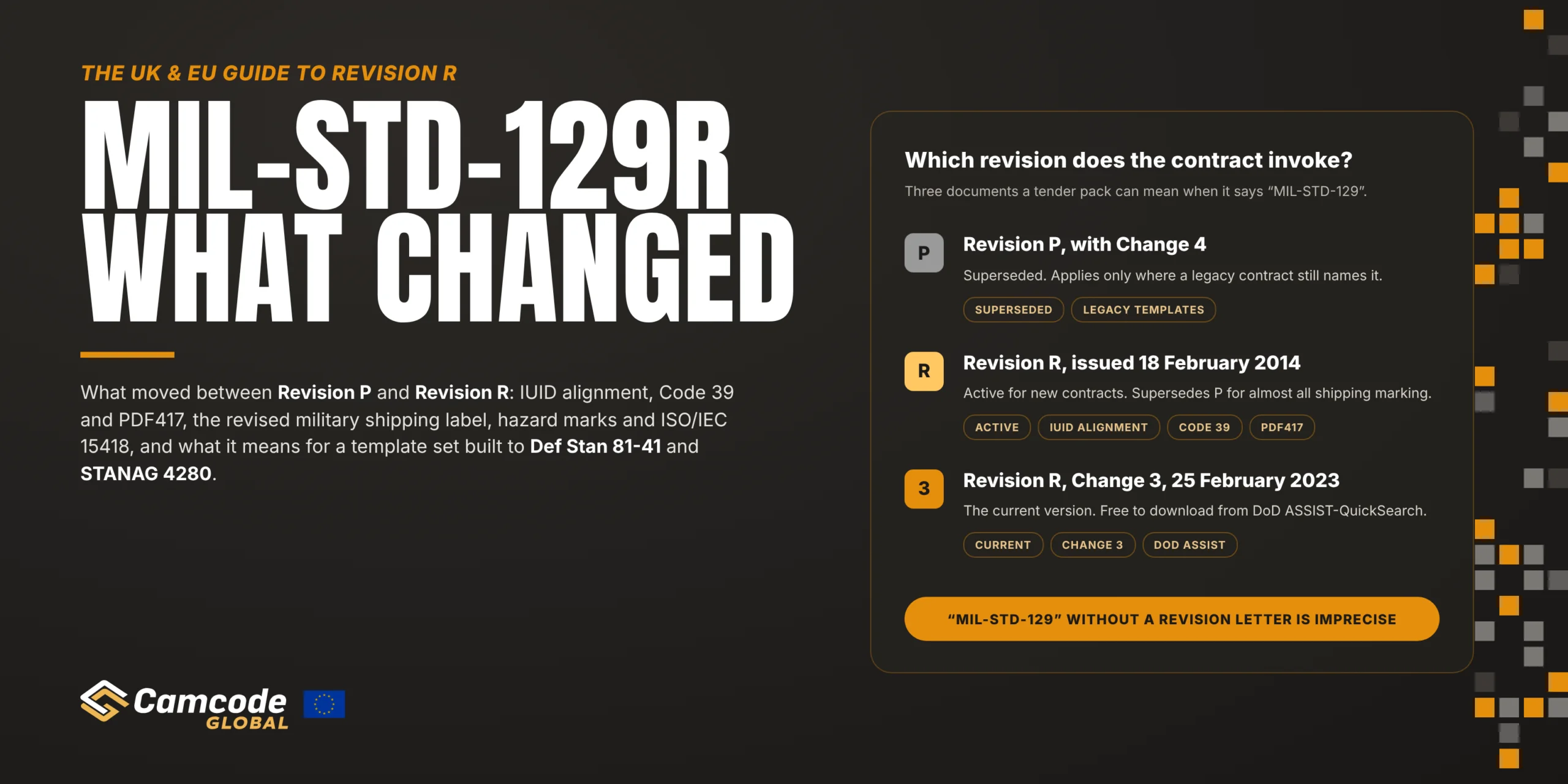
MIL-STD-129R was issued by the US Department of Defense on 18 February 2014, with subsequent change notices published through Change 3, dated 25 February 2023. According to the DoD ASSIST repository’s revision log, MIL-STD-129R is the active revision for new contracts, and Revision P (the predecessor) has been formally superseded for almost all shipping-marking purposes. For UK and EU suppliers feeding into US DoD or NATO-via-US-prime programmes, knowing what changed between revisions and what is now expected on the loading bay is the difference between a clean receipt and a returned shipment.
Rarely does a MIL-STD-129R shipping label travel without companion documentation. The package to which it is affixed will often itself contain serialised items which carry their own item identification markings. That same consignment may also need to meet UK MOD, Netherlands MoD, NATO, aerospace or EU healthcare marking requirements. Get the packaging mark right and the item mark wrong (or vice versa) and the receiving depot will still be unable to reconcile what arrived with what was ordered.
This guide focuses on what’s required by MIL-STD-129R that wasn’t in previous versions, what didn’t change and considerations UK and EU suppliers need to weigh when upgrading their packaging and labelling systems to comply with MIL-STD-129R. We’ll then look at the broader scope: identifier types found on packages and items, marking technologies Camcode Global offer to apply those identifiers, automatic identification technologies (AIT) used to read them, other UK, EU and NATO standards that accompany MIL-STD-129R and finally Camcode Global’s seven step process to integrate it all.
 CAMCODE GLOBAL
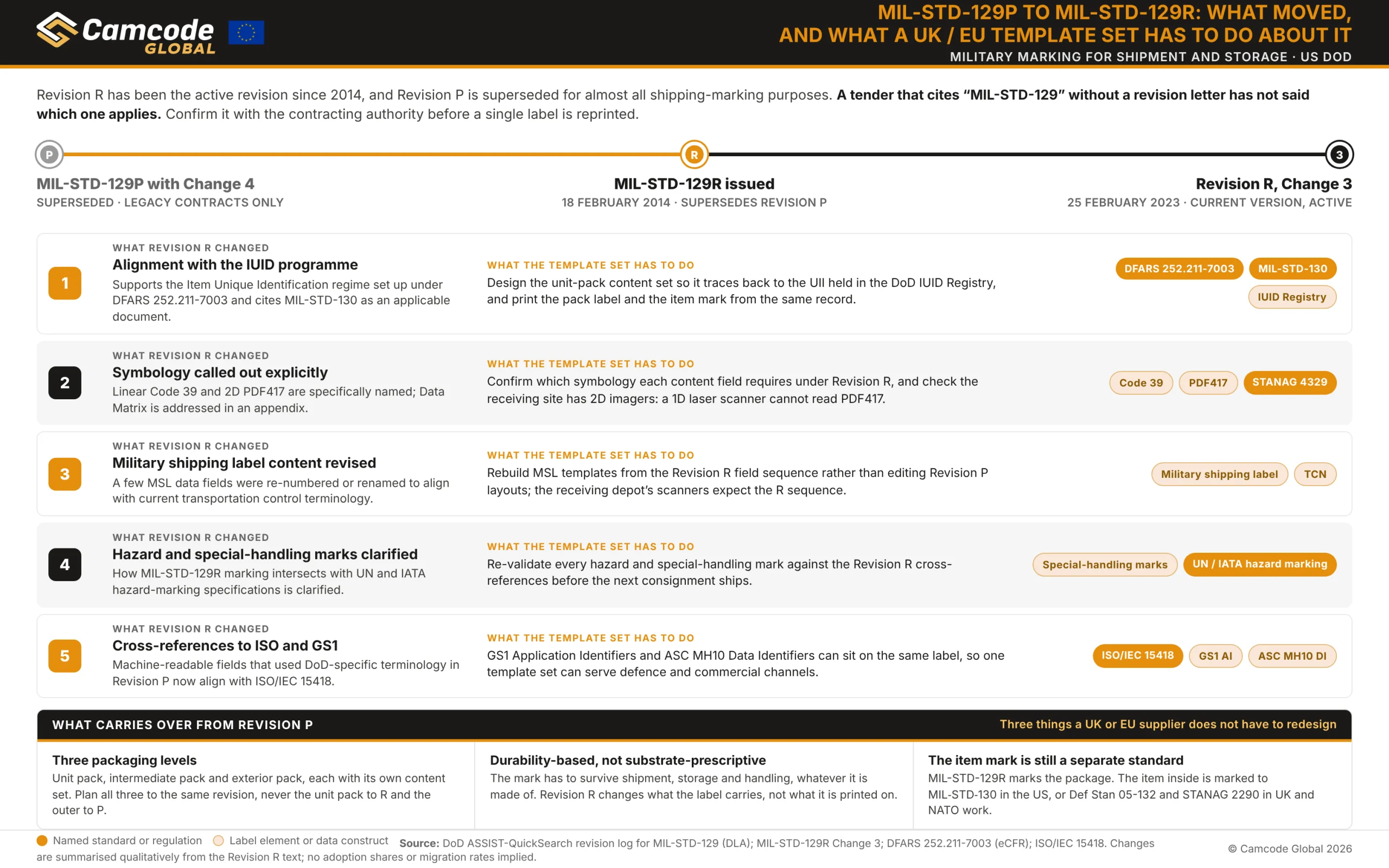
MIL-STD-129P vs MIL-STD-129R – what changed
| Area | Revision P | Revision R | UK / EU supplier action |
|---|
How this is calculated & sources used
Comparison compiled from MIL-STD-129R published text, DoD ASSIST revision log, and Camcode Global UK / EU supplier engagement experience.
Sources actually used:
• MIL-STD-129R
• DoD ASSIST repository
• DFARS 252.211-7003
Note: MIL-STD-129R is a US military specification. UK and EU purchasers will not usually ask for MIL-STD-129R itself unless the programme feeds a US DoD contract or a US-led NATO effort. Even so, the marking content, barcode symbology and durability that MIL-STD-129R requires are often used to show compliance with the closest UK/EU equivalents: primarily Def Stan 81-41 for UK MOD packaging, NATO STANAG 4280 and STANAG 2828 for NATO packaging, and NATO STANAG 4329 for bar code symbology. Defence logistics, aerospace and other regulated supply chains typically expect packaging marks to stay readable through shipment, storage and handling. That is why MIL-STD-129R requirements appear throughout this guide, even though the standard has no formal standing in UK or EU procurement outside of contracts that invoke it.
What MIL-STD-129R Is
MIL-STD-129R is the latest revision of the US DoD Military Marking for Shipment and Storage standard. This standard stipulates the marking content, layout, symbology and durability requirements for packaging that is shipped to DoD contractors at unit-pack, intermediate- pack and exterior-pack levels.
The “R” suffix on the title denotes the revision letter of the standard; previous revisions were denoted by “P” (as in “legacy supplier documentation you may still see”), and so on through the alphabet. References to MIL-STD-129 without an identifying revision letter in tender packs is therefore imprecise. Suppliers in the UK and EU should always seek clarification from the contracting authority as to which revision applies.
It’s also important to understand what MIL-STD-129R isn’t: a standard for marking the item itself. Permanent item identification is covered by MIL-STD-130 in the US and Def Stan 05-132 (UK), CDS 751 (Netherlands) and STANAG 22.90 (NATO) elsewhere. Both layers should be designed as part of a compliant programme.
What Changed in Revision R
Across the revision, the most operationally important changes from the supplier’s perspective are:
- Alignment with the IUID programme. Revision R makes accommodation for the Item Unique Identification (IUID) programme instituted through DFARS 252.211-7003 by explicitly referencing MIL-STD-130 (Identification Marking of U.S. Military Property) as an acceptable document and anticipating the unit pack content set supporting traceability back to the IUID registry.
- Accommodation of 2D symbologies. Linear Code 39 and 2D PDF417 barcodes are specifically called out in Revision R (Data Matrix is included in an appendix). Confirm the symbology requirements for each content field against the current revision of the standard.
- Revised military shipping label (MSL) content. A few data fields on the MSL were re-numbered or renamed to better align with evolving transportation control terminologies.
- Clarified rules for hazardous and special-handling marks. How MIL-STD-129R requirements intersect with UN/IATA hazard marking specifications is clarified.
- Standard cross-references to ISO and GS1 standards. Many machine-readable content fields which used DoD-specific terminology in Revision P have been updated to comply with ISO/IEC 15418 (GS1 Application Identifiers and ASC MH10 Data Identifiers) and other global standards in Revision R.
The Three Layers Behind a Compliant MIL-STD-129R Shipment
A scannable MIL-STD-129R label presented at the depot is the desired outcome of three choices made earlier in the programme. Each choice is prone to failure in its own way, so each deserves its own specification.
Layer 1: The identifier. The data itself: which identifiers does the pack and the item have to carry, in what format, and who is issuing them? For a MIL-STD-129R shipment, this would usually include some combination of NSN, part number, CAGE or NCAGE code, contract number, serial or lot numbers, and for serialised items, a Unique Item Identifier.
Layer 2: The mark. How to physically apply the identifier. For the package, it’s usually a thermal-transfer polyester label. For the item within, it could be a Metalphoto® laser-etched anodised aluminium plate, a laser printed or marked label, woven fabric tag or direct part mark. Choice of the right medium depends on the substrate, environment, and required shelf life.
Layer 3: The capture. The scanners, RFID readers and backend systems that read the mark, extract the data, and feed it into your ERP, warehouse management and asset tracking systems. A PDF417 barcode is wasted on a receiving facility that only invests in 1D laser scanners, and passive RFID tags are pointless if there is no reader on the dock door.
The sections below dive into each layer in more detail. To see how these layers work together across multiple compliance standards, see our guide to UID label compliance.
Identifier Types: What Goes Onto MIL-STD-129R Marks and the Items Inside
Every identifier that a shipping label, item label or nameplate is going to carry needs to be defined against the contract, the issuing authority and system that will be consuming the data. A typical MIL-STD-129R consignment might need to utilise a dozen different identifier types just between the pack and the item itself.
NATO Stock Number (NSN)
A 13-digit supply classification number assigned through the NATO Codification System in line with STANAG 3150 and STANAG 3151. The NSN relates to a standardised item of supply rather than an individual serialised asset. It is one of the core elements of MIL-STD-129R identification marking, and as it’s also central to UK MOD and NATO marking, forms the primary area of overlap between US and European schemes.
Part Number and CAGE / NCAGE Code
The part number of the manufacturer that produced the item being shipped, paired with the CAGE (Commercial and Government Entity) or NCAGE (NATO CAGE) code of the organisation that designed it uniquely identifies exactly what is contained within the pack. UK and EU suppliers will hold an NCAGE code, the CAGE/NCAGE also forms the enterprise identifier within most UID constructs.
Contract, Document and Transportation Identifiers
Packaging marks on MIL-STD-129R shipments include the contract or purchase order number. And on the military shipping label, transportation identifiers such as the Transportation Control Number (TCN), consignee information and shipment priority. These identifiers are at the shipment level. They inform the defence transportation system where this pack needs to go and why, and they associate the physical consignment with its transportation documentation.
Serial and Lot / Batch Numbers
Serial numbers identify individual items; lot or batch numbers identify groups of the same product made in the same production run. Both serial and lot numbers may be present on the pack in human-readable and machine-readable form. Serial numbers are also incorporated into UII and NATO UID constructs. Shelf-life and preservation dates may also need to be included for shelf-life controlled items.
Unique Item Identifier (UII / IUID)
A global unique, permanent number assigned to identify an individual item. IUID is used by the US Department of Defense and has specific governance under DFARS 252.211-7003 and MIL-STD-130. Item data is registered in the DoD IUID Registry where required. MIL-STD-129R unit-pack content will need to trace back to this identifier.
NATO UID
This is an item-level identifier created according to specification STANAG 2290 and AUIDP-1. NATO UID allows for unique identification and traceability of single assets throughout their lifecycle for partners across nations. NATO UID serves the same purpose as US IUID does, but is based on European standards. These standards have been established as interoperable so if constructed correctly, one UID can meet both standards.
GS1 Identifiers: GIAI, GTIN and SSCC
The GS1 Global Individual Asset Identifier (GIAI) is used to identify a single asset against an organisation’s GS1 Company Prefix. The Global Trade Item Number (GTIN) identifies a type of product. When used with a serial number it also allows for item level identification. The Serial Shipping Container Code (SSCC) is used to identify a logistic unit (e.g., pallet or case). As Revision R aligns with ISO/IEC 15418, both GS1 Application Identifiers and ASC MH10 Data Identifiers can exist on the same label. This is particularly relevant for suppliers who provide goods to both Defence and commercial channels.
EU Medical Device UDI
Medical devices sold on the EU market under Medical Device Regulation 2017/745 will be registered with a Unique Device Identifier. This number includes a UDI-DI (device model) and UDI-PI (production information: serial, lot, expiry). Defence medical supply chains that have products entering EU recipients will need to add this to any existing MIL-STD-129R packaging marks.
EU Falsified Medicines Directive Pack Identifiers
If your prescription medicines are covered by the EU Falsified Medicines Directive (2011/62/EU) then they are required to have a pack level unique identifier: product code + serial number + batch number + expiry date. This data string is encoded within a 2D Data Matrix symbol and checked against the European medicines verification system.
UK Ministry of Defence Identifiers
Equipment, inventory and logistics identifiers are used in addition to NSNs, serial numbers and UID data by the UK MOD. The format will depend on the Defence Standard being used, the platform, contract and Logistics Information System.
Internal or Proprietary Asset Identifiers
Companies may wish to use their own asset numbering if they are responsible for allocating the numbers, ensuring no duplication occurs and maintaining a record of allocations. Internal identifiers must relate directly to standardised identifiers above as well as the organisation’s ERP or asset-management system.
Selecting the correct combination of these identifiers is not about creating a label design. Your choice will be dependent on the contract you are fulfilling, the standards that apply, the authority issuing the numbers and every system that will read the data along the supply chain. At Camcode Global, we define the identifier structure, validate the underlying asset information and design compliant label formats before the first label is produced.
Mark Types: How Camcode Global Physically Applies the Identifier
One of MIL-STD-129R’s primary objectives is durability. It is not prescriptive about substrate. The key requirement for MIL-STD-129R marks is that they can survive the shipping/storage process, whatever they are made of. Item level marks within the pack will often be required to last much longer, sometimes for the entire service life of the asset. Camcode Global has eight marking technologies which can be selected based upon substrate, end environment, lifecycle needs, volume and even the capture technology used at the receiving end.
Photosensitive Anodised Aluminium (Metalphoto®)
Metalphoto® seals a photographic image beneath the anodised surface of aluminium, producing a sub-surface, inorganic image that is extremely durable and meets a wide set of performance requirements, including resistance to abrasion, chemicals, UV, heat and sunlight exposure. It is best suited to medium- and high-volume programmes rather than small volumes or on-site marking, and comes in flexible sizes, thicknesses and attachment options.
In a MIL-STD-129R context, Metalphoto® is typically used for the item-level IUID or NATO UID plate inside the pack, and for identification plates on reusable shipping and storage containers that must outlast many deployments.
Typical applications include:
- Small arms and weapon ancillaries
- Ships and marine equipment
- Aircraft and aerospace components
- Engines and components
- Complex and crew-served weapons systems
- Communications equipment
- Assets exposed to chemicals, heat or sunlight
Laser-Markable Materials
Laser-markable stainless steel, BlackPlus and acrylic produce an etched or bonded image. The permanence of this image will vary by substrate. Because laser marking is a slower, more labour-intensive process than photographic production, it is recommended for low-volume or on-site applications where immediate marking is necessary. There are few limitations to the size, thickness and attachment options. If pre-cut blanks are not available, on-site cutting may be required. Camcode Global’s portable laser marking cart allows you to bring this functionality to the depot floor. Small-run UID markings can be created and verified on-site after asset data has been verified.
Typical applications include:
- Small arms and weapon ancillaries
- Aircraft and aerospace components
- Engines and components
- Complex and crew-served weapons systems
- Communications equipment
- Maintenance, repair and overhaul operations
Thermal Transfer
Thermal transfer uses a ribbon to transfer an ink image onto a compatible label stock, most often polyester. Durability is a function of facestock, ribbon, adhesive and any laminate, so understanding the application’s operating environment is crucial to selecting the proper construction. Thermal transfer is used for moderate-high volumes, and allows on-site printing when instantaneous marking is needed, though options for size, thickness and attachment are limited when compared to metal plates.
It is commonly used in military applications for MIL-STD-129R packaging labels and military shipping labels where TCNs, serial numbers and Code 39 and PDF417 barcodes need to be printed in real-time. There are also specialised high temperature constructions that can withstand extreme heat in the range of 500 °C to 1,200 °C, subject to validation against the actual exposure.
Typical applications include:
- MIL-STD-129R unit, intermediate and exterior pack labels
- Military shipping labels
- Soft and hard armour
- Hospital equipment
- Direct circuit-board marking
- Suppressor marking
- General asset tracking
Ink Jet
Ink-jet printed labels suit applications needing variable data, colour or graphics at moderate-to-high volumes. Durability depends on the material and any protective overlay, and size, thickness and attachment options are limited.
Typical applications include:
- Soft and hard armour
- Ballistic and bump helmets
- Hospital equipment
- General asset tracking
Cut Through
CNC-punched cut-through plates create characters and codes as openings in a metal plate. They offer good durability but are most suitable for low quantities, can present readability issues in some applications, and have size, thickness and attachment options limited by the material.
Typical applications include:
- Heavy equipment
- Ships and marine assets
- Chassis marking
Woven Fabric
Woven fabric tags carry the identifier on textile assets where rigid labels cannot be used. They offer moderate durability and are attached by heat sealing or sewing.
Typical applications include:
- Parachutes
- Apparel
- Webbing, soft armour carriers and other woven or fabric assets
Direct Part Mark (DPM)
Laser etched or dot-peen direct marks place the identifier onto the part. The mark will not wear off, but the process takes time to mark and is labour intensive. DPM becomes the solution when a label can not be applied to a part, or when the identifier needs to remain with a component through multiple overhauls. Special consideration must be taken so marking the part does not damage it or cause issues with its certification. The resulting Data Matrix will be graded according to ISO/IEC TR 29158.
Typical applications include:
- Bridging equipment
- Harsh chemical environments
- Surgical tools
- Aircraft components
NFC
NFC stands for Near Field Communication. It is a passive radio-frequency identification protocol that needs to be within approximately 4 cm of the reader to scan. It can be read by most smart phones. Use NFC when you can’t attach a barcode, or when you want the scanning system to perform an action every time you scan (e.g., open up a maintenance record).
Typical applications include:
- Communications equipment
- Hospital equipment
- General asset tracking
Selecting the Correct Marking Method
Environmental conditions and attachment surfaces need to be determined prior to selecting a marking technology. The factors we evaluate include the substrate and surface finish, temperature range and exposure duration, chemicals, fuels and cleaning agents, UV and weather, abrasion and handling, available marking area, required service life, attachment method, the barcode, RFID or NFC reading requirement, production volume, and the defence, industry and customer standards that apply. Choosing the wrong material or adhesive is a common reason for early field failure of labels and unreadable IDs.
AIT Solutions: How the Identifier Is Captured
A durable mark is only useful if its data is captured accurately and reaches the systems that manage the asset. Camcode Global’s AIT technologies form the capture layer, integrating with ERP systems such as SAP to improve data visibility and lifecycle management. We select each technology according to read range, environment, data volume, system architecture, security requirements and workflow.
Barcodes and QR Codes
Linear and 2D barcodes continue to provide the most robust, lowest-cost means of capture. MILSTD-129R actually specifies Code 39 and PDF417, and Data Matrix is the most popular symbology used for item-level UID markings compliant with MIL-STD-130, Def Stan 05-132, CDS 751, STANAG 2290 and EN 9132. STANAG 4329 mandates which symbologies are used throughout NATO supply chains. Camcode Global software also supports Code 128, GS1-128 and QR Code, allowing users to encode UIIs, NSNs, GTINs, GIAIs and SSCCs. The receiving site must be equipped with 2D imagers, because a 1D laser scanner is unable to read PDF417 or Data Matrix symbology.
RFID (Passive and Active)
Passive RFID tags receive their power from the reader. These tags work best for bulk reading, non-line-of-sight capture and automated receipt processes. Many contracts calling for RFID require passive RFID tagging of DoD shipments at the case and pallet levels in addition to the physical MIL-STD-129R barcode marks, therefore the label and tag must be designed to work together.
Active RFID tags contain their own power source and can transmit at longer ranges. Active tags are useful for container movements, vehicles and other high-value assets while in-transit. Both types feed into NATO in-transit visibility tools like the RFID Routing Hub.
Real-Time Locating Systems (RTLS)
RTLS provides continuous location visibility within a defined area such as a depot, MRO facility or hospital, using technologies including active RFID, Bluetooth Low Energy, ultra-wideband and Wi-Fi. It suits frequently moved tools, mission-critical equipment and work-in-progress tracking.
Optical Character Recognition (OCR)
OCR translates typed, stamped or engraved characters into formatted data. Camcode Global deploys OCR on asset surveys and data-cleansing projects to read legacy nameplate information, part numbers and serial numbers without having to manually enter the information, such as automating weapon serial number recognition to load into SAP. Verification is always performed on OCR output due to recognition errors from worn plates and other characters.
Global Positioning Tags (GPS)
GPS and other satellite navigation tags, when combined with cellular or satellite communications, can locate assets while they are between fixed sites, across regions and throughout countries. GPS tagging is ideal for vehicles, containers, deployable equipment and high-value assets shipped internationally that require visibility while in transit.
Biometrics and Smart Cards
Smart cards, credentials and biometric verification tie an asset transaction to the individual performing the transaction. Biometrics are used for controlled issue and return processes, arms-room accountability, tool control and restrictions to certain inventory, governed by the customer’s security and privacy standards.
Sensor Technology
Used to record temperature, humidity, shock, vibration and other conditions then links it to the assets unique identifier. Creating a condition history for temperature sensitive materiel, shock sensitive components and ammunition both in storage and transit. This also supports predictive maintenance.
Electronic Article Surveillance (EAS)
Offers theft deterrence and perimeter monitoring for sensitive or high-value inventory. EAS is not its own means of identification but rather a security control used in conjunction with UID, barcode and RFID technologies as required.
Connecting the Physical Asset to Enterprise Systems
When Camcode Global recommends a UID implementation, we don’t stop at supplying labels, tags or scanners. We look at the complete workflow. Identifier and data structure, physical mark, data carrier, reader or mobile device, validation and business rules, integration with SAP, ERP and logistics systems and reporting. This is what allows a MIL-STD-129R receipt scan to automatically update the asset record rather than creating manual reconciliation.
The Standards Stack Around MIL-STD-129R
Very few UK and EU suppliers will conform to MIL-STD-129R by itself. Often one shipment will have to comply with NATO, UK, Netherlands, aerospace, healthcare and asset-management standards. Below are the ones we come across most frequently, along with information on how they can integrate with MIL-STD-129R.
NATO STANAG 2290: Unique Identification of Items
STANAG 2290, implemented through AUIDP-1, defines how individual items are uniquely identified across NATO. It is the European and alliance-level counterpart to US IUID, and the basis of most item-level marking for NATO programmes. Where a MIL-STD-129R pack contains serialised items destined for NATO use, the item mark will typically be built to STANAG 2290 as well as MIL-STD-130. Camcode Global’s work with the Latvian Ministry of Defence, for example, uses STANAG 2290 as the foundation for a four-phase asset visibility and data governance plan.
NATO STANAG 4329: Bar Code Symbology
STANAG 4329 details the bar code symbologies and data conventions used when marking items and shipments throughout NATO supply chains, allowing any nation’s scanners to read any other’s markings. It is the NATO-level reference for the machine-readable content that MIL-STD-129R places on US packaging, and it should be checked whenever a label must be readable in both US and European depots.
NATO STANAG 4427: Configuration Management
STANAG 4427 covers configuration management in system life cycle management, implemented through the Allied Configuration Management Publications. The standard requires traceability between the physical item, its configuration and its authoritative data record. Unique identification enables that traceability to work; when an item is replaced or otherwise modified, the UID associates the change with the correct configuration record.
UK Def Stan 05-132: Marking for Identification of Items of Supply
Def Stan 05-132 is the UK MOD’s marking standard for items of supply, essentially the UK equivalent to MIL-STD-130. It can require NSN, part number, serial number, CAGE / NCAGE code, human-readable text and machine-readable Data Matrix, all using a marking material fit for purpose for the life of the asset. Marking requirements for UK packaging are specified separately: see Def Stan 81-41 below.
Netherlands MoD Policy CDS 751
CDS 751 sets out requirements for identification and marking of assets within Netherlands Ministry of Defence procurement and asset management. Depending on the contract and asset class, this standard may require the NSN and associated item-master data, part number and serial number, enterprise identifiers such as CPAID, and NATO UID credentials compliant with format specified in STANAG 2290.
It also calls for durable machine-readable Data Matrix tagging of assets. Suppliers should verify the marking requirements in the contract they’re bidding on or working with, rather than assuming every asset will need to carry the same information on a label.
EN 9132: Data Matrix Quality for Aerospace Parts
EN 9132 establishes quality requirements for Data Matrix marks applied to aerospace parts. This includes minimum size requirements for symbols and cells, requirements for location of marking and process control/verification and confirmation that the applied mark does not compromise form fit or function. Aerospace components being shipped to meet MIL-STD-129R requirements will frequently include a direct part mark or label applied in accordance with EN 9132.
EU Medical Device Regulation 2017/745
EU Medical Device Regulation EU 2017/745 requires UDI on applicable medical devices and their packages with data registered in a national copy of the EU’s EUDAMED database. It is only applicable in the EU and is entirely separate from (but conceptually similar to) US FDA UDI requirements, which uses the GUDID database. Compliance with one does not mean compliance with the other.
EU Falsified Medicines Directive (2011/62/EU)
The EU Falsified Medicines Directive requires safety features on applicable prescription medicines. This includes a unique identifier encoded in a GS1 DataMatrix on individual packs which is verified against national medicines verification systems. EU defence pharmaceutical suppliers must meet this directive regardless of any MIL-STD-129R requirements applied to outer packaging.
ISO/IEC TR 29158 (Formerly AIM DPM-1-2006)
ISO/IEC TR 29158, originally published by AIM as DPM-1-2006 and since issued by ISO/IEC as 29158, establishes the quality-grading method for direct part marked Data Matrix symbols. It is the grading scheme referenced by UK MOD and EU OEMs for DPM, while printed labels are graded under ISO/IEC 15415. Any programme using laser or dot-peen marks should build TR 29158 verification into the point of marking.
ISO 55001: Asset Management Systems
ISO 55001 specifies requirements for an asset management system, and its 2024 revision places greater emphasis on maintaining reliable asset information throughout the lifecycle. Unique identification is the foundation that makes ISO 55001 workable: without a persistent, readable identifier, the asset register cannot be trusted. Camcode Global’s work with the Spanish MoD on an advanced logistics base, for example, is built around the ISO 55000 family.
MIL-STD-130: Identification Marking of US Military Property
MIL-STD-130 defines how US military property is permanently marked with a UII and Data Matrix symbol, and requires that the mark remain legible and machine-readable for the life of the item. MIL-STD-129R cites it as an applicable document, which is why it matters for any pack containing serialised items.
Note: MIL-STD-130 is a US military specification. UK and EU purchasers will not ask for MIL-STD-130 itself, but the proof of durability that MIL-STD-130 requires is often used to demonstrate compliance with the closest UK and EU equivalents, primarily Def Stan 05-132, Netherlands MoD policy CDS 751 and NATO STANAG 2290, with EN 9132 applying the equivalent Data Matrix quality discipline to aerospace parts. We mention it here because MIL-STD-129R cites it for the item-level mark, and because MIL-STD-130 durability evidence is the benchmark behind the 20+ year outdoor service life quoted for Metalphoto® identification plates. Military, aerospace, rail and energy specifications typically ask for this lifespan.
Comparing MIL-STD-129R Against UK and EU Packaging Equivalents
For UK and EU suppliers comparing Revision R to the packaging standards they already know:
- Def Stan 81-41 (UK MOD packaging) and STANAG 4280 / 2828 (NATO packaging) overlap in scope but differ in content and presentation.
- EN ISO 21067-1 (Packaging, Vocabulary) underpins EU terminology.
- GS1 General Specifications and ISO/IEC 15418 govern the machine-readable elements that MIL-STD-129R has now more explicitly aligned with, while STANAG 4329 sets the NATO-level symbology conventions.
Meeting Def Stan 81-41 plus the relevant STANAGs does not automatically meet MIL-STD-129R; UK and EU suppliers will need a Revision R-specific template set if the contract invokes it.
How UK and EU Suppliers Should Approach Revision R
For UK and EU suppliers, here’s a practical framework for approaching Revision R:
- Verify with the contracting authority that Revision R is being used. Many UK suppliers still have Revision P labels and unit-pack stock specified against Revision P language.
- Specify every marking scheme the contract cascades: MIL-STD-129R packaging marks, MIL-STD-130 (for US-origin items) and whichever of Def Stan 05-132, CDS 751, STANAG 2290, EN 9132, EU MDR or FMD applies to the contents of the pack.
- Update your MSL templates. Field sequences and names may have changed since Revision P and the receiving depot’s scanners will be calibrated to Revision R field sequences.
- Audit your machine-readable symbology choices. MIL-STD-129R includes both linear Code 39 and 2D PDF417 symbologies. Confirm which symbology each field should use under the current revision and update any out of spec labels.
- Re-validate hazard and special-handling marks against the Revision R cross-references to UN/IATA rules.
- Update your IUID flow-through. If the contract is for a serialised item, both unit-pack and IUID mark applied directly to the item should be designed against current cross references.
- Align mark type to expected environment. Polyester thermal-transfer labels are suitable for packaging; Metalphoto®, laser-markable surfaces, or DPM for items needing to survive their entire service life.
- Grade every mark at the point of application. Use ISO/IEC 15415 for printed symbols and ISO/IEC TR 29158 for direct part marks, to the grade each scheme requires.
- Confirm the receiving site’s capture technology. Make sure 2D imagers and, where contracted, RFID readers are in place, and that the data flows into the right ERP or registry.
Designing One Marking Set for MIL-STD-129R and UK / EU Schemes
Suppliers with US and European customers can eliminate parallel label programmes by designing once to satisfy the superset of requirements:
- Design the item plate to satisfy the worst case. Data-rich item marks that have enough space to encode NSN, part number, CAGE/NCAGE, serial, UII and human-readable equivalents will satisfy MIL-STD-130, Def Stan 05-132, CDS 751 and STANAG 2290 in most cases.
- Use Data Matrix on items, Code 39 and PDF417 on the pack. Data Matrix barcoding is recognised for item-marking by all relevant standards; packaging marks specified by MIL-STD-129R have their own symbology standards that are allowed.
- Print every label from one source of truth. Variable-data printing tells a compelling story about mismatches between packs and the items inside if the template isn’t driven from a single validated dataset.
- Integrate registry submission into your despatch process. IUID Registry, EUDAMED and national FMD registries each require their own submission procedure at defined intervals.
- Use RFID/NFC/sensors only when the receiving operation needs them.
Common Pitfalls When Moving from Revision P to Revision R
Some trends we’re noticing from UK and EU suppliers:
- Continuing to use legacy MSL templates because “MIL-STD-129R is MIL-STD-129.” It’s not. Revision R made substantial changes.
- Planning the unit pack according to Revision R and the outer pack according to Revision P (or vice versa).
- Making the assumption the IUID link is optional when in fact it is required by contract.
- Printing a barcode that cannot meet the depot’s required readability grading.
- Packaging appropriately, but selecting an item mark that degrades within years, not decades because the substrate was suitable for shipping but not for service life.
- Requiring RFID tags or 2D matrix symbols without first ensuring the receiving site has readers that can successfully capture the data.
- Using MIL-STD-129R compliance as a replacement for UK, NATO or EU item-marking directives that also apply to the content.
Camcode Global’s Seven-Step Data Cleansing, Asset Identification and Data Optimisation Process
A compliant MIL-STD-129R programme doesn’t consist of just one label design. It’s a repeatable process. Camcode Global’s proven seven-step process has been developed over years working with NATO defence customers on interoperability and in-transit visibility and is tailored to ensure compliance with NATO STANAGs including STANAG 2290 and ISO standards from your initial consultation through to lifecycle management. See The Framework to find out more about each stage.
Step 1: Asset Identification and AIT Consultation
Our team assesses your project and recommends how to align processes with the relevant standards and frameworks, maximise asset utilisation, optimise processes for efficiency and compliance, integrate technology and automation, and improve asset supply chain management. For a MIL-STD-129R programme, this is where every scheme cascaded by the contract is identified, together with overlaps between US, UK, NATO and EU requirements.
Step 2: Engineering Services
Our engineering team develops the marking specification, or factsheet, defining how each asset is identified in terms of both data and physical marking. After verifying a subset of asset data in the field, the team defines business rules and data governance and selects the most suitable physical marking method from the eight mark types described above. This is where the pack-level and item-level marks are designed to work together.
Step 3: Data Remediation, Reconciliation and Verification
Camcode Global’s proprietary offline and online data collection software is the key to accuracy. It ensures alignment with standards and frameworks, streamlines workflows by minimising human error, integrates with existing systems and generates detailed reports and analytics. Clean source data is what prevents a correctly printed label from carrying the wrong NSN, serial or UII.
Step 4: AIT Product Manufacture and Procurement
Products are manufactured or procured to the specifications developed earlier in the process. They can include barcodes (1D, 2D, QR, GTIN, SSCC, UDI), RFID, sensors, GPS, OCR, RTLS, NFC, EAS, biometrics and other technologies, on any of the mark types the application requires.
Step 5: AIT Product Installation
Our NATO Security Cleared installation teams follow the procedures in the marking specification, and our proprietary software ensures accurate data association between each AIT product and the corresponding asset. All installations comply with relevant regulatory and NATO requirements. Where on-site marking is needed, mobile laser marking allows small-run UID marks to be produced and verified at the point of use.
Step 6: Data Reporting and Migration
With markings in place, a tailored reporting system provides insight into key operational metrics. Discrepancy detection and streamlined data management help achieve and maintain high-quality master data, reduce the effort spent on reconciliation and support migration into ERP systems such as SAP S/4HANA.
Step 7: Asset Life Cycle Management Advisory (ALCMA)
Offered by KPMG, ALCMA helps manage assets from planning and acquisition through maintenance, optimisation and disposal, focusing on asset performance, cost reduction and compliance with industry standards and regulations such as ISO 55001.
What the Process Delivers
The Results of this approach show up across seven areas that matter to defence organisations: high-value asset visibility and equipment accountability; configuration management to ensure only approved parts are fitted; asset lifecycle management from cradle to grave; BPO through the automation of manual business processes; digital transformation; NATO Interoperability by ensuring asset data is clean and shareable; and Supply Chain Management where UID provides the digital thread linking engineering, configuration management and logistics systems.
Across defence programmes in the UK, the Netherlands, the US and Australia, Camcode Global has identified more than 3 million ITAR items to support US DoD reporting obligations, cleansed more than 4 million lines of system data to improve asset visibility and readiness, and validated and corrected over 21% of OEM data so that rotary fleets meet EU regulations and achieve airworthiness.
Frequently Asked Questions
Is MIL-STD-129R now mandatory?
Mandatory where the contract invokes it. Older legacy contracts may still reference Revision P, in which case Revision P remains the applicable revision for that contract.
Did MIL-STD-129R change the label substrate requirements?
The substrate requirements remain durability-based rather than substrate-prescriptive. The marks have to survive the shipping environment regardless of revision. Premium polyester remains the workhorse; outdoor and marine shipping needs ruggedised polyester or aluminium-faced labels.
What is the difference between MIL-STD-129R and MIL-STD-130?
MIL-STD-129R marks packaging for shipment and storage; MIL-STD-130 permanently marks the item itself. A serialised item shipped to the DoD usually needs both. In the UK and EU, the item-marking equivalents are Def Stan 05-132, CDS 751 and STANAG 2290, not MIL-STD-130.
Does a MIL-STD-129R label satisfy Def Stan 05-132 or STANAG 2290? No. Those standards govern item marking, not packaging. A compliant pack label does not replace a compliant item mark.
Do we need RFID as well as barcodes?
Only where the contract requires it or the workflow benefits from it. Barcodes remain the baseline under MIL-STD-129R; passive RFID is added where the contract invokes DoD RFID tagging, and active RFID, RTLS or GPS where in-transit or in-facility visibility is needed.
Where can I download MIL-STD-129R? The DoD ASSIST repository (assist.dla.mil) is the authoritative source. Current documents can be downloaded free of charge through ASSIST-QuickSearch, and no account is required for public search and download of non-restricted standards.
Do UK MOD contracts ever reference MIL-STD-129R directly?
Yes, when a UK MOD programme is feeding into a US-led NATO effort, the UK contract may cascade MIL-STD-129R obligations. UK suppliers should treat MIL-STD-129R as part of the wider stack alongside Def Stan 81-41 and Def Stan 05-132.
How does MIL-STD-129R interact with the new commercial CMMC requirements?
MIL-STD-129R is about physical packaging marking; CMMC is about cybersecurity maturity. They do not overlap operationally, but a single supplier may have to satisfy both within the same contract.
How Camcode Global Supports MIL-STD-129R Programmes
Camcode Global supplies the durable polyester and aluminium-faced labels, variable-data printing, IUID-linked plate work and verification services UK and EU suppliers need to meet MIL-STD-129R at every packaging level. Our marking range covers Metalphoto® photosensitive anodised aluminium, laser markables, thermal transfer, ink jet, cut-through plates, woven fabric, direct part marking and NFC, and our AIT capability spans barcodes and QR codes, passive and active RFID, RTLS, OCR, GPS, biometrics and smart cards, sensor technology and EAS, all integrated with your ERP systems through our proprietary data software.
As a NATO-approved provider for over 12 years and holder of a NATO Support and Procurement Agency (NSPA) Enabling Contract (LS-SU/4600004170), we design marking programmes that satisfy MIL-STD-129R alongside MIL-STD-130, Def Stan 05-132, CDS 751, STANAG 2290, 4329 and 4427, EN 9132, EU MDR, EU FMD and ISO 55001, delivered through our seven-step asset identification process. Our experience spans UK suppliers feeding US DoD programmes, US primes operating in Europe, and EU contractors working through US-led NATO routes.
Talk to a Camcode specialist about your MIL-STD-129R packaging and marking programme.