The NATO Support and Procurement Agency (NSPA) is NATO’s principal logistics and procurement body, serving all 32 Allies plus partner nations. It is a customer-funded agency operating on a “no profit, no loss” basis, with around 1,550 staff and more than 2,500 contractors worldwide, making it one of NATO’s largest single procurement and logistics organisations for European and UK defence suppliers (NATO). NSPA’s reach across spare parts, maintenance, transportation, and logistics for fielded NATO equipment means that any UK or EU defence supplier with a serialised product is likely to encounter NSPA at some point in its commercial life.
UK and European suppliers working with NSPA often face complex identification and marking requirements that extend well beyond simply applying an NSN to a part. A single asset moving through NSPA’s supply chain may need to satisfy multiple contractual standards, identifier structures, marking specifications, and automatic identification and data capture technologies at once, and the requirements can differ depending on the platform, the destination nation, and whether the item is a standardised supply-class part or an individually tracked serialised asset. When these requirements are not properly aligned, suppliers can experience rejected labels, unreadable marks, incomplete asset records, interoperability issues across allied logistics systems, and audit or contractual non-compliance.
Meeting NSPA’s expectations involves more than simply producing a label. The identifier must be structured correctly for the scheme it serves, whether that is an NSN, a NATO UID under STANAG 2290, an IUID, or a national or GS1 identifier running alongside it. The appropriate label material or direct-marking method must be selected for the asset and the environment it will operate in. And the barcode, RFID, NFC, or other AIT technology used to capture that identifier must integrate cleanly with the customer’s data, ERP, and asset-management systems, so that the mark on the part and the record in the system never fall out of step.
This is a common challenge for UK and European suppliers supporting NATO, national defence, and multinational procurement programmes, and NSPA sits at the centre of a great deal of that work.
This guide is intended for procurement, quality, engineering, logistics, and asset-management teams whose NSPA contracts include identification, marking, serialisation, or asset-traceability requirements. It explains how NSPA operates and engages with suppliers, the identifier schemes and standards most commonly cascaded through its contracts, the identification and marking technologies available to meet them, and the factors that must be considered when selecting a compliant solution.
It also outlines Camcode Global’s seven-step approach to asset identification and data optimisation. From requirements analysis and data validation through identifier construction, material selection, label production, verification, system integration, and ongoing lifecycle advisory, Camcode Global provides a complete asset identification and traceability solution for NSPA suppliers, from initial assessment to final implementation.
 CAMCODE GLOBAL
NSPA supplier readiness checklist
How this is calculated & sources used
Checklist distilled from NSPA supplier guidance, STANAG 4427 / 4329, and Camcode Global UK / EU NSPA-supplier experience.
Sources actually used:
• NSPA supplier guidance
• STANAG 4427 / 4329
• STANAG 3150 / 3151
What NSPA Is and How It Operates
NSPA is the principal logistics and procurement agency of NATO. Headquartered in Capellen, Luxembourg, with main operational centres in France, Hungary, and Italy and an outstation in Kosovo, it acts as a central acquisition and life-cycle management body for NATO nations and partner countries (NATO). The Agency reports to the North Atlantic Council and is the executive body of the NATO Support and Procurement Organisation (NSPO), whose member nations are represented on the NSPO Agency Supervisory Board, which directs and controls NSPA’s activities.
NSPA’s operating model is built around supporting fielded NATO equipment (aircraft, vehicles, missile systems, communications equipment, infrastructure) across three capability areas:
- Support for operations and exercises. Real-life support services such as accommodation, catering, and medical services; infrastructure; airfield support; and fuel, oil, and port services for naval shipping, delivered directly to deployed forces.
- Life-cycle management. NSPA oversees every phase of a weapon system’s life cycle, from acquisition through in-service support to retirement. The Agency currently manages 32 multinational support partnerships covering more than 90 major weapons systems (including helicopters, radars, missiles, and armoured vehicles) spanning high-visibility programmes such as the Multinational Multi-Role Tanker Transport Fleet, Alliance Ground Surveillance, and Ground Based Air Defence.
- Services. A broader portfolio including the NATO Logistics Stock Exchange, General Procurement Shared Services, and management of the Central Europe Pipeline System, NATO’s largest petroleum pipeline network.
This translates into centralised procurement of replacement components and services on behalf of multiple member nations, supply chain operations including warehousing, transportation, and repair management, programme support to specific weapons systems and platforms, and codification services aligned with the NATO Codification System.
NSPA’s contract awards span national prime contractors, SMEs, and refurbishers across the alliance. Its supplier base includes a substantial number of UK and EU companies, which are eligible to compete for and win NSPA work alongside other NATO/NSPO-nation industries.
How NSPA Engages with Suppliers
Before a UK or EU company can bid on anything, it needs to be registered in the NSPA Source File, a centralised database of past, present, and potential vendors that supports source selection and due-diligence checks. Registration creates a vendor account in NSPA eProcurement, the Agency’s online procurement platform, and suppliers are advised to keep their registered capabilities and points of contact up to date, since this is what NSPA buyers search against when identifying candidates for a requirement. Camcode Global works with UK and EU suppliers at this stage as well as later stages, helping them understand which of NSPA’s identification and marking requirements will apply to their product line before they commit to a tender.
Once registered, UK and EU suppliers typically encounter NSPA in three operating modes:
- Open competitive tenders. Posted via NSPA’s eProcurement portal and visible to all eligible suppliers in NATO member nations. For procurements above roughly €160,000, NSPA publishes advance Future Business Opportunities (FBOs) at least 10 calendar days before the tender is issued (20 days where security clearances are required) giving suppliers a genuine planning window before bid deadlines of at least 35 calendar days (20 days for operations and missions work). Offers above the small-values threshold must be submitted through the portal’s eBid system, which manages bidding transparently and provides automatic notifications of changes to an opportunity.
- Framework or long-term agreements. Multi-year arrangements for spares, repair, or services on specific platforms, often tied to one of NSPA’s Support Partnerships, where the Agency consolidates requirements from multiple member nations to secure better pricing and delivery terms than any single nation could negotiate alone.
- Direct purchase orders against existing catalogues. Day-to-day spares against NSNs already held in NSPA inventory, placed through direct online ordering tools such as eCat once a supplier is an established catalogue source.
In each mode, identification and marking requirements cascade through. NSPA-issued contracts almost universally invoke:
- The NATO Codification System (STANAG 3150 / 3151) for NSN management is the single 13-digit NATO Stock Number used to identify an item, or group of functionally interchangeable items, by form, fit and function, enabling global identification of materiel and reducing the inventory duplication that comes from every nation using its own part-numbering scheme.
- STANAG 4329 for bar code symbology; DataMatrix is now dominant for new work because it packs more data into a smaller mark and reads reliably across the wide range of scanning equipment used by different member nations.
- STANAG 4427 / ACMP-2000 for configuration management on serialised items, ensuring that any part which updates an in-service configuration is captured and traceable at the asset, the NSN record, and the supplier’s own configuration baseline.
- National identification standards (Def Stan 05-132 for UK suppliers, MIL-STD-130 for US, equivalents elsewhere) that continue to apply alongside the NATO-level standards, since NSPA’s role is to consolidate procurement across nations rather than to replace each nation’s own marking rules.
- MIL-STD-129R or national equivalents for shipment marking, which govern how the outside of a pallet, crate, or container is labelled so it can be tracked and received correctly once it leaves the supplier’s premises and enters NSPA’s multinational logistics chain.
Camcode Global helps suppliers translate this standards cascade into a single, practical marking specification (rather than treating each requirement as a separate label design exercise) so that one compliant mark satisfies the NSN, the applicable STANAGs, and any national standard the receiving nation still requires alongside them.
Identifier Types NSPA Suppliers Will Encounter
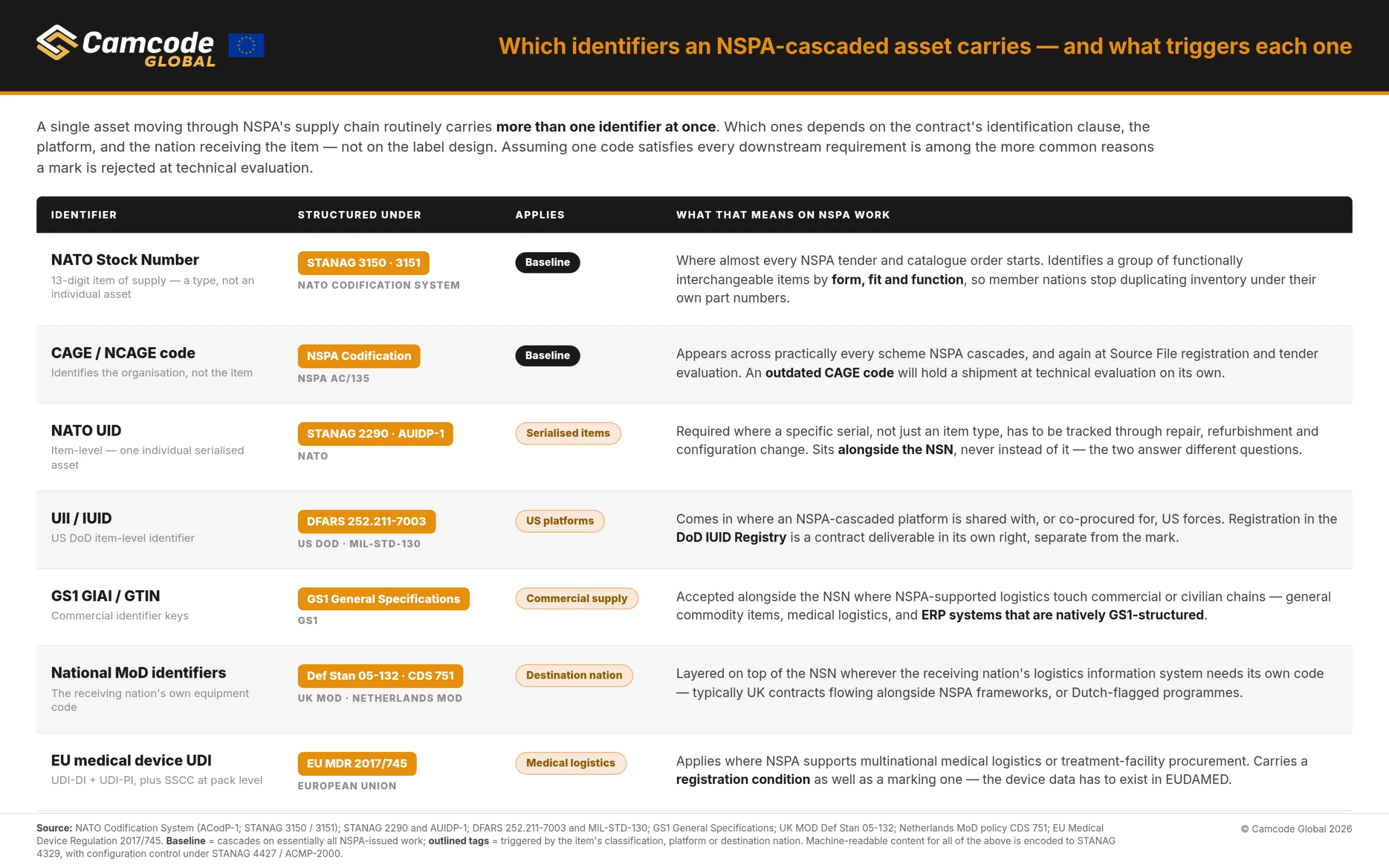
A single NSPA-cascaded asset can require more than one identifier at once, depending on the item’s classification, the nations receiving it, and the platform it supports. Suppliers who assume one code satisfies every downstream requirement are one of the more common sources of rejected labels. Camcode Global works through this identifier selection with every NSPA supplier client as part of our engineering process, mapping the applicable contract clauses, platforms, and destination nations to the correct combination before any label is designed. The identifier types most frequently encountered on NSPA-issued work include:
NATO Stock Number (NSN)
The 13-digit item-of-supply identifier assigned through the NATO Codification System under STANAG 3150 and STANAG 3151. This is the identifier most NSPA tenders and catalogue orders start from, and it identifies a standardised item of supply rather than an individual serialised asset.
Typical applications include:
- Direct purchase orders against existing NSPA catalogue holdings
- Spares and repair items procured under framework or long-term agreements
- Any item entering NATO’s multinational supply chain, regardless of platform
- Cross-referencing part numbers between manufacturers and member-nation logistics systems
NATO Unique Identification (NATO UID)
An item-level identifier structured under STANAG 2290 and AUIDP-1, used to track an individual serialised asset’s lifecycle across participating nations and systems. An NSN and a NATO UID can, and often do, appear on the same asset because they serve different purposes.
Typical applications include:
- High-value serialised assets requiring lifecycle traceability (engines, weapon systems, major components)
- Configuration-managed items where a specific serial, not just an item type, must be tracked
- Assets that transfer between member nations and need a consistent identity across systems
- Programmes where NSPA or a member nation requires individual asset accountability beyond supply-class tracking
Unique Item Identifier (UII / IUID)
The U.S. Department of Defense’s item-level identifier, governed by DFARS 252.211-7003 and MIL-STD-130. UK and EU suppliers encounter this where an NSPA-cascaded platform is shared with, or co-procured for, US forces.
Typical applications include:
- Coalition platforms with shared US DoD sustainment or spares pipelines
- Items requiring registration in the DoD IUID Registry as a contract deliverable
- Serialised assets moving through both NATO and US logistics chains simultaneously
- Multi-nation aircraft, vehicle, or weapons programmes with a US prime or co-sponsor
CAGE and NCAGE Codes
Identify the organisation responsible for manufacturing, supplying, or controlling an item. They appear across almost every scheme NSPA cascades and are typically issued and looked up via the NSPA CAGE tool.
Typical applications include:
- Manufacturer identification on NSN, NATO UID, and IUID marks alike
- Supplier verification during NSPA Source File registration and tender evaluation
- Cross-national supply chain traceability, since NCAGE codes are recognised across all NATO codification bureaus
- Configuration management records under STANAG 4427 / ACMP-2000
GS1 GIAI and GTIN
GS1 GIAI and GTIN are increasingly accepted alongside NSNs where NSPA-supported logistics touch commercial or civilian supply chains, including general commodity items and medical logistics.
Typical applications include:
- General commodity items procured outside pure defence-platform sustainment
- Medical and pharmaceutical logistics support, including field hospitals and treatment-facility procurement
- Programmes where NSPA-supported items also move through civilian distribution or retail-style supply chains
- Interoperability with commercial ERP and inventory systems that are natively GS1-structured
National MoD Identifiers
Member-nation logistics and equipment identifiers, such as UK MOD equipment codes or Netherlands MoD identifiers issued under CDS 751, which sit alongside the NSN in the destination nation’s own systems.
Typical applications include:
- Assets that will be received into a specific national inventory or asset register after NSPA procurement
- UK defence contracts flowing through or alongside NSPA framework agreements
- Netherlands MoD programmes cascading CDS 751 identification requirements
- Any item where the receiving nation’s own logistics information system requires a national code in addition to the NSN
EU Medical Device UDI and Packaging/Logistics Identifiers
Relevant where NSPA is supporting multinational medical logistics or treatment-facility procurement for member nations; these can include UDI Device and Production Identifiers, GS1 Serial Shipping Container Codes (SSCC), lot numbers, batch numbers and expiry dates.
Typical applications include:
- Medical equipment and devices procured for field hospitals or treatment facilities
- Pharmaceutical and consumable supplies subject to EU Medical Device Regulation or Falsified Medicines Directive requirements
- Packaging-level and pallet-level identification for multinational medical logistics shipments
- Items requiring registration in EUDAMED or another applicable regulatory database as a condition of supply
Selecting the right combination is not a label-design afterthought. It depends on the asset’s classification, the contract’s identification clause, and the systems that will consume the data at each receiving nation. This is precisely where Camcode Global’s engineering team adds the most value: rather than defaulting to a single scheme, we assess the full set of identifiers a given NSPA contract actually requires and build a marking specification that satisfies all of them on one compliant mark.
Standards That Cascade Through NSPA-Issued Contracts
Beyond the codification and marking standards summarised above, UK and EU suppliers working NSPA contracts should be familiar with the full set of standards that can apply depending on the platform, item type, and destination nation(s). Camcode Global evaluates this complete set before a single label is designed, since a mark built to satisfy one standard in isolation frequently fails another cascaded through the same contract.
STANAG 2290 (NATO UID)
STANAG 2290, or NATO UID, defines the structure for unique, item-level identification of individual NATO assets, supporting lifecycle traceability across participating nations and systems. Requirements may include:
- A compliant NATO UID construct, built in accordance with AUIDP-1
- Human-readable and machine-readable information on the same mark
- DataMatrix encoding of the identifier
- Traceability that persists through repair, refurbishment, and configuration changes
- Coexistence with the item’s NSN, since the two identifiers serve different purposes on the same asset
STANAG 4427 (Allied Configuration Management Documentation) / ACMP-2000
STANAG 4427 governs configuration management of serialised items, ensuring that a re-identification is triggered whenever an in-service configuration changes. Requirements may include:
- A documented Configuration Management Plan for any serialised item supplied
- Defined triggers for re-identification following repair, modification, or upgrade
- Alignment between the physical mark, the NSN record, and the supplier’s own configuration baseline
- Traceability of configuration history across the item’s full service life
STANAG 4329 (NATO Bar Code Symbology)
STANAG 4329 sets the machine-readable marking and data-carrier requirements NSPA-cascaded contracts invoke; DataMatrix has become the dominant symbology for new work. Requirements may include:
- Use of an approved symbology, typically DataMatrix for new programmes
- Defined data structure and content within the symbol
- Verified print or mark quality suitable for handheld scanning across NATO member-nation logistics systems
- Interoperability with the range of scanning equipment fielded across the alliance, rather than a single national scanner fleet
Netherlands MoD Policy CDS 751
Netherlands MoD Policy CDS 751 defines identification and marking requirements used within Netherlands Ministry of Defence procurement and asset-management activities, and is frequently cascaded through NSPA contracts touching Dutch-flagged programmes. Requirements may include:
- NATO Stock Number and item-master information
- Part and serial numbers
- Manufacturer or enterprise identifiers, such as CAGE/NCAGE
- NATO UID data structured in accordance with STANAG 2290 where item-level traceability is required
- Human-readable and machine-readable information
- Durable marking appropriate to the asset and its operating environment
Def Stan 05-132
Def Stan 05-132 is the UK MOD specification for marking for identification of items of supply, applicable to UK defence contracts that flow through or alongside NSPA. Requirements may include:
- NATO Stock Number
- Manufacturer’s part number
- Serial number, where applicable
- Manufacturer or enterprise identifier, such as a CAGE or NCAGE code
- Contract, date, or other lifecycle information
- Human-readable text alongside machine-readable data, where required
EN 9132
EN 9132 supports DataMatrix marking of aerospace parts and assemblies, defining requirements for applying and evaluating machine-readable marks on aviation and aerospace components sourced through NSPA. Requirements may include:
- Defined DataMatrix content and structure
- Approved marking location on the component
- Specified symbol size and cell dimensions
- Verified symbol quality at the point of mark
- Confirmation that the marking process does not affect the component’s form, fit, function, or structural integrity
EU Medical Device Regulation 2017/745 (EU MDR)
EU Medical Device Regulation 2017/745 (EU MDR) requires applicable medical devices and packaging levels to carry Unique Device Identification (UDI) data, relevant where NSPA supports multinational medical logistics or treatment-facility procurement. Requirements may include:
- A UDI-DI (Device Identifier) identifying the device model or version
- A UDI-PI (Production Identifier), such as serial number, lot number, manufacturing date, or expiry date
- Encoding via an approved issuing entity’s data structure and barcode symbology, commonly GS1 DataMatrix
- Registration of device data in the EUDAMED database in accordance with the device classification and implementation schedule
EU Falsified Medicines Directive (2011/62/EU)
EU Falsified Medicines Directive (2011/62/EU) requires prescription medicines to carry pack-level safety features, including a unique serial number and batch/expiry data, encoded as a 2D symbol and verified against national medicines verification systems. Requirements may include:
- Product code
- Unique serial number
- Batch or lot number
- Expiry date
- National reimbursement information, where required
- Verification against the applicable national medicines verification system connected to the wider European network
ISO/IEC 29158
ISO/IEC 29158 (originally published as ISO/IEC TR 29158, and before that as AIM DPM-1-2006) establishes the readability grading scheme for Direct Part Marks, referenced whenever a NSPA-cascaded contract calls for laser-etched or dot-peen DataMatrix rather than an applied label. Requirements may include:
- A defined minimum grade for the applied DataMatrix, assessed against the standard’s grading parameters
- Verification equipment and methodology suitable for direct part marks specifically, distinct from the printed-label verification used under ISO/IEC 15415
- Re-verification following repair or refurbishment where the mark may have been affected
- Documented grading records retained as part of the supplier’s quality evidence
ISO 55001
ISO 55001 is the international asset management systems standard; several NSPA-supported nations reference it as the framework their asset registers and lifecycle management processes must ultimately support. Requirements may include:
- Documented rules for how identifiers are issued, controlled, and retired
- A defined, auditable link between the physical asset and its data record
- Processes for maintaining data quality and identifier integrity across the asset’s lifecycle
- Governance structures supporting continual improvement of the asset management system, which Camcode Global’s KPMG-delivered Asset Life Cycle Management Advisory (ALCMA) is built to support
MIL-STD-130
MIL-STD-130 is the U.S. DoD’s item marking specification, most often encountered through its durability testing rather than as a contractual requirement in its own right (see note below).
Note: MIL-STD-130 is a US Military specification. UK and EU purchasers will not ask for MIL-STD-130 itself, but the proof of durability that MIL-STD-130 requires is often used to demonstrate compliance with the closest UK/EU equivalent standards, primarily Def Stan 05-132, Netherlands MoD policy CDS 751, and NATO STANAG 2290 (as adopted through EN 9132). Military, aerospace, rail and energy specifications typically ask for this lifespan of evidence, which is why UK and EU suppliers will still see MIL-STD-130 referenced on Metalphoto® and other durability data sheets even though no British or European procurement document formally recognises it.
Camcode Global routinely designs single-substrate solutions that satisfy several of these standards at once (for example, a Metalphoto® plate carrying an NSN, CAGE code, and a STANAG 2290-structured NATO UID encoded in a STANAG 4329-compliant DataMatrix), verified to the grade each cascaded standard requires. Rather than treating STANAG, national, and sector standards as separate design exercises, our engineering team maps the full set that applies to a given NSPA contract before the marking specification is finalised.
Mark Types Camcode Global Supplies for NSPA-Cascaded Work
The identifier and the standard it must satisfy only get a supplier halfway there. The identifier still has to be applied to the asset using a marking method that remains readable and securely attached throughout the asset’s expected service life. Camcode Global manufactures and installs the full range of marking technologies NSPA-cascaded programmes call for, selecting the right one according to the asset’s material, surface condition, operating environment, lifecycle, production volume, attachment requirements, and required data-capture technology.
Photosensitive Anodized Aluminium (Metalphoto®)
Metalphoto® uses a photographic image sealed beneath the anodised surface of the aluminium. This creates a highly durable, sub-surface image that can withstand abrasion, chemicals, ultraviolet exposure, temperature changes, and harsh operating environments. It is well suited to medium- and high-volume runs and can be produced in various sizes, thicknesses, colours, and attachment configurations.
Typical applications include:
- Small arms and weapon ancillaries
- Ships and marine equipment
- Aircraft and aerospace components
- Engines and mechanical components
- Complex or crew-served weapons systems
- Communications equipment
Laser Markables
Laser-markable materials use a laser to create a permanent image within or on the surface of a specially designed substrate, including steel, BlackPlus, or acrylic. Manufacturing laser markables is slower and more labour-intensive compared to Metalphoto®, so it’s best for low- and medium-volume applications or situations requiring serialised marks to be produced at the point of use.
Typical applications include:
- Small arms and weapon ancillaries
- Aircraft and aerospace components
- Engines and mechanical assemblies
- Complex weapons systems
- Communications equipment
- On-site NSPA supplier marking programmes requiring real-time, point-of-use production
Thermal Transfer
Thermal-transfer printing uses a ribbon to transfer the printed image onto a compatible label material, with the durability of the finished mark depending on the selected facestock, ribbon, adhesive, laminate, and protective construction. It is a flexible and cost-effective option for medium- and high-volume production and can also support on-demand printing at depots, warehouses, hospitals, and field locations.
Typical applications include:
- Soft and hard body armour
- Hospital and medical equipment
- Direct circuit board marking
- General asset identification and tracking
- Suppressor marking
- Extreme-heat applications (500°C–1200°C), using specialised high-temperature constructions individually validated against the asset’s actual temperature range and exposure duration
Ink Jet
Digitally printed or inkjet-produced labels provide a flexible option for applications requiring variable data, colour, graphics, or moderate-to-high production volumes. Durability depends on the printing process, substrate, adhesive, and any protective laminate or overcoat applied.
Typical applications include:
- Soft and hard body armour
- Ballistic and bump helmets
- Hospital and medical equipment
- General asset identification and tracking
- Equipment branding and instructional labels
- Packaging and logistics applications
Cut Through
Cut-through, mechanically engraved, stamped, or CNC-produced plates create characters or openings directly within a metal plate. These methods can provide durable identification for large industrial assets but may offer limited data density compared with modern barcode and DataMatrix technologies, so the design must be carefully controlled, as damaged, obstructed, or poorly sized characters can affect readability.
Typical applications include:
- Heavy equipment
- Ships and marine assets
- Vehicle and chassis marking
- Industrial machinery
- Large equipment identification plates
Woven Fabric
Fabric tags are designed for textile-based assets where rigid labels or metal plates cannot be applied. They may be woven, printed, heat-sealed, or sewn directly onto the asset, with construction and attachment method selected according to expected laundering, abrasion, chemical exposure, temperature, and handling conditions.
Typical applications include:
- Parachutes
- Military apparel
- Webbing and load-bearing equipment
- Soft armour and textile carriers
- Other woven or fabric-based assets
Direct Part Mark (DPM)
DPM applies the identifier directly to the asset rather than using a separate label or plate, through methods including laser etching, laser engraving, dot peen, and chemical etching. It is appropriate where a separate label cannot be securely attached or where the identifier must remain with the component throughout its lifecycle, though the marking process must be assessed carefully to ensure it does not damage the part, alter its performance, or affect applicable certifications. DPM DataMatrix quality is graded to ISO/IEC TR 29158.
Typical applications include:
- Bridging equipment
- Harsh chemical environments
- Surgical and medical instruments
- Aircraft components
- High-value serialised parts where the identifier must remain with the component through repair and refurbishment
NFC
NFC is a short-range, passive radio-frequency identification protocol, readable within roughly 4cm and by most compatible smartphones and tablets. It is a data-carrier technology rather than a physical marking method by itself, and can be incorporated into a label, tag, nameplate, or other identification product alongside a human-readable identifier or machine-readable barcode. It’s ideal where a barcode cannot be affixed or where the system needs to trigger an action, such as pulling up a digital record, on each scan.
Typical applications include:
- Communications equipment
- Hospital and medical equipment
- Tools and test equipment
- Inventory and maintenance operations
- General asset tracking
- Applications requiring access to digital records, maintenance instructions, or inspection forms on each scan
Selecting the Correct Marking Method
The asset’s operating environment and surface condition must be evaluated before a marking technology is selected. Important factors include:
- Asset substrate and surface finish
- Temperature range and exposure duration
- Chemicals, fuels, oils, and cleaning agents
- Ultraviolet exposure and weather conditions
- Abrasion, impact, and handling
- Available marking area
- Required service life
- Attachment method
- Barcode, RFID, or NFC reading requirements
- Production volume and point-of-use needs
- Applicable NSPA, NATO, national, and sector standards
Using an incompatible material, adhesive, or marking method is a common and preventable cause of premature label failure and unreadable identifiers on NSPA-cascaded contracts. This is one of the first questions Camcode Global’s engineering team works through with an NSPA supplier (during Step Two of our process, described below), evaluating the complete application, including the asset, environment, identifier structure, marking material, attachment method, and capture technology, to provide an identification solution that remains usable throughout the asset’s operational lifecycle.
Automatic Identification and Data Capture (AIT) Technologies
A durable mark is only useful once its data can be captured accurately and transferred into the systems that manage the asset. AIT (also referred to as AIDC — Automatic Identification and Data Capture) forms the capture layer of Camcode Global’s asset identification solutions for NSPA-cascaded work: these technologies read the identifier, reduce manual data entry, and connect physical assets to the records maintained in SAP, ERP, EAM, inventory, maintenance, and logistics systems across NSPA-supported nations. Camcode Global selects and deploys the appropriate technology based on the required read range, asset environment, data volume, system architecture, security requirements, and operational workflow.
Barcodes and QR Codes
Barcodes provide a reliable, cost-effective method of capturing asset, item, packaging, and shipment information. Camcode Global supports linear and two-dimensional symbologies, including Code 39, Code 128, GS1-128, QR Code, PDF417, and DataMatrix. The selected symbology can encode identifiers and data elements such as an NSN, NATO UID, IUID, GTIN, GIAI, SSCC, lot number, or production information. DataMatrix is the backbone of serialised NSPA-cascaded identification because it can encode significant data in a small area, applies through either a label or Direct Part Marking, and reads reliably with any smartphone or imager.
Typical applications include:
- NATO UID and NSN-level asset identification under STANAG 2290 and STANAG 4329
- Item Unique Identification and IUID serialisation
- Packaging and shipment identification
- Maintenance and repair processes
- Warehouse and inventory management
- Medical device and healthcare identification
- Tool, equipment, and component tracking
RFID (Passive and Active)
Passive RFID tags do not require an internal power source; they draw energy from an RFID reader and transmit encoded information back to the system. They’re appropriate when assets must be identified without direct line of sight, when multiple items need to be captured simultaneously, or when barcode scanning would be inefficient. Active RFID tags carry their own power source and transmit over longer distances, making them better suited to higher-value assets, containers, vehicles, or equipment that must be detected across a larger area. They can also support sensor data, location events, and automated entry or exit records. The right technology and frequency depend on the asset, material, operating environment, and required read range.
Typical applications include:
- Warehouse and depot inventory
- Tool and equipment accountability
- Arms-room and controlled-inventory management
- Containers, transport assets, and vehicles
- High-value defence assets requiring in-transit visibility
- Yard, depot, and facility tracking
- Automated perimeter and gateway monitoring
- Supply-chain and shipment visibility across NSPA’s multinational logistics network
Real-Time Locating Systems (RTLS)
RTLS provides ongoing visibility into asset location and movement within a defined environment, using active RFID, Bluetooth Low Energy, ultra-wideband, Wi-Fi, or other technologies depending on the required accuracy, facility layout, asset value, and operational need.
Typical applications include:
- Frequently moved tools and equipment
- Warehouses and distribution centres
- Maintenance, repair and overhaul (MRO) facilities
- High-value or mission-critical equipment
- Hospital and medical asset tracking within treatment facilities
- Production and work-in-progress tracking
Optical Character Recognition (OCR)
OCR converts printed, stamped, or engraved characters into structured digital data. Camcode Global uses OCR heavily during data cleansing and legacy nameplate capture, reducing manual transcription and accelerating the collection of part numbers, serial numbers, manufacturer information, and other asset attributes. Results must be validated, since worn plates, damaged marks, inconsistent formatting, and similar characters can create recognition errors.
Typical applications include:
- Asset surveys and physical inventories
- Data cleansing and enrichment ahead of ERP or SAP migration
- Legacy nameplate and data-plate capture on assets marked before current standards were adopted
- Part-number and serial-number collection for NSN cross-referencing
- Migration from legacy asset-management systems
Global Positioning Tags (GPS)
GPS and other GNSS technologies, often combined with cellular or satellite communications, track mobile assets and shipments moving between facilities, regions, or countries. They’re most appropriate for assets that operate outside controlled facilities and require location updates over a wide geographic area.
Typical applications include:
- Vehicles and mobile platforms
- Containers and transport equipment
- Deployable systems and field equipment
- International shipments moving through NSPA’s supply chain
- High-value assets moving between NATO member nations
Biometrics and Smart Cards
Smart cards and other electronic credentials connect an asset transaction to the individual performing it, used to control access, record equipment issue and return, or establish accountability for sensitive assets. Biometric technologies may be integrated where an organisation requires a higher level of identity verification, depending on its security, privacy, and information-assurance requirements.
Typical applications include:
- Controlled equipment issue and return
- Arms-room accountability
- Tool-control programmes
- Restricted inventory access
- Operator authorisation
- Sensitive asset transactions requiring identity verification
Sensor Technology
Sensors collect information about an asset’s condition and operating environment, monitoring temperature, humidity, shock, vibration, pressure, movement, or other conditions depending on the application. Sensor data is associated with the asset’s unique identifier to build a more complete lifecycle and condition history.
Typical applications include:
- Temperature-sensitive materials and pharmaceuticals
- Medical and pharmaceutical equipment
- Shock-sensitive components
- Ammunition and controlled inventory
- Storage and transportation monitoring across multinational logistics chains
- Predictive maintenance programmes
Electronic Article Surveillance (EAS)
EAS provides theft deterrence and perimeter monitoring for controlled, sensitive, or high-value inventory. It’s generally used as a security control rather than a complete asset-identification solution, and where required, it’s incorporated alongside a UID, barcode, or RFID solution, rather than replacing it.
Typical applications include:
- Controlled or sensitive defence inventory
- High-value equipment stores and arms rooms
- Perimeter and gateway monitoring at depots and facilities
- Programmes where theft deterrence complements, rather than replaces, item-level identification
Connecting the Physical Asset to Enterprise Systems
Camcode Global does more than supply scanners, labels, or tags for NSPA suppliers. We evaluate the complete asset-identification workflow, including the identifier and required data structure, the physical label, tag, or direct mark, the barcode, RFID, or other data carrier, the reader, scanner, or mobile device, data validation and business rules, integration with SAP, ERP, EAM, and logistics systems, and reporting, analytics, and asset-visibility requirements.
By combining the correct identifier, durable marking method, and appropriate capture technology, Camcode Global helps NSPA suppliers improve data accuracy, reduce manual processes, and maintain asset visibility from procurement and receipt through maintenance, deployment, and disposal, closing the loop between the physical mark and the authoritative data record at every receiving nation.
What NSPA Suppliers Should Know About Marking
Below, we discuss a few practical observations from UK and EU suppliers’ NSPA work and from Camcode Global’s own experience marking assets for NSPA-cascaded programmes over more than a decade as a NATO-approved provider:
- NSN-driven marking content. NSPA tenders typically supply the NSN; the supplier is responsible for ensuring it appears correctly on the mark together with manufacturer’s part number, CAGE code, and serialisation where required. Errors here are one of the most common reasons a mark is rejected at technical evaluation. A transposed digit or an outdated CAGE code can hold up an entire shipment, even where the underlying asset and its documentation are otherwise compliant. Camcode Global’s data validation step cross-checks NSN, CAGE, and serial data against the supplier’s own records before a single label is produced, catching these errors before they reach the mark.
- Multi-national interoperability. A part shipped to NSPA may onward-ship to any NATO nation. The mark has to be readable by every receiving nation’s logistics systems, which drives the move to DataMatrix and away from purely national symbology. This matters more than it might first appear: a mark that scans cleanly on the supplier’s own equipment can still fail at a receiving depot using different hardware or a different minimum grade threshold. Camcode Global designs and verifies marks against the grading requirements of the destination nation’s systems, not just the supplier’s own, so the mark performs consistently wherever the part ends up.
- Durability evidence. NSPA buyers expect substrate durability evidence (Metalphoto® MIL-STD-130-validated; premium polyester durability rated). Vague substrate descriptions delay technical evaluation. Suppliers who cannot point to specific, testable durability data for their chosen substrate should expect follow-up questions during evaluation, which can add weeks to an already time-limited tender window. Camcode Global supplies durability documentation alongside every Metalphoto® and polyester solution we manufacture, so suppliers can attach concrete evidence to a bid rather than a general assurance.
- Configuration management discipline. Spares that update an in-service configuration must trigger re-identification at the asset, the NSN record, and the supplier’s configuration baseline. This is where STANAG 4427 / ACMP-2000 becomes a practical, day-to-day discipline rather than a paperwork exercise — a part that changes an aircraft’s or vehicle’s configuration but isn’t re-identified at all three points creates a traceability gap that can surface at the next audit or, worse, during an in-service safety investigation. Camcode Global builds re-identification triggers into the marking specification itself during Step Two of our process, so the rule for when and how an asset gets re-marked is defined up front rather than worked out after the fact.
- Lead times and on-site marking. NSPA’s shorter bid windows for operations and missions work (as little as 20 calendar days) can leave little room for off-site label production and shipping once a contract is awarded. Where this is a factor, Camcode Global can deploy laser-markable or thermal-transfer solutions that support real-time, on-site marking, so a supplier isn’t waiting on an external production run to meet a tight delivery schedule.
Working with NSPA: A Practical Path for UK and EU Suppliers
For a UK or EU SME approaching NSPA for the first time, the path from registration to a compliant, deliverable product typically follows six steps. Camcode Global works alongside suppliers at several of these points, particularly where marking substrate, verification, and configuration management decisions are involved.
- Register on the NSPA eProcurement portal. Eligibility is open to suppliers from NATO member and qualified partner nations. Registration in the NSPA Source File creates your vendor account and is a prerequisite for bidding. It’s worth completing well before an active tender appears, since the registration process itself can take time to work through and requires a documented company profile and points of contact.
- Build a capability statement that maps your products and services to NSPA’s commodity classes and active programmes.A capability statement that speaks NSPA’s own commodity and platform language is far more likely to surface in a buyer’s search than a generic company profile, and it’s worth revisiting as your product line or certifications change.
- Confirm your configuration management approach. Even SMEs need a documented CM Plan if they will supply serialised items. This doesn’t need to be an elaborate system, but it does need to define, in writing, how a configuration change gets flagged and where the re-identification happens (at the asset, the NSN record, and your own baseline), since this is exactly what STANAG 4427 / ACMP-2000 compliance is assessed against.
- Validate your marking substrate set. Metalphoto® for outdoor/serialised assets; premium polyester for indoor / packaging; DPM where a label cannot be affixed. Getting this wrong early is expensive to fix later. A substrate chosen without reference to the asset’s actual operating environment can pass initial evaluation and still fail in service, triggering a re-mark and re-registration cycle that a correct substrate choice would have avoided entirely. Camcode Global’s engineering team runs this substrate selection with suppliers as a standard part of Step Two of our process, matching material to environment before any marking specification is finalised.
- Set up DataMatrix verification. Handheld ISO/IEC 29158 verifier for direct part marks (ISO/IEC 15415 for printed symbols); grade C minimum. Verification equipment is a one-off cost that pays for itself quickly. A mark that looks acceptable to the eye can still fail grading, and catching that before dispatch is far cheaper than a rejected shipment or a field failure. Camcode Global grades every applied mark we produce and can advise suppliers on setting up their own in-house verification where volume justifies it.
- Watch for the active tenders. NSPA publishes tender notices through its eProcurement portal, and many UK and EU suppliers also monitor NATO Industrial Advisory Group communications and NSPA’s Future Business Opportunities announcements, which give a genuine planning window of at least 10 calendar days (20 where security clearances are required) ahead of a tender’s release.
Suppliers who work through Camcode Global before their first NSPA tender typically arrive at bid submission with their identifier structure, marking specification, and verification approach already resolved, rather than working these out under the pressure of a live bid deadline.
Camcode Global’s Seven-Step Data Cleansing, Asset Identification, and Data Optimisation Process
This is the process Camcode Global runs with every NSPA supplier, prime contractor, and defence agency client, and it is what sits behind our NSPA Enabling Contract work described below. See The Framework for full detail on each stage, and The Results for the defence, infrastructure and manufacturing organisations that have already benefited from it.
Step One: Asset Identification & AIT Consultation
Our team assesses your project and recommends how to align processes with the applicable standards and frameworks (NATO, Def Stan, CDS 751, GS1, or another combination), maximise asset utilisation, optimise processes for efficiency and compliance, integrate technology and automation, and improve asset supply chain management.
Step Two: Engineering Services
Our engineering team develops the marking specification (sometimes called a factsheet) that defines how the identified asset will be marked, both from a data perspective and a physical marking perspective. After field-verifying a subset of asset data, the team defines business rules and data governance and selects the appropriate physical marking method from the mark types described above.
Step Three: Data Remediation, Reconciliation & Verification
Camcode Global’s proprietary offline and online data collection software ensures alignment with the relevant standards and frameworks, reduces human error, integrates with existing SAP, ERP and asset-management systems, and produces detailed reports and analytics.
Step Four: AIT Product Manufacture & Procurement
Customised AIT products, including barcodes (1D, 2D, QR, GTIN, SSCC, UDI), RFID, sensors, GPS, OCR, RTLS, NFC, EAS, biometrics or other technology, are developed based on the data and material specifications created in Step Two.
Step Five: AIT Product Installation
Our NATO Security Cleared installation teams follow the marking specification/factsheet directions, and our in-house software associates the correct data with the product being installed on each asset. All installations comply with the relevant regulatory and NATO requirements.
Step Six: Data Reporting & Migration
With markings in place, customisable reporting provides insight into key operational metrics, quickly identifies discrepancies, and maintains high-quality master data, reducing the time and effort required for ongoing reconciliation.
Step Seven: Asset Life Cycle Management Advisory (ALCMA)
Delivered by KPMG, ALCMA solutions support customers in managing assets from planning and acquisition through maintenance, optimisation and disposal, with an emphasis on improving asset performance, reducing costs, and maintaining compliance with industry standards and regulations such as ISO 55001.
For the complete breakdown of each stage, see The Framework, and for evidence of how this process has delivered results for defence organisations across the alliance, see The Results.
NSPA vs. Direct National Defence Procurement: What Differs
A UK or EU supplier working both NSPA and a national MOD will notice a few differences, and understanding them upfront saves suppliers from applying a single marking approach across contracts that don’t actually share the same requirements.
NSPA contracting language is typically more standardised across nations than national MOD language. Because NSPA consolidates requirements from multiple member nations into a single contract, its identification and marking clauses tend to reference the NATO-level standards directly rather than a national MOD’s own internal policy documents. A supplier used to interpreting a single national MOD’s marking clause may find NSPA’s language more prescriptive on symbology and identifier structure, but less specific on the finer points a national contract would spell out, such as exact label placement or approved local suppliers.
NSPA leans more heavily on the NATO Codification System and STANAG references (STANAG 2290, 3150/3151, 4329, 4427) than national-only contracts. A national MOD contract may reference its own equipment code or asset register alongside (or occasionally instead of) an NSN, whereas an NSPA contract will almost always start from NSN and STANAG references as the baseline, with national identifiers layered on top only where the destination nation’s own systems require them.
Configuration management expectations are more uniform under STANAG 4427 / ACMP-2000. National MODs sometimes maintain their own configuration management documentation standards in parallel with, or as a variant of, ACMP-2000. NSPA contracts tend to hold suppliers to the STANAG 4427 baseline directly, which can simplify compliance for suppliers already working other NATO-facing contracts but requires close attention from suppliers whose CM Plans were built around a single national MOD’s variant.
Marking specifications cluster around the NATO STANAGs rather than purely national standards, though national standards (Def Stan 05-132, CDS 751, MIL-STD-130) and sector standards (EN 9132, EU MDR, EU FMD) still cascade through depending on the platform and item type. In practice, this means a supplier working both an NSPA contract and a national MOD contract on the same platform may need two marking specifications that share a common core (NSN, CAGE, DataMatrix) but diverge on the national or sector-specific content layered around it.
Camcode Global works with suppliers who hold both NSPA and national MOD contracts to identify exactly where these specifications overlap and where they diverge, so a single engineering effort, rather than two disconnected processes, produces marks that satisfy both. Where the underlying asset and identifier are the same across an NSPA and a national contract, this frequently means one mark design can be adapted for both rather than built twice from scratch.
Frequently Asked Questions
Is NSPA the same as the old NAMSA?
NSPA was created in 2012 through the consolidation of the NATO Maintenance and Supply Agency (NAMSA), the Central Europe Pipeline Management Agency (CEPMA), and the NATO Airlift Management Agency (NAMA). NSPA continues to handle the legacy NAMSA functions plus additional remit.
Can a UK supplier still work with NSPA after Brexit?
Yes. UK membership of NATO is unaffected by EU membership status, and UK suppliers remain fully eligible for NSPA work. NSPA’s portal explicitly recognises UK companies as eligible suppliers.
Does NSPA prescribe specific label brands or products?
No. NSPA prescribes the standards (STANAG 2290, STANAG 4329, STANAG 4427, and applicable national identification standards). The supplier chooses substrate and product subject to durability and verification evidence. Metalphoto® anodised aluminium is widely accepted because of its long-life durability evidence under MIL-STD-130 testing.
How does NSPA interact with national MOD codification?
NSPA works within the NATO Codification System (STANAG 3150 / 3151). National codification bureaus, such as the UK NCB, the US DLA Logistics Information Services (formerly the Defense Logistics Information Service), etc., operate under the same framework, so NSNs allocated by national bureaus flow into NSPA records smoothly.
Where do I find current NSPA tenders?
The NSPA eProcurement portal publishes current tenders. Registration is free for suppliers from NATO member nations.
How Camcode Global Supports NSPA Supplier Work
Camcode Global has supplied identification labels, Metalphoto plates, and direct-part-marking services into NATO supplier chains for decades. Our UK / EU client base includes prime contractors, SMEs, and refurbishers working both NSPA frameworks and national MOD contracts. We can advise on substrate choice, DataMatrix verification, and configuration management traceability that satisfies NSPA-cascaded standards.
See The Framework for full detail on our seven-step process, and The Results for how it has performed for defence organisations across the alliance.
Talk to a Camcode specialist about your NSPA-supplier marking programme.