DEFCON 528: How the UK MoD’s Import and Export Licence Clause Affects Defence Suppliers
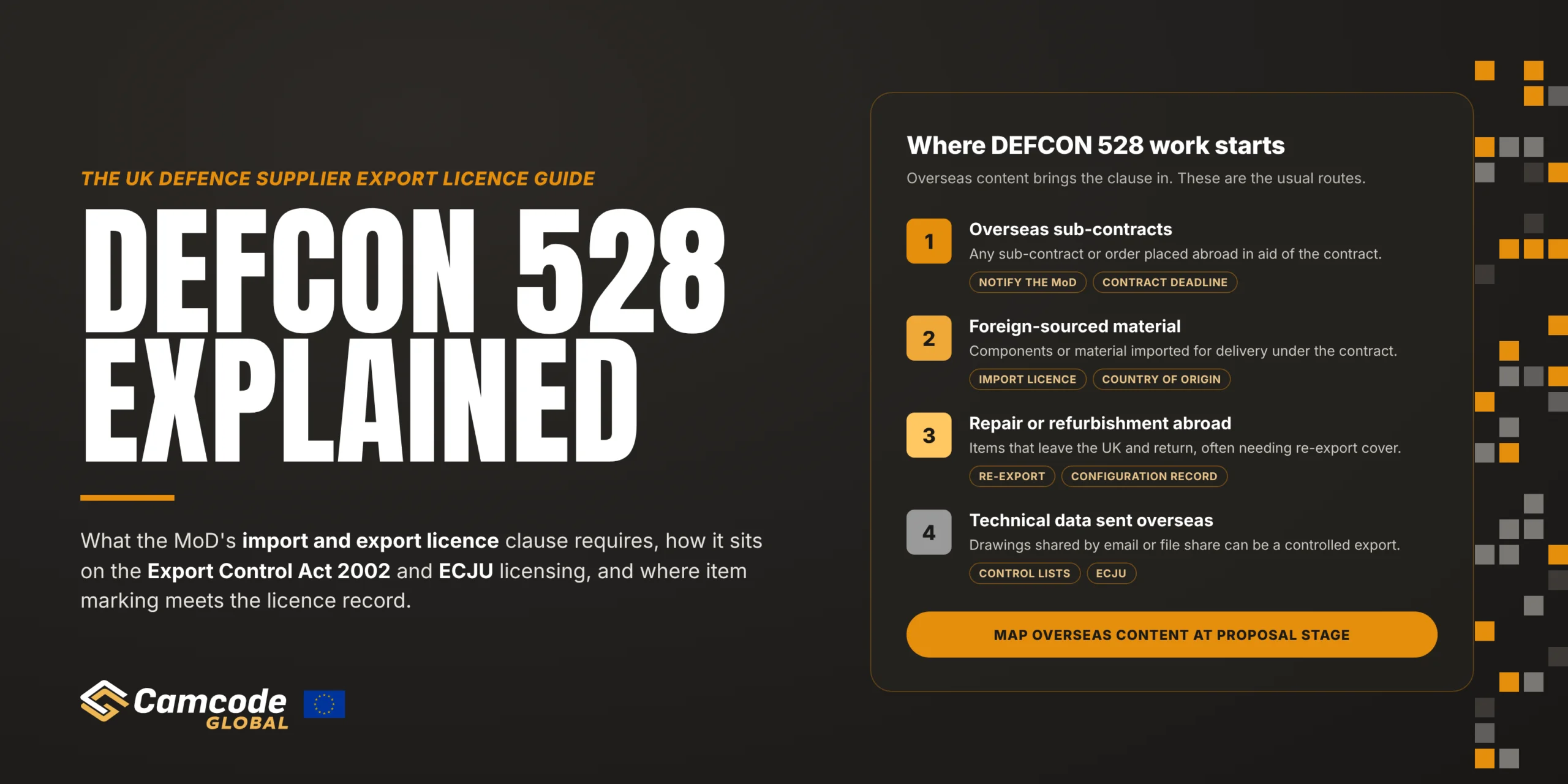
DEFCON 528 is the UK Ministry of Defence’s (MoD) standard contract clause covering import and export licences. DEFCON 528 is invoked in MoD procurement contracts that involve overseas sub-contracting or foreign-sourced material. For UK defence suppliers working with international supply chains, DEFCON 528 sets out clear obligations around notifying the MoD of overseas activity and managing the licences that govern import and export of controlled goods.
This guide is for UK and European defence supplier procurement, contracts, and compliance teams who need a practical understanding of DEFCON 528, what it requires, and how it interacts with the wider UK export control framework.
What DEFCON 528 Is
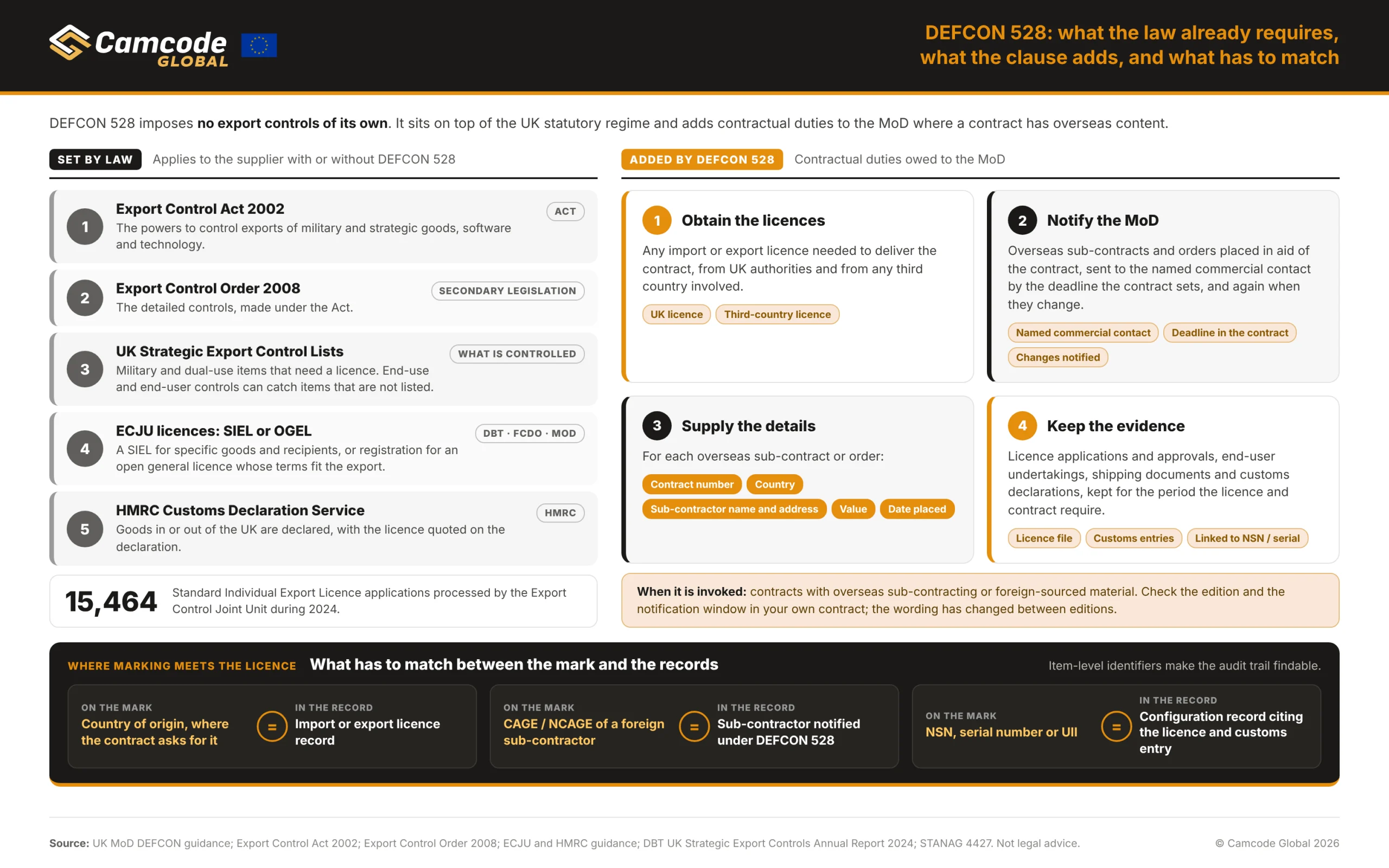
DEFCON 528 adds contractual duties alongside UK export control law. The chart outlines licensing, notification and evidence requirements, plus how item identifiers connect markings to supporting records.
DEFCON 528 is one of the Defence Conditions (DEFCONs) used by the UK MoD in its procurement contracts. The current 2026 edition (Edn 05/26, “Import And Export Licences”) continues to be invoked across UK defence procurement. Its core provisions cover:
The requirement for suppliers to obtain any import or export licences needed in connection with delivery under the contract.
The requirement to notify the MoD Contracts Branch of overseas sub-contracts or orders placed in aid of the contract.
The information that must be supplied to MoD on overseas activity, including contract number, country, sub-contractor identity, sub-contract value and date.
The supplier’s responsibility for ensuring compliance with applicable national export control regimes.
DEFCON 528 sits alongside the wider UK strategic export control framework administered by the Export Control Joint Unit (ECJU) within the Department for Business and Trade.
Why DEFCON 528 Matters for UK Defence Suppliers
For UK defence suppliers with international supply chains, DEFCON 528 introduces concrete contractual obligations.
Notification timing. Overseas sub-contract details must be notified to MoD within a defined window (typically one month of contract acceptance under the standard wording).
Information scope. Contract number, country in which the sub-contract is placed, name and address of the sub-contractor, value, and date.
Licence responsibility. The supplier is responsible for identifying and obtaining the required import/export licences, including from the supplier’s own national authorities and from any third-country authorities involved.
Compliance evidence. Documented evidence of licence application, approval and use is part of the contract record.
How DEFCON 528 Interacts With the Wider UK Export Control Framework
DEFCON 528 does not impose its own export controls. Rather, it is layered over the UK’s current legal regime governing the export of military and sensitive equipment, so suppliers will need a basic understanding of that if they are to comply with the clause.
The starting point is the Export Control Act 2002, under which the government has powers to control the export of military and strategic goods, software and technology. The detailed controls are set out in secondary legislation made under that Act. This is principally the Export Control Order 2008.
Most commonly, exporters deal with two licence types: Standard Individual Export Licences (SIELs) and Open General Export Licences (OGELs). SIELs are applied for by a company against specific goods and specific recipients. OGELs are licences published in advance that any exporter can make use of if they register that they intend to, and meet its criteria. Checking if an OGEL covers the activity can save time vs applying for a SIEL.
Licensing isn’t just based on what the goods are. End-use and end-user controls consider what they will be used for and by whom. They may require a licence even if the actual items aren’t on the controls lists (e.g., if they could be used in military equipment or weapons of mass destruction). Exporters may need to obtain end-user undertakings, signed statements from the recipient about their intended use of the goods.
Lastly, any goods entering or leaving the UK will usually need to be declared to HM Revenue & Customs (HMRC) via their Customs Declaration Service system. This system manages import and export declarations. Details of licences must be referenced in those customs declarations, so your records on both sides must be aligned.
DEFCON 528 is the contractual vehicle that hooks the MoD’s interest in this framework into the supplier relationship. DEFCON 528 doesn’t absolve you from responsibility for following the law: you as the supplier are still responsible for compliance with the above statutory requirements. DEFCON 528 does however introduce contractual duties to notify the MoD of overseas activity that’s relevant to it, and to co-operate with them by sharing information, giving them insight to imports and exports in their supply chain.
What UK Suppliers Should Plan For
A practical compliance approach for UK defence suppliers subject to DEFCON 528:
Map your supply chain abroad before you start. Look for sub-contracts overseas, material from other countries or international movement of your goods as early as the proposal stage. Licence lead times and notification deadlines begin on day one, and it’s much harder to address gaps after you’ve won the contract.
Identify your controlled goods. Check your products, components, software and technical data against the UK Strategic Export Control Lists. If you’re not sure if something’s listed, you can contact the ECJU for a classification advice service. Remember there may also be end-use controls on your products that could apply if your items are unlisted, depending on who your customer is and where the items are going.
Allow time to apply for licences. Some licences can take weeks to be processed. SIEL applications are assessed on a case-by-case basis, so factor that in when agreeing on delivery schedules. You can cover multiple shipments under one registration if an OGEL is available, but only if each shipment falls under the scope of that licence.
Build the notification workflow. Implement a documented internal procedure which initiates the DEFCON 528 notification to the MoD by the timescale specified in your contract. Your contract will stipulate who the MoD commercial contact is that will receive notifications (typically someone in the contracts/commercial branch who manages the contract).
Store records that prove compliance. Retain copies of licence applications and approvals, end-user undertakings, shipping documents and customs declarations for however long is stipulated in your licence conditions and contract. Link these records to item-level identifiers where possible (such as NSNs, serial numbers, etc.). They’ll be much easier to locate when requested at audit if they’re already matched to technical identifiers.
Train your extended team. In reality, your procurement, logistics and shipping teams will all deal with DEFCON 528 responsibilities at some point. Even engineers: exporting technical drawings or data overseas (including by email or file share) can be a controlled export.
Review if anything changes. Whether you’re adding a sub-contractor overseas, changing destination or there’s an update to one of the control lists, your obligations under Export Controls may change. Implement a trigger within your change-management process to ensure a review takes place.
How DEFCON 528 Interacts With Marking and Identification Requirements
UK defence contracts frequently ask suppliers to mark items with identification data such as stock numbers, serial numbers and machine-readable barcodes so that they can be tracked through the supply chain. These marking requirements are typically cascaded down from the MoD or prime contractor into each sub-contract.
DEFCON 528 doesn’t affect what needs to go on the mark. It provides separate contractual obligations around licensing and notification of that data. However, the two regimes need to dovetail because the identification on the item itself links it to its licence, shipping documentation and customs records.
Which marking standards apply will depend on the customer and the destination country. The following are the most commonly encountered by UK suppliers:
Def Stan 05-132. UK MoD standard that specifies how items of supply should be marked. Typical marks include the NATO Stock Number (NSN) which identifies what item it is; the manufacturer’s part number; a serial number; and a CAGE or NCAGE code which identifies the company that manufactured or supplied the item.
STANAG 2290. STANAGs are NATO Standardisation Agreements, which NATO member nations agree to use so their equipment, parts and data can all work together. STANAG 22 90 deals with unique identification (UID) of individual items. Marking is how each item is given its own permanent identifier, and this standard is the basis for NATO UID.
STANAG 4329. NATO’s standard covering barcode symbology and machine-readable marking so that marks can be scanned consistently by all member nations.
STANAG 4427. NATO’s configuration management standard. Configuration management tracks exactly which version, parts and modifications an item has, so its records stay accurate as it’s maintained or upgraded.
Netherlands MoD policy CDS 751. Dutch defence marking policy. This is relevant if you’re delivering items into Dutch programmes. Like many countries, it requires NATO UID data but requires it to be structured according to STANAG 2290.
DAOD 3038-0. One of Canada’s Defence Administrative Orders and Directives, which sets out Department of National Defence marking requirements for materiel. This is relevant if Canada is the end destination.
MIL-STD-130. The US Department of Defense standard for identification marking of US military property.
Note: MIL-STD-130 is a US Military specification. UK and EU purchasers will not ask for MIL-STD-130 itself, but the proof of durability that MIL-STD-130 requires is often used to demonstrate compliance with the closest UK/EU equivalent standards, primarily Def Stan 05-132, Netherlands MoD policy CDS 751, and NATO STANAG 2290 (as adopted through EN 9132). The exception in a DEFCON 528 context is a UK supplier whose overseas sub-contract or end customer sits within a US Department of Defense programme: there, MIL-STD-130 applies directly through the US contract.
The interactions worth noting:
Country of origin marking. Where contracts specify country-of-origin marking, the marked country of origin must match the import/export licence record
Configuration management traceability. Following STANAG 4427, the NSN, IUID UII, NATO UID or GS1 identifier supplied on the mark ties the physical item to its configuration record which in turn references the customs record and licence record.
Supplier identification. Using CAGE and NCAGE codes on the mark to identify the organisation that built or supplied the item. If a foreign sub-contractor’s NCAGE code appears, it should match the details of the sub-contractor as notified to MoD under DEFCON 528.
Re-export controls. Items that return to the UK after foreign refurbishment or repair may trigger requirements for re-export licences and updates to configuration management records. The mark has to survive that overseas process. For this reason, durable Metalphoto® laser etched anodised aluminium plates or direct part marking (laser engraving or dot peen Data Matrix) will usually be specified for items with a high likelihood of foreign repair.
Capture technology is relevant, too. Data Matrix barcodes that can be scanned at despatch and receipt, and passive RFID where items are shipped in bulk or without line of sight, automatically generate a time-stamped record of each controlled item passing a border. This information not only supports the evidence of compliance DEFCON 528 requires suppliers to maintain, but can also be shared with NATO visibility tools such as the NATO RFID Routing Hub and Barcode Routing Hub.
UK suppliers who run programmes spanning multiple NATO countries need to synchronise DEFCON 528 obligations with marking obligations cascaded from STANAGs as a routine operational discipline.
Common UK Supplier Pitfalls With DEFCON 528
The majority of DEFCON 528 problems we observe are not due to a failure to understand the legal requirements. They are due to timing and process failings: data arriving too late to be useful, changes not being communicated, or records not being made. Each of the pitfalls below maps to one of the planning steps above, and these are the patterns we see most often across UK supplier work:
Late identification of overseas content. The bill of materials (the full list of parts and components) is finalised after the contract is accepted, and overseas content only surfaces then. By that point, the DEFCON 528 notification deadline in the contract may already have passed. Mapping the supply chain at proposal stage avoids this.
OGEL eligibility goes unchecked. A supplier automatically submits a SIEL when they would have otherwise used an existing OGEL. This can add weeks of lead time and unnecessary administrative effort.
End-use undertakings missing. Documentation ensuring the end-user of exported goods won’t re-export them is not obtained at order. Having to go back and obtain it can stall licence applications and shipments if the foreign recipient is unresponsive.
Sub-contractor change not propagated. An overseas sub-contractor is changed mid-way through a contract, however the change is not notified to MoD. The original notification no longer represents the true supply chain, and additional licences may be required.
Technical data sent overseas unchecked. Engineers are emailing drawings or technical data to overseas subsidiaries or partners through file share without knowing this could be a controlled export. Transfers like this are easy to miss because no physical goods are crossing the border.
Records not retained. Licence evidence is stored in individual inboxes or local files and gets lost throughout the lifespan of a contract. If a query or audit from MoD comes through, the supplier can’t demonstrate what has been licenced, shipped and notified.
Frequently Asked Questions
Is DEFCON 528 the same as a licence application?
No. DEFCON 528 is the contractual clause requiring the supplier to obtain and manage the necessary licences and to notify MoD of overseas activity. The licences themselves are administered by the Export Control Joint Unit (ECJU).
Does DEFCON 528 apply to UK-only contracts?
DEFCON 528 is invoked where the contract involves any overseas sub-contracting or foreign-sourced material. Contracts with no international content typically do not invoke it.
What is the notification window under DEFCON 528?
Typically one month from contract acceptance for the initial notification of overseas sub-contracts, with ongoing notification of changes during the contract.
Who at the supplier is responsible for DEFCON 528 compliance?
The contract holder is responsible to the MoD. In practice, procurement, contracts, and logistics teams all touch the operational obligations.
How does DEFCON 528 interact with EU export control rules?
DEFCON 528 is a UK MoD contractual clause; EU export control rules apply to EU suppliers in their own right. UK suppliers with EU operations may face both frameworks simultaneously.
How Camcode Global Supports UK Suppliers Operating Under DEFCON 528
Camcode Global manufactures identification labels, plates, and direct part marking outputs, including Metalphoto® plates and Data Matrix and RFID-enabled tags, with country-of-origin documentation supplied alongside delivery. Our quality and shipping records support UK supplier compliance with DEFCON 528 notification and information-sharing requirements where Camcode Global-supplied content forms part of an overseas sub-contract chain. We operate from offices in Bristol (UK), The Hague (Netherlands), Cleveland (US) and Collingwood (Australia).
That work runs through our seven-step Data Cleansing, Asset Identification, and Data Optimisation Process: asset identification and AIT consultation; engineering services to define the marking specification; data remediation, reconciliation and verification; AIT product manufacture and procurement; installation by NATO Security Cleared teams; data reporting and migration; and Asset Life Cycle Management Advisory provided by KPMG. For DEFCON 528 work, the data remediation and reporting steps matter most, because they keep the item-level records that link each mark to its licence and shipping evidence accurate and ready for audit. See The Framework for details on each stage and The Results for the defence, infrastructure and manufacturing organisations that have benefited.
As a NATO-approved provider for over 12 years and holder of a NATO Support and Procurement Agency (NSPA) Enabling Contract (LS-SU/4600004170), we also give defence organisations a route to these services without a lengthy separate procurement.
Meet the marking and governance requirements of standards such as CDS-751, DEF STAN 05-132, MIL-STD-130, DEF(AUST) 1000C, and DAOD 3038-0 with a fully integrated, all-in-one mobile laser marking cart solution. Produce and mark assets on-site after data has been verified — ensuring:
Small-run, on-demand UID production
Durable, permanent 2D Data Matrix marking
Alignment with SAP S/4HANA data governance
Elimination of external lead times UID mark verification
Thank You
We have received your request. We will reach out to you soon.