MIL-STD-129, the US Department of Defense’s Military Marking for Shipment and Storage standard, is now in Revision R (issued 18 February 2014; the current active version is Change 3, dated 25 February 2023). For UK and EU suppliers supplying products into US-led NATO programmes, MIL-STD-129 can appear simple, but small mistakes can be easily made.
MIL-STD-129 only labels the exterior of a shipment. However, that package label is just one layer of a much bigger Identification stack: The identifiers applied to the asset, the physical form that carries those identifiers for life of the asset and the Automatic identification and data capture (AIDC / AIT) technology used to read them into your ERP system. UK and EU contracts further complicate things with their own overlapping schemes: NATO STANAGs, Def Stan 05-132, Netherlands MoD policy CDS 751, EN 9132, EU medical-device regulation, EU medicines and medical device regulations and ISO 55001.
Learn what MIL-STD-129 specifies, how it differs from UK and EU packaging standards your QA team is familiar with, what identifier types, mark types and AIT solutions are involved, what each of the supporting standards requires and how they are integrated using Camcode Global’s seven step process when UK and EU suppliers land their first US DoD or NATO-via-US-prime contract.
 CAMCODE GLOBAL
MIL-STD-129 supplier readiness checklist
How this is calculated & sources used
Checklist compiled from MIL-STD-129R, DFARS 252.211-7003, DCMA 2024 non-conformance review, and Camcode Global UK/EU supplier experience.
Sources actually used:
• MIL-STD-129R
• DFARS 252.211-7003
• DCMA 2024 review
• Def Stan 81-41
| Note: MIL-STD-129 and MIL-STD-130 are US-only standards. MIL-STD-129 (marking for shipment and storage) and MIL-STD-130 (identification marking of US military property) are specifications developed by the US Department of Defense (DoD). Purchasers in the UK and EU will not typically request MIL-STD-129 or MIL-STD-130 by name. Neither standard has any formal standing in UK or EU defence procurement contracts unless you are working directly for the US DoD or the contract has been flowed down to you from a US prime. Why we reference them: The level of durability proofing that MIL-STD-130 specifies is commonly used to prove adherence to the closest UK / EU equivalent standards, primarily Def Stan 05-132, Netherlands MoD policy CDS 751 and NATO STANAG 2290. Military, aerospace, rail and energy specs usually ask for this lifespan. That’s why we reference it: we test Metalphoto® anodised aluminium plates to MIL-STD-130 and expect them to last 20+ years outside. MIL-STD-130 is used as a stringent benchmark for UK and EU projects. The closest equivalents by layer: Packaging marks: Def Stan 81-41 Part 6 (Package Marking) and STANAG 4281 (NATO Standard Marking for Shipment and Storage). Item marks: Def Stan 05-132, CDS 751 and STANAG 2290. Aerospace DataMatrix quality standard: EN 9132, the European adoption of the IAQG 9132 standard published by SAE as AS9132, which MIL-STD-130 itself allows as a quality standard. |
What MIL-STD-129 Covers
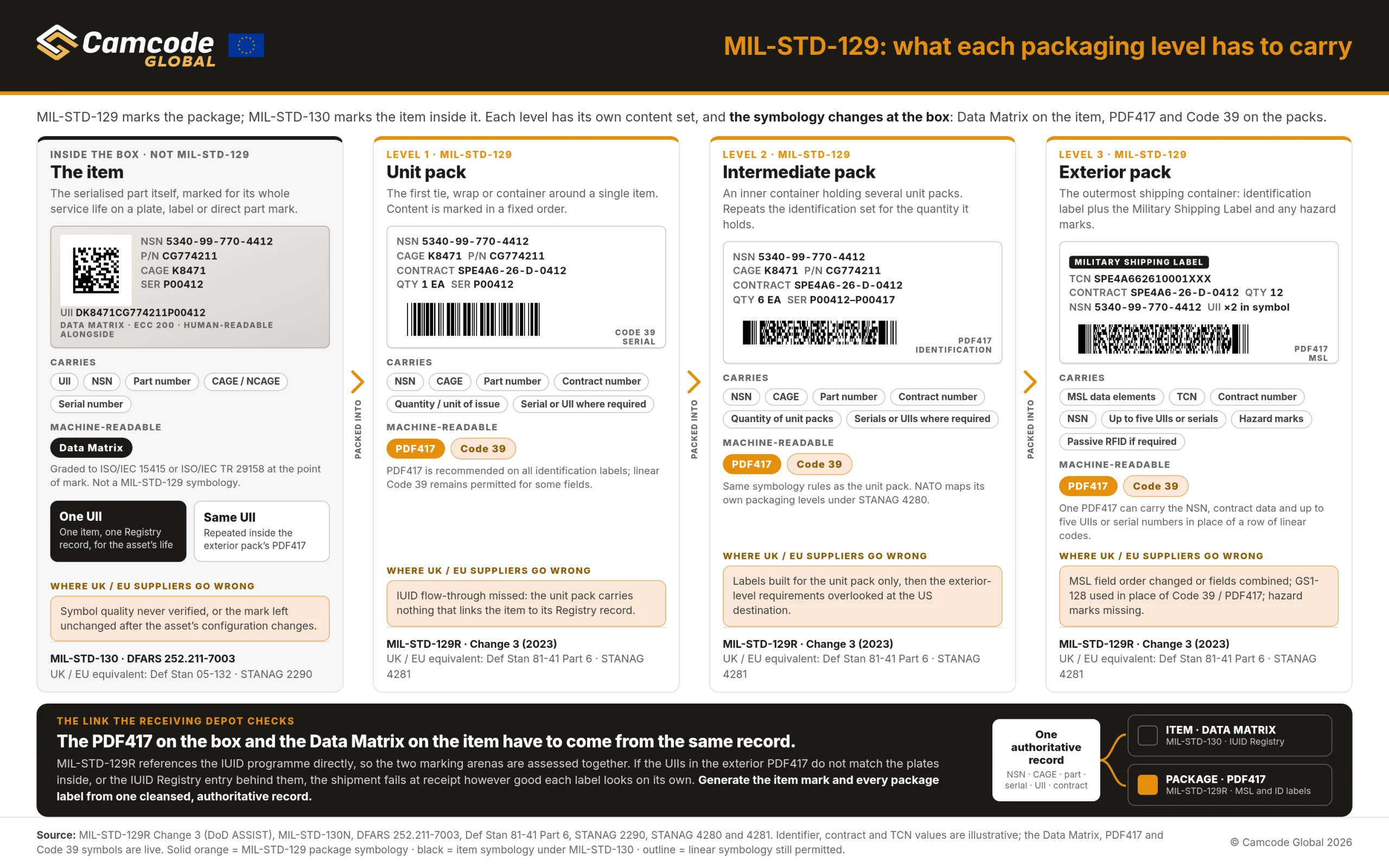
MIL-STD-129 is the US DoD standard which defines marking of military shipments and stored materiel. It covers:
- What information is applied to each packaging level (unit pack, intermediate pack, exterior pack).
- Where those pieces of information are placed on the packaging.
- What machine readable information is required (linear Code 39 barcodes and 2D PDF417 symbols).
- What handling and hazard markings are required with the identification markings.
- Traceability information linking the package to both the contract and the shipment.
- When passive RFID tagging of exterior containers is required (by the contract) for in-transit visibility.
In addition MIL-STD-129R explicitly references the US DoD Item Unique Identification (IUID) programme via DFARS 252.211-7003, so MIL-STD-129 and the IUID / MIL-STD-130 marking arenas must be considered jointly. As implemented, the markings placed on an exterior container label can contain much of the container-label data (NSN, contract data and up to five UIIs or serial numbers) within a single PDF417 symbol rather than a series of linear barcodes as was required with older revisions of the MIL-STD-129 standard.
The Three Levels of Packaging
MIL-STD-129 distinguishes packaging marking by packaging level:
- Unit pack: the smallest individual packaged unit. Carries the NSN, part number, contract number, CAGE, and quantity.
- Intermediate pack: an inner container that holds multiple unit packs.
- Exterior pack: the outermost shipping container. Carries the full set of shipping markings including military shipping label (MSL) data elements, transportation control numbers, hazard markings, etc.
The marking requirements differ by level. UK and EU suppliers creating labels only at the unit-pack level often overlook the requirements at the exterior-pack level and show up at their US destination point with non-conforming shipments. NATO defines levels of packaging as well (STANAG 4280), so a multi-national programme may require level mappings between the standards.
Where Packaging Marks Meet Item Marks: The Three Layers of Identification
MIL-STD-129 dictates requirements for the package. Whether an entire shipment conforms comes down to three separate but linked layers, each of which can fail for independent reasons:
- Layer 1: The identifier. The data unique to the item/package: its numbering system, syntax, data qualifiers and formatting rules (e.g., an NSN, a UII, a GS1 GIAI or an SSCC).
- Layer 2: The physical mark. The mechanism by which the identifier is permanently affixed: a durable label, nameplate, direct part mark or fabric tag selected for the asset, its operating environment and life-cycle.
- Layer 3: The capture technology. The mechanism by which the identifier is captured into your systems: barcode scanners, RFID/NFC, OCR software, mobile devices integrated with your ERP/maintenance/logistics applications.
All three layers apply to both the item and package level, and they must match up. STANAG 2290 mandates, for example, a DataMatrix code on the item (or on its data plate or label) and a PDF417 symbol on the lowest level of packaging, both of which encode the same 2D symbology that MIL-STD-129R uses on shipping container labels. Asset identification marks placed on the item and package will conflict at the receiving depot if they are not created from the same authoritative record. Learn more about the three layers in our Asset Identification field guide.
Identifier Types: What Goes Into the Marks
One asset in a multinational programme may have several identifiers applied at the same time, because each identifier has a different purpose: codification, item-level traceability, ownership, maintenance, shipment visibility or regulatory reporting. Here are the identifier types UK and EU suppliers encounter most frequently:
| Identifier | What it identifies | Where you will meet it |
| NATO Stock Number (NSN) | A 13-digit supply classification identifier for a standardised item of supply (not an individual serialised asset), assigned under STANAG 3150 and STANAG 3151. | NATO and allied supply chains; MIL-STD-129 package labels; Def Stan 05-132 marks. |
| Unique Item Identifier (UII / IUID) | A globally unique, permanent identifier for one individual item, registered in the DoD IUID Registry where required. | US DoD contracts (DFARS 252.211-7003, MIL-STD-130); carried in the PDF417 on MIL-STD-129R container labels. |
| NATO UID | An item-level identifier structured to STANAG 2290 and AUIDP-1 for lifecycle traceability across NATO nations. | NATO programmes; the basis for Def Stan 05-132 and CDS 751. |
| GS1 GIAI | A globally unique asset identifier built from a GS1 Company Prefix plus an internal asset reference. | Commercial, public-sector, healthcare and some defence supply chains. |
| GS1 GTIN | The type of trade item supplied; combined with a serial number it gives item-level identification. See GTIN. | Product, packaging and healthcare labelling. |
| GS1 SSCC | A logistic unit such as a pallet or shipping container. See SSCC. | Packaging and logistics; shipment visibility. |
| UK MOD identifiers | Equipment, inventory and logistics identifiers used alongside NSNs, serial numbers and UII data. | UK MOD contracts under Def Stan 05-132; structure depends on platform and contract. |
| EU UDI (UDI-DI + UDI-PI) | The device model or version (DI) plus production information such as serial, lot and dates (PI). | Medical devices under EU MDR 2017/745. |
| Pharmaceutical pack identifier | Product code, unique serial number, batch and expiry date (plus national reimbursement data where required). | Prescription medicine packs under the EU Falsified Medicines Directive. |
| CAGE / NCAGE | The organisation that manufactures, supplies or controls an item. | Enterprise identifier inside UIIs; package labels; Def Stan 05-132 marks. |
| Contract and shipment data | Contract or order number, CLIN, shipment number and serial numbers. | MIL-STD-129R container labels. |
| Internal asset codes | Your own scheme, provided allocation rules prevent duplication and the codes map cleanly to your ERP or EAM. | Internal registers, SAP and maintenance systems. |
Selecting the identifier is a data decision as much as a label-design decision: it depends on what asset you are marking, which contract you are working to, who is issuing the mark, what authoritative registry you are working with and what systems will be consuming your data. An NSN will identify a type of item, a UII identifies one unique serialised item. So you can have both on the same plate. If you are using GS1 identifiers as well, our GS1 guide explains where they sit along with the defence schemes.
How MIL-STD-129 Compares to UK and EU Packaging Standards
UK and EU suppliers new to MIL-STD-129 may find it helpful to compare it against standards with which they are familiar:
- Def Stan 81-41 (UK MOD packing specifications, including Part 6: Package Marking) covers broadly similar content but with UK-specific rules for what content should appear, and how it should be presented.
- STANAG 4281 (NATO Standard Marking for Shipment and Storage) is the NATO equivalent to MIL-STD-129 for package marking.
- STANAG 4280 (NATO Levels of Packaging) and STANAG 2828 (NATO packaging) both cover areas that overlap MIL-STD-129 for multinational programmes.
- EN ISO 21067-1 (Packaging, Vocabulary) provides the underlying terminology that will be familiar from EU work but does not prescribe rules for marking content.
- ISO/IEC 15418 (GS1 Application Identifiers) is the global commercial specification that MIL-STD-129 references for the machine-readable components.
In practice this means that conforming to Def Stan 81-41 is not proof that you can meet MIL-STD-129. The package marking content sets are similar, but the layout, sequence and machine-readable formatting requirements are different.
Item-Marking and Regulatory Standards Behind the Package
Packaging marks are in addition to item-marking programmes and industry regulations. Several of these utilise the same underlying technology, typically a graded DataMatrix, but they each specify their own identification format, encoded information, marking application, symbol quality, permanency, verification requirements and registry criteria. Adoption of a DataMatrix symbol alone does not ensure compliance.
| Standard | Issuer / region | What it governs |
| STANAG 2290 | NATO | Unique identification of items: UII structure, DataMatrix marking of the item, PDF417 on first-level packaging. |
| STANAG 4329 | NATO | NATO standard bar code symbologies (Code 39, PDF417, DataMatrix), now the NATO Standard Bar Code Handbook. |
| STANAG 4427 | NATO | Configuration management in system life cycle management. |
| Def Stan 05-132 | UK MOD | Marking of Service Materiel Items using a Unique Item Identifier (UII); invoked by DEFCON 644 / 528. |
| CDS 751 | Netherlands MoD | National UID policy built on STANAG 2290 for equipment supplied to the Netherlands MoD. |
| EN 9132 | European aerospace | DataMatrix coding quality requirements for parts marking. |
| ISO/IEC TR 29158 | ISO / IEC | Quality grading of direct part marks (formerly AIM DPM-1-2006). |
| EU MDR 2017/745 | European Union | Unique Device Identification (UDI) for medical devices. |
| EU FMD 2011/62/EU | European Union | Safety features, including a unique identifier, on prescription medicine packs. |
| ISO 55001 | ISO / BSI | Requirements for an asset management system. |
| MIL-STD-129 / MIL-STD-130 | US DoD (US-only) | Package marking for shipment and storage; identification marking of US military property (IUID). |
NATO STANAG 2290: Unique Identification of Items
STANAG 2290 mandates (through the supporting AUIDP-1 guidance document) the construction of the Unique Item Identifier for NATO and Allied forces. This standard also provides guidance for the content and physical manifestation of both a machine-readable DataMatrix applied to the item, data plate or label, as well as a PDF417 symbol placed on the first piece of packaging.
STANAG 2290 does not supersede the NATO Codification System; the NSN will continue to identify what item it is while the UII provides the data key for that unique item and its associated records wherever they may reside. A properly applied UII will consist of a UII built to the STANAG’s construction guidelines, an ECC 200 DataMatrix symbol, human readable information, and an associated data record.
STANAG 4329: NATO Bar Code Symbologies
STANAG 4329 standardises the bar code symbologies used to mark NATO forces’ materiel, containers and documentation. It was originally issued as NATO Standard Bar Code Symbologies (AAP-44) but is now issued as NATO Standard Bar Code Handbook (AAITP-09), which details linear Code 39 and the two dimensional PDF417 and DataMatrix symbologies. STANAG 2290 references it for use of the ECC 200 DataMatrix and Def Stan 05-132 is designed to be read in conjunction with it so it sets out symbology rules for both the item mark and the package symbol.
STANAG 4427: Configuration Management
STANAG 4427, Configuration Management in System Life Cycle Management, is applied via the Allied Configuration Management Publications (ACMP-2000 series). STANAG 4427 does not tell you how to mark up an item. This matters because configuration management relies on every physical component or item being traceable to its configuration documentation record. That is what the UII does as a data key. Proper unique identification is what allows a maintainer to ensure that only the correct, properly altered part has been installed.
UK MOD Def Stan 05-132
Def Stan 05-132, Marking of Service Materiel Items Using a Unique Item Identifier (UII), is the UK MOD’s adoption of the NATO standard. It is usually called off via DEFCON 644 and/or DEFCON 528. These documents both state that assets must be received with a permanent indelible mark; otherwise, they are liable to be shipped back at the owners expense or not paid for at all. Def Stan 05-132 is written assuming it is read in conjunction with STANAG 2290, AAP-44(A), STANAG 4281 and Def Stan 81-41 Part 6. Some of the requirements include:
- It should have a UII consisting of the CAGE / NCAGE code, original part number and serial number. The NSN along with other information can also be added, but is not mandatory.
- The UII should be a DataMatrix formatted to ISO/IEC 15434. Normally Data Identifiers are used (other formats of DataMatrix can be used if the authority responsible agrees).
- The mark must be permanent for the expected life of the asset and be able to survive all foreseeable maintenance, storage and handling as well as the operating environment.
- Each mark must be verified prior to attachment, with verification evidence retained.
Although both MIL-STD-130 and Def Stan 05-132 prefer DataMatrix, the way they encode the data and the human readable portion of the codes differ.
Netherlands MoD Policy CDS 751
CDS 751 is the UID policy published by the Netherlands Ministry of Defence, based on STANAG 2290. This document details the requirements relating to the Unique Identification of equipment procured under contract to the Netherlands MoD.
Depending on contract and asset type, this may include requirement for the NSN and item-master data, part number and serial number, manufacturer codes, NATO UID information formatted per STANAG 2290, human readable information and machine readable information, DataMatrix marking and the appropriate long-life physical marking depending on asset and environment. Refer to the contract specific requirements of CDS 751 before assuming all assets require the same information on the label.
EN 9132: Aerospace DataMatrix Quality
EN 9132 details requirements for DataMatrix coding quality when marking aerospace parts. Used in conjunction with customer drawings and part-specific marking instructions, EN 9132 typically includes:
- Agreed content for the DataMatrix and approved location to place the mark.
- Size of symbol and cell size requirements.
- Method to verify symbol quality and control the marking process.
- Validation that the mark will have no adverse effect on the part’s form, fit, function or structural integrity.
ISO/IEC TR 29158: Direct Part Mark Quality
ISO/IEC TR 29158 (formerly AIM DPM-1-2006) modifies the ISO/IEC 15415 grading process to accommodate marks that are applied directly to a part and read by a 2D imager (i.e., laser engraved or dot-peen DataMatrix). Prints will be graded to ISO/IEC 15415; direct part marks will be graded to TR 29158. MIL-STD-130 recognises either grading process, as well as SAE AS9132 (EN 9132’s equivalent), as a quality standard, and the acceptance grade you will need to achieve is dependent on what revision of the standard your contract stipulates.
EU Medical Device Regulation 2017/745
EU MDR 2017/745 mandates that medical devices (along with packaging levels where applicable) bear a Unique Device Identifier comprising a UDI-DI (device model number) and a UDI-PI (production instance information), presented in both machine-readable and human-readable forms. GS1 DataMatrix is one way of meeting this requirement, but GS1-barcoded data is not the only acceptable option.
All device information must also be registered in an EU database called EUDAMED. Unique Device Identification is an EU requirement only. While similar in many ways, the US FDA has its own UDI rule, which registers devices in a different system, GUDID, so the EU and US systems are not inherently compatible.
EU Falsified Medicines Directive 2011/62/EU
The Falsified Medicines Directive mandates that qualifying prescription medicines must be equipped with safety features at the individual-pack level. This must include a unique identifier. The 2D symbol usually contains the product code, a unique serial number, the batch or lot number, expiry date and, where necessary, national reimbursement information. The information contained within the symbol is checked with the national medicines verification system that interfaces with the European network.
ISO 55001: Asset Management Systems
ISO 55001 (Asset management: Management systems, Requirements; revised in 2024) does not mandate a marking approach, but there can be no asset management system without reliable asset identification. Registers, maintenance histories and audit trails all rely on being able to associate a record to one and only one physical asset for its entire lifecycle. That’s why unique identification is the foundation beneath any ISO 55001 programme and also why lifecycle advisory is the final stage of Camcode Global’s process.
Other Allied Schemes
Multinational programmes may also require compliance to Canada’s DAOD 3038-0 or Australia’s DEF(AUST) 1000C. Camcode Global’s mobile laser marking cart was built to conform with the marking and governance standards of those programmes as well as CDS 751, Def Stan 05-132 and MIL-STD-130.
Mark Types: How Camcode Global Physically Marks the Identifier
Choosing your identifier is only part of the equation. You need to attach it with a mark that will remain readable and adhered for the lifetime of the asset. Camcode Global has eight marking technologies we evaluate against substrate, environment of operation, lifecycle, production quantities, attachment technique and capture technology:
| Mark type | Characteristics | Typical applications |
| Photosensitive anodised aluminium (Metalphoto®) | Sub-surface, inorganic image that is extremely durable and meets a wide variety of performance requirements. Best for high to medium volume; poor for small volumes or on-site marking. Flexible size, thickness and attachment options. | Small arms and weapon ancillaries; ships and marine; aircraft and aerospace; engines and components; complex and crew-served weapon systems; communications equipment; chemical, heat and sunlight exposure. |
| Laser markables | Steel, BlackPlus or acrylic. Etched or bonded image is durable (depending on substrate), but laser marking is slow and labour-intensive: best for low-volume, on-site work where real-time marking is needed. May require on-site fabrication if pre-cut blanks are unavailable. | Small arms; weapon ancillaries; aircraft and aerospace; engines and components; complex weapon systems; communications equipment; chemical, heat and sunlight exposure. |
| Thermal transfer | Ink-transfer image with limited durability depending on material. Meets moderate to high demand volume, with on-site printing possible for real-time marking. Limited size, thickness and attachment options. | Soft and hard armour; hospital equipment; direct circuit board marking; general asset tracking; suppressor marking; extreme heat (500–1,200 °C)*. |
| Ink jet | Printed image with limited durability depending on material or overlay. Meets moderate to high demand volume. Limited size, thickness and attachment options. | Soft and hard armour; ballistic and bump helmets; hospital equipment; general asset tracking. |
| Cut-through | CNC-punched plates with good durability, most suitable for low quantities. Can present readability issues in some applications; size, thickness and attachment limited by material. | Heavy equipment; ships and marine; chassis marking. |
| Woven fabric | Sewn tags with moderate durability and limited attachment options (heat seal or sewn). Ideal for fabric marking. | Parachutes; apparel; other woven and fabric assets. |
| Direct part mark (DPM) | Laser-etched or dot-peen mark that is durable, although the process is slow and labour-intensive. Ideal where affixing a label is not possible. | Bridging; harsh chemical environments; surgical tools; aircraft components. |
| NFC | A passive radio-frequency identification protocol that needs the reader within 4 cm of the tag, and can be read by most smartphones. Ideal where a barcode cannot be affixed or the system needs alternate actions on each scan. | Communications equipment; hospital equipment; general asset tracking. |
*Attachment surface and operating environments should be identified prior to selecting a marking technology and extreme-heat constructions should be qualified per the asset’s true temperature range/exposure duration.
In the case of a MIL-STD-129 shipment, the package labelling may consist of a heavy-duty polyester label created by thermal transfer or ink jet printing (or an aluminium-faced label for outdoor or marine exposure), while the item mark may be a Metalphoto plate or direct part mark. NFC was listed above as it’s typically ordered in conjunction with a label, but RFID and NFC are not marking methods by themselves. They are data carriers that are built into a label or tag.
Applied Marks versus Direct Part Marking
When a label or plate isn’t going to survive the lifetime of the part (due to high vibration, high heat or application on refurbished parts), then the identifier must be applied directly to the part. Direct part marking isn’t always ideal, however. Verification becomes more difficult, the marking equipment is costly and some substrates (such as heat treated steel or coated aluminium alloys) cannot be reliably marked without damage.
We typically only recommend DPM once you have proven that an applied mark can’t be made durable enough for the intended environment. If a label is still an option, our mobile laser marking cart can generate small-run UID marks right on-site after the data has been verified, eliminating outside lead times.
Selecting the Correct Marking Method
Regardless of the mark type you ultimately choose, consider the entire application before deciding. Issues to consider include:
- Composition of the substrate and finish of the surface to be marked.
- Temperature extremes and expected duration of exposure.
- Solvents, fuels, oils and cleaning agents it will encounter.
- UV Exposure and weathering.
- Abrasion, shock and general handling.
- Size of available area for marking and method of attachment.
- Expected service life.
- Barcode, RFID or NFC scanning requirements.
- Volume of production and point-of-use considerations.
- Relevant defence, industry and/or customer standards.
Mis-specifying the mark can be costly. An inexpensive polyester or polycarbonate label that has to be replaced every three to five years in a harsh environment costs significantly more than the label itself: someone has to locate the asset, remove the old label, apply the new label and register it in the system again. Getting the mark specification right the first time around is much less expensive over the lifetime of the asset.
AIT Solutions: Capturing the Mark and Tracking the Shipment
But a durable mark is only useful if you can capture that data accurately and feed it into the systems that manage the asset. Camcode Global’s Automatic Identification Technology (AIT) includes the following technologies. These technologies all integrate into SAP, ERP, EAM, maintenance and logistics platforms:
| AIT solution | What it does | Typical defence uses |
| Barcodes and QR codes (1D, 2D, QR, GTIN, SSCC, UDI) | Reliable, low-cost capture of asset, item, packaging and shipment data. Supported symbologies include Code 39, Code 128, GS1-128, QR Code, PDF417 and DataMatrix; use only those your contract specifies. | UII and serialisation; MIL-STD-129 container labels; NATO and national asset identification; UDI. |
| Passive RFID | No internal power source; energy comes from the reader. Reads without line of sight and captures many items at once. | Warehouse inventory; tool and arms-room accountability; issue and return; shipment visibility. |
| Active RFID | Tag has its own power source and a longer read range; can also carry sensor information and location events. | Containers; vehicles; high-value assets; depot and yard tracking; in-transit visibility; gateway monitoring. |
| Real-Time Locating Systems (RTLS) | Continuous location and movement of assets in a defined space, using active RFID, Bluetooth Low Energy, ultra-wideband, Wi-Fi or other technology. | Maintenance, repair and overhaul facilities; warehouses; high-value or mission-critical equipment. |
| Optical Character Recognition (OCR) | Converts printed, stamped or engraved characters into structured data. Results must be validated because worn plates and similar characters cause errors. | Asset surveys; legacy nameplate capture; data cleansing; SAP and ERP record validation. |
| GPS tags | Location of assets moving between facilities, regions or countries, over cellular, satellite or radio links. | Vehicles; containers; deployable systems; international shipments. |
| NFC | Short-range read by compatible smartphones and tablets, giving access to records, instructions or inspection forms. | Maintenance and inspection workflows; communications and medical equipment; equipment authentication. |
| Biometrics and smart cards | Ties an asset transaction to the individual performing it, for access control and accountability. | Arms-room accountability; controlled equipment issue and return; tool control. |
| Sensor technology | Monitors temperature, humidity, shock, vibration, pressure or movement, linked to the asset’s unique identifier. | Ammunition and controlled inventory; temperature-sensitive materials; predictive maintenance. |
| Electronic Article Surveillance (EAS) | Theft deterrence and perimeter monitoring. A security control rather than a complete identification solution. | Controlled, sensitive or high-value inventory. |
Barcodes or RFID?
Barcodes (specifically DataMatrix) continue to be the dominant method of serialised asset identification since any smartphone or imager can scan them without additional investment. RFID gains traction when you want to read assets from a distance, multiple at a time or without line of sight such as with reusable transit documents, tool crib or instrument trays. They are not mutually exclusive; many utilise both.
In-Transit Visibility
This is where correctly marked packages deliver ROI. Solutions from Camcode Global allow you to leverage NATO in-transit visibility tools such as the RFID Routing Hub and Barcode Routing Hub which require well formed barcode and RFID data at the package level. Capture technology must also align with the receiving site: you cannot read 2D symbologies like DataMatrix with a 1D laser scanner, and RFID or NFC technology is wasted if the receiving site lacks readers.
Connecting the Physical Asset to Enterprise Systems
Supplying labels, tags and scanners is only part of the process. We look at the complete workflow:
- The identifier and required data structure.
- The label, tag or direct part mark.
- The barcode, RFID or other data carrier.
- The scanner, reader or mobile device.
- Data validation and business rules.
- Integration with SAP, ERP, EAM and logistics systems.
- Reporting, analytics and asset-visibility needs.
Designing One Mark Set for Multiple Schemes
UK and EU suppliers commonly require one plate, label set and shipping mark to meet multiple national requirements, NATO standards and customer requirements simultaneously. Here are some practical tips to help manage these varying requirements:
- Plan the space for the worst case. Design space into the label substrate for NSN, manufacturer’s part number, CAGE/NCAGE, serial number, UII, GS1 GIAI and UDI content, as well as the human-readable version of all of those data strings.
- Select the mark type for the substrate and environment. Use Metalphoto labels for long-life, outdoor applications that need to be serialised; thermal transfer or ink jet labels for high-volume, serially marked soft goods; DPM marking where a label is not feasible; NFC or RFID tags where line-of-sight scanning won’t work.
- Format the machine-readable content to the right symbology for each layer. DataMatrix is used for every 2D symbol included in item marking standards (STANAG 2290, MIL-STD-130, Def Stan 05-132, CDS 751, EN 9132 and EU UDI), while legacy packaging marking defined by MIL-STD-129R uses Code 39 and PDF417.
- Grade every mark when it is applied. Grade every applied mark against ISO/IEC 15415 (printed marks) or ISO/IEC TR 29158 (direct part marks) to the extent required by each scheme and retain the per-item proof.
- Add the right capture technology. Barcode or DataMatrix scanning for point-of-use reads; RFID or RTLS for remote or bulk scans; or OCR technology to capture data from older serial numbering schemes.
- Document your registry workflow. Every registry or database submission (the IUID Registry, EUDAMED, national medicines verification systems) needs its own designated step defined in your supplier quality system.
Where UK and EU Suppliers Go Wrong
Typical mistakes with MIL-STD-129 compliance that we regularly see from UK and EU suppliers, and some of the common root causes behind them:
- Order of content on MSL label. The military shipping label for USDC shipments has very specific field order; changing it, or combining fields disrupts automated scanning processes when the container is received at the depot.
- Missing IUID-mark link. If a contract requires IUID, make sure the unit pack has identifiable data that links to the IUID registry. A lot of focus goes to package marking itself and IUID flow-though is missed.
- Incorrect barcode symbology. MIL-STD-129R calls out linear Code 39 and 2D PDF417 symbologies for bar codes, and recommends PDF417 use for package-level identification marks (although Code 39 is still allowed for some data fields). Using non-standard symbology (e.g., GS1-128), or an incorrect symbology for the data field will fail when received.
- Missing hazard markings. If applicable, UN/IATA dangerous goods placarding must accompany MIL-STD-129 content; they are not optional.
- Applying labels to the wrong substrate. Labels intended to survive outdoor or marine shipping environments need to withstand moisture, abrasion, UV, etc. Commercial quality, office-deployed thermal labels don’t. Item-level markings are subject to the same principle: that expensive resin coded polyester tag you applied to an outdoor industrial asset may well pass compliance inspection when applied, but fail in year five.
- Trying to take shortcuts with content. Applying a mark that complies with one scheme but omits data required by another, like an NSN-only application that does not meet IUID or UII requirements.
- Symbol quality not verified. A DataMatrix that looks fine but misses the minimum grade causes decode failures downstream.
- Missing or incomplete registry entries. The mark exists, but IUID Registry, EUDAMED or other record doesn’t exist or isn’t updated.
- Package data doesn’t match item data. The PDF417 symbol on the box lists UIIs or serial numbers that don’t match the plates applied to the items inside.
- Capture technology doesn’t match the receiver’s capabilities. The specified RFID or NFC isn’t being read because the receiving facility doesn’t possess the correct readers, or they’re using 1D scanners on 2D symbols.
- Mark not updated when asset configuration changes. An asset’s configuration changes, but the mark and the registry record are not updated to match.
Early-life label or tag failure is one of the leading root causes of identification-related audit observations, so choosing the correct mark type matters as much as the identifier content.
Camcode Global’s Seven-Step Data Cleansing, Asset Identification and Data Optimisation Process
Data marking fails when it’s seen as a single point-in-time labelling exercise. Our 7-Step Data Cleansing, Asset Identification and Data Optimisation Process sees it as a repeatable programme. Developed through our work with NATO defence customers on interoperability and in-transit visibility projects, it maps to NATO STANAGs from initial consultation through lifecycle management.
We’ve been authorised as a NATO supplier for this process and others like it for over 12 years, and deliver it through our NATO Support and Procurement Agency (NSPA) Enabling Contract (LS-SU/46/00004170), allowing defence organisations to purchase access to our services in a simplified manner. Learn about each stage in The Framework, or read The Results to see where we’ve applied it.
Step 1: Asset Identification and AIT Consultation
We evaluate your project and make recommendations on how best to structure your processes to meet the applicable standards/frameworks, increase asset utilisation, streamline processes for efficiency and compliance, implement technology and automation, and transform your supply chain. For MIL-STD-129 or multi-standard programme(s), this is where we identify all the schemes your contract cascades down to (MIL-STD-129, MIL-STD-130 / IUID, Def Stan 05-132, CDS 751, STANAG 2290, EN 9132, EU MDR or FMD), determine where content overlaps and decide on the AIT strategy.
Step 2: Engineering Services
Our engineers create the marking specification, or factsheet, which outlines how the asset will be identified by both data and physical marking. They validate a portion of the asset data in-country, establish business rules and data governance and determine the best mark type to use from above. Typically, the factsheet will specify the identifier construct, the symbologies (DataMatrix, PDF417, Code 39), material/presentation, placement, verification process and required grade, and contents of the label for each MIL-STD-129 packaging level.
Step 3: Data Remediation, Reconciliation and Verification
Our proprietary offline and online data collection software is the key to accuracy and efficiency. It aligns the data with the relevant standards, reduces human error, integrates with your existing systems and generates detailed reports and analytics. In practice, this creates one cleansed, authoritative record, so the item plate and the package label are generated from the same data, and OCR can capture legacy nameplates and serials at scale.
Step 4: AIT Product Manufacture and Procurement
Products are manufactured against the defined data and material specifications. Barcodes (1D, 2D, QR, GTIN, SSCC, UDI), RFID, sensors, GPS, OCR, RTLS, NFC, EAS, biometrics and other technologies may be included on products. This translates into any and all types of marks used in a typical enterprise (Metalphoto plates, laser markables, thermal transfer and ink jet labels, cut-through plates, woven fabric tags, NFC tags, direct part marking), containing variable data pulled from the single authoritative record.
Step 5: AIT Product Installation
Our NATO Security Cleared installation teams follow the procedures in the marking specification, and our proprietary software ensures accurate data association between each product and its asset. All installations comply with the relevant regulatory and NATO requirements. In practice, where low volumes or real-time needs rule out an off-site supply route, our mobile laser marking cart produces small-run, verified 2D DataMatrix marks on-site once the data has been checked, in line with SAP S/4HANA data governance.
Step 6: Data Reporting and Migration
Custom reporting provides visibility into your critical operating metrics, identifies variances, simplifies data management and helps ensure superior master data quality, saving time and effort on record reconciliation. This is where per-item grading results and registry submissions are logged, and cleaned data is transferred into SAP or your other ERP and asset management systems.
Step 7: Asset Life Cycle Management Advisory (ALCMA)
Provided by KPMG, ALCMA can assist you in taking charge of your assets from planning and procurement through maintenance, optimisation and disposal. It focusses on helping you improve asset performance and reduce costs while meeting industry standards and compliance regulations like ISO 55001. This also includes physical asset data management, ERP integration and migration and data analytics from KPMG’s advisory services. This is where rules are set around re-identification in practice, so that an asset that has been refurbished, transferred or reconfigured still carries a mark and record that match.
What the Process Delivers
Clients have implemented the process to solve problems in asset identification, configuration management, asset life cycle management, BPO automation, digital transformation, NATO interoperability and supply chain management. The UID acts as a digital key to enable cross-linking of assets in engineering systems, life cycle systems, configuration management systems and supply chain systems. Through the NSPA contract we have delivered solutions for many defence agencies across Europe and Oceania. To give you an idea of the size of some these projects:
- Over 3 million lines of ITAR items were identified to maintain compliance and meet US DoD reporting requirements.
- Over 4 million lines of system data were cleansed to improve asset visibility, life cycle management and operational readiness.
- Rotation fleet data by OEM’s was validated where over 21% of the data was found to be inaccurate and needed correction to meet EU regulation and allow aircraft to become airworthy.
How to Build MIL-STD-129 Compliance Into a UK or EU Operation
Here’s a pragmatic approach for building MIL-STD-129 compliance into your UK or EU operation:
- Get the current revision. Most US DoD contracts today will call for MIL-STD-129R with Change 3 (dated 25 February 2023).
- Map the contract’s specific clauses. Contracts won’t require every clause on every shipment. Make note of every standard the contract flows down (i.e., Def Stan 05-132, CDS 751 or STANAG 2290 requirements too).
- Develop label templates for the three packaging levels: unit, intermediate and exterior.
- Choose a durable substrate. Think about where your labels will spend their lives. Heavy-duty premium polyester works great for warehouse environments. Outdoor-rated polyester labels or aluminium-faced labels are better for shipping environments exposed to sunlight and moisture. Consider Metalphoto labels or a direct part mark when enduring lifecycle prevents normal labels from working.
- Build an IUID link if the contract requires it. This will associate your package marking (MIL-STD-129) to the item (MIL-STD-130) and allow you to maintain one source of data that flows to both packages and items.
- Validate the symbology. MIL-STD-129R calls for Code 39 and PDF417 (DataMatrix is used for item marking under MIL-STD-130); your contract will define which barcode is used for each data field.
- Grade and record every mark. Create a master record using ISO/IEC 15415 (printed) or ISO/IEC TR 29158 (DPM), and keep proof of application records for each item within your quality record.
- Match capture to the receiving site. Ensure your receiving site scans correctly by validating the scanners, RFID readers or NFC devices downstream will read your marks.
- Submit registry records before or with despatch. Maintain a separate step to submit IUID, EUDAMED and medicines verification registry records.
- Plan for re-identification. Establish a process for updating marks, registries and configuration records if an asset is refurbished, redeployed or reconfigured.
Frequently Asked Questions
Is MIL-STD-129 mandatory for all UK and EU suppliers shipping to the US DoD?
If the contract invokes it (which most US DoD contracts do for shipped goods), yes. The supplier on the contract is responsible for compliance regardless of country of origin.
How does MIL-STD-129 relate to MIL-STD-130?
MIL-STD-129 governs packaging and shipping marks. MIL-STD-130 governs identification marking of the items themselves (IUID). The two work together on serialised items: MIL-STD-130 marks the part, MIL-STD-129 marks the package.
Do UK or EU customers require MIL-STD-129 or MIL-STD-130?
Neither by name. They are US-only, and UK/EU defence contracts will not formally recognise them unless they’re flowed down by a US contract. They are, however, covered by equivalents: Def Stan 81-41 Part 6 and STANAG 4281 for packaging, Def Stan 05-132, CDS 751 and STANAG 2290 for item marking.
Can I substitute Def Stan 81-41 marking for MIL-STD-129?
No. The two are similar in intent but differ in content and layout. UK contracts that flow into US-led NATO programmes typically require MIL-STD-129 in addition to Def Stan 81-41.
Does MIL-STD-129R require DataMatrix?
No. MIL-STD-129R calls for linear Code 39 and 2D PDF417 barcodes. One of the major changes addressed in Revision R was the move to use PDF417 instead of linear barcodes on all Container Identification Labels. DataMatrix is used for item marking (MIL-STD-130, IUID) and GS1-128 is a commercial symbology not called out in the standard.
How does Def Stan 05-132 differ from MIL-STD-130?
MIL-STD-130 is the US DoD specification for marking US military property. Def Stan 05-132 is the UK MOD’s UII marking standard, which is issued on UK defence contracts through DEFCON 644 / 528. Both standards prefer DataMatrix; however the encoding rules and human-readable portion are different.
How long should a mark last?
Metalphoto anodised aluminium has an expected life of 20+ years outdoors and is tested to military standard MIL-STD-130 as a benchmark. Polyester labels usually last 3-7 years depending on UV and chemical exposure. Def Stan 05-132 requires a mark that will last for the normal life of that asset.
Can one plate satisfy several schemes?
Yes, if the content is organised properly. A plate that includes the NSN, manufacturer’s part number, CAGE / NCAGE, serial number, UII and a graded DataMatrix will typically meet the item-marking requirements IUID, Def Stan 05-132 and DAOD 3038-0 require. Always verify against each contract.
Do we need RFID, or are barcodes enough?
For marking items and packages, barcodes are sufficient for the vast majority of applications. Use RFID when you need reading distance, or millions of reads at a time (bulk reads), or if you must read without line-of-sight to the readers. If you are using NATO in-transit visibility products, they already use RFID. Many inventory control programmes run both systems concurrently.
Do all schemes require a registered identifier?
Not necessarily. IUID, EU MDR UDI and EU FMD require registry or database submission. Other schemes use national codification systems, customer asset registers or the issuing organisation’s controlled database. Review the registry obligations in your contract.
Does GS1 replace the NSN or UII?
No. While GS1 GIAI is gaining acceptance alongside NSN in UK and EU government commercial templates, defence specific (Def Stan, MIL-STD, STANAG) work still centres on NSN/UII compatibility. GS1 will be used when crossover into civilian industry is required.
Where do I get the current revision?
The DoD ASSIST repository (assist.dla.mil) publishes the current revision of MIL-STD-129. UK and EU suppliers can register and download. Always verify the revision matches what your contract invokes.
How Camcode Global Supports MIL-STD-129 Shipments
Camcode Global provides the tough polyester and aluminium-faced labels, the variable data printing services and verification tools that UK and European suppliers require to conform to MIL-STD-129 at unit, intermediate and outer pack levels. Outside of packaging, we produce Metalphoto plates, laser markables, thermal transfer and ink jet labels, cut-through plates, woven fabric tags, NFC tags and direct part marking substrates. We apply barcodes and QR codes, passive and active RFID tags and devices, RTLS, OCR, GPS tags, biometrics and smart cards, sensor technologies and EAS, all linked into your ERP solution with our customised data cleansing and reporting platform.
Delivered via our proprietary seven-step process, as a NATO-approved company and NSPA Enabling Contract holder with Asset Life Cycle Management Advisory support from KPMG. We understand UK suppliers supplying programmes to the US Department of Defense via NATO Allies, US-headquartered primes working within Europe, and European Union contractors working on IUID-tagged programmes. Learn more about how it all works together with our UID label compliance guide and asset identification overview.
Talk to a Camcode expert about your packaging and marking needs for MIL-STD-129.