GS1 compliance labels (labels that include GS1 DataMatrix or GS1-128 content to meet specific regulatory requirements) have become part of everyday business life for healthcare, pharma and medical devices operators across the UK and EU. Compliance with GS1 standards is compulsory across the NHS in England, as part of the Department of Health’s NHS eProcurement Strategy. And the EU Falsified Medicines Directive places requirements on packs of prescription medicine that are introduced into circulation in the EU market place, with few exceptions (NHS SPS).
This guide is specific to GS1 compliant labels: labels created with the intention of meeting regulatory requirements and industry specific schemes such as EU MDR (European Union Medical Device Regulation) UDI, EU FMD (Falsified Medicines Directive), NHS Scan4Safety and the UK MHRA (Medicines and Healthcare products Regulatory Agency) UDI programme. We differentiate compliant labels from general GS1 asset/product labels due to the higher expectations placed on the content, labelling grading and end-to-end traceability.
GS1 standards are one set of identification requirements amongst many that UK and EU businesses must adhere to, and they rarely operate in isolation. Many of Camcode Global’s customers work in healthcare, defence, aerospace and general industry simultaneously and require a single identification programme; one that incorporates the structure of the identifier, physical mark and data-capture technology required to apply GS1 content as well as NATO, UK Ministry of Defence, aerospace and alternative regulatory identifiers where their supply chains converge.
In this guide we position GS1 compliant labelling within that broader context: what identifier types Camcode Global works with, what physical marking technologies we can produce, and what automatic identification and data capture (AIDC) technologies we can deploy; as well as the broader standards landscape (GS1 and beyond) which defines label content across UK and EU markets. We will also outline Camcode Global’ seven-step Data Cleansing, Asset Identification, and Data Optimisation Process; the repeatable programme used to create every compliant label we produce.
 CAMCODE GLOBAL
GS1 compliance label readiness checklist
How this is calculated & sources used
Checklist compiled from EU MDR / IVDR / FMD official guidance, NHS Scan4Safety, UK MHRA UDI position papers, and Camcode Global UK / EU compliance-label customer experience.
Sources actually used:
• EU MDR 2017/745 / IVDR 2017/746
• EU FMD 2011/62/EU
• Delegated Regulation 2016/161
• NHS Scan4Safety guidance
• UK MHRA UDI guidance
What Makes a Label a “Compliance Label”
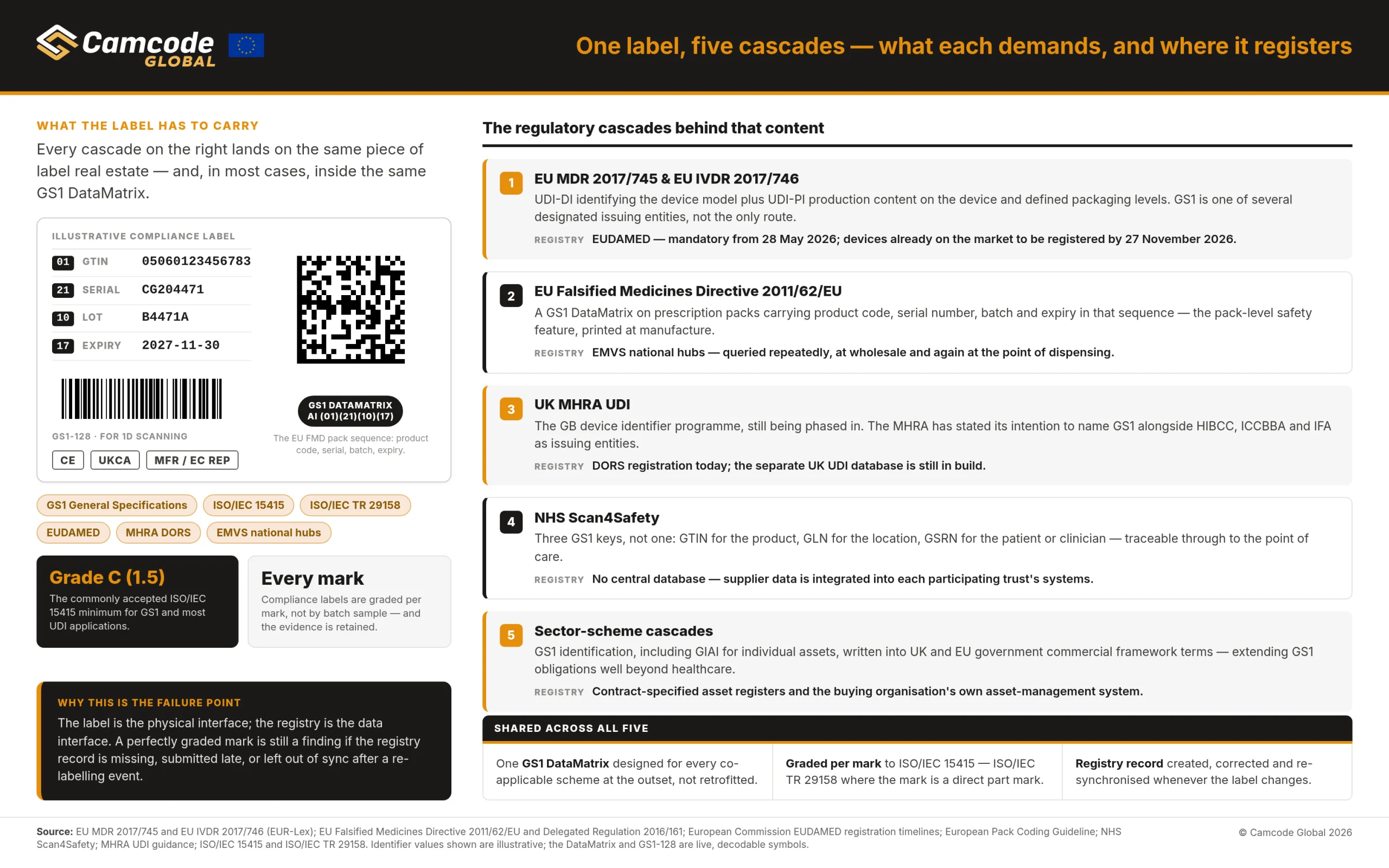
Not all labels that feature a scannable code are compliance labels. An off-the-shelf asset tag or inventory barcode can be manufactured to your organisation’s own internal standard; you choose the content, symbology and quality rules it must adhere to. With compliance labels, you have no such choice. They’re defined by a regulator or industry scheme (hence “scheme-compliant”), and must adhere to that scheme’s rules. In UK / EU practice a compliance label will:
- Contain mandatory content. Regulations and industry schemes usually specify which data fields must appear on the label (product code, serial number, batch/lot, expiry date, device identifier, etc.). The placement of these elements is normally prescribed, and they must appear in the format mandated by the regulation or scheme documentation.
- Adhere to specific symbology, grading, and content requirements. Regulations and schemes will usually specify which barcode/DataMatrix symbologies are permitted, the print quality (grade) standard the applied mark must meet, and may mandate the syntax (including GS1 Application Identifiers where appropriate) used to construct the encoded data string.
- Trigger audit implications if content or quality is incorrect. If one of your internal asset labels is illegible or damaged, it can be re-printed. But if a regulatory label scans incorrectly, or is deemed to be of inferior print quality, you can expect to see audit findings during your next regulatory inspection or customer audit. Products can be held from release, recalled from the market, or in severe cases, lose market authorization.
- Often interface with a central registry or database (EUDAMED, UK MHRA, GUDID, NATO CMDB, or for crossover programmes maybe the DoD IUID Registry). The label is often only part of the compliance obligation. The identifier it carries must be registered with, and kept synchronised against, the relevant authoritative database.
For GS1 compliance labels in particular, there are several regulatory cascades behind these requirements, each specifying its own content, symbology and registry requirements that Camcode Global can help you meet:
EU MDR 2017/745: UDI on Medical Devices
Under EU Medical Device Regulation, designated medical devices (and certain packaging levels) must be labelled with a Unique Device Identifier, which is made of UDI-DI (identifies device model/version) + UDI-PI (production data: serial number/lot number/expiry date, etc.). The identifier must be registered in EUDAMED (European Database on Medical Devices), the centralized medical device database maintained by the EU.
Registrations to EUDAMED became mandatory starting 28 May 2026 (rather than voluntary as it had previously been). Device manufacturers who wish to place new devices on the EU market are required to undergo Actor registration and UDI/Device registration for their products in EUDAMED before the product is placed on the market. Additionally, there is a deadline of 27 November 2026, by which all devices already on the market must be registered retrospectively. As GS1 is one of several UDI issuing entities designated by the EU, GS1 DataMatrix is commonly used by manufacturers to encode the UDI DI and PI content required by EU MDR, however it is not the only issuance framework accepted (EUR-Lex).
EU IVDR 2017/746: UDI on In-Vitro Diagnostic Medical Devices
The EU In Vitro Diagnostic Medical Devices Regulation (EU IVDR) places the same UDI obligation on in- vitro diagnostic devices, utilising the same concept of UDI- DI / UDI-PI format as well as registration pathway through EUDAMED as the EU MDR. Registration under IVDR will fall under the same compulsory EUDAMED timeline starting 28 May 2026, thus IVD manufacturers will be subject to the same Actor and UDI/Device registration deadlines as outlined for manufacturers of medical devices under EU MDR. Furthermore, manufacturers will be dependent on GS1 or another appointed issuing body to assign how their UDI should be built (EUR-Lex).
EU Falsified Medicines Directive 2011/62/EU: GS1 DataMatrix on Pharmaceutical Packs
The EU Falsified Medicines Directive (FMD) mandates that all prescription medicines being placed on the EU market have a GS1 DataMatrix on the package encoding unique pack-level safety features. The DataMatrix barcode is verified against a national medicines verification system for each pack before it is dispensed to a patient.
This requirement makes compliance with FMD different from EU MDR and IVDR legislation in one key aspect: instead of checking against a central registry once at the point of manufacture, FMD controls verify the legitimacy of every package repeatedly throughout the supply chain, first at wholesale level, then at pharmacy level. This means the applied mark must stay scannable AND accurate through every step of handling from manufacture to dispensation (EUR-Lex).
UK MHRA UDI: UK Medical Device Unique Identifier
The UK has its own incoming device identification programme. Under reforms previously outlined by the MHRA in its consultation response last year (2025), manufacturers wishing to place devices on the GB market will be required to assign them a UDI that can be searched against a public UK UDI database, with plans to eventually scrap the UKCA marking requirement when that database becomes available and the UDI transitional period expires (Burges Salmon, Jul 2025 / updated Feb 2026).
For now, registering medical devices with the MHRA runs through their existing DORS database, separate from what will be the UDI database at launch (Casus Consulting, 2026 MHRA registration guide). Following its consultation last year (2022), the MHRA confirmed plans to name GS1 in addition to HIBCC (Health Industry Business Communications Council), ICCBBA (International Council for Commonality in Blood Banking Automation) and IFA as authorised UDI issuing bodies (GS1 UK, Jul 2022; HIBCC, Jun 2022). This position has not been officially re-addressed since. Camcode Global tracks both the DORS registration requirement currently in place as well as the upcoming UK UDI database rules when specifying GS1 labelling, ensuring our customers won’t have to rework their labelling when the UDI database launches.
NHS Scan4Safety: GS1 GTIN / GLN / GSRN
Scan4Safety is an NHS-wide programme which mandates participating suppliers to use three GS1 identifier types; GTINs to identify products being tracked through the supply chain, GLNs to identify NHS locations at multiple sites, and GSRNs to identify patients and clinicians individually.
Combined, these identifiers allow a product to be traced through NHS supply chains right through to the location and person administering its use. This supports patient safety, product recall responsiveness and accurate inventory levels, with NHS England estimating that GS1 adoption would save every hospital trust in the country several million pounds annually while simultaneously improving patient care quality (Scan4Safety).
Various Sector-Scheme Cascades
Outside of healthcare, some public-sector organisations within the UK and EU have started to mandate GS1 identification (including GIAI) on supplier agreement terms within their procurement frameworks, extending GS1 obligations into standard government commercial contracts.
In practice, this could see organisations that previously only needed GS1 IDs to identify healthcare/pharma products having to apply GS1 across general equipment/supplies purchased via certain UK/EU government commercial frameworks too, making a robust, standards compliant identification programme beneficial to implement outside of the industries GS1 was originally mandated in.
Identifier Types: GS1 Keys and the Wider Identification Landscape
Prior to a compliant label / nameplate / direct mark being created, the identifier(s) it will bear must first be determined. This will need to conform to the relevant regulation, industry scheme, issuing authority and downstream system (EUDAMED, GUDID, an NHS trust’s inventory system or defence logistics platform) that will ultimately ingest the data.
GS1 Identifier Keys
- GTIN (Global Trade Item Number): identifies the type of product or trade item being supplied, and may be combined with a serial number for item-level identification.
- GIAI (Global Individual Asset Identifier): a globally unique asset identifier created from an organisation’s GS1 Company Prefix plus an internally controlled asset reference. GIAI is increasingly accepted alongside NSN-based schemes in UK and EU government commercial contract templates.
- SSCC (Serial Shipping Container Code): identifies a logistics or shipping unit, supporting shipment visibility and packaging-hierarchy traceability.
- GLN and GSRN: location and individual-person identifiers used, together with GTIN, under NHS Scan4Safety.
Identifier Types Beyond GS1 That Camcode Global Also Supports
Many customers require one or more of these identifiers on the same asset, or within the same programme, as GS1 content:
- NATO Stock Number (NSN): assigned through the NATO Codification System under STANAG 3150 and STANAG 3151; identifies a standardized item of supply rather than an individual serialized asset.
- Unique Item Identifier (UII / IUID): a globally unique, permanent identifier for an individual item, used by the U.S. Department of Defense under DFARS 252.211-7003 and MIL-STD-130, and registered in the DoD IUID Registry.
- NATO UID: an item-level identifier structured in accordance with STANAG 2290 and AUIDP-1, supporting unique identification and lifecycle traceability of individual assets across participating NATO nations.
- UK Ministry of Defence identifiers: internal equipment, inventory and logistics identifiers used alongside NSNs and serial numbers, structured under Def Stan 05-132.
- EU Medical Device UDI-DI / UDI-PI: the Device Identifier and Production Identifier required under EU MDR 2017/745, supporting device identification, production traceability and regulatory reporting.
- CAGE and NCAGE codes: identify the organization responsible for manufacturing, supplying or controlling an item; frequently used as enterprise identifiers within UID and other defence identification constructs.
- Internal or proprietary asset identifiers: organisation-specific identification schemes, provided they follow controlled allocation rules and map cleanly to the organisation’s ERP, EAM or asset-management systems.
Camcode Global assists organisations in determining the appropriate identifier(s), validating the underlying asset data and constructing a compliant label/mark that includes all mandated identifiers without content replication or conflict.
What Goes on a GS1 Compliance Label
A typical GS1 compliance label content set:
- GTIN (or DI under UDI) identifying the product type.
- Serial number, batch / lot, expiry date: as PI (production identifier) content under UDI.
- GS1 DataMatrix: encoding the GTIN + PI content via GS1 application identifiers.
- GS1-128: linear barcode where the workflow requires line-of-sight 1D scanning.
- Human-readable equivalents: of the encoded content.
- Regulatory marks (CE / UKCA where applicable, country of origin, manufacturer / authorised representative).
- Hazard or warning marks: where the product requires them.
In the context of EU FMD, the GS1 DataMatrix of pharmaceutical packs carries the GTIN, serial number, batch number and expiry date encoded in that specific order using GS1 Application Identifiers AI (01), (21), (10) and (17) respectively (European Pack Coding Guideline).
The Standards and Regulatory Landscape: GS1 and Beyond
GS1 compliance labelling doesn’t exist in a vacuum. Depending on the sector and customer, a Global label, nameplate or DPR may need to adhere to one, or many, of the following simultaneously.
GS1 and Healthcare-Specific Regulation
- EU Medical Device Regulation (EU MDR) 2017/745: mandates that applicable medical devices and packaging levels have a Unique Device Identifier that consists of a UDI-DI (device model/version) and UDI-PI (serial number, lot, manufacturing or expiry date). UDI information is registered to EUDAMED; GS1 DataMatrix is one issuing framework, but not the only acceptable one.
- EU IVDR 2017/746: the parallel UDI requirement for in-vitro diagnostic medical devices.
- EU Falsified Medicines Directive (2011/62/EU): mandates that packs of prescription medicines sold on the EU market have safety features applied at the individual-pack level. The GS1 DataMatrix usually encodes product code, unique serial number, batch/lot number and expiry date. When verified, each of these data fields is checked against the national medicines verification system used in that EU country.
- UK MHRA UDI: the UK medical device unique identifier programme, currently being phased in.
- NHS Scan4Safety: mandates GS1 GTIN, GLN and GSRN to identify products, locations and people across NHS trusts.
NATO Identification Standards
- STANAG 2290 — NATO Unique Identification of Items (UID): defines the format of the item level identifier for unique identification and lifecycle traceability of individual assets throughout the lifecycle in NATO nations of adoption. Used in conjunction with AUIDP-1.
- STANAG 4427 — Allied Configuration Management Documentation: serialized NATO assets should be marked and tracked throughout the alliance supply chain to facilitate configuration management and interoperability between allies.
- STANAG 4329 — NATO Bar Code Symbology: specifies the machine-readable marking and data-carrier requirements (i.e., the symbology rules for barcode/DataMatrix) to be used for NATO UID and configuration-managed items.
National Defence Standards
- UK MOD Defence Standard 05-132: specifies UK government requirements related to the identification marking of defence materiel. Varies based on equipment, contract and marking category, but may include requirements for the NSN, manufacturer’s part number, serial number, CAGE/NCAGE code, and human- or machine-readable data.
- Netherlands MoD policy CDS 751: specifies Netherlands government requirements related to the identification and marking of materiel used within MoD procurement activities and asset-management. Varies based on contract and materiel category, but may require NSN and item-master information, NATO UID data formatted to STANAG 22590, and DataMatrix marking.
Aerospace Standard
- EN 9132: establishes requirements for the marking of aerospace parts and assemblies with DataMatrix codes. It specifies the requirements for defined DataMatrix content, approved marking location, symbol size and cell dimensions, verification of symbol quality, control of the marking process, and confirmation that the mark will not interfere with the component’s form, fit, function or structural integrity.
Verification and Grading Standards
- ISO/IEC 15415: barcode and DataMatrix symbol quality grading standard for printed symbols. Grade C (1.5) is the widely accepted minimum acceptance criterion for GS1 and most UDI applications (ISO/IEC 15415).
- ISO/IEC TR 29158 (formerly AIM DPM-1-2006): DataMatrix symbol quality grading standard for Direct Part Marks (laser-etched or dot-peen DataMatrix codes). Adopted by UK MOD and EU OEMs to validate/read DPM applied to aerospace, defence and medical-instrument components (ISO/IEC TR 29158).
Asset Management Standard
- ISO 55001: the global standard for asset management systems has adopted unique identification as its cornerstone concept; the rest of an asset-management system depends on identification working properly. ISO 55,001: 2024 added requirements to ensure the lifetime integrity of that identification. This is directly applicable to GS1 asset labelling programmes where the assets are tracked throughout their lifetime.
A US Standard Referenced for Context: MIL-STD-130
Note: MIL-STD-130 is a US Military standard. Purchasers in the UK and EU won’t request MIL-STD-130 per se, but durability evidence that MIL-STD-130 necessitates will typically satisfy these regions’ closest equivalent standards, these being Def Stan 05-132 for UK Government, Netherlands MoD policy CDS 751 for Dutch Government and NATO STANAG 2290 (implemented as EN 91.32) for EU Member Governments. Many military, aerospace, rail and energy specifications will request this lifespan.
That’s why we refer to MIL-STD-130: longevity proofed to this benchmark is widely recognised (20+ years for Metalphoto® anodised aluminium when exposed outdoors), and suppliers in the UK/EU will often reference it on data sheets as an extremely tough comparison point, despite holding no formal standing in UK or EU government specifications and not applying to GS1 compliant labels themselves.
Mark Types: How Camcode Global Physically Applies GS1 and Compliance Identifiers
A compliant identifier is only valuable if the physical mark which displays it remains legible, and permanently affixed throughout the expected lifetime of the asset or product to which it is applied. Camcode Global produces the complete spectrum of physical marking technologies used in GS1, healthcare, defence, aerospace and commercial industrial identification applications:
Photosensitive Anodized Aluminum (Metalphoto®)
Camcode Global’s Metalphoto® marks feature a sub-surface, inorganic image that is sealed beneath the anodized surface of the aluminum. This construction makes the image extremely durable, allowing it to withstand abrasion, chemicals, ultraviolet exposure and temperature changes without degrading. Metalphoto® is best suited to medium- to high-volume programmes, and Camcode Global offers it with flexible size, thickness and attachment options to suit the asset.
Typical applications include:
- Small arms / weapon ancillaries
- Ships / marine
- Aircraft / aerospace
- Engines / components
- Complex / crew-served weapons systems
- Communications equipment
- Assets exposed to chemical, heat or sunlight exposure
Laser-Markable Materials
Camcode Global produces laser-markable materials in steel, BlackPlus, or acrylic. The etched or bonded image these materials produce is durable, with the degree of durability depending on the substrate selected, though the laser marking process itself is slower and more labour-intensive than other methods. This makes laser-markable materials best suited to low-volume, on-site applications where real-time marking is required.
Typical applications include:
- Small arms and weapon ancillaries
- Aircraft / aerospace
- Engines / components
- Complex / crew-served weapons systems
- Communications equipment
- Chemical / heat / sunlight exposure
Thermal Transfer Labels
Thermal transfer labels carry an ink-transfer image with durability depending on the label material selected for the application. These labels can meet moderate to high demand volumes, and Camcode Global can support on-site printing where real-time marking is required.
Typical applications include:
- Soft and hard armor
- Hospital equipment
- Direct circuit board marking
- General asset tracking
- Suppressor marking
- Extreme heat, 500°C–1200°C constructions
Ink Jet Labels
Ink jet labels carry a printed image with durability depending on the material and overlay used, and they can meet moderate to high demand volumes across a range of applications.
Typical applications include:
- Soft and hard armor
- Ballistic / bump helmets
- Hospital equipment
- General asset tracking
Cut-Through, Stamped and Engraved Plates
Camcode Global manufactures CNC-punched or mechanically engraved plates that offer good durability and are most suitable for low-quantity runs. These plates can present readability issues in certain applications, and their size, thickness and attachment options are limited by the material used.
Typical applications include:
- Heavy equipment
- Ships / marine
- Chassis marking
Woven Fabric Tags
Woven fabric tags are sewn tags that offer moderate durability, with attachment limited to heat seal or sewn methods. This makes them an ideal choice for identifying fabric-based assets.
Typical applications include:
- Parachutes
- Apparel
- Other woven / fabric assets
Direct Part Marking (DPM)
Camcode Global applies direct part marking through laser etching or dot peening, producing a mark directly on the asset itself. This mark is durable, although the marking process is slower and more labour-intensive than applying a separate label, which makes DPM ideal for applications where affixing a separate label is not possible. Camcode Global grades the DataMatrix marks it creates through DPM to ISO/IEC TR 29158.
Typical applications include:
- Bridging
- Harsh chemical environments
- Surgical tools
- Aircraft components
NFC
NFC tags use a passive radio-frequency identification protocol that requires the reading device to be within roughly 4cm of the tag, and they can be read by most smartphones. NFC is an ideal choice where a barcode cannot be affixed, or where the system requires alternate actions to be triggered on each scan.
Typical applications include:
- Communications equipment
- Hospital equipment
- General asset tracking
Substrate and Print Considerations
The substrate used when printing a GS1 compliant label will impact whether it survives that product’s foreseeable handling, sterilisation, and storage conditions without delaminating or obscuring/scarring the printed DataMatrix. Camcode Global offers expertise and experience in choosing between various substrate types to match the regulatory pathway needed for your product.
Premium polyester substrates are standard for medical devices, pharmaceutical packaging, and healthcare equipment. Polyester handles print definition and common chemicals without issue at a fraction of the cost of some specialised substrates. This means that for most products that require GS1 labelling, but do not require sterilisation of the label itself, premium polyester is the ideal substrate.
Pack-printed paper or card is used for pharmaceutical secondary packaging. With these labels, the GS1 DataMatrix along with other pack-level content will be printed directly onto the carton at manufacture, rather than being applied as a separate label at the end of the packing process. This technique is most frequently used for EU FMD, where by regulation safety-feature content must be part of the pack at manufacture instead of added on as a subsequent process step.
Products that require sterilisation of their identifying label along with the device, implant or packaging it belongs to will need a specialised substrate. These substrates are rigorously tested to withstand standard sterilisation processes without print degradation or loss of adhesion. Medical devices that are implantable, or autoclavable are frequent examples of products that fall into this category. Specialised substrates ensure that the label can handle repeated autoclaving along with the device itself.
Ceramic, polyimide or specialist polymer substrates are required for high-use instruments or devices that require autoclaving or another sterilisation process as part of their regular reset between uses throughout their useful life. Examples include reusable surgical instruments, which are often sterilised repeatedly using heat, steam or chemical sterilants. Substrates must be chosen that can withstand that sterilisation process repeatedly without breaking down to the point that the printed DataMatrix becomes unreadable.
Regardless of substrate choice, the method by which the GS1 DataMatrix is printed onto that substrate must produce a code that meets the grading threshold set by the relevant regulator. GS1 DataMatrix printed on packages intended to comply with EU FMD regulations requires Grade C (1.5) or better readability commonly (See EMVS pack coding guideline) so Camcode Global will validate substrate and print method combination against that threshold prior to approving a label design. That way the combination of material, adhesive, and print process is assured to hold grade not only when scanned post-application, but throughout the products expected life-cycle of handling and sterilisation.
Automatic Identification and Data Capture (AIDC) Technologies Camcode Global Deploys
A durable, compliant mark is only useful when its data can be captured accurately and transferred into the systems that manage the product or asset. Camcode Global selects and deploys the appropriate AIDC technology based on required read range, environment, data volume, system architecture, security requirements and operational workflow.
Linear and Two-Dimensional Barcodes
Camcode Global supports linear and two-dimensional symbologies, including Code 39, Code 128, GS1-128, QR Code, PDF417 and DataMatrix, encoding identifiers and data elements such as a UII, serial number, NSN, GTIN, GIAI, SSCC, lot number or production information. DataMatrix is the workhorse for GS1 and defence UID applications alike because it encodes significant data in a small area and can be applied via label or Direct Part Marking.
Passive RFID
Tags with no internal power source, drawing energy from an RFID reader. Appropriate where assets must be identified without direct line of sight, where multiple items need to be captured simultaneously, or where barcode scanning would be inefficient, such as warehouse inventory, arms-room accountability, medical and hospital equipment tracking.
Active RFID
Tags with their own power source, transmitting over longer distances than passive RFID. Generally used for higher-value assets, containers, vehicles or equipment that must be detected across a larger area, including in-transit visibility and automated perimeter monitoring.
Real-Time Locating Systems (RTLS)
Ongoing visibility into the location and movement of assets within a defined environment, using active RFID, Bluetooth Low Energy, ultra-wideband, Wi-Fi or other technologies. RTLS is valuable for hospital and medical assets, MRO facilities, and high-value or mission-critical equipment.
Optical Character Recognition (OCR)
Converts printed, stamped or engraved characters into structured digital data. Camcode Global uses OCR in asset data-capture and cleansing programmes to reduce manual transcription and accelerate collection of part numbers, serial numbers and manufacturer information; results are always validated because worn plates and damaged marks can create recognition errors.
GPS and GNSS Asset Tracking
Global Navigation Satellite System technologies, combined with cellular, satellite or radio communications, track assets moving between facilities, regions or countries. This is appropriate for mobile assets operating outside controlled facilities that require location updates over a wide geographic area.
Biometrics and Smart Cards
Smart cards and other electronic credentials connect an asset transaction to the individual performing it, controlling access, recording equipment issue and return, or establishing accountability for sensitive assets. Biometric technologies may be integrated where a higher level of identity verification is required.
Sensor Technology
Sensors collect information about an asset’s condition and operating environment (temperature, humidity, shock, vibration, pressure or movement) and can be associated with the asset’s unique identifier to build a complete lifecycle and condition history, particularly valuable for temperature-sensitive medical and pharmaceutical equipment.
Electronic Article Surveillance (EAS)
Provides theft deterrence and perimeter monitoring for controlled, sensitive or high-value inventory. EAS is generally a security control rather than a complete identification solution, and can be incorporated alongside GS1, UID, barcode or RFID technologies.
These tools integrate seamlessly with enterprise resource planning (ERP), EAM, inventory, maintenance and logistics systems, enhancing data visibility and lifecycle management across GS1 and non-GS1 identification programmes alike.
Verification: The Specific Demands of Compliance Labels
Verification of compliance labels is much more stringent than typical UID work since a regulatory regime considers a defective mark a compliance failure instead of just a production defect to be fixed.
Per-mark grading, rather than sample grading, is the norm. Industrial and defence UID programmes will often confirm that a sample of applied marks meet expectations, and assume that quality is consistent across the rest of the batch. Verification sampling like this is almost never appropriate for compliance labelling. EU FMD packs, for example, are serialised on the pack level, so each one has its own unique identifier instead of one batch identifier that all shares. That means each DataMatrix needs to be verified, and needs to pass in its own right. Sampling that would be fine for an entire batch of identical industrial asset tags will not be acceptable when each mark must by law be unique and individually traceable.
Verified records of grading must be retained within the quality system for many years. It is not sufficient to check a mark when it is applied; the organisation must be able to retrieve documented evidence of that check upon request (usually as part of the batch record or device history file). Regulatory agencies and auditors expect this documentation to be available for a specified period of years (often several, depending on the category of product and jurisdiction), and the inability to present grading records during an inspection can be a compliance violation in and of itself, regardless of whether the label itself was truly defective.
Encoded content audit is separate from print-quality assessment. For example, a DataMatrix may receive a high ISO/IEC 15415 grade (i.e., scans cleanly and accurately) while actually encoding incorrect data (perhaps because of production-line data-encoding/linking error that incorrectly matches this high-quality symbol to a different batch or serial number). Therefore, validation normally includes performing an encoded content audit which verifies that the data the DataMatrix encodes is correct for the registered product, batch and serial numbers associated with that physical piece (and not merely that the symbol scans correctly as a well-formed barcode).
Registry interaction closes the loop between the physical mark and the regulatory record. Regulators for a number of compliance schemes mandate that whatever identifier is applied to the physical label must also be registered on a central regulatory database (whether EUDAMED for EU medical devices, GUDID (Global Unique Device Identification Database) for products being sent to the US market, or the relevant FMD national hub for pharmaceutical packaging) prior to or upon release to market. Validating the mark itself therefore only completes part of the compliance task; organisations must also validate that the registry record exists, is correct, and remains consistent with the physical mark throughout the product’s lifetime.
Since EU FMD packs must be serialised individually, per-mark verification ensures that grading or encoding errors occurring on individual packs( which would be missed by sample-only verification) are caught. That’s why the Directive demands it rather than allowing a lighter, sampling-based regime. Where a programme also contains direct part marks for crossover defence, aerospace or medical-instrument components, Camcode Global extends the same rigour to ISO/IEC 29158, the grading standard for laser-etched or dot-peen DataMatrix codes. Customers running both GS1-regulated products and defence- or aerospace-marked components can enjoy a single, uniform verification discipline across their entire identification programme rather than having separate, disconnected quality regimes for each type of product.
Common UK / EU GS1 Compliance Label Pitfalls
We see the same few failure modes repeated across our labelled operations, usually where a label programme is built to meet one regulatory requirement without considering realities of production, layout or ongoing data management.
Designing the label content for one scheme without considering co-applicable schemes is a frequent starting-point error. A manufacturer might create their label content and layout based solely on EU MDR UDI requirements and later learn that the same product is also required to comply with NHS Scan4Safety, which looks for GS1 GLN and GSRN content that the manufacturer never planned to include. Retrofitting content for a second scheme onto a label design that’s already been finalised is far more disruptive (and expensive) than taking the time up-front to identify every applicable scheme and designing from the outset to satisfy all of them.
Treating CE / UKCA marking as separate from the GS1 content overlooks the fact that, physically, the marks share the same label real estate. On a physical level, these markings occupy the same label real estate. While CE mark and GS1 content may be designed by separate teams or at separate stages in a product’s lifecycle, it can be useful to remember that they do not in fact have their own dedicated spaces on a package. They both need to co-exist on the same finite space as human readable text, hazard warnings and all other required content. A label design which treats them as separate frequently results in conflicts over space, legibility or late stage redesigns when all of the content is combined.
Lapses in per-mark verification sometimes occur because of its perceived effect on production-line throughput. Verifying every DataMatrix, instead of sampling, takes longer on a production line. When throughput is under pressure, it can be tempting to only verify a portion of packs and assume the remainder are the same. This short-cutting is a false economy when applied to compliance labels: it negates the benefits of per- mark verification (which is there to find individual-pack defects that sampling won’t catch), and leaves the organisation unable to prove, when challenged during an audit, that every single pack placed on the market met the required grade.
One of the most costly mistakes is registry submissions which are not coordinated with label production. The label can pass every physical inspection but still be out of compliance because the registry record (EUDAMED, GUDID, or national FMD hub) was never submitted or was submitted after the product launched in the market. The label and the registry are produced by separate systems, and typically by different teams, so it can easily happen that production gets too far ahead of registry submission without detection until an audit, or a verification fail further down the line, reveals the problem.
Events which aren’t recorded through the registry can cause the same sort of disconnect between product and paperwork. If a product gets re-labelled (due to repackaging, batch correction, configuration change, etc.), then both the product label and the registry entry must be updated. If the registry isn’t updated to match the new label, then the registry holds information about an outdated version of the product and the authoritative record and physical label begin to diverge, undermining the traceability they were designed to ensure.
Camcode Global incorporates each of these checks into our seven-step process (outlined elsewhere in this guide), so that consideration of co-applicable schemes, shared label real estate, per- mark verification and registry synchronisation are built into the label design and production process itself, rather than becoming issues identified as gaps after your product hits the marketplace.
Registries: What Compliance Labels Connect To
For UK / EU GS1 compliance labels, several distinct registries matter, and each one plays a different role depending on the product category and market.
EUDAMED is the central database for EU medical devices under EU MDR / IVDR. Effective 28 May 2026, registration with the EUDAMED database became mandatory (not voluntary) registration for all new devices placed on the market and all existing devices on the market before then will need to be registered retrospectively by 27 November 2026. The registry requirement is no longer an optional task manufacturers can put off doing or use national parallel processes to accomplish; manufacturers can expect the label content and the EUDAMED record to exist concurrently once a device reaches market (European Commission).
MHRA UDI registry is the parallel database being constructed for the UK’s standalone device identification programme. The UK programme is being implemented separately to EUDAMED as a result of the UK departing from the EU regulatory framework. In the interim before this system is up and running, UK registration of medical devices is being handled via the MHRA’s current DORS system. Therefore there are two points of registration for UK suppliers at present: DORS and the UDI specific database which is under construction.
GUDID is the registry of medical devices maintained by the US FDA. UK / EU suppliers should become aware of this registry if they also ship products to the US. It’s important to note that GUDID operates differently from EUDAMED. It stores only the Device Identifier (DI) portion of a device UDI, plus flags that indicate which PI attributes exist, not the PI data itself. A supplier responsible for both EU and US requirements should be aware that these two databases are not mirror images of each other in scope, even where the same underlying GS1 GTIN is used in both cases(US FDA).
EU FMD national hubs like the Italian NMVO are country-level pharmaceutical pack registries that are part of the EU Medicines Verification System. Since packs are individually serialised and verified at the point of dispensing, rather than following the model of a device registry such as EUDAMED where registration is a one-time event at the time of manufacture, the national hub will be repeatedly queried as the pack travels through wholesalers and pharmacies. Thus the interaction with the registry for FMD purposes is more of a continual verification process than a single submission.
NHS Scan4Safety integrates supplier GS1 data with NHS trust inventory and patient-record systems directly. NHS trusts do not input data into a central database, unlike EUDAMED or GUDID. Scan4Safety suppliers must integrate their GTIN, GLN and GSRN data into each participating trust system. This highlights the importance of ensuring accurate and consistent data at the time of first registration with GS1 UK.
Guidance for data stewardship related to the DoD IUID Registry applies when a programme includes UII data in addition to GS1 content. This situation is common among organizations that supply into defence supply chains linked to the US and therefore must use GS1 identification for commercial or healthcare purposes, as well as register for IUID for defence traceability. These crossover programmes can create a situation where one asset must meet the requirements of two distinct registries. That’s why Camcode Global takes care to build an identifier structure that allows for multiple schemes, right from the start.
The label is the physical interface; the registry is the data interface. Devices separating the two create audit trails issues, as a compliant, well-labelled product provides no assurances if the registry record behind it is lost, delayed or out of sync with physical shipments. Regulators treating mandatory registry submissions as synonymous with the label itself (such as with required EUDAMED registrations beginning in 2026) is a strong indicator of this shift.
Camcode Global’s Seven-Step Data Cleansing, Asset Identification, and Data Optimisation Process
Creating a sustainable GS1 compliant label programme involves much more than designing the label, particularly when GS1 numbering needs to co-exist alongside other regulatory markings on the same item. That’s why Camcode Global executes the same repeatable 7-step process for every identification programme, whether GS1 based or not. Visit The Framework to learn more about each step in the process and read The Results to find out how healthcare, defence, infrastructure and manufacturing organisations have benefitted from the approach.
Step One: Asset Identification & AIT Consultation
Our specialists analyse your project and advise you on how to streamline your processes to align with applicable standards and frameworks (GS1, EU MDR, NHS Scan4Safety, or defence and aerospace schemes where relevant), maximise your product/asset utilisation, optimise your processes to drive efficiency and compliance, embed automation and enhance your supply-chain management.
Step Two: Engineering Services
Our engineers will develop the marking specification (factsheet) which defines what data is marked on the identified product/asset and how it will be physically marked. This is finalized after sample assets have been field verified, business rules defined, data governance has been applied and the correct mark type has been chosen from the options described above.
Step Three: Data Remediation, Reconciliation & Verification
Camcode Global’s proprietary offline and online data capture software ensures accurate data collection, aligns with the applicable standards, integrates with existing databases and systems, simplifies workflows to reduce human error, and generates detailed reports and analytics.
Step Four: AIT Product Manufacture & Procurement
Products can include barcodes (1D, 2D, QR, GTIN, SSCC, UDI), RFID, sensors, GPS, optical character recognition, real-time locating systems, near-field communication, electronic article surveillance or biometrics, based on the data and marking specifications developed in Step Two.
Step Five: AIT Product Installation
Our professional, NATO Security Cleared installation technicians perform installations per the marking spec/factsheet. Our custom software correctly associates data between the AIT product and asset. All installations are compliant with necessary regulatory standards.
Step Six: Data Reporting & Migration
Once labelled, customised reporting allows you to see important operational metrics. Easily identify gaps and manage your data more efficiently to reach and maintain excellence in master data quality, decrease time spent reconciling, and streamline for the future.
Step Seven: Asset Life Cycle Management Advisory (ALCMA)
Helping customers plan, acquire, maintain and dispose of their products and assets throughout the entire lifecycle, ALCMA solutions (provided by KPMG) focus on optimising performance, reducing costs and meeting industry requirements and regulations like ISO 55001.
Frequently Asked Questions
Is EU FMD still applicable to the UK after Brexit?
The EU FMD safety-features scheme ended in Great Britain at the end of the Brexit transition period (31 December 2020 – Pharmaceutical Journal). Packs placed on the GB market are therefore not currently expected to include an EU FMD DataMatrix, although the UK plans to introduce equivalent national safety features requirements. EU FMD will also no longer apply to Northern Ireland under the Windsor Framework, with the safety-features requirement disapplied UK-wide from 1 January 2025 (GOV.UK). Packs placed on the EU market will continue to need EU FMD.
Are CE and UKCA both required on UK medical devices?
Under transitional measures from the UK Government, CE-marked medical devices can continue to be placed on the GB market following MHRA advice (GOV.UK MHRA). Introduction of UKCA marking will be staggered; medical devices have their own UKCA timetable, which differs from the general guidance on goods. Check with MHRA for their latest position before confirming label content.
Does GS1 own the EU FMD specification?
The EU FMD specification is published by the European Commission through Delegated Regulation 2016/161 (EUR-Lex). GS1 owns the DataMatrix encoding specifications that EU FMD builds upon.
What grade should an EU FMD DataMatrix achieve?
The minimum acceptance level is typically Grade C (1.5) under GS1 General Specifications and the FMD implementation guideline (European Pack Coding Guideline). Better grades decrease decode failures in-service.
Is it possible to combine EU FMD and EU MDR UDI content into a single label?
For the majority of med-device / pharma combinations, this is not possible because they are two different products. In cases where a single product has overlapping requirements, careful planning of the layout will allow both to fit within the same DataMatrix, or as individual marks on a single label.
How Camcode Global Supports GS1 Compliance Label Programmes
Camcode Global produces GS1-compliant labels for medical device, pharmaceutical, healthcare and government customers in the UK and EU. Our DataMatrix grading is ISO/IEC 15415 Grade C minimum, and we retain per-mark grade evidence for audit purposes. We can offer advice on substrate selection, layout design, integration with regulatory marks and optimisation for registry workflows.
Talk to a Camcode specialist about your GS1 compliance label programme.