Automatic identification and data capture (AIDC) is the family of technologies that make information about physical assets, products, and locations readable by machines. Adoption of AIDC technology within UK and EU industry continues to rise as organisations serialise assets at greater levels and compliance standards for traceability continue to tighten. While AIDC technologies themselves are mature (barcodes, RFID, OCR, RTLS), the patterns and standards by which they integrate have changed significantly over the past decade.
Here we provide guidance for teams across UK and European organisations looking at scoping or upgrading their AIDC capabilities. This includes teams responsible for AIDC across facilities, asset management, manufacturing operations, healthcare logistics, and military and NATO supply chains. We explain what each AIDC technology is useful for and where it falls short. We discuss the UK / EU and NATO standards that govern each, and how Camcode Global’s identifiers, mark types, AIT capture technologies and seven step process can be combined to deliver an asset identification solution that meets your needs and will last.
 CAMCODE GLOBAL
Which AIDC technology fits your use case?
Question 1 of 5
What are you identifying?
Question 2 of 5
What environment will the mark / tag live in?
Question 3 of 5
How will the mark be read?
Question 4 of 5
Which sector applies?
Question 5 of 5
Annual volume per asset class?
Your result
How this is calculated & sources used
Compiled from publicly available standards documentation and Camcode Global experience.
Sources actually used:
• Camcode Global
The Three Layers of an AIDC Programme
An effective AIDC solution really boils down to three connected decisions. Any one of these three can go wrong. We approach every UK, EU and defence customer with this model:
- The identifier. The structured data and numbering system that is unique to the asset (an NSN, a UII, a NATO UID, a GS1 GIAI or some other internal coding scheme).
- The mark. The method by which that identifier is applied to the asset in a physical and permanent manner (Metalphoto® plate, laser engraved Data Matrix, woven fabric tag, etc.).
- The capture. The scanners, readers, RFID middleware and backend infrastructure that reads the mark and gets the data into your ERP, EAM or logistics system.
Get any one of the three wrong and the other two cannot compensate for it. A perfectly structured identifier printed on the wrong substrate will be unreadable within a few years. Likewise, a durable mark encoded with the wrong data structure will fail an audit even though it survives the environment. See our Asset Identification field guide for a deeper walkthrough of this model.
Identifier Types: The Data Layer
Prior to any label, plate or tag being manufactured, the identifier itself must be established. One asset being tracked as part of a multinational defence programme may need to concurrently carry multiple identifiers which individually feed different downstream systems. The most commonly seen identifier types on UK, EU and NATO AIDC programmes are:
- NATO Stock Number (NSN): This is a 13-digit number that classifies a supply item established through NATO Codification System agreement STANAG 3150 and STANAG 3151. The NSN designates a standard item of supply, not an individual serialised asset.
- Unique Item Identifier / IUID (UII): A globally unique, permanent identifier for an individual item as used by the United States Department of Defense. Unique item identifiers for items are regulated by MIL-STD-130 and DFARS 252.211-7003 and are registered in the DoD IUID Registry when required.
- NATO UID: An Item level identifier formatted under STANAG 2290 and AUIDP-1 for the purpose of unique identification and life-cycle traceability of individual assets by NATO nations.
- Configuration data linked under STANAG 4427: Allied Configuration Management Documentation, which defines how a serialised item's configuration baseline is recorded and kept aligned with its NATO UID or NSN record as the asset is modified, repaired or upgraded.
- GS1 Global Individual Asset Identifier (GIAI): A unique asset identifier created from an organisation's GS1 Company Prefix. GIAI is gaining acceptance in UK and EU commercial and government contract templates as an alternative to NSN.
- GS1 Global Trade Item Number (GTIN): This identifier identifies the type of item supplied and can be concatenated with a serial number to provide a unique item level identifier, commonly used with SSCC (Serial Shipping Container Code) for packaging and logistics traceability.
- CAGE and NCAGE codes: Code used to identify the organisation that manufactures, supplies or otherwise has responsibility for an item. Commonly used as an element of UID and defence marking schemes as an enterprise identifier.
- UK Ministry of Defence identifiers: Asset specific equipment, stock and supply chain identifiers used in addition to NSNs, serial numbers and UID when marking assets. Their format and composition is dictated by whichever Defence Standard, platform and supply chain computer system needs to identify the asset.
- Netherlands Ministry of Defence identifiers (CDS 751): Identification codes and marking practices required to be applied to items by Netherlands MoD procurement specification, often integrating NSN, part numbers/serial numbers, manufacturer codes and NATO UID information structured per STANAG 22MEMO90 on a single item.
- EU Medical Device identifiers (UDI): The UDI Device Identifier (UDI-DI) and UDI Production Identifier (UDI-PI) required for medical devices sold on the EU market under EU Medical Device Regulation 2017/745.
- Internal or proprietary asset identifiers: An organisation’s own numbering scheme. These identifiers are used when your numbering scheme has rules to control allocation and avoid duplication and maps cleanly to your ERP, EAM or maintenance systems.
Choosing the right identifier isn't just a label-design choice. It depends on the asset you're tagging, the contract being tendered, the applicable standard or specification, who will be issuing the label and what system will ultimately consume the data.
Camcode Global's Mark Types: The Physical Layer
After deciding on the identifier, it must be applied to the asset in a manner that will remain legible throughout its working life. Camcode Global manufactures the entire spectrum of AIDC marking technologies, chosen based on the asset's substrate, environment, production volume and desired service life:
Photosensitive Anodized Aluminium (Metalphoto®)
An image encased below the surface of the anodised aluminium. This mark type is highly durable and capable of meeting the most demanding performance criteria. It’s ideal for high- to medium-volume applications but is not well-suited to very low volumes or on-site marking. It’s versatile in size, thickness and attachment possibilities. Typical applications include:
- Small arms / weapon ancillaries
- Ships / marine
- Aircraft / aerospace
- Engines / components
- Complex / crew-served weapons systems
- Communications equipment
- Chemical / heat / sunlight exposure applications
Laser Markables
Steel, BlackPlus, or acrylic substrates. While the etched or bonded image is permanent (depending on substrate), laser marking can be slow and labour-intensive. Best used for low-volume, on-site applications where the marking is needed in real-time. Size, thickness and attachment options can be flexible, though may require on-site fabrication if pre-cut blanks are not used. Typical applications include:
- Small arms and weapon ancillaries
- Aircraft / aerospace
- Engines / components
- Complex / crew-served weapons systems
- Communications equipment
- Chemical / heat / sunlight exposure applications
Thermal Transfer
An image created by transferring ink. The life expectancy varies based on the substrate material used. Thermal transfer is able to meet moderate-to-high volumes. Printing can be done on-site when there is a need for real-time application. Options for size, thickness, and attachments are limited. Typical applications include:
- Soft and hard armour
- Hospital equipment
- Direct circuit board marking
- General asset tracking
- Suppressor marking
- Extreme heat applications (500°C - 1200°C)
Ink Jet
Ink-jet printed images that may have limited durability depending on material and overlay. Ink jet marking can meet moderate to high demand volumes with limited size, thickness and attachment options. Typical applications include:
- Soft and hard armour
- Ballistic / bump helmets
- Hospital equipment
- General asset tracking
Cut Through
CNC-punched plates offer good durability, but they’re best suited for low quantities. Readability issues can occur in certain applications, and size, thickness and attachment options are limited by the material. Typical applications include:
- Heavy equipment
- Ships / marine
- Chassis marking
Woven Fabric
Sewn tags offer moderate durability but have limited attachment options (heat seal or sewn). They’re ideal for fabric marking where a rigid plate or label cannot be applied. Typical applications include:
- Parachutes
- Apparel
- Other woven / fabric assets
Direct Part Mark (DPM)
A laser-etched or dot-peen mark applied directly to the component. DPM is highly durable, although the marking process is slower and more labour-intensive. It’s ideal for applications where affixing a separate label isn't possible, and it’s graded against ISO/IEC TR 29158. Typical applications include:
- Bridging
- Harsh chemical environments
- Surgical tools
- Aircraft components
NFC
A passive radio-frequency identification technology that needs the reader device to be positioned within approximately 4cm of the tag. NFC can also be read by most smartphones, making it great for use where a barcode cannot be placed, or where an alternate action needs to occur every time the device is scanned. Typical applications include:
- Communications equipment
- Hospital equipment
- General asset tracking
The operating environment and attachment surface should always be identified prior to selecting a marking technology. An identifier may need an entirely different mark type when applied to an indoor IT asset versus an outdoor weapons platform.
Camcode Global's AIT Capture Technologies: The Capture Layer
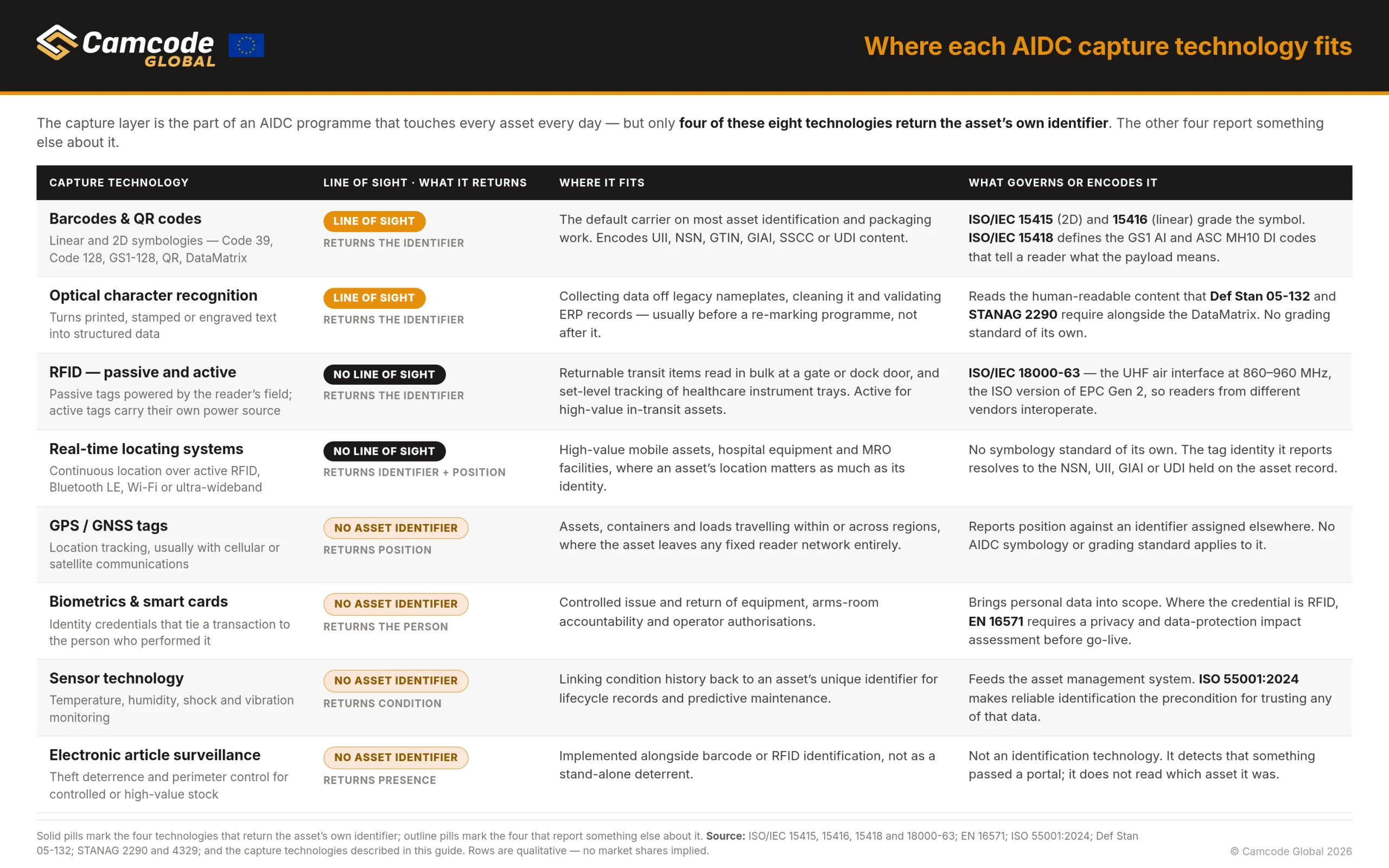
A permanent mark is of no value unless the data encoded on the mark can be read reliably and transferred to the systems that control the asset. Camcode Global deploys the following automatic identification technologies, chosen for required read distance, environment, data quantity and application architecture:
- Barcodes and QR Codes – Linear and 2D symbologies (Code 39, Code 128, GS1-128, QR, DataMatrix) that encode UII, NSN, GTIN, GIAI, SSCC or UDI data. Ideal for most asset identification and packaging applications.
- RFID (Passive and Active) – Similar to barcodes in many ways, passive RFID does not require line of sight to read and can capture many tags simultaneously. Active RFID uses an onboard power source which allows for greater read ranges and is best suited for high dollar, mobile or in-transit assets.
- Real-Time Locating Systems (RTLS) – Provides continuous location tracking and works with active RFID, Bluetooth Low Energy, Wi-Fi, or ultra-wideband. Ideal for high-value mobile assets, hospital equipment and MRO facilities.
- Optical Character Recognition (OCR) – Turns printed, stamped or engraved text into structured data; useful for collecting data from legacy nameplates, cleaning data and validating ERP records.
- Global Positioning Tags (GPS) – GPS/GNSS location tracking, often integrated with cellular or satellite communications capabilities, for assets, containers and loads travelling within or across regions.
- Biometrics and Smart Cards – Identity-based credentials that tie an asset transaction to the specific individual who performed it. Ideal for controlled issue/return of equipment, arms-room accountability or operator authorisations.
- Sensor Technology – Used to monitor condition of assets (temperature, humidity, shock, vibration) and link that information to an asset's unique identifier for lifecycle and predictive-maintenance history.
- Electronic Article Surveillance (EAS) – Theft deterrence and perimeter control for inventory that is controlled or high value. Usually implemented in conjunction with barcode or RFID identification, rather than as a stand-alone deterrent.
These technologies are implemented to tie into ERP, EAM and logistics systems to provide complete data visibility and lifecycle management, rather than exist as independent scanning tools.
How AIDC Is Standardised in the UK, EU and NATO
The standards universe is larger than what the typical reader might imagine. It divides generally into commercial/ISO standards, NATO/national defence standards, aerospace standards, and health care/pharma standards, as well as general asset-management standards.
Commercial and ISO Standards
ISO/IEC 15418 specifies the dual data-identifier schemes used in commercial AIDC: GS1 Application Identifiers (AIs) and ASC MH10 Data Identifiers (DIs). These abbreviated codes instruct a scanner or other downstream system what a particular string of encoded characters means (e.g. how to tell a batch number from an expiry date or serial number within the same barcode payload). Without a common data-identifier scheme two trading partners might inadvertently encode the same information in mutually incompatible ways.
By standardising these indicator codes, ISO/IEC 15418 allows any compliant reader or middleware system to correctly parse the contents of a barcode or RFID tag regardless of which system encoded it. This standard forms the basis for virtually every commercial machine-readable identification scheme utilised in UK and EU supply chains.
ISO/IEC 15415 specifies the test methodology and test parameters used to determine the print quality grade of two-dimensional symbols such as Data Matrix, QR Code or Aztec symbols. These grades are determined by an evaluator who verifies such attributes as symbol contrast, decode consistency, axial non-uniformity and print growth.
Based on these attributes, the evaluator will assign a global grade (often reported as a letter grade A-F or as a 4.0-0.0 scale). The resulting quality grade is what your procurement department and quality engineers are referring to when your contract states that a Data Matrix mark shall be printed to "Grade B" or "Grade C". It is how an objective and repeatable determination can be made that a printed symbol will reliably scan instead of just appearing subjectively decent.
ISO/IEC 15416 is the companion verification standard for one-dimensional (linear) barcodes such as Code 128, Code 39 and GS1-128. It specifies an equivalent print-quality grading methodology to ISO/IEC 15415, adapted to the differing geometry and failure modes of linear symbols (e.g., bar width reduction, edge determinacy, etc.). Combined, ISO/IEC 15415 and 15416 provide a UK/EU AIDC programme with a symbology-independent way to verify that any barcode produced will be field-readable.
ISO/IEC 29158 (previously published as AIM DPM-1-2006 before it was adopted into the ISO family) takes print-quality grading rules and applies them to Direct Part Marks. (Codes which are etched, engraved or dot-peened directly onto the component, rather than printed on a label.) As DPM marks are on metal/plastic/composite surfaces they have much greater variance in reflectivity / texture / contrast than a traditional printed label.
As such, they require their own set of grading rules, and shouldn't be graded under ISO/IEC 15415. ISO/IEC 29158 is widely referenced by UK MOD and EU aerospace OEMs as so much defence and aerospace componentry is marked direct rather than labelled. It is also the basis of Camcode Global's laser-etched and dot-peen DPM standard that every Data Matrix mark they grade is tested against.
ISO/IEC 18000-63 specifies the air-interface protocol for UHF RFID applied to item management. You can think of it as the dialect that passive UHF tags and readers converse with each other in on the 860-960 MHz band. It's the ISO-certified version of what most people refer to as EPC Gen 2 and it is what enables interoperability of RFID hardware from multiple vendors in the same asset-tracking and supply-chain deployment (instead of forcing customers to be stuck with a single vendor's proprietary version of "Gen 2").
EN 16571 describes the methodology that an organisation should follow when undertaking a privacy and data-protection impact assessment prior to implementing an RFID deployment. Created as guidance to enforce the European Commission's RFID Recommendation (2009/387/EC), it mandates organisations assess what personal information may be exposed or captured by an RFID system, what privacy risks are inherent in the deployment and what mitigations are put in place, all prior to go-live. Any UK/EU AIDC programme involving the use of RFID in scenarios where people can be tracked (such as workforce access control systems, as opposed to simple asset tracking applications) can expect this Standard to become applicable.
GS1 General Specifications is the rule book that defines every GS1 identifier key (GTIN, GLN, GIAI, SSCC etc. ), as well as the barcode and RFID data structures used to represent them. It's not actually an ISO or CEN standard (GS1 is a standards organisation that's owned by the industry). For all practical purposes, it's the single most important document around when it comes to commercial AIDC, as it defines precisely how a valid GTIN, GIAI or SSCC must be formatted and encoded if it should work the same way for every manufacturer, retailer, logistics provider and healthcare system in the world. GS1 publishes updates to the General Specifications according to a fixed publication cycle, so staying current with the latest version is important if you're building something that's meant to have a long shelf life.
ISO 55001 isn't actually a marking or symbology standard. It is the requirements standard for the overall asset management system of an organisation, how assets are planned, acquired, operated, maintained and disposed of. It relates to an AIDC programme because ISO 55001 makes reliable, unique asset identification of physical assets a baseline requirement: if you can't dependably identify your assets, none of the information your asset-management system is based upon (condition reports, maintenance scheduling, lifecycle costing) can be relied upon to be associated with the correct physical asset.
The standard was updated in 2024 along with its sister guidance publication ISO 55002, with stronger requirements around lifecycle certainty of asset identification. Simply put, a label or marking selected for short-term price over longevity can lead to non-conformance against the standard as of this latest revision.
NATO and National Defence Standards
STANAG 2290 is the NATO Standardisation Agreement that sets forth the basic requirements for Unique Identification (UID) of individual items. First published in 2007, the current version is STANAG 22.90 Version 3. Its primary focus is establishing the standardised format and content of Unique Item Identifier (UII), including the data elements (issuing agency code, enterprise identifier, original part number and serial number) used to form the unique alphanumeric code that distinguishes each item in the world, as well as how to physically mark that UII (again as a machine-readable Data Matrix symbol) directly on the item, on a data plate or label, and (as a PDF417 symbol) at packaging level 1.
STANAG 2290 is not intended to supersede the NATO Codification System which assigns NATO Stock Numbers; instead, the systems are meant to be used in conjunction with each other (an NSN identifies what an item is; a STANAG 2290 UID identifies one particular serialised instance of that item).
STANAG 4329 is NATO Standard Bar Code Handbook. It contains the symbology specifications for machine-readable marking and data-carriers symbols that are referenced in STANAG 2290. So, when STANAG 2290 says an item shall have a machine-readable symbol using Data Matrix symbology, STANAG 4329 specifies how that symbol encodes its data and its physical dimensions so that the encoded data can be read the same way by any NATO country's equipment. The two standards are usually used together; STANAG 2290 dictates what data is placed into the item identifier, while STANAG 4329 dictates how to physically build that identifier.
STANAG 4427 governs Allied Configuration Management Documentation. These are the documentation and processes used by NATO member countries to control the configuration baseline (specific build standard, variations, approved change notices) of an asset throughout its lifecycle.
This is important to an AIDC programme because although the physical mark on a serialised item is half the battle, STANAG 4427 is what links it back to a definitive record of what that item actually is at any given time. This is critical when a component is repaired/upgraded/transferred between platforms and its configuration must be verified again based on its identity.
Netherlands MoD policy CDS 751 is the marking policy of the Netherlands Ministry of Defence. As it is not published publicly in the way the STANAGs or Def Stan 05-132 are (being MoD procurement and contractual policy rather than a publicly-available standard), no public link is provided here; suppliers are expected to encounter its requirements as part of their contractual documentation rather than as a standalone standard from a standards organisation.
Depending on asset and contract, CDS 751 mandates requirements for NATO Stock Number and item-master data, a NATO UID formatted according to STANAG 2290, and permanent Data Matrix marking, usually all on the same nameplate/label.
Def Stan 05-132 is the UK Ministry of Defence Defence Standard publication containing their requirements for the identification marking of materiel entering UK MOD contracts. Published as part of the UK's Defence Standardisation programme, it is based around the same core principles as STANAG 2290 but details what identifier content UK MOD contracts will require (usually including NATO Stock Number, part number from the manufacturer, serial number, and a CAGE or NCAGE code identifying the organisation supplying/manufacturing the part) in both human readable text and machine readable Data Matrix form.
As Def Stan 05-132 is essentially the UK national adoption of the NATO UID specification, a label complying with it will typically include much of the same information as would be required on a label adhering to STANAG 2290/4329, albeit with the format/layout and acceptance criteria defined by the Defence Standard.
Note: MIL-STD-130 is a US Military specification. UK and EU purchasers will not ask for MIL-STD-130 itself, but the proof of durability that MIL-STD-130 requires is often used to demonstrate compliance with the closest UK/EU equivalent standards, primarily Def Stan 05-132, Netherlands MoD policy CDS 751, and NATO STANAG 2290 (as adopted through EN 9132). Military, aerospace, rail and energy specifications typically ask for this lifespan.
Aerospace Standards
EN 9132 is a European aerospace standard that prescribes how Data Matrix codes are to be applied to marked parts and assemblies. Published as part of EN 9100 family of aerospace quality-management standards through the International Aerospace Quality Group (IAQG), EN 9132 establishes the requirements that must be met by a manufacturer when applying a Data Matrix mark to an aerospace component: what information the symbol must hold, where it can be placed on the part, what symbol size and cell dimensions are allowable, and how the completed mark is to be quality verified.
Crucially, EN 9132 also demands that manufacturers demonstrate that the marking method itself (laser etching, dot peen or whatever direct-marking process they choose) does not adversely affect the part's form, fit, function or integrity. This is no trivial requirement given how frequently aerospace parts are marked on safety-critical surfaces, rather than labelled separately.
EN 9132 tends to be how marking requirements set by others make their way into European aerospace supply chains: NATO STANAG cascades and US MIL-STD-130 durability requirements will usually find their way into European aerospace contracts indirectly, by being translated to (or satisfied through) EN 9132 compliance, rather than being called out explicitly.
Healthcare and Pharmaceutical Standards
EU Medical Device Regulation 2017/745 mandates that medical devices that are placed on the EU market (including packaging, both primary and secondary) must have a Unique Device Identifier. A UDI according to this Regulation consists of two components: a UDI- DI (Device Identifier) which identifies a specific model or version of a device, issued by an EU recognised issuing entity, and a UDI-PI (Production Identifier), which holds variable data, including serial number, lot or batch number, date of manufacture and expiry date. The UDI is most commonly applied to devices using GS1 Data Matrix symbology as the identifier, although GS1 is not the only issuing specification allowed by the Regulation.
Device data will also need to be entered in the EU's central medical-device registry, EUDAMED, according to device risk classification and the deadlines laid out in the Regulation's timeline for phased implementation. Note that EU MDR compliance is an obligation only within the European Union; while the rules are conceptually similar, it is not mutually compliant with UDI regulations from other nations' bodies such as the FDA in the United States. Accordingly, a device sold both in the EU and US will typically need to meet both regulators' requirements separately rather than having one registration satisfy both.
EU Falsified Medicines Directive (2011/62/EU) mandates safety features on prescription medicines packaging at individual sales pack level, with the aim of allowing pharmacists or wholesalers to verify the authenticity of a pack before it is dispensed to a patient. The safety feature is typically a two-dimensional symbol, such as a GS1 Data Matrix containing a product code, unique random serial number, batch or lot number and expiry date. This must be verified against a database before dispensing. The directive also requires tamper-evident features on the packaging itself.
At the point of dispensing or wholesale distribution (when a medicine pack leaves the pharmacy or wholesaler), the coded pack identifier is verified against national medicines verification systems which link to the European Medicines Verification System. This verifies the pack's serial number and then decommissions it so it cannot be verified again. This is what stops a counterfeit or diverted pack being put back into the supply chain with a copied code.
A UK / EU AIDC programme built around GS1 identifiers and printing DataMatrix to ISO/IEC 15415 grade C or better will be interoperable at a commercial level across the majority of receiving partners. Layering STANAG 2290, STANAG 4329 and Def Stan 05-132 content onto that same DataMatrix symbol will additionally meet NATO and UK MOD cascades.
Choosing the Right AIDC Technology for the Use Case
Factors like shelf life, readability and regulations mean no single identifier, mark type or capture technology is appropriate for every asset. Getting the right match depends on how long you need that asset to be identifiable, its operating environment, how it will be read in practice and which contractual and regulatory schemes it falls under.
This is one of the most common (and costly) mistakes we see across UK, EU and defence AIDC programmes: applying a technically compliant identifier with the wrong marking method means you’ll still fail an audit once that mark itself degrades and becomes unreadable. Think of the below as a starting point framework rather than a one-size-fits-all solution. We work through this logic with UK, EU and defence operators case by case.
Long-life Serialised Assets
Metalphoto® anodised aluminium plate featuring a DataMatrix code. It can be combined with a passive UHF RFID tag for at-distance reading if required. It's Metalphoto's sub-surface image that enables the 20+ year service life. The image is actually embedded beneath the anodised surface, so unlike a printed label it won't wear away from abrasion, UV radiation or chemical exposure. While adding RFID capability is usually worth the additional expense if you'll need to count or locate these assets without line-of-sight, it's not required simply for identification purposes.
Returnable Transit Items (Kegs, Gas Bottles, Cages)
Surface-mounted hard-cased RFID tags; the read-at-distance benefit pays back the capital cost quickly. These assets cycle through many hands and locations, often in loading docks or yards where scanning a barcode on every unit individually is impractical; a bulk RFID read at a gate or dock door can capture dozens of items in seconds. The hard-cased construction also matters here specifically because transit items are routinely dropped, stacked and knocked around in ways a delicate label wouldn't survive.
Healthcare Instruments and Trays
UHF RFID for set-level tracking, with GS1 DataMatrix for instrument-level UDI per EU MDR. The two technologies serve different purposes on the same tray: RFID lets sterile processing staff confirm an entire instrument set is complete and accounted for with a single scan, while the individual DataMatrix mark on each instrument satisfies the device-level identification EU MDR requires and survives the repeated autoclave cycles that would destroy an adhesive label.
Pharmaceutical Packaging
GS1 DataMatrix symbols to encode product code, serial, batch and expiry date to comply with the EU Falsified Medicines Directive (FMD) at package level. Since this identifier will need to be verified against national medicines verification systems when the medicine is dispensed, the quality of the symbol is just as important as the data encoded within. A Data Matrix that doesn't scan reliably at the pharmacy counter creates the same sort of problems (and bottlenecks) that the FMD was designed to remove, therefore print verification at manufacture is mandatory.
Warehouse and Stores Items
Linear barcodes (Code 128 / GS1-128) applied to labels; the cost of each label is minimal, and every handheld imager scans them. If you have high-volume, lower-value inventory and the label will probably be replaced long before it wears out, investing in a more robust mark type just doesn't make financial sense. It's the common combination of inexpensive polyester label + off-the-shelf 1D scanner that works best.
Refurbished Components
Direct part marking (laser etch DataMatrix) governed by ISO/IEC TR 29158 grading. Refurbishment is the scenario where a label genuinely cannot do the job: the component may be stripped, cleaned or re-coated during overhaul in ways that would remove or obscure an applied label, so the identifier needs to be etched into the part itself to survive the process and remain traceable across multiple service cycles.
UK Defence Serialised Items
DataMatrix per STANAG 4329 / Def Stan 05-132 on Metalphoto® plates, with NATO UID content structured under STANAG 2290. This is a case where the mark type is driven almost entirely by the durability expectations baked into the standard rather than the physical environment alone. Def Stan 05-132 assumes a service life measured in decades, which points toward Metalphoto by default even before the specific operating environment is considered.
Netherlands MoD Assets
Identification and marking content aligned to CDS 751, combining NSN, NATO UID (STANAG 2290) and durable DataMatrix marking on a single Metalphoto® plate. As with UK defence assets, the driving consideration is fitting several distinct data elements (supply classification, item-level serialisation, and manufacturer identification) onto one physical mark without exceeding the available marking area, which is as much a layout and content-planning exercise as a technology choice.
Aerospace Components
DataMatrix marked and verified to EN 9132, with configuration data maintained in line with STANAG 4427 where the platform is NATO-aligned. The marking decision here is inseparable from the part's certification status: because EN 9132 requires confirmation that the mark doesn't affect form, fit or function, the marking method (and often its exact location) has to be agreed with engineering before it's applied, not selected independently as a labelling decision.
What Makes AIDC Programmes Fail
Most AIDC programmes don't fail because the underlying technology doesn't work. Data Matrix, RFID and OCR are all mature, well-understood technologies with decades of deployment behind them. They fail because the identifier, the mark and the capture technology were specified and procured as three separate decisions rather than one connected system, so a choice that looked reasonable in isolation turns out to undermine a decision made elsewhere in the programme. The failure modes below aren't hypothetical; they're the patterns we see repeat across UK and EU asset-identification programmes regardless of sector, and nearly all of them are avoidable with the right specification work up front.
- Substrate-environment mismatch. Labels chosen for cost rather than survival. This is the single most common failure we see, and it's usually a procurement decision rather than a technical one. A cheaper polyester label looks identical to a premium one on the day it's applied, and the gap only becomes visible years later when the asset is due for an audit and the label has delaminated, faded or fallen off entirely.
- Symbology not graded at point of mark. A printed DataMatrix can look fine to the human eye and still fail a verifier. Human eyesight simply isn't a reliable proxy for the contrast, axial non-uniformity and print-growth measurements a verifier actually checks against ISO/IEC 15415 or 29158, so a batch of marks can pass visual inspection on the production line and still generate decode failures once they reach the field.
- Scanner / mark mismatch. A handheld imager calibrated for 1D barcodes cannot reliably read DataMatrix without an upgrade. This gap tends to surface at the worst possible moment (during an audit or a receiving inspection) because the label and the identifier structure were specified by one team while the scanning hardware already in use at the receiving site was chosen, or inherited, by another, with no one checking that the two were compatible.
- Single source of truth not maintained. The mark says one thing, the system says another. Once an asset is transferred, repaired or reissued without the corresponding system record being updated, every downstream process that trusts that record (maintenance scheduling, compliance reporting, lifecycle costing) starts working from stale or contradictory data without any obvious signal that something is wrong.
- Registry or record gaps. The mark is applied correctly but the associated IUID Registry, EUDAMED, or national verification-hub record is incomplete or missing. This is a particularly costly failure mode because the physical identification work is entirely correct (the plate is durable, the Data Matrix is graded and readable) yet the programme is still non-compliant, since several of the schemes discussed above treat registry submission as a mandatory part of compliance rather than an optional extra.
- Operator training gaps. AIDC is only as accurate as the people scanning, and operator behaviour drift is the silent failure mode. Unlike a substrate failure or a registry gap, this one rarely produces an obvious error message. An operator who scans the wrong item, skips a step under time pressure, or works around a scanner that's inconvenient to use will keep generating plausible-looking data that quietly corrupts the record without anyone noticing until an audit or a stock discrepancy forces the issue.
Organisations that specify identifier, label technology, scanner capability and operator training together, rather than procuring each in isolation, consistently see fewer scanning errors and less rework. In practice this means the same team, or at least the same review, needs visibility across all four decisions before any of them is finalised because a change to any one of them (a new scanner model, a cheaper label supplier, a revised identifier structure) has direct consequences for the other three.
Camcode Global's Seven-Step Data Cleansing, Asset Identification, and Data Optimisation Process
Everything above, identifier selection, mark type, AIT capture technology and standards alignment, comes together through Camcode Global's seven-step process. It was developed through years of work with NATO defence customers on interoperability and in-transit visibility projects, and is designed to carry a programme from first consultation through lifecycle management. See The Framework for full detail on each stage and The Results for the defence, infrastructure and manufacturing organisations that have already benefited.
Step One: Asset Identification & AIT Consultation
Our team assesses the project and recommends how to align processes with relevant standards and frameworks, maximise asset utilisation, optimise processes for efficiency and compliance, integrate technology and automation, and improve asset supply chain management.
Step Two: Engineering Services
The engineering team develops the marking specification, or factsheet, defining how the asset will be identified from both a data and a physical marking perspective. After field verification of sample assets, business rules and data governance are set, and the appropriate mark type is selected from the full range described above.
Step Three: Data Remediation, Reconciliation & Verification
Camcode Global's proprietary offline and online data collection software ensures alignment with the applicable standards and frameworks, reduces human error, integrates with existing databases, and produces detailed reports and analytics.
Step Four: AIT Product Manufacture & Procurement
Products are manufactured to the marking specification, ranging across barcodes (1D, 2D, QR, GTIN, SSCC, UDI), RFID, sensors, GPS, OCR, RTLS, NFC, EAS and biometrics, or other technology determined by the specification created in Step Two.
Step Five: AIT Product Installation
Our NATO Security Cleared installation teams install the AIT product following the marking spec/factsheet, with proprietary software ensuring accurate association between the product and the correct asset. All installations comply with the applicable regulations and NATO standards.
Step Six: Data Reporting & Migration
With products marked, tailored reporting gives visibility into key operational metrics, quickly identifies discrepancies and simplifies data management, delivering best-in-class master data and reducing time spent on reconciliation.
Step Seven: Asset Life Cycle Management Advisory (ALCMA)
KPMG's Asset Life Cycle Management Advisory solutions support customers in managing assets from planning and acquisition through maintenance, optimisation and disposal, with an emphasis on improving performance, lowering costs, and maintaining compliance with standards including ISO 55001.
A UK / EU AIDC Programme Roadmap
Everything covered so far, including identifier types, mark types, capture technologies and the standards governing them, comes together in a specific sequence when a programme is actually scoped and built. Doing these steps out of order is itself a common source of the failures described above: choosing a mark type before the identifier content is finalised, for instance, often means re-doing the label layout once the full data set is known. The roadmap below reflects the order we walk UK and EU operators through when scoping a new or refreshed AIDC programme, whether that's a single site or a multinational defence contract.
- Define the use cases by asset class and operational environment. Group assets by how they're actually used and where they live, not just by category. For instance, an "IT equipment" grouping that spans desk-bound office kit and ruggedised field laptops will need two different answers even though both are technically IT assets. This step sets the boundaries for every decision that follows.
- Identify every identifier type the asset must carry (NSN, UII, NATO UID, GIAI, UDI, internal codes) and how they map to issuing authorities and registries. A single defence asset may need to carry three or four of these simultaneously, so it's worth establishing this fully before any label layout work begins. Discovering a missing identifier requirement after the marking specification is finalised usually means reworking the physical design.
- Match the AIDC mark type to each use case using the framework above. With the use cases and identifier content defined, the mark type follows fairly directly. A long-life outdoor asset points toward Metalphoto, a refurbished component points toward direct part marking, and so on.
- Choose the substrate and tag form factor to match the environment and required service life. Even within a single mark type there are choices to make: plate thickness, adhesive type, laminate and attachment method all need to be specified against the asset's actual temperature range, chemical exposure and handling conditions, not a generic assumption about "outdoor use".
- Specify the symbology grading targets (ISO/IEC 15415, 15416, ISO/IEC TR 29158). Decide the acceptance grade up front (Grade B for MIL-STD-130/IUID-adjacent work, Grade C for most GS1 and UDI contexts) so that verification is built into production rather than treated as an afterthought once marks are already in the field.
- Choose the AIT capture technology (barcode, RFID, RTLS, OCR, GPS, NFC) that aligns with the symbology and read-range requirement. This is where the mark and the capture layer have to be checked against each other explicitly: confirm that the scanners and readers already deployed, or being procured, can actually read the symbology and data carrier chosen in the previous steps, rather than assuming compatibility.
- Build operator training and audit cycles around the chosen kit. Training needs to cover not just how to use the scanner, but why the scanning process matters. Operators who understand what a skipped or incorrect scan actually breaks downstream are less likely to develop the behaviour drift that quietly corrupts data over time. Periodic audits against a sample of marked assets catch this drift before it becomes systemic.
- Align with the UK / EU / NATO regulatory and contractual standards (STANAG 2290, STANAG 4329, STANAG 4427, Def Stan 05-132, CDS 751, EN 9132, EU MDR, EU FMD, GS1, ISO 55001) that apply. Treat this as a final cross-check rather than the starting point. By this stage, the identifier, mark, substrate and capture technology should already satisfy the applicable standards by construction, and this step confirms that's actually the case and documents it for audit purposes.
Frequently Asked Questions
What is the difference between AIDC and IoT?
AIDC is the identification and capture layer (reading the mark or tag). IoT (Internet of Things) is the wider connectivity layer that transports the captured data and adds sensor telemetry. Many modern programmes layer AIDC underneath IoT.
Is RFID always better than barcodes?
No. Barcodes are essentially free to read with any imager-equipped device, and DataMatrix carries enough data for most asset identification needs. RFID adds value when line-of-sight scanning is impractical or you need to read tags in bulk.
Does GS1 own AIDC standards?
GS1 owns the commercial identification standards (GTIN, GLN, GIAI, GS1 DataMatrix, GS1-128) and is one of the most active standards bodies in AIDC, but it does not own the ISO/IEC symbology grading or RFID air-interface standards, nor the NATO STANAGs used in defence.
How is MIL-STD-130 different from Def Stan 05-132, CDS 751 or STANAG 2290?
MIL-STD-130 is a US-only standard: a US DoD specification for marking US military property. It has no formal authority over UK, Netherlands or NATO-cascade contracts. Note: MIL-STD-130 is a US Military specification. UK and EU purchasers will not ask for MIL-STD-130 itself, but the proof of durability that MIL-STD-130 requires is often used to demonstrate compliance with the closest UK/EU equivalent standards, primarily Def Stan 05-132, Netherlands MoD policy CDS 751, and NATO STANAG 2290 (as adopted through EN 9132). Military, aerospace, rail and energy specifications typically ask for this lifespan. All of these standards specify DataMatrix as the preferred 2D symbology, but the encoding rules and human-readable portion differ.
What is the difference between a NATO Stock Number and a NATO UID?
An NSN, assigned under STANAG 3150 / 3151, identifies a standardised item of supply, essentially a part number recognised across NATO. A NATO UID, structured under STANAG 2290, identifies one specific serialised item. Both may appear on the same nameplate because they serve different purposes, and STANAG 4427's configuration management documentation ties the physical serialised item back to its configuration record over time.
How do we handle UK / EU divergence post-Brexit?
For most AIDC purposes, UK and EU standards remain harmonised through ISO/IEC, GS1 and NATO STANAGs. Divergence is most visible in sector-specific marking (UKCA vs CE, UK MHRA UDI vs EU UDI). The AIDC technology layer is largely unchanged.
What grade should our DataMatrix marks be?
For commercial work, ISO/IEC 15415 Grade B or better is a strong baseline. For defence and aerospace work under STANAG 4329, Def Stan 05-132, CDS 751 or EN 9132 cascades, Grade C is typically the minimum acceptance threshold, with direct part marks graded to ISO/IEC TR 29158.
How Camcode Global Supports UK / EU AIDC Programmes
Camcode Global supplies the complete AIDC stack UK, EU and NATO operators need. On the identifier side, we help define and validate NSN, IUID/UII, NATO UID (STANAG 2290), GS1 GIAI/GTIN, CAGE/NCAGE, EU MDR UDI and internal identifier structures. On the mark side, we manufacture Metalphoto® anodised aluminium plates, laser-markable labels, thermal transfer and ink jet labels, cut-through plates, woven fabric tags, direct part marking, and NFC tags. On the capture side, our AIT capability spans barcodes and QR codes, passive and active RFID, RTLS, OCR, GPS tags, biometrics and smart cards, sensor technology, and electronic article surveillance, all integrated with SAP, ERP and EAM systems through our proprietary data cleansing and reporting software.
As a NATO-approved provider for over 12 years and holder of a NATO Support and Procurement Agency (NSPA) Enabling Contract, we routinely design multi-content marks that satisfy STANAG 2290, STANAG 4329, STANAG 4427, Def Stan 05-132, CDS 751, EN 9132, EU MDR UDI, EU FMD and GS1 schemes on a single substrate. This is delivered through our seven-step Data Cleansing, Asset Identification, and Data Optimisation Process, with Asset Life Cycle Management Advisory provided by KPMG.
See The Framework for a full breakdown of each stage of that process, from initial AIT consultation through engineering, data remediation, manufacture, installation, reporting and lifecycle advisory, and The Results for how it plays out in practice across asset identification, configuration management, asset lifecycle management, BPO automation, digital transformation, NATO interoperability and supply chain management for the defence, infrastructure and manufacturing organisations we've supported. Our UK / EU client base spans defence, aerospace, rail, energy, healthcare, and manufacturing.