Organizations supporting multinational defence, transport and regulated supply-chain programmes often face complex identifier decisions when a single asset, document or shipment must satisfy multiple contractual standards, identification structures, marking specifications and automatic identification and data capture (AIDC) technologies at once. When these requirements are not properly aligned, suppliers can experience rejected labels, unreadable marks, incomplete asset records, interoperability issues, and audit or contractual non-compliance. PDF417 sits squarely inside this problem: it remains the mandated symbology for certain identity, transport and legacy systems, while newer defence, aerospace, healthcare and pharmaceutical standards have moved to DataMatrix. Choosing the wrong one, or failing to plan for both existing side by side, creates exactly these failure modes.
Getting this right involves more than simply picking a barcode symbology. The identifier must be structured to the format required by the governing standard or system, the appropriate label material or direct-marking method must be selected for the asset and its operating environment, and the barcode, RFID, NFC or other AIT technology ultimately used to read it must integrate with the customer’s data, ERP and asset-management systems.
This is a common challenge for UK and European suppliers supporting NATO, national defence, transport, healthcare and multinational procurement programmes, where a PDF417-encoded identity document, boarding pass or waybill may need to sit alongside DataMatrix-marked defence or medical assets within the very same supply chain.
This guide is intended for procurement, quality, engineering, logistics and asset-management teams whose contracts or systems include PDF417, DataMatrix or other machine-readable identification requirements. It explains what PDF417 is, where it still belongs, how it compares to the wider identification landscape UK and EU operators use for asset and product marking, which physical marking methods can actually carry a PDF417 (or any 2D) symbol, and the standards and factors that must be considered when selecting a compliant solution.
It also outlines Camcode Global’s seven-step approach to asset identification and UID implementation. From requirements analysis and data validation through identifier construction, material selection, label production, verification, system integration and ongoing programme support, Camcode Global provides a complete asset identification and traceability solution from initial assessment through final implementation, whether the identifier ultimately needed is PDF417, DataMatrix, RFID or another AIT technology.
PDF417 itself was invented by Symbol Technologies in 199 (the core patent, US Patent 5,243,655, was filed that year by Dr. Ynjiun P. Wang and issued in 1993) and standardised as ISO/IEC 15438 in 2001. Its clearest, most verifiable footprint today is in North America: the American Association of Motor Vehicle Administrators’ DL/ID Card Design Standard mandates PDF417 as the required machine-readable technology in Zone V of every US state and Canadian provincial driver’s licence and ID card. Despite its name, AAMVA is a joint US–Canada body: all 10 Canadian provinces and 3 territories are voting jurisdiction members alongside the 50 US states, so the standard is jointly maintained rather than a US rule Canada simply follows.
The same PDF417 requirement is written into the US REAL ID rule under 6 CFR § 37.19. PDF417 is also the default symbology for printed IATA boarding passes under Resolution 792, the Bar Coded Boarding Pass (BCBP) standard, and FedEx prints PDF417 alongside a Code 128 barcode on its shipping labels for address and recipient data (UPS, by contrast, uses its own MaxiCode symbology rather than PDF417). UK and EU driving licences are a different case: Directive 2006/126/EC, Annex I permits member states to add “bar codes and national symbols” to the licence design at their own discretion, but doesn’t mandate a machine-readable barcode or specify a symbology, so PDF417’s presence there is inconsistent rather than standardised, unlike the AAMVA-driven US and Canadian system.
 CAMCODE GLOBAL
2D barcode symbology selector
| Criterion | PDF417 | DataMatrix | QR Code |
|---|
How this is calculated & sources used
Comparison compiled from ISO/IEC 15438 (PDF417), 16022 (DataMatrix), 18004 (QR Code), GS1 General Specifications, and Camcode Global UK / EU sector experience.
Sources actually used:
• ISO/IEC 15438
• ISO/IEC 16022
• ISO/IEC 18004
• GS1 General Specifications
What PDF417 Is
PDF417 is a stacked linear barcode, a 2D barcode that encodes data in multiple horizontal rows of stacked symbols. The “PDF” stands for Portable Data File, and the “417” refers to the symbol’s structural unit: each codeword is made up of four bars and four spaces, totalling 17 modules wide. The result is a tall, rectangular barcode that can encode up to 1.8 kilobytes of binary data or roughly 1,800 ASCII characters in a single symbol.
PDF417 is standardised as ISO/IEC 15438:2015, and the standard remains current.
For UK and EU identification and product-marking programmes, understanding PDF417 requires more than knowing how the symbol is structurally built. Its practical fit for a given label depends on how its data capacity, encoding modes, physical footprint and error correction interact with the available label real estate, the operating environment, and the reading infrastructure the symbol will be scanned with.
From Camcode Global’s perspective, specifying PDF417 correctly begins with understanding what the symbol can and cannot do before it’s applied to a label, credential or waybill.
A PDF417 symbol carrying identity, transport or asset data may be printed by one supplier, scanned by another organisation’s handheld imager, and ultimately read by a completely different system months or years later. Throughout that lifecycle, the symbol has to remain decodable, which depends on choices made at the point the symbol is specified and printed, not just on the symbology itself.
This requires attention to four areas:
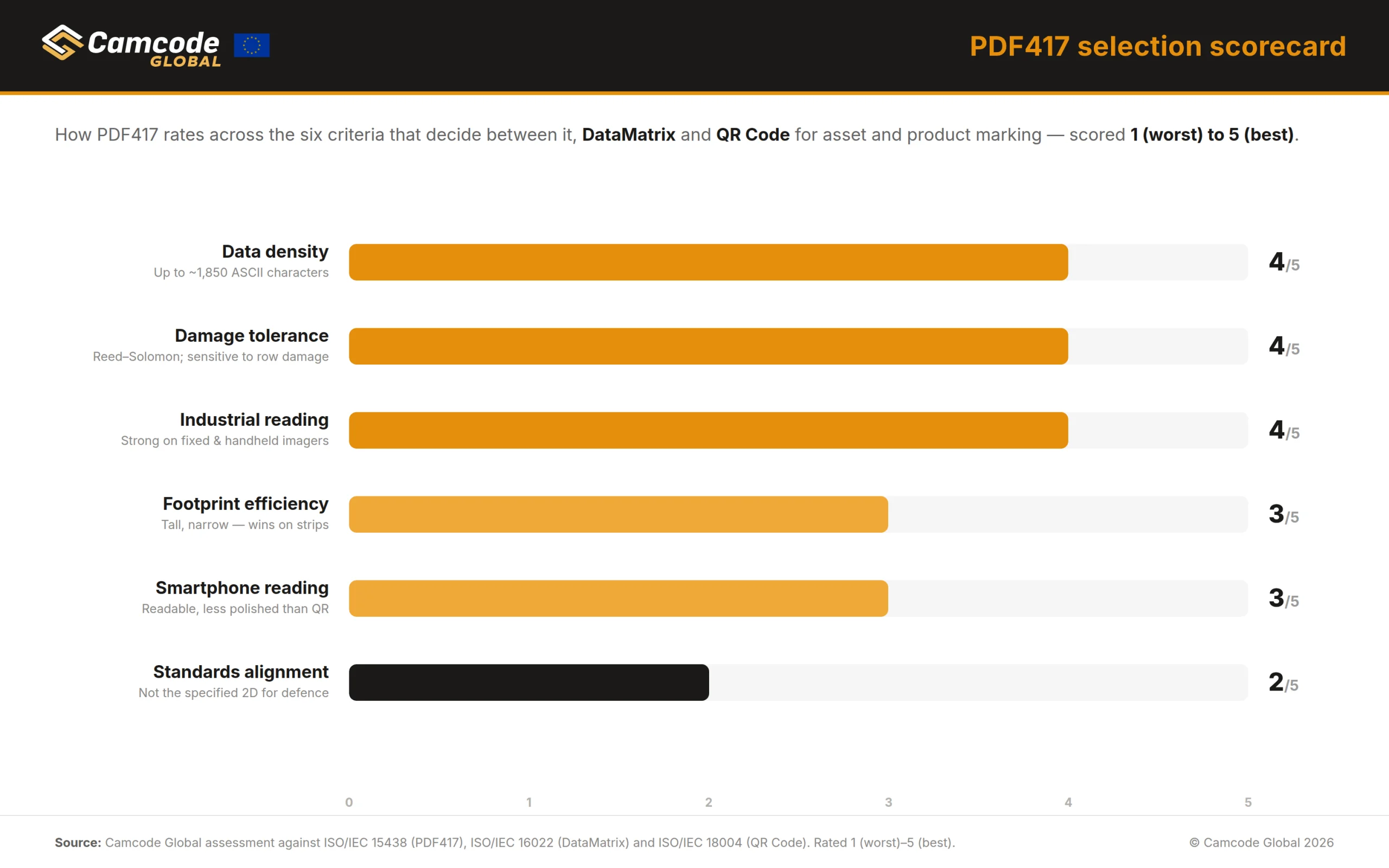
Symbol Structure and Capacity. Each PDF417 codeword is built from four bars and four spaces across 17 modules, and a full symbol can range from 3 to 90 columns and 3 to 90 rows, giving it a wide but tall footprint. Within that structure, the symbol can hold up to roughly 1,850 ASCII characters, 1,108 binary bytes, or around 2,700 numeric digits, with truncated and compact variants trading some of that capacity and damage tolerance for a smaller footprint.
Data Encoding and Compaction. PDF417 uses three compaction modes (Text, Byte and Numeric) selected automatically or manually depending on the content, and can switch between them within a single symbol to use space efficiently. Where the data payload exceeds what a single symbol can hold, Macro PDF417 splits the content across multiple linked symbols that a reader reassembles in sequence.
Error Correction and Damage Tolerance. PDF417 uses Reed-Solomon error correction across nine selectable levels (0-8), allowing the symbol to remain readable even with partial damage or print defects. Higher error-correction levels increase the symbol’s resilience but also its size, so the level chosen has to reflect how much wear, abrasion or contamination the label will realistically face in service.
Standards and Reader Compatibility. PDF417 print quality is graded against ISO/IEC 15415, the same framework used for DataMatrix and QR Code, and its use in specific applications (driving licences, boarding passes, GS1 logistics labels) is governed by the standard or specification that mandates it rather than by ISO/IEC 15438 alone. Reader compatibility is close to universal on modern industrial imagers and smartphone camera scanners, though PDF417 is less commonly the default symbology in handheld imager configurations than DataMatrix.
Depending on the application, PDF417’s structural characteristics may determine:
- How much data the symbol can realistically carry for the intended content (numeric-only, alphanumeric, or binary)
- Whether a truncated or compact variant is appropriate for a space-constrained label, or whether full-size PDF417 is needed for damage tolerance
- What error-correction level is required given the asset’s or document’s expected handling and wear
- How many rows and columns the symbol needs to fit the target payload within the available label real estate
- Whether Macro PDF417 is required to split content across multiple linked symbols
- What quiet-zone clearance and minimum X-dimension the intended scanning distance and reader type require
- Which grading standard and minimum acceptance grade (typically ISO/IEC 15415 Grade C) will be used to verify the symbol at the point of mark
- Whether the receiving organisation’s reading infrastructure (industrial imager, handheld scanner, or smartphone app) can decode PDF417 reliably, or whether the programme should specify DataMatrix instead
Where PDF417 Sits Among Identification Technologies
PDF417 is a single symbology inside a much wider identification landscape. When Camcode Global scopes an identification programme, PDF417 is evaluated against every other identifier type in the following categories, not in isolation:
- NATO Stock Number (NSN). A 13-digit supply classification identifier assigned through the NATO Codification System in accordance with STANAG 3150 and STANAG 3151. An NSN identifies a standardised item of supply, not an individual serialised asset. This distinction matters because a NATO Stock Number and a serialised UID are answering different questions and frequently appear on the same label together.
- Linear (1D) barcodes. Code 39, Code 128 and similar formats, still specified where the data payload is small and the reading infrastructure is legacy 1D-only.
- Stacked linear 2D barcodes (PDF417). PDF417, the focus of this guide, provides high data density in a tall, narrow footprint.
- Matrix 2D barcodes. DataMatrix and QR Code, both of which encode data in a square grid rather than stacked rows. DataMatrix is now the default matrix symbology in defence, aerospace, healthcare and pharma; QR Code dominates consumer-facing scanning.
- GS1 application identifiers. GS1-128, GTIN, SSCC, the GS1 Global Individual Asset Identifier (GIAI), and GS1 DataMatrix, which are data-content standards that can be carried inside a 1D or 2D symbol rather than symbologies in their own right. GIAI in particular is increasingly recognised alongside NSN-based identifiers in UK government commercial and NHS Scan4Safety contexts.
- Unique device and asset identifiers (UDI). The data structure required under regulations such as EU MDR, typically split into a UDI-DI (device identifier) and UDI-PI (production information such as serial, lot or expiry), independent of which barcode ultimately carries it.
- Radio Frequency Identification (RFID), passive and active. A data-carrier technology rather than a printed symbology incorporated into a tag or label and read at a distance and without line of sight. The right choice for returnable transit items, tool cribs and bulk reads.
- Near-Field Communication (NFC). Also a data-carrier technology rather than a physical mark in its own right, NFC is a short-range passive RF protocol, readable by most smartphones within about 4cm, used where a barcode cannot be affixed or where the system needs to trigger an action on each scan.
PDF417’s practical competition is DataMatrix and QR Code, so the comparisons below focus there. But an experienced identification consultancy always starts from the full list, because the right identifier for a returnable gas cylinder read at a distance (RFID) is a completely different decision from the right identifier for a driving licence (PDF417) or a serialised aircraft component (DataMatrix). RFID and NFC are worth flagging separately: unlike PDF417, DataMatrix or QR Code, they are not marks that go on a label. They are electronic data carriers that get built into a label, tag or nameplate alongside a human-readable or barcoded identifier.
Camcode Global works across every category on this list rather than defaulting to a single preferred symbology or technology. Because a single multinational programme can require an NSN for NATO codification, a serialised UID for item-level traceability, a GS1 identifier for commercial interoperability, and an RFID or NFC data carrier for distance reads (sometimes on the same asset), our engineering team scopes the full identifier landscape at the start of every programme rather than assuming PDF417, DataMatrix or any other single symbology is the answer. That evaluation, carried out in Step One of our seven-step process, is what determines whether PDF417 is the right fit, the wrong fit, or one layer of a multi-identifier label.
The Automatic Identification and Data Capture Technologies Camcode Global Deploys
A durable label or direct part mark is only useful when its data can be captured accurately and transferred into the systems that manage the asset. Automatic Identification and Data Capture (AIDC) technologies form the capture layer of Camcode Global’s asset identification solutions: they read the identifier, reduce manual data entry, and connect physical assets with records maintained in SAP, ERP, EAM, inventory, maintenance and logistics systems. Camcode Global selects and deploys the appropriate technology based on the required read range, asset environment, data volume, system architecture, security requirements and operational workflow, not on a single default technology. PDF417 sits inside the first of them.
Linear and Two-Dimensional Barcodes
Barcodes provide a reliable and cost-effective method of capturing asset, item, packaging and shipment information. Camcode Global supports linear and two-dimensional symbologies, including Code 39, Code 128, GS1-128, QR Code, PDF417 and DataMatrix, encoding identifiers and data elements such as a UII, NSN, GTIN, GIAI, SSCC, serial or lot number. DataMatrix is the default choice for defence UID work because it packs significant data into a small area and can be applied via a label or Direct Part Marking; PDF417 remains relevant chiefly for identity documents, boarding passes and transport waybills.
Typical applications include:
- Item Unique Identification and serialization
- NATO and national defence asset identification
- Packaging and shipment identification
- Maintenance and repair processes
- Warehouse and inventory management
- Medical device and healthcare identification
- Tool, equipment and component tracking
Passive RFID
Passive RFID tags do not require an internal power source; they receive energy from an RFID reader and transmit the encoded information back to the system. Passive RFID is appropriate where assets must be identified without direct line of sight, where multiple items need to be captured at once, or where barcode scanning would be inefficient. Different RFID technologies and frequencies may be selected depending on the asset, material, operating environment and required read range.
Typical applications include:
- Warehouse inventory
- Tool and equipment accountability
- Arms-room and controlled-inventory management
- Asset issue and return processes
- Supply-chain and shipment visibility
- Medical and hospital equipment tracking
Active RFID
Active RFID tags contain their own power source and can transmit over longer distances than passive RFID tags. They’re generally used for higher-value assets, containers, vehicles or equipment that must be detected across a larger area, and may also support sensor data, location events and automated entry/exit records.
Typical applications include:
- Containers and transport assets
- Vehicles and mobile equipment
- High-value defence assets
- Yard, depot and facility tracking
- In-transit visibility
- Automated perimeter and gateway monitoring
Real-Time Locating Systems (RTLS)
RTLS provides ongoing positional visibility into the location and movement of assets within a defined environment. Depending on the application, RTLS solutions may use active RFID, Bluetooth Low Energy, ultra-wideband, Wi-Fi or other technologies. The appropriate technology depends on the required accuracy, facility layout, asset value and operational need.
Typical applications include:
- Frequently moved tools and equipment
- Hospital and medical assets
- Maintenance, repair and overhaul facilities
- Warehouses and distribution centers
- High-value or mission-critical equipment
- Production and work-in-progress tracking
Optical Character Recognition (OCR)
OCR converts printed, stamped or engraved characters into structured digital data. Camcode Global uses OCR as part of asset data capture and cleansing programmes to reduce manual transcription and accelerate the collection of part numbers, serial numbers, manufacturer information and other asset attributes, including weapon serial number recognition programmes. OCR results must be validated, since worn plates, damaged marks, inconsistent formatting and similar characters can create recognition errors.
Typical applications include:
- Asset surveys and physical inventories
- Data cleansing and enrichment
- Legacy nameplate and data-plate capture
- Part number and serial number collection
- SAP and ERP record validation
- Migration from legacy asset-management systems
GPS and GNSS Asset Tracking
GPS and other Global Navigation Satellite System technologies can be combined with cellular, satellite or radio communications to track assets moving between facilities, regions or countries. These technologies are most appropriate for mobile assets that operate outside controlled facilities and require location updates over a wide geographic area.
Typical applications include:
- Vehicles and mobile platforms
- Containers and transport equipment
- Deployable systems
- International shipments
- High-value assets moving between sites
- Supply-chain and in-transit visibility
NFC-Enabled Asset Identification
NFC is a short-range RFID technology that can often be read using compatible smartphones and tablets. It can be incorporated into an asset label or tag to give field staff access to equipment records, maintenance instructions, inspection forms, digital manuals or other authorised information, in addition to identification.
Typical applications include:
- Maintenance and inspection workflows
- Medical and communications equipment
- Tools and test equipment
- Access to digital asset records
- Field-service applications
- Equipment authentication
Smart Cards, Credentials and Identity-Based Technologies
Smart cards and other electronic credentials connect an asset transaction to the individual performing it: controlling access, recording equipment issue and return, or establishing accountability for sensitive assets. Biometric technologies may also be integrated where an organisation requires a higher level of identity verification, depending on the customer’s security, privacy and information-assurance requirements.
Typical applications include:
- Controlled equipment issue and return
- Arms-room accountability
- Tool-control programmes
- Restricted inventory access
- Operator authorization
- Sensitive asset transactions
Sensor-Enabled Asset Monitoring
Sensors collect information about an asset’s condition and operating environment (temperature, humidity, shock, vibration, pressure, movement or other conditions) and sensor data can be associated with the asset’s unique identifier to build a more complete lifecycle and condition history.
Typical applications include:
- Temperature-sensitive materials
- Medical and pharmaceutical equipment
- Shock-sensitive components
- Ammunition and controlled inventory
- Storage and transportation monitoring
- Predictive maintenance programmes
Electronic Article Surveillance (EAS)
EAS provides theft deterrence and perimeter monitoring for controlled, sensitive or high-value inventory. It’s generally used as a security control rather than as a complete asset-identification solution, and where required, is incorporated alongside UID, barcode, RFID or inventory-management technologies rather than in place of them.
Connecting the Physical Asset to Enterprise Systems
Camcode Global does more than supply scanners, labels or tags. We evaluate the complete asset-identification workflow, including:
- The identifier and required data structure
- The physical label, tag or direct mark
- The barcode, RFID or other data carrier
- The reader, scanner or mobile device
- Data validation and business rules
- Integration with SAP, ERP, EAM and logistics systems
- Reporting, analytics and asset-visibility requirements
By combining the correct identifier (whether that’s PDF417, DataMatrix or another symbology) with a durable marking method and the appropriate capture technology from the list above, Camcode Global helps defence and industrial organisations improve data accuracy, reduce manual processes and maintain asset visibility from procurement and receipt through maintenance, deployment and disposal.
Mark Types: How PDF417 (and Every Other Symbol) Actually Gets Applied
Choosing an identifier (PDF417, DataMatrix, QR Code or otherwise) only answers what data goes on the asset. It says nothing about how that symbol survives the asset’s working environment. That is a separate, physical decision, and Camcode Global manufactures across the full range of marking technologies, selected according to the asset’s material, surface condition, operating environment, lifecycle, production volume, attachment requirements and required data-capture technology.
Photosensitive Anodized Aluminum — Metalphoto®
Metalphoto uses a photographic image sealed beneath the anodized surface of the aluminum, creating a highly durable, sub-surface image that withstands abrasion, chemicals, ultraviolet exposure, temperature changes and harsh operating environments. It’s well suited to medium- and high-volume programmes and can be produced in various sizes, thicknesses, colors and attachment configurations. PDF417 can be reproduced on Metalphoto for long-life applications, though its tall, narrow shape is unusual on serialised metal plates sized for a square DataMatrix.
Typical applications include:
- Small arms and weapon ancillaries
- Aircraft and aerospace components
- Ships and marine equipment
- Engines and mechanical components
- Communications and electronic equipment
- Crew-served and complex weapon systems
- Nameplates, data plates and equipment identification plates
- Assets exposed to chemicals, sunlight, abrasion or severe weather
Laser-Markable Label Materials
Laser-markable materials use a laser to create a permanent image within or on the surface of a specially designed substrate, including stainless steel, engineered polymers, acrylics and other laser-reactive constructions. Laser marking is particularly valuable for decentralized or on-site operations because labels can be produced in real time, and is generally best suited to low- and medium-volume applications or serialized labels produced at the point of use.
Typical applications include:
- Small arms and weapon ancillaries
- Aircraft and aerospace components
- Engines and mechanical assemblies
- Communications equipment
- Complex weapon systems
- Maintenance, repair and overhaul operations
- On-site UID implementation programmes
Thermal-Transfer Labels
Thermal-transfer printing uses a ribbon to transfer the printed image onto a compatible label material. Durability depends on the selected facestock, ribbon, adhesive, laminate and protective construction. It’s a flexible, cost-effective option for medium- and high-volume production, and supports on-demand printing at depots, warehouses, hospitals, production facilities and field locations. This is one of PDF417’s strongest substrate matches: thermal transfer’s sharp, consistent bar edges suit PDF417’s stacked-row structure well.
Typical applications include:
- Soft and hard body armor
- Medical and hospital equipment
- General asset identification and tracking
- Electronics and circuit-board identification
- Warehouse and logistics operations
- Packaging and shipment identification
- Assets requiring real-time, on-site label production
Specialized high-temperature label constructions may also be used where the application requires resistance to elevated temperatures (500°C-1200°C). The material must be individually validated against the asset’s actual temperature range and exposure duration.
Digitally Printed and Inkjet Labels
Digitally printed or inkjet-produced labels provide a flexible option for applications requiring variable data, color, graphics or moderate-to-high production volumes. Durability depends on the printing process, substrate, adhesive and any protective laminate or overcoat applied. Alongside thermal transfer, this is the other strong substrate match for PDF417, particularly where variable serial data needs to be printed at volume.
Typical applications include:
- Soft and hard body armor
- Ballistic and bump helmets
- Medical equipment
- General asset identification
- Equipment branding and instructional labels
- Packaging and logistics applications
Cut-Through, Stamped and Engraved Plates
Cut-through, mechanically engraved, stamped or CNC-produced plates create characters or openings directly within a metal plate. These methods provide durable identification for large industrial assets but offer limited data density compared with barcode or DataMatrix marking, and the design must be carefully controlled because damaged, obstructed or poorly sized characters affect readability. PDF417 is a poor fit here. The achievable module size and row count on a punched or engraved plate rarely support a reliably decodable PDF417 symbol.
Typical applications include:
- Heavy equipment
- Ships and marine assets
- Vehicles and chassis
- Industrial machinery
- Large equipment identification plates
Woven and Printed Fabric Tags
Fabric tags are designed for textile-based assets where rigid labels or metal plates can’t be applied. They may be woven, printed, heat-sealed or sewn directly onto the asset, with construction and attachment method selected against expected laundering, abrasion, chemical exposure and handling. PDF417 is not well suited to this substrate category; the print resolution achievable on woven or heat-sealed fabric rarely holds PDF417’s tight row spacing.
Typical applications include:
- Parachutes
- Military apparel
- Webbing and load-bearing equipment
- Soft armor and textile carriers
- Bags, covers and other fabric-based assets
Direct Part Marking (DPM)
DPM applies the identifier directly to the asset (laser etching, laser engraving, dot peen, chemical etching or other controlled processes) rather than through a separate label or plate. It’s slow and labour-intensive, but the only option where affixing a label isn’t possible or where the identifier must remain with the component through overhaul. DataMatrix DPM marks are verified using the grading principles established in ISO/IEC 29158. PDF417 is essentially never used for DPM. The denser, square DataMatrix symbol is far easier to etch or peen within the available surface area and to hold to a verifiable grade.
Typical applications include:
- Aircraft and aerospace components
- Surgical and medical instruments
- Bridging and engineering equipment
- Metal components exposed to chemicals or abrasion
- Components for which an attached label is unsuitable
- High-value serialized parts
RFID- and NFC-Enabled Tags
RFID and NFC are data-carrier technologies rather than physical marking methods by themselves. They’re incorporated into a label, tag, nameplate or other identification product and used alongside a human-readable identifier or machine-readable barcode, including, where relevant, a PDF417 or DataMatrix symbol on the same tag. NFC is a short-range RFID technology readable by most smartphones and tablets within about 4cm; RFID supports longer read ranges, bulk inventory activities and automated asset visibility depending on the selected frequency and system configuration.
Typical applications include:
- Communications and electronic equipment
- Medical and hospital assets
- Tools and test equipment
- Inventory and maintenance operations
- General asset tracking
- Applications requiring access to digital records or instructions
Selecting the Correct Marking Method
The asset’s operating environment and surface condition must be evaluated before a marking technology (and, in turn, whether PDF417, DataMatrix or another symbology is even viable on that substrate) is selected. Important factors include:
- Asset substrate and surface finish
- Temperature range and exposure duration
- Chemicals, fuels, oils and cleaning agents
- Ultraviolet exposure and weather conditions
- Abrasion, impact and handling
- Available marking area
- Required service life
- Attachment method
- Barcode, RFID or NFC reading requirements
- Production volume and point-of-use needs
- Applicable defence, industry and customer standards
Using an incompatible material, adhesive or marking method is a common cause of premature label failure and unreadable identifiers. PDF417’s tall, narrow footprint and row-based error correction make it a good match for thermal-transfer and digitally-printed polyester labels, identity-card and credential stocks, and photosensitive anodized aluminium for long-life applications, but a poor match for woven and printed fabric tags, cut-through/stamped/engraved plates, and most direct part marking, where the smaller, denser DataMatrix square is easier to mark and to hold a verifiable grade.
Camcode Global evaluates the complete application (the asset, environment, identifier structure, marking material, attachment method and capture technology) as a single decision, rather than choosing a symbology and a mark type independently. That evaluation happens in Step Two of our seven-step process, where the engineering team confirms both what the identifier will be and how it will physically survive on the asset before any product is manufactured.
PDF417 vs DataMatrix: The Practical Comparison
For UK and EU asset and product marking, the choice between PDF417 and DataMatrix usually comes down to five practical factors:
Data Capacity
Comparable in the ranges typically needed for asset and product marking. A full-size PDF417 symbol can hold up to roughly 1,850 ASCII characters or 1,108 binary bytes, while DataMatrix (ECC 200) can hold up to around 2,335 alphanumeric characters or 1,556 bytes at its largest size. Both handle the typical asset/product content set (NSN, part number, serial number, CAGE code, batch or lot data) comfortably, so data capacity alone rarely decides the choice.
Physical Footprint
DataMatrix is square or near-square; PDF417 is tall and narrow, typically several times wider than it is high. DataMatrix wins where label real estate is limited to a compact square area, such as a small component or nameplate corner. PDF417 wins where the available space is a long, narrow strip, the reverse of an ID card, the edge of a waybill, or a credential’s magnetic-stripe-height panel.
Damage Tolerance
Both symbologies use strong Reed-Solomon error correction and can remain readable with partial damage. DataMatrix is generally more resilient to localised damage, such as a scratch or a missing corner, because its error correction is distributed across a two-dimensional grid. PDF417 is more sensitive to row damage: because its data is organised in horizontal stacked rows, damage that wipes out an entire row or a run of rows can defeat the symbol’s error correction more easily than an equivalent area of damage scattered across a DataMatrix grid.
Reader Compatibility
Both are universally supported by modern industrial imagers and smartphone camera apps. DataMatrix has overtaken PDF417 as the default 2D symbology in handheld imager configurations across defence, aerospace and healthcare scanning fleets, meaning a DataMatrix mark is more likely to be read correctly “out of the box” without reconfiguring the scanner’s symbology settings.
Standards Alignment
DataMatrix has been adopted as the preferred symbology by Def Stan 05-132, MIL-STD-130, STANAG 4329, EN 9132, EU MDR UDI, and the EU Falsified Medicines Directive. PDF417 has not been adopted as the preferred symbology by any of these. Its governing standards sit instead in identity, transport and travel documentation (national ID/driving licence schemes, IATA boarding pass specifications, and individual carrier waybill formats).
For new asset identification and product marking work in UK/EU defence, aerospace, healthcare, and pharmaceutical contexts, DataMatrix is the better choice, and it is the symbology Camcode Global specifies by default when scoping a new-build identification programme in these sectors. PDF417 remains the right answer when an existing standard or system specifies it (identity documents, transport waybills, boarding passes), or where a customer is extending a legacy PDF417 estate rather than starting fresh.
Camcode Global evaluates all five factors together, not in isolation, because the right answer depends on which ones actually apply to a given asset. A returnable transit case with a wide, flat marking surface has no footprint constraint pushing it toward PDF417; a driving licence has no choice in the matter because the document format is fixed. Where a customer is genuinely undecided (for example, a new label design with real estate that could go either way), our engineering team weighs the governing standard, the reading infrastructure already deployed at the customer’s sites, and the asset’s damage exposure during Step One and Step Two of our seven-step process, so the symbology decision is made once, correctly, rather than revisited after labels are already in the field.
PDF417 vs QR Code: The Practical Comparison
QR Code (ISO/IEC 18004) is the consumer-facing 2D barcode that dominates mobile-phone scanning use cases. The practical comparison across four factors:
Consumer Scanning
QR wins decisively. Every modern smartphone camera recognises and decodes QR Code natively, without a dedicated scanner app, which is why it has become the default symbology for anything a member of the public is expected to scan: marketing links, payment prompts, menus, event tickets and public-facing asset information panels. PDF417 lacks this native, frictionless consumer recognition; while most smartphone camera apps can decode it, the experience is less polished and less universally expected.
Industrial Scanning
PDF417 is well supported by industrial imagers used in warehouses, depots and manufacturing environments, and holds up reliably in that setting. QR Code is also readable by industrial imagers, but it isn’t the symbology those environments are typically configured or tuned around, and its square, low-aspect-ratio shape doesn’t offer PDF417’s advantage on long, narrow label real estate.
Standards Alignment for Product/Asset
PDF417 is specified where an external standard or system mandates it: identity documents, boarding passes, transport waybills. QR Code is far more prevalent in marketing, packaging front-of-pack branding and consumer-engagement applications (linking to product information, warranty registration or promotional content) than in the machine-readable identification layer itself. Neither symbology is the default choice for regulated asset and product identification in UK/EU defence, aerospace, healthcare or pharma. That role belongs to DataMatrix, as covered in the previous section.
Data Capacity
QR Code can handle larger payloads than PDF417 at large symbol sizes, encoding up to around 7,089 numeric characters or 4,296 alphanumeric characters at its maximum version, versus PDF417’s roughly 1,850 ASCII characters. In practice this rarely matters for identity, transport or asset content, where the encoded data is far smaller than either symbology’s ceiling. QR Code’s capacity advantage tends to matter more for the URLs or free text found in consumer and marketing applications.
For UK/EU asset and product marking, the order of preference is typically DataMatrix > PDF417 > QR Code, depending on the standard cited in the contract. Set that broader ranking aside, though, and PDF417 versus QR Code specifically comes down to audience: PDF417 is built for a trained operator or a fixed system reading a standards-mandated document under controlled conditions, while QR Code is built for a member of the public reading it with a phone they already have in their pocket.
Camcode Global sees this pairing most often on labels that need to do both jobs at once: carry a PDF417 symbol that satisfies an identity, transport or waybill standard, and also give a technician or member of the public an easy way to pull up supporting information without a dedicated scanner. Where that’s the case, we design dual-symbol labels with the PDF417 mark sized and positioned to the governing specification and a QR Code placed alongside it for general-purpose access, defined as part of the same marking specification developed in Step Two of our seven-step process.
Where PDF417 Is Still Widely Used
Even with DataMatrix now dominant in defence, aerospace, healthcare, and pharmaceutical applications, PDF417 keeps a meaningful footprint across a specific set of UK and EU applications. Most of them governed by an external standard, carrier specification, or legacy system rather than a free choice of symbology:
Identity Documents
Many EU and UK identity card and driving licence designs use PDF417 as the primary machine-readable element on the reverse, encoding the holder’s name, date of birth, licence number and category entitlements in a format that police, border and verification systems are built to read. Because the card format and reader estate are fixed for the life of the document design, migrating away from PDF417 here is a national programme decision, not a supplier one.
Boarding Passes
PDF417 is the standard symbology for IATA-compliant boarding passes (Bar Coded Boarding Pass, or BCBP), encoding passenger name, flight details, seat and frequent-flyer data; you encounter it every time you fly. Airline and airport check-in and gate infrastructure worldwide is built around this symbology, making it one of the most stable, unlikely-to-change PDF417 use cases in existence.
Transport Waybills
Many freight and parcel carriers (DHL, UPS, FedEx for high-density data) continue to print PDF417 on shipping labels alongside a linear barcode, using PDF417’s higher data capacity to carry customs, routing and tracking information that a 1D symbol can’t hold. Carrier label templates and depot scanning infrastructure are standardised across huge fleets, so a single shipper switching symbologies unilaterally isn’t practical.
Vehicle Registration Documents
The DVLA V5C in the UK and equivalent EU vehicle registration documents use PDF417 in places to encode registration and keeper data for rapid capture by enforcement and registration systems.
Some Legacy Defence and Aerospace Applications
Where the substrate/size combination favoured a stacked linear over a square matrix, typically older programmes marked before Def Stan 05-132, STANAG 4329 and EN 9132 formalised DataMatrix as the preferred 2D symbology, and where the labelled assets remain in service today.
Camcode Global manufactures and supports PDF417 marking across each of these categories where a UK or EU customer’s contract, carrier specification or legacy reading infrastructure requires it, producing PDF417 on premium polyester labels, identity-card stock and credential substrates to the ISO/IEC 15415 grading level the application demands. Where a customer is supporting a legacy defence or aerospace asset still carrying a PDF417 mark from before the shift to DataMatrix, we assess the existing estate as part of Step One of our seven-step process and advise on whether to continue marking to PDF417 for consistency or to plan a phased migration to DataMatrix as assets come through for re-identification, so the label estate never ends up with an unplanned mix of unreadable or non-standard marks.
Standards That Govern Identifier and Mark Selection
Whether PDF417, DataMatrix, QR Code, RFID or NFC is the right answer is usually dictated, directly or indirectly, by a governing standard. The standards most relevant to UK and EU identification programmes are:
- STANAG 2290 — NATO Unique Identification of Items (UID). The overarching NATO standard requiring assets to carry a globally unique, item-level identifier structured in accordance with STANAG 2290 and AUIDP-1 across allied supply chains, and the standard against which Camcode Global’s NSPA enabling contract work is delivered.
- STANAG 4427 — Allied Configuration Management Documentation. Governs how serialised assets are marked and tracked as they move through configuration-managed alliance supply chains, maintaining traceability between the physical asset, its configuration and its authoritative data record.
- STANAG 4329 — NATO Bar Code Symbology.The underlying NATO machine-readable marking and data-carrier standard, which (like Def Stan 05-132) has moved to DataMatrix as its preferred 2D symbology rather than PDF417.
- STANAG 3150 / STANAG 3151 — NATO Codification System. Governs how NSPA and national codification bureaus assign NATO Stock Numbers. An NSN is a separate concept from a STANAG 2290 UID: the NSN identifies a standardised item of supply, while the UID identifies one specific serialised item, and both routinely appear on the same label.
- Netherlands MoD policy CDS 751. The Dutch Ministry of Defence’s cascade of the STANAG 2290 unique identification requirement into Netherlands defence contracts, typically requiring NSN and item-master information, NATO UID data structured to STANAG 2290, and DataMatrix marking. Suppliers should confirm the specific CDS 751 content requirements per contract rather than assume a single fixed label design.
- Def Stan 05-132. The UK Ministry of Defence specification for Marking for Identification of Items of Supply, applying to UK defence contract equipment and specifying DataMatrix as its preferred 2D symbology, alongside NSN, manufacturer’s part number, serial number and CAGE/NCAGE code where applicable.
- EN 9132. The aerospace industry standard for DataMatrix marking, prescribing symbol content, marking location, cell dimensions and quality verification for safety-critical aerospace components, alongside confirmation that the mark doesn’t affect form, fit or function.
- EU Medical Device Regulation 2017/745. Requires Unique Device Identification (UDI-DI plus UDI-PI) for medical devices sold in the EU, registered in the EUDAMED database, a separate regime from the US FDA’s UDI rule and GUDID database. GS1 DataMatrix is a common implementation, though GS1 is not the only recognised issuing framework.
- EU Falsified Medicines Directive (2011/62/EU). Requires a GS1 DataMatrix pack-level symbol carrying product code, unique serial number, batch/lot number and expiry date, verified against the applicable national medicines verification system to combat counterfeit medicines entering the supply chain.
- ISO/IEC 29158 (originally published as ISO/IEC TR 29158, and before that as AIM DPM-1-2006). The readability grading scheme for direct part marking, referenced by both UK MOD and EU OEMs when a DataMatrix symbol is etched or dot-peened directly into a component.
- ISO 55001. The international asset management systems standard, which treats unique identification as a prerequisite for the rest of the asset management system to function, and which was updated by BSI in 2024 with more stringent requirements around the lifetime integrity of identification.
- MIL-STD-130. A US Military marking specification. Note: MIL-STD-130 is a US Military specification. UK and EU purchasers will not ask for MIL-STD-130 itself, but the proof of durability that MIL-STD-130 requires is often used to demonstrate compliance with the closest UK/EU equivalent standards, primarily Def Stan 05-132, Netherlands MoD policy CDS 751, and NATO STANAG 2290 (as adopted through EN 9132). Military, aerospace, rail and energy specifications typically ask for this lifespan, which is why UK and EU suppliers still quote it on data sheets even though no British or European standard formally recognises it. Where MIL-STD-130/IUID grading is referenced, Grade B (ISO/IEC 15415 grade 3.0) at point of mark is the benchmark; most GS1 and UDI contexts instead work to Grade C (grade 1.5).
- Canadian DAOD 3038-0 (Materiel Identification). Included here for completeness on multinational programmes: the Canadian Department of National Defence’s materiel identification instruction, aligned with the NATO Manual on Codification (ACodP-1). A UID-specific DAOD, expected to be numbered 30 10-1 and harmonised with STANAG 2290, had not yet been published as an active instruction at time of writing. DAOD 3038-0 remains the standard to follow until it is.
Across all of these standards, one pattern holds: where a governing standard specifies a 2D symbology at all, it specifies DataMatrix, not PDF417. PDF417’s relevance in UK and EU regulated environments is almost entirely confined to identity documents, transport and legacy systems that predate the shift to DataMatrix, not to new-build asset identification programmes governed by the standards above.
Substrate Choices for PDF417 Marks
The symbol’s tall, narrow geometry makes substrate choice more consequential for PDF417 than for a square DataMatrix. The label material and printing method both need to accommodate the shape without forcing the symbol’s error-correction level or module size below what the application can reliably scan. PDF417 prints well on:
- Premium polyester labels: with thermal-transfer or laser printing. Polyester’s dimensional stability holds the tight row spacing PDF417 needs, and thermal-transfer printing in particular produces the sharp bar edges required for consistent row-to-row decoding. A softer or smudged edge affects PDF417 more than it would a DataMatrix cell, given the symbol’s sensitivity to row damage.
- Metalphoto® anodised aluminium: for long-life applications, although the tall narrow footprint is unusual on serialised metal plates. Metalphoto’s sub-surface, inorganic image gives PDF417 the same multi-decade durability it offers any other symbology, but plate layouts sized for a square DataMatrix or a short human-readable string often need to be redesigned taller and narrower to accommodate PDF417 without cramming the module size below a reliable minimum.
- Identity card and credential stocks: with PVC or polycarbonate substrates. This is PDF417’s most standardised substrate use case: national ID cards and driving licences are printed to a fixed card format (ID-1, per ISO/IEC 7810) where the reverse-side real estate for a machine-readable zone is set by the document design, not by the label supplier, and PDF417’s tall proportions fit that fixed panel efficiently.
- Self-adhesive paper/synthetic shipping labels: for transport applications. Freight and parcel labels typically combine a PDF417 symbol with a linear barcode and human-readable text on a single label format standardised across a carrier’s entire network, so the substrate has to hold up to thermal-transfer or direct-thermal printing at high production volumes as well as depot handling.
The grading standard for PDF417 readability is ISO/IEC 15415 (the same grading framework used for DataMatrix and QR Code). UK/EU operators printing PDF417 should grade at point of mark with a 2D verifier; Grade C is the common minimum acceptance threshold, though applications tied to a stricter governing standard may require a higher grade to allow more scanning tolerance as the label ages and is handled.
Camcode Global manufactures PDF417 marks across all four of these substrate categories, matching the material and printing method to the application rather than defaulting to a single label construction. Because PDF417’s row-based structure is more sensitive to localised damage than DataMatrix, our engineering team pays particular attention to module size, quiet-zone clearance and error-correction level when a PDF417 layout is adapted onto a substrate (such as a Metalphoto® plate) that wasn’t originally proportioned for a tall, narrow symbol. Every PDF417 mark we produce is graded at the point of application against ISO/IEC 15415, with grading records retained as part of the same verification step (Step Three of our seven-step process) used for every other symbology and mark type we manufacture, so a PDF417 label carries the same evidentiary quality record as a DataMatrix or direct part mark.
When PDF417 Is the Right Choice
PDF417 is the right answer when:
The application standard or system specifies PDF417 (boarding passes, EU driving licences, some transport waybills). Where a national identity scheme, an IATA boarding-pass specification, or a carrier’s waybill format mandates PDF417, the symbology isn’t a supplier decision. It’s fixed by the document or system the label has to interoperate with, and specifying anything else would produce a label that fails at the point of use.
The available label real estate is a long narrow strip rather than a square area. PDF417’s tall, narrow proportions make efficient use of space that a square DataMatrix would struggle to fill without shrinking its module size below a reliably scannable minimum, the reverse of a credit-card-format ID, the edge of a shipping label, or a similarly constrained panel.
You are integrating with an existing scanning system that is calibrated for PDF417 and cannot economically be upgraded. A depot, gate or verification network built around PDF417-reading infrastructure (hardware, firmware and downstream data parsing all tuned to that symbology) represents a real switching cost. Where that estate is large and the business case for wholesale reader replacement isn’t there, continuing with PDF417 is the more defensible choice than forcing a symbology change the infrastructure isn’t ready for.
PDF417 is the wrong answer when:
A regulator or contracting authority has specified DataMatrix (defence, aerospace, EU MDR UDI, EU FMD). Where the governing standard names DataMatrix explicitly, a PDF417 label simply won’t satisfy the contract or the audit, regardless of how well it’s produced.
The label real estate is constrained to a square or near-square area. Forcing PDF417’s tall, narrow footprint into a square panel means either shrinking the symbol below a reliable module size or accepting a cramped, hard-to-verify mark. A square DataMatrix will almost always fit that space more efficiently.
You are starting fresh and have no existing PDF417 estate to interoperate with. Without a legacy reader network or an external standard forcing the choice, there’s no advantage to specifying PDF417 over DataMatrix, and doing so simply creates an unnecessary interoperability gap with the wider defence, aerospace and healthcare identification landscape, which has already moved to DataMatrix.
Camcode Global treats this decision as a starting-point question rather than a preference. Because our engineering team scopes every programme against the full identification landscape, not a single default symbology, during Step One of our seven-step process, a PDF417 recommendation only comes out of a genuine standards, real-estate or existing-infrastructure constraint, never out of habit. Where a customer’s asset or programme sits ambiguously between the two (a new label design with real estate that could accommodate either shape, for instance), we weigh the governing standard, the reading infrastructure already deployed at the customer’s sites, and the asset’s expected damage exposure before recommending either symbology, so the decision holds up whether the label is checked against a contract, an audit, or a scanner in the field.
How a PDF417 (or DataMatrix, or RFID) Decision Fits Into Camcode Global’s Seven-Step Process
Regardless of which identifier and mark type is ultimately correct, it’s never selected in isolation. It comes out of Camcode Global’s seven-step Data Cleansing, Asset Identification, and Data Optimisation Process, built to align with STANAG 2290 and the wider standards landscape covered above. See The Framework for full detail on each stage, and The Results for how it has performed for defence, infrastructure and manufacturing organisations.
Step One: Asset Identification & AIT Consultation. Our team assesses the project and recommends how to align processes with the relevant standards and frameworks, maximise asset utilisation, optimise processes for efficiency and compliance, integrate technology and automation, and optimise asset supply chain management. This is where the choice between PDF417, DataMatrix, QR Code, RFID, NFC or another AIT solution is first scoped against the full identification landscape, not a single default symbology.
Step Two: Engineering Services. The engineering team develops the marking specification, or factsheet, that defines how the asset is identified in terms of both data and physical marking. After verifying a subset of asset data in the field, the team defines business rules and data governance and determines the most suitable physical marking method from the mark types available, including whether PDF417’s tall, narrow footprint is even viable on the intended substrate.
Step Three: Data Remediation, Reconciliation & Verification. Proprietary offline and online data collection software guarantees alignment with the governing standard, streamlines workflows by minimising human error, integrates with existing systems, and generates detailed reports and analytics.
Step Four: AIT Product Manufacture & Procurement. Products can include barcodes (1D, PDF417, DataMatrix, QR, GTIN, SSCC, UDI), RFID, sensors, GPS tags, OCR, RTLS, NFC, EAS, or biometrics, based on the data and material specifications developed in Steps One and Two.
Step Five: AIT Product Installation. Expert NATO Security Cleared installation teams follow the procedures defined by the marking specification, and proprietary software ensures accurate data association between the AIT product and the corresponding asset. All installations comply with relevant regulatory and NATO requirements.
Step Six: Data Reporting & Migration. With product markings in place, a tailored reporting system provides insight into key operational metrics. Discrepancy detection and streamlined data management help achieve and maintain high-quality master data, reducing the time and effort required for reconciliation.
Step Seven: Asset Life Cycle Management Advisory (ALCMA). Offered by KPMG, this final stage manages assets throughout their life cycle (from planning and acquisition to maintenance, optimisation and disposal), focusing on performance, cost reduction and ongoing compliance with industry standards.
A migration away from a legacy PDF417 estate, or a decision to keep it where an existing standard demands it, is a Step One and Step Two decision that then flows through the remaining five steps, so the symbology choice is made once, correctly, rather than revisited after labels are already in the field.
Frequently Asked Questions
Is PDF417 still being updated?
The ISO/IEC 15438:2006 standard remains current. PDF417 itself is not undergoing major revision; the symbology is mature and stable.
Can a smartphone read PDF417?
Yes. Most modern smartphone camera apps and dedicated scanner apps support PDF417 natively. The reading experience is slightly less polished than QR Code because PDF417 is less common in consumer settings.
Does GS1 endorse PDF417?
GS1 General Specifications include PDF417 as one of the GS1-approved symbologies for certain applications. However, the GS1 default for new product and asset identification is GS1 DataMatrix or GS1-128.
Is PDF417 used in UK MOD work?
Rarely for new work. Def Stan 05-132 and STANAG 4329 cascade toward DataMatrix. PDF417 appears in legacy transport documents associated with MOD logistics.
What is the maximum data capacity of PDF417?
A full-size PDF417 symbol can encode up to 1,850 ASCII characters or 1,108 binary bytes. Truncated and compact variants reduce capacity in exchange for smaller footprint.
How Camcode Global Supports PDF417 and the Wider AIT Landscape
Camcode Global has advised and supplied AIT solutions (ID labels, plates, laser markable products, RFID and DPM) to defence, infrastructure and manufacturing customers throughout the UK and Europe for over 60 years. Metalphoto® plates and high-performance polyester labels are specified by many of our customers on MOD, NSPA and NATO supplier contracts, and that same manufacturing base carries every mark type described above (photosensitive anodized aluminium and laser markables through thermal transfer, ink jet, cut through, woven fabric, direct part mark and NFC) alongside the full AIT toolkit: barcodes and QR codes, RFID, RTLS, OCR, GPS tags, biometrics and smart cards, sensor technology and EAS.
We manufacture the premium polyester labels and Metalphoto® plates that carry PDF417 marks where an application standard or legacy system requires them, and we advise UK and EU operators on migration from PDF417 to DataMatrix where the standards landscape favours it: the same substrate and marking technology guidance we apply across our full range, including DataMatrix grading and dual-scheme plate design that satisfies NATO interoperability cascades.
Through advisory services delivered with KPMG (spanning Physical Asset Data Management, Supply Chain Specialists, Data Analytics and Management, ERP Integration and Migration, Robotics/AI/Low Code Implementation, Cybersecurity Asset Management, and ESG Services) Camcode Global carries an identification decision all the way through to enterprise-wide asset lifecycle management, aligned with ISO 55001 and NATO’s through-life support vision, so a symbology choice like PDF417 versus DataMatrix doesn’t stop being managed once the mark is applied.
See The Framework for full detail on our seven-step process, and The Results for how it has performed for defence organisations across the alliance.
Talk to a Camcode specialist about your PDF417 or DataMatrix marking programme.