Supply of anodised aluminium across the UK and EU is split between several large, niche manufacturers and hundreds (if not thousands) of resellers/converter businesses. Vendor qualification timelines for anodised aluminium identification products are typically longer than procurement teams schedule for, since anodising capability, imaging method, and marking-spec compliance must be evaluated simultaneously. This is a quick guide for UK and EU procurement, QA and asset management professionals scoping a new supplier of anodised aluminium products, or revalidating an existing supplier.
Specifically, we focus on anodised aluminium plates used for asset identification (Metalphoto® and other photosensitive coatings, and regular anodised plates for engraving/plating). Since an anodised aluminium plate is only one part of your asset identification solution, this document covers the types of identifiers that will be applied to the plate; how anodised aluminium compares to other marking technologies from Camcode Global and our AIT partners; and the complete list of standards your UK or EU supplier should be able to show proof of experience with.
 CAMCODE GLOBAL
Anodised aluminium supplier capability comparison
| Capability | Vertically integrated specialist | Standard anodised plate supplier | Converter / reseller | Local marking shop |
|---|
How this is calculated & sources used
Comparison drawn from Camcode Global’s UK / EU client onboarding interviews and competitive due diligence. Tiering reflects what we observe in procurement RFQs, not formal market research.
Sources actually used:
• Camcode Global UK / EU procurement interviews 2024
• CIPS 2024 procurement benchmarking study
What to Evaluate in an Anodised Aluminium Supplier
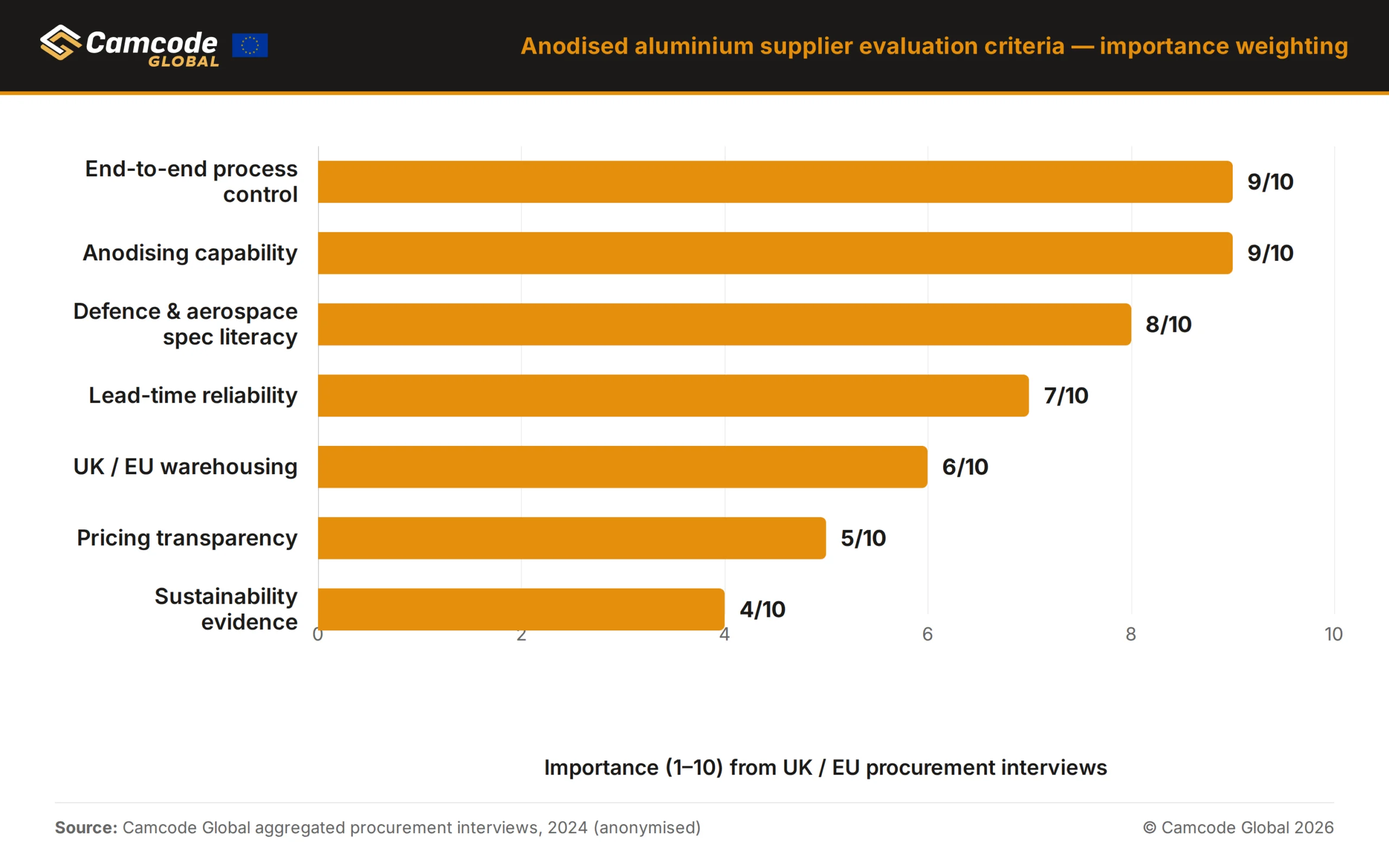
Here’s a breakdown of the key factors UK and EU-based procurement teams should consider when evaluating capabilities:
- Anodising capability. Type II vs Type III, thickness range of layers they can apply, in-house vs sub-contracted anodising.
- Image method. Photosensitive (Metalphoto®), inkjet, laser etch, mechanical engraving, screen print, and what imaging methods they recommend for specific applications.
- Substrate sourcing. Aluminium grade, supplier traceability, and whether a certification of conformance (CoC) is available.
- Process certification. Certifications reflecting process quality. ISO 9001 at a minimum; AS9100 (aerospace), IRIS (rail), ISO 13485 (medical), and ISO 55001 (asset management systems), depending on sector.
- Marking specification experience. Def Stan 05-132, NATO STANAG 2290, STANAG 4427, STANAG 4329, Netherlands MoD policy CDS 751, EN 9132, EN 15380-2, EU Medical Device Regulation 2017/745, and the EU Falsified Medicines Directive (2011/62/EU) where relevant. Concrete supplier-side experience matters more than generic claims. See the full standards breakdown below.
- DataMatrix verification. Will the supplier verify each plate to ISO/IEC 15415 and ISO/IEC TR 29158 (previously AIM DPM-1-2006) prior to despatch with verifiable evidence?
- Lead times. Typical production lead times for low, medium, and high volumes.
- Capacity. Maximum annual output and ability to expand capacity for programme ramps.
- Geographic presence. Production in UK and/or EU locations or warehousing eliminates lengthy transits and customs complications.
- Transparent pricing. Volume break structure, tooling charges, change costs, etc.
- Range of AIT solutions. Can they support the plate with RFID, GPS, OCR, RTLS, biometrics, smart cards, sensor tech and EAS if you eventually need them rather than just offering anodised aluminium as their only option?
The Identifier: Which ID Type Will the Plate Carry?
Anodised aluminium is a robust image substrate for ID plates; what you choose to store on it is another decision entirely. Fortunately, a reputable supplier will guide you through making that decision and getting it right. Here are the identifier schemes we most commonly encode onto Metalphoto® and standard anodised plates for our UK and EU customers:
- UII and IUID (Item Unique Identification). A Unique Item Identifier built to NATO STANAG 2290 and, where applicable for UK contracts, Def Stan 05-132 standards. This is used as the standard scheme for serialised defence assets that will enter into NATO or national defence supply chains.
- UDI (Unique Device Identification). Mandated by the EU Medical Device Regulation 2017/745 on medical devices intended for sale in the EU. Recorded in the EUDAMED database. Note that this is not interoperable, nor is it equivalent to the US FDA’s UDI Rule.
- GS1 GIAI (Global Individual Asset Identifier). A GS1-standard asset identifier increasingly mandated on UK public-sector schemes, such as the Department of Health and Social Care’s Scan4Safety programme and Cabinet Office commercial templates.
- NATO Stock Number (NSN). Assigned by the NATO Support and Procurement Agency (NSPA) and national codification bureaus to assets catalogued in the NATO supply system.
- MOD Equipment Asset Code. Asset coding applied within the UK Ministry of Defence as a layer of coding in addition to (and sometimes instead of) UII for equipment appearing in MOD record systems.
- Internal asset codes. Asset identifiers which are organisation-specific, assuming that it is controlled, recorded and able to consistently convert to whatever external standard may be requested by a customer or auditor at a later date.
A supplier with knowledge of only the plate material, but not the identifier scheme it must carry, will eventually manufacture plates that are built to last but may fail to meet compliance standards. Require each shortlisted anodised aluminium supplier to walk you through how each of these ID types is formatted, validated, and (when relevant) submitted to a government or industry registry.
Marking Technologies: Where Anodised Aluminium Fits
Anodised aluminium is just one of many marking technologies manufactured by Camcode Global. Knowledge of our full range allows a buyer to determine if a prospective supplier is offering anodised aluminium because it is right for the application, or because it’s the only thing they manufacture. Technologies we offer (and where each is typically applied) include:
- Photosensitive anodised aluminium (Metalphoto®). Extremely durable, sub-surface, inorganic image. Meets widest range of performance specifications. Best performance on high- to medium-volume applications; not ideal for very low volumes or on-site marking. Size, thickness and attachment method are very flexible. Ideal for: small arms/weapon ancillaries, ships/marine, aircraft/aerospace, engines/components, complex or crew-served weapons systems, communications equipment, and products requiring chemical, heat, or sunlight resistance.
- Laser markables (steel, BlackPlus, or acrylic). An etched or bonded image, very durable depending on substrate but much slower and labour intensive. Ideal for low volume on-site work where real time marking is needed. Typical uses: small arms, weapon ancillaries, aircraft/aerospace, engines/components, complex or crew-served weapons systems, and communications equipment.
- Thermal transfer. Durable ink transfer image longevity varies by material; can handle medium- to high-volume demand and allows for on-site printing. Common uses: soft armour, hard armour, hospital assets, direct PCB marking, general asset identification, suppressor marking, and high heat (500° C – 1200° C) applications.
- Ink jet. Image is printed onto surface, and permanence depends on the material it’s printed on and how much overlay occurs; capable of moderate- to high-volume printing. Common uses: Soft armour, hard armour, ballistic/bump helmets, hospital assets, and general asset tracking.
- Cut-through (CNC punched plates). These have good durability but are best suited to low quantities; size, thickness and attachment options are limited by the stock material. Common applications: heavy equipment, ships/marine, and chassis marking.
- Woven fabric. Sew-on tags, either heat sealed or sewn to a backing material. They provide fair longevity and are suitable for labelling materials. Common applications: parachutes, clothing, and other woven or fabric assets.
- Direct part marking (DPM). Laser engraved or dot-peen markings that are etched directly into the part; long-lasting but time-consuming and labour intensive. Suitable for applications where it’s not possible to affix a label. Common uses: bridging, harsh chemical environments, medical/surgical equipment, and aviation parts. Graded to ISO/IEC TR 29158 (formerly AIM DPM-1-2006).
- NFC. A short-range, passive radio frequency identification protocol that needs to be within 4cm of the reading device to work. NFC can be read by most smartphones and is useful when you can’t affix a barcode or when you want the system to initiate an action every time it is scanned. Common use cases: communications equipment, hospital equipment, and general asset tracking.
Anodised aluminium tends to be the default recommendation for most UK and EU defence, aerospace, rail and heavy-industrial ID programmes due to its ability to deliver long-term durability alongside flexibility in size and content. However, a supplier that tries to push every enquiry towards anodised aluminium, regardless of substrate, environment or volume, should be questioned. The solution should come as a result of an assessment, not before.
Standards and Regulations a UK/EU Supplier Should Know
Standards relating to anodised aluminium ID plates cover NATO and national defence, aerospace, rail, medical and pharmaceutical regulation. Your supplier should be able to discuss all of the following and provide evidence of project experience for your sector:
- NATO STANAG 2290 (NATO Unique Identification of Items): the standard from which all national UID standards are derived from. This standard outlines how the Unique Item Identifier (UII) should be formatted and how items should be marked with this identifier. The UK UID standard, Def Stan 05-132, is based upon this standard.
- STANAG 4427 (Allied Configuration Management Documentation): this standard is intended for use in conjunction with STANAG 2290 for configuration-managed, serialised assets that transit through NATO/allied supply chains.
- STANAG 4329 (NATO Bar Code Symbology): establishes barcode symbology requirements for items marked for use by NATO/allied forces.
- Netherlands MoD policy CDS 751: UID policy of the Netherlands Ministry of Defence for uniquely identifying defence equipment. This standard covers items such as ballistic plates.
- Def Stan 05-132: UK Ministry of Defence specification for marking of items of supply. This standard determines marking requirements for all contracted defence equipment supplied to UK MOD.
- EN 9132: a European aerospace industry standard for quality requirements for parts marking using DataMatrix.
- EU Medical Device Regulation 2017/745: requires Unique Device Identification (UDI) marking of medical devices sold in the EU, registered with the EUDAMED database. This is a distinct, non-mutually-compliant regime from the US FDA’s UDI rule.
- EU Falsified Medicines Directive (2011/62/EU): mandates the use of GS1 DataMatrix codes affixed to unique pack-level IDs for pharmaceuticals to help prevent counterfeit medicines from entering EU supply chains.
- ISO/IEC TR 29158 (formerly AIM DPM-1-2006): standardises laser and dot-peen direct part marking; also defines the grading scale (levels of readability) used by UK MOD programmes and European aerospace and defence OEMs.
- ISO 55001: the global standard for asset management systems. It views unique identification as something that enables the rest of the management system to operate. The new 2024 revision clarified requirements around the permanent legibility of asset identifiers.
- MIL-STD-130: MIL-STD-130 is a United States Military standard. Buyers outside of the US (such as UK and EU purchasers) will not request MIL-STD-130 directly; however, evidence of durability required to pass MIL-STD-130 is often used to show compliance to the nearest UK/EU equivalent requirements, namely Def Stan 05-132, Netherlands MoD policy CDS 751 or NATO STANAG 2290 (incorporated as EN 9132). Military, aerospace, rail and energy specifications will usually require this lifespan. This is why UK and EU suppliers continue to quote it as their durability requirement despite having no contractual power outside of the US.
How UK and EU Suppliers Typically Segment
Across UK and EU asset identification work, the anodised aluminium supplier base segments as:
- Vertically integrated Metalphoto®/photosensitive anodised aluminium manufacturers. These producers provide the full photosensitive anodising service in-house. Camcode Global is one of the largest suppliers of Metalphoto® plates in the world.
- Standard anodised aluminium plate suppliers. These producers specialise in anodising and supply the plate for downstream marking (engraving, inkjet, laser etch) by a third party.
- Converters and resellers. These companies purchase anodised plates from a primary producer and add some sort of marking or finishing operation.
- Local marking shops. These companies purchase standard anodised plates and will add local marking (engraving, etching, printing) for local projects.
In UK and EU defence, aerospace, rail and industrial applications where long-life serialised asset identification is required, the vertically integrated supplier is preferred because substrate quality and imaging quality can be controlled from end to end.
Red Flags in Anodised Aluminium Supplier Selection
A few warning signs we’ve identified from UK and EU procurement engagements:
- The supplier specifies anodising thickness as “up to” without a minimum. Useful specifications quote minimum thickness and a maximum tolerance band.
- The supplier does not offer DataMatrix grade reporting. If a supplier can’t supply batch-by-batch grade reports, they can’t be expected to meet ISO/IEC 15415 cascading requirements.
- The supplier uses vague durability terminology without evidence. “Long-life” is meaningless without test data to back it up. See if they cite MIL-STD-130 test methods, or equivalent.
- The supplier will only offer single-source aluminium. Aerospace and defence programmes should insist on flexibility of aluminium grade and supply base.
- The supplier does not offer to provide certification of conformance. UK and EU defence and aerospace work expects per-batch CoC as a standard.
- The supplier isn’t fluent in the standards that actually apply to your sector. If a supplier struggles to explain the difference between STANAG 2290 and Def Stan 05-132, or EU MDR and the FDA’s UDI rule, they’ll struggle to specify correctly.
Comparison: What Differentiates the UK and EU Supplier Tiers
These seven factors set UK and EU anodised aluminium suppliers apart when specifying for ID plate projects:
- End-to-end process control (anodising, imaging and sealing in one facility).
- Specification knowledge based on defence and aerospace industry experience.
- Audit trail capacity within DataMatrix information grades.
- Variable-data capability (each plate carries unique content) at production volume.
- Lead time for standard versus custom-format plates.
- EU and UK warehousing infrastructure: to bypass post-Brexit customs complexity.
- Evidence of sustainability standards (REACH, RoHS, recycled aluminium content).
Camcode Global’s Seven-Step Process
Selecting a durable plate and appropriate identifier scheme is only as valuable as the process the supplier follows from consultation to lifecycle advisory services. Camcode Global’s seven-step data cleansing, asset identification and data optimisation process is the framework we apply on every UK and EU anodised aluminium and wider AIT engagement, and it is worth using as a benchmark when evaluating any supplier’s own methodology.
Step One: Asset Identification & AIT Consultation
Prior to any markings decisions being made, an expert assessment is conducted to ensure alignment to appropriate standards and frameworks, maximise asset utilisation and supply chains, automate where possible, and optimise efficiency.
Step Two: Engineering Services
Once field verification is conducted on a representative sample of assets, and business rules and data governance are defined, the engineering team creates the marking specification or factsheet which defines how each asset will be marked, both from a data standpoint and physical marking standpoint.
Step Three: Data Remediation, Reconciliation & Verification
Our proprietary offline and online data collection software ensures accurate data collection, compliance with standards, easy integration with existing systems and detailed reporting and analytics.
Step Four: AIT Product Manufacture & Procurement
Customised AIT products (anodised aluminium plates, barcodes, RFID tags, sensors, GPS tracking units, OCR symbols, Real Time Locating Systems (RTLS), NFC chips, EAS tags, biometrics and much more) are manufactured or procured to the previously developed specification.
Step Five: AIT Product Installation
NATO Security Cleared installation teams work to the marking specification, and our proprietary software allows for positive asset-to-data association during installation of all products that meet appropriate regulatory and NATO standards.
Step Six: Data Reporting & Migration
Custom reporting solutions offer visibility into operations, help identify anomalies and keep master data clean, minimising time and effort spent on continuous data reconciliation.
Step Seven: Asset Life Cycle Management Advisory (ALCMA)
KPMG’s Asset Life Cycle Management Advisory (ALCMA) service helps you manage assets from cradle to grave (planning and acquisition through maintenance, optimisation and disposal) with an emphasis on performance, reducing costs and compliance with industry standards.
See The Framework to learn more about each stage of the process. See The Results for examples of how this has translated into outcomes such as asset visibility, configuration management, lifecycle management, BPO automation, digital transformation, NATO interoperability, and supply chain management for defence organisations across the UK, EU, US and Oceania.
How to Run an Anodised Aluminium Supplier Pre-Qualification
A pragmatic UK/EU pre-qualification workflow:
- Draft a clear requirement spec. This should include plate dimensions, content set, identifier type (UII/IUID, UDI, GS1 GIAI, NSN, MOD Equipment Asset Code, or internal code), DataMatrix grade target, life expectation, environment, volume, and required lead time.
- Shortlist suppliers. Identify three to five suppliers that can sufficiently meet the above specifications.
- Request samples: Ask for samples with your actual production content. Don’t rely on generic demo plates.
- Grade-verify the samples: Use your own ISO/IEC 15415 or ISO/IEC TR 29158 verifier or arrange for an independent third party to do it.
- Request reference customers: Ask for references specifically in your industry.
- Audit one or two finalists: Conduct an on-site or remote audit with a focus on critical process steps (anodising, imaging, sealing, grade verification, packing/shipping).
- Lock the specification: This should include the substrate, anodising process, thickness, image process, seal option, adhesive, attachment method and grade verification standard.
- Negotiate: Reach an agreement onvolume break structure, lead times, and change-control terms.
Incorporating a sample-verify step into pre-qualification (testing real production samples before awarding the order) is generally considered the single best way to eliminate spec disputes after supply starts.
Frequently Asked Questions
Who are the major anodised aluminium identification plate suppliers in the UK and EU?
The vertically integrated Metalphoto®/photosensitive anodised aluminium manufacturing sector is quite small on a global scale with only a few large players such as Camcode Global. The non-Metalphoto® anodised plate market is larger and comprises numerous UK and EU domestic anodisers.
Should we single-source or dual-source?
In the case of programmes where the assets are serialised and there is significant volume, it is becoming more common to dual-source to minimise supply risk. The sources do not have to be perfect substitutes as long as both meet specifications.
What lead time can we expect on custom Metalphoto plates?
Depending on volume and customization, 2-3 weeks from approval of final artwork is standard within the UK/EU for regular format. Higher volumes or custom formats will increase this.
How can we assess a supplier’s DataMatrix grading performance?
Ask for sample per-batch grade reports from past production. They should quote either ISO/IEC 15415 or ISO/IEC TR 29158, identify the verifier model, and list grade values for the sample plates.
What about non-Metalphoto® anodised aluminium options?
Regular anodised aluminium with engraving, inkjet or laser etch is still a good option if you have lower density content or shorter life requirements. The compromise is image durability and content density.
Does an anodised aluminium supplier need to support identifier types beyond a simple serial number?
Yes. Depending on the application and sector, a plate will need to be marked with a UII/ IUID as per STANAG 2290 and Def Stan 05-132, a UDI as per EU MDR 2017/745, a GS1 GIAI, a NATO Stock Number, a MOD Equipment Asset Code or even your internal code. A supplier who can support only one scheme will limit your options in the future.
How does MIL-STD-130 relate to UK/EU procurement if it’s a US standard?
Whilst not legally binding within UK and EU contracts, the durability testing portions have been widely adopted within UK and EU supply chains as the de facto interpretation of the closest equivalents: UK Defence Standard 05-132, Netherlands MoD policy CDS 751 and NATO STANAG 2290 (as adopted through EN 9132). Suppliers reference it because it’s a rigorous, well-understood proof point, not because it’s required.
Do we need RFID or other AIT along with the plate, or does the mark do the job?
The mark on its own will meet requirements for the majority of serialised asset programmes. Use of RFID, GPS, RTLS, OCR, biometrics, sensor technology or EAS is required when assets need to be read at distance, in bulk, at speed, without line of sight or with condition monitoring. Plates manufactured by Camcode Global can be engineered or paired to deliver any of these capabilities where the programme demands.
How Camcode Global Compares as a Supplier
Camcode Global is a vertically integrated Metalphoto® and anodised aluminium plate manufacturer. With decades of experience supplying to UK and EU defence, aerospace, rail and industry sectors, we fully anodise, image, seal and grade everything in-house and are certified to ISO 9001 and various industry-specific standards. We routinely supply products against NATO STANAG 2290, STANAG 4427, STANAG 4329, Netherlands MoD policy CDS 751, Def Stan 05-132, EN 9132, EN 15380-2, ISO/IEC TR 29158, ISO 55001, EU Medical Device Regulation 2017/745, and the EU Falsified Medicines Directive (2011/62/EU). Camcode Global utilises MIL-STD-130 as our benchmark for durability, which forms the base requirements of many equivalents.
Beyond anodised aluminium, our AIT portfolio spans laser markables, thermal transfer, ink jet, cut-through, woven fabric, direct part marking, and NFC, together with RFID, GPS, OCR, RTLS, biometrics, smart cards, sensor technology, and electronic article surveillance, all delivered through the same seven-step data cleansing, asset identification, and data optimisation process, from consultation through to lifecycle advisory delivered by KPMG.
Talk to a Camcode specialist about how we’d fit into your supplier base.