The Global Individual Asset Identifier (GIAI) from GS1 provides UK and EU organisations with a standards-based, externally-interoperable asset identifier. It can be used as an alternative/complement to existing defence NSN (NATO Stock Number) allocations, the STANAG 2290 based UID marking used on NATO-aligned defence equipment or an organisation’s internal asset code. GS1 UK also advocates use of the GIAI as the primary identifier for improving asset traceability in healthcare and NHS asset management, including projects undertaken through the NHS Scan4Safety programme. The same principles for the use of GIAI apply for UK government asset registers and organisations working towards alignment with ISO 55001 asset management.
This guide focuses specifically on labels carrying GS1 GIAI (or other GS1-based asset identifiers) for asset identification, not commercial product labels or pharmaceutical pack labels. Here we explain what a GS1 asset label should do, the standards that apply to marking assets and ensuring data quality, which substrates and mark types work best in different applications, and how to plan a GIAI programme from inception through to lifecycle management.
 CAMCODE GLOBAL
GS1 asset label batch cost estimator
How this is calculated & sources used
Compiled from publicly available standards documentation and Camcode Global experience.
Sources actually used:
• Camcode Global
What a GS1 Asset Label Has to Do
A GS1 asset label has to:
- Include a GIAI (or other GS1 identifier where relevant) as a unique identifier.
- Encode the identifier in machine-readable form, typically GS1 DataMatrix (GS1) or GS1-128 (GS1 US).
- Carry human-readable content in conjunction with the machine-readable component (typically the GIAI itself, description of the asset, and ownership information).
- Survive the environment in which the asset will operate for the anticipated life of the asset.
- Remain readable per ISO/IEC 15415 (ISO/IEC) throughout that lifespan.
- Optionally, may include additional content, owner branding, regulatory requirements, hazard symbols, calibration or inspection status.
Should any of the aforementioned points fail, the label has failed the program it was created for.
Where GIAI Fits Among UK and EU Asset Identifiers
GIAI is one identifier scheme that UK and EU asset managers encounter amongst several others. In practice, GIAI will very rarely be used on its own. It’s helpful to consider how it relates to the others when deciding whether GIAI should be used as the primary identifier for an asset class, or supplemented by a defence or sector specific scheme:
- GIAI (GS1 Global Individual Asset Identifier). An owner-allocated identifier that’s constructed from a GS1 company prefix and an individual asset reference number that’s encoded with the GS1 Application Identifier “8004”. It is globally unique, externally interoperable and the preferred identifier scheme for civilian, healthcare and general government asset registers.
- NSN (NATO Stock Number). Issued by NSPA and national codification bureaus, NSN is a defence codification identifier assigned to items that have been codified using the NATO Codification System. Supply chains dealing with defence equipment will default to NSN, not GIAI.
- UID/IUID (Unique Item Identifier). This marking scheme specifies the requirements for marking NATO and allied defence equipment, based on STANAG 2290, transposed to the national level by such standards as UK Def Stan 05-132 and the Netherlands MoD’s CDS 751. Serialised assets moving through alliance supply chains must be marked with a UID, rather than GIAI.
- MOD Equipment Asset Code. An asset code used internally by the UK Ministry of Defence logistics systems, separate from NSN and GIAI.
- UDI (Unique Device Identification). Unique Device Identification numbers are mandated on medical devices intended to be supplied into the EU under the EU Medical Device Regulation 2017/745. NHS trusts will often operate assets marked with UDI and assets marked with GIAI in the same estate (devices and fixed assets, respectively), Scan4Safety layouts will also often contain GTIN and/or GLN content in addition to the GIAI for context in the supply chain.
- Internal/organisation-specific asset codes. Free-text or numbering schemes that were in use before implementation of a standards-based programme. They rarely survive supplier changes, mergers or successful long-term lifecycle management, hence the need for migration to GIAI.
One asset register may legitimately have more than one of these identifiers attached to the same physical object (e.g., it may have an NSN for defence standardisation purposes, and it may have a GIAI as its own organisationally interoperable asset identifier). The key requirement is that the register is clear about which identifier is primary for what purpose, and that whatever is marked on the asset itself tallies with the register.
How GS1 GIAI Is Structured
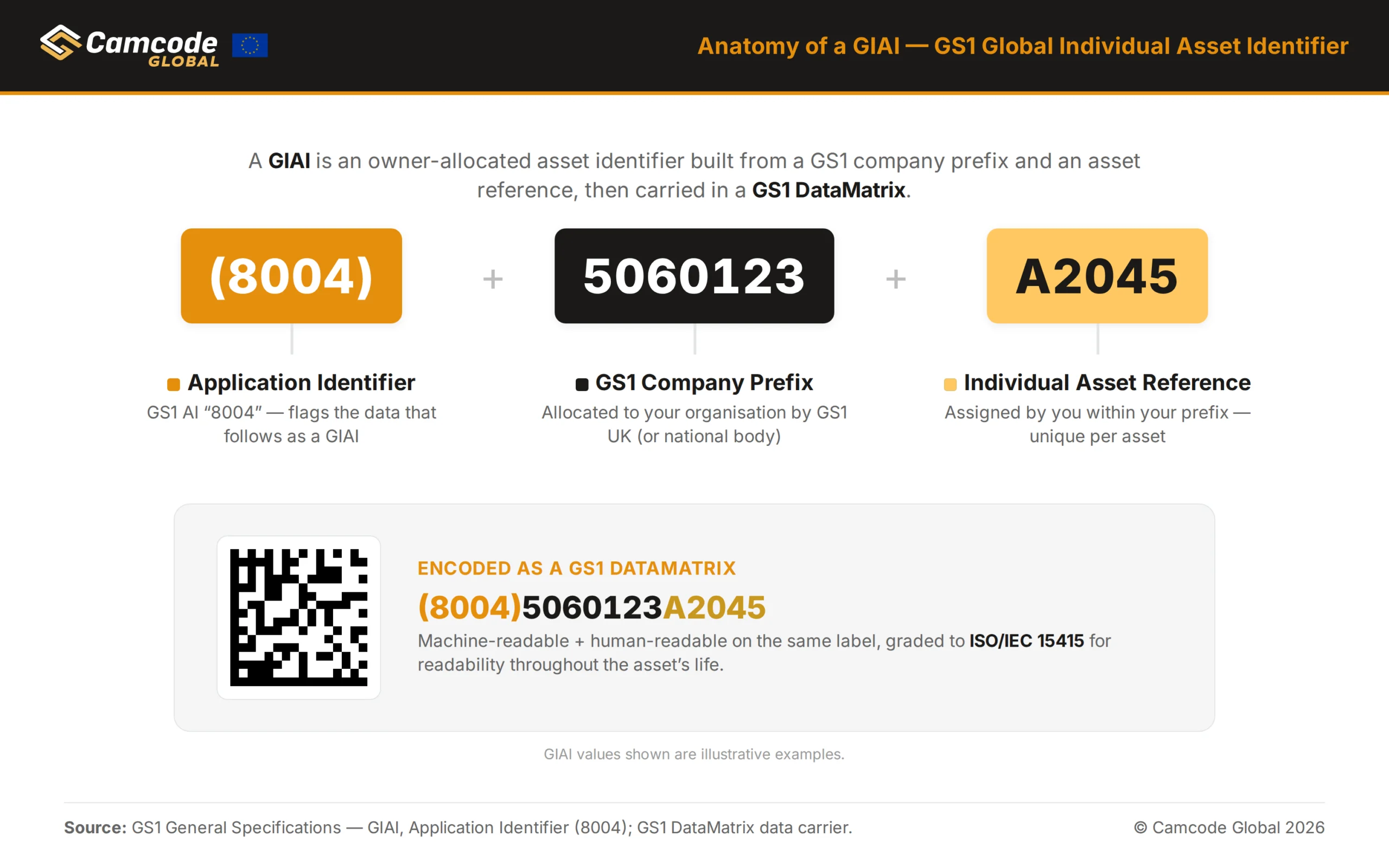
A GIAI is constructed as:
- GS1 Company Prefix (allocated by GS1 UK or equivalent national body).
- Individual Asset Reference (allocated by the organisation within its prefix).
The combined identifier is encoded with the GS1 Application Identifier “8004” (for GIAI) (GS1). In a GS1 DataMatrix, the full encoding includes the AI prefix plus the GIAI value.
For UK organisations, GIAI allocation requires a current GS1 UK membership and an allocated company prefix. GS1 UK provides allocation tools to help organisations manage their reference or serial space without duplicates.
Standards and Regulatory Context for GS1 Asset Labels
GIAI is a GS1 standard. However, in the UK and EU there are very few asset programmes that operate purely on GS1 rules. Additional needs vary by sector, but a GIAI tagged asset may also need to conform to defence, aerospace, medical or asset-management standards. The following standards are most relevant to GS1 asset label programmes:
- NATO STANAG 2290 (NATO Unique Identification of Items). Underlying standard upon which all NATO UID marking standards are based. Defines how the Unique Item Identifier (UII) is structured and how items should be marked with the UII. National UID standards like DEF STAN 05-132 are based on this standard.
- STANAG 4427 (Allied Configuration Management Documentation). To be applied in conjunction with STANAG 2290 where UID marking supports the configuration management of NATO assets.
- STANAG 4329 (NATO Bar Code Symbology). The standard that defines the barcode symbology for NATO UID marking; all serialised assets moving through alliance supply chains must bear a mark compliant to this standard.
- Netherlands Ministry of Defence policy CDS 751. The UID policy of the Netherlands MoD, establishing guidelines for uniquely identifying defence equipment such as ballistics plates.
- UK Def Stan 05-132. Defines marking requirements for all contract defence equipment supplied to UK MOD.
- EN 9132. Defines the identification marking scheme to be applied to safety-critical aerospace components.
- EU Medical Device Regulation 2017/745. Mandates the use of UDI in order to place medical devices on the EU market. Devices are registered in the EU’s EUDAMED database. This is separate to asset GIAI; however, most healthcare estates run both schemes concurrently.
- EU Falsified Medicines Directive (2011/62/EU). Specifies GS1 DataMatrix for singular pack-level pharmaceutical identifiers. It’s a different GS1 use case from fixed-asset GIAI labelling, but it’s applicable where an organisation is standardising GS1 DataMatrix symbology use across both product and asset labels.
- ISO/IEC TR 29158 (formerly AIM DPM-1-2006). Specifies laser and dot-peen direct part mark symbologies, and standardizes the grading scale for readability as adopted by UK MOD programmes and European aerospace and defence OEMs.
- ISO 55001. The asset management systems standard. This standard considers unique identification a necessary foundation for the rest of the management system to work.
- MIL-STD-130. MIL-STD-130 is a US Military specification. Buyers based in the UK and EU will not request MIL-STD-130 specifically; however, the durability requirement that MIL-STD-130 specifies has commonly been used to validate adherence to the nearest equivalent UK/EU standards, most commonly Def Stan 05-132, Dutch MoD policy CDS 751 and NATO STANAG 2290 (incorporated as EN 9132). Requirements for military, aerospace, rail and energy applications tend to ask for this life expectancy, and it can be a useful benchmark to apply even to civilian equipment labelled to GIAI standards when a similar lifespan is required.
In cases where a GIAI-marked item also falls within scope of one of the defence, aerospace or medical standards above, it’s often necessary for the label to comply with both standards simultaneously: GS1 encoding and content guidelines alongside the marking, durability or registration guidelines of the relevant standard.
Substrate Choice for GS1 Asset Labels
The substrate decision for GS1 asset labels follows the same environment-driven logic as any UID label programme:
- Premium polyester labels: for indoor electronics, instrumentation, IT, light industrial, typical service life 3-7 years.
- Ruggedised polyester or aluminium-faced labels: for semi-outdoor or industrial, 5-12 years.
- Metalphoto® anodised aluminium plates: for outdoor, marine, and serialised long-life, 20+ years.
- Ceramic tags: for paint-strip and chemical exposure, 20+ years.
- Polyimide labels: for high-temperature applications.
For UK NHS Scan4Safety equipment and most government asset register work, the substrate set is dominated by premium polyester (indoor, instrumentation) and Metalphoto plates (outdoor, long-life).
Symbology Choice
For GS1 asset labels, the dominant symbology choices:
- GS1 DataMatrix. The default for asset labels carrying GIAI plus additional content. Damage-tolerant, dense, widely supported.
- GS1-128 (linear). Used where the asset workflow involves logistics scanning compatible with shipping infrastructure.
- EAN/UPC. Not typically used for asset labels (product-focused).
GS1 DataMatrix on a Metalphoto® plate or premium polyester label is the workhorse asset-label configuration for UK and EU operators.
Camcode Global’s Mark Types for GS1-Encoded Labels
The lifespan of a GIAI is only as long as the mark it’s printed on. We produce every type of marking technology found in UK and EU asset marking programmes. Camcode Global can output a GS1 GIAI/DataMatrix payload into any of these marking technologies where the substrate and production volumes allow:
- Photosensitive anodised aluminium (Metalphoto®). Extremely durable sub-surface, inorganic image with very versatile performance characteristics. Ideal for high to medium volume applications; less suitable for small production runs or on-site applications. Can be supplied in a variety of sizes, thicknesses and attachments to suit most applications. Typically used for small arms/weapon ancillaries, ships/marine, aircraft/aerospace, engines/components, complex/crew-served weapons systems, communications, electronics where durability and reliability is required during chemical, heat or sunlight exposure.
- Laser markables (steel, BlackPlus, or acrylic). The image is etched/bonded to the substrate and longevity will depend on the substrate. Laser marking takes longer and is more labour-intensive, so it’s ideal for low volume, on-site applications where marking must happen in real-time. Size, thickness and attachment options are flexible, however on-site fabrication may be necessary if pre-cut blanks are not available.
- Thermal transfer. Produces an ink- transfer image that is durable depending on material choice; Able to accommodate moderate- to high-demand volumes and capabilities for on-site printing if needed for real-time marking. Restrictive in size, thickness and attachment options. Common applications include soft armour, hard armour, hospital instruments, direct PCB marking, general asset marking, suppressor marking, extremely high heat environments (500°C-1200°C).
- Ink jet. An ink-jet printed image with variable durability based on the material and overlay used. Moderate- to high-demand volume is achievable with some limits on size, thickness and options for attachment. Common applications include soft armour, hard armour, ballistic/bump helmets, hospital equipment, general asset tracking, etc.
- Cut through (CNC punched plates). Durable but best suited for short runs. May have legibility problems with some applications. Size, thickness and attachment methods are limited by the material choice. Common applications include heavy machinery, ships/marine, and frame marking.
- Woven fabric. Sewn tags offering moderate durability and limited attachment options (heat-seal or sewn). This is ideal for fabric marking such as parachutes, apparel and other woven or fabric assets.
- Direct part mark (DPM). Laser engraved or dot-peen permanent marking. This marking method is slow and labour-intensive and is suitable for assets where a label can’t be applied, such as bonding closures, caustic chemical exposure, medical instruments and aerospace components. DPM readability is categorized by ISO/IEC TR 29158.
- NFC. A passive radio-frequency identification protocol where the reading device needs to be held within 4cm of the tag to read it. Easily read by most smartphones. It’s best used where you can’t affix a barcode, or where you need the system to perform a secondary action every time it’s scanned. Common applications include communications equipment, hospital equipment and general asset tracking.
Application environment and substrate should always be considered prior to choosing a marking technology. The same asset class may require a different mark depending on where and how it will be used.
Content Layout on a GS1 Asset Label
A typical UK/EU GS1 asset label carries:
- The GS1 DataMatrix encoding the GIAI (with AI 8004).
- Human-readable GIAI text.
- Asset description/nomenclature.
- Owner identification (organisation name, logo).
- Optionally: calibration/inspection status, hazard marks, regulatory marks, helpline or asset return contact.
For Scan4Safety equipment, the layout often also carries GTIN and/or GLN content for additional supply chain context.
Integration with ISO 55001 Asset Management
For UK/EU asset-intensive organisations aligning with ISO 55001, GS1 asset labels typically integrate as follows:
- The asset register holds the GIAI alongside the asset record.
- The CMMS or EAM application uses the GIAI as the primary key for maintenance, inspection, and condition records.
- The label on the physical asset carries the GIAI and is the operator-facing read-point.
- Audit cycles confirm mark-to-register correspondence (validation) and mark grade (verification).
Programmes that use GIAI consistently from register through to label typically produce cleaner audit findings than programmes that allocate identifiers ad-hoc.
Common UK/EU GS1 Asset Label Pitfalls
Patterns we see across UK and EU GS1 asset-label programmes:
- Allocating GIAIs without recording them in the register. The label exists, but the central record does not.
- Re-using GIAIs across asset classes. GIAIs are intended to be globally unique within the prefix. Re-use within different asset classes breaks that.
- Choosing the cheapest label substrate without environment matching. A polyester label on outdoor industrial equipment fails within 18 months.
- Skipping symbology grading. GS1 DataMatrix should be graded to ISO/IEC 15415 at the point of mark.
- Not designing the layout for the full content set. GIAI, DataMatrix, human-readable, owner identification, and regulatory marks all need space.
Frequently Asked Questions
Is a GIAI the same as an asset tag number?
A GIAI is a specific GS1 allocated identifier. An asset tag number is a generic term. They can be the same, many organisations use GIAI as their asset tag number to allow external interoperability.
Do I need GS1 UK membership to use GIAI?
Yes, because GIAI allocations require a GS1 company prefix, and these are allocated by GS1 UK (or equivalent GS1 national member in other countries).
Can I migrate an existing asset register to GIAI?
Yes. Migration would usually consist of assigning a GIAI to every asset, updating the asset register with this identifier and re-labeling assets during the next maintenance cycle (or sooner for critical assets).
Is GIAI accepted in UK MOD work?
UK MOD defence supply chains use NATO Stock Numbers (NSN) as a standard, so MOD defence contracts specify NSN by default. GS1 is promoting the GIAI as an interoperable, standards-based, owner allocated asset identifier that organisations can use in addition to an NSN where a GS1 interoperable identifier is of value, such as on civilian or dual-use asset registers. Always check the identifier requirements of individual contracts or templates before relying on GIAI.
How does GIAI compare to a serial number?
A serial number is an identifier allocated by the manufacturer in the manufacturer’s domain. A GIAI is an owner-allocated identifier (under the owner’s GS1 prefix) which is globally unique. They are complementary; a label may have both.
How Camcode Global Supplies GS1 Asset Labels
In the UK and Europe, Camcode Global produces machine-readable polyester labels, Metalphoto® plates, ceramic tags, laser-markable steel/BlackPlus/acrylic plates, thermal transfer and ink jet labels, cut-through CNC plates, woven fabric tags, direct-part- marking outputs and NFC tags (all of which can be encoded with GS1 GIAI, GS1 DataMatrix, GS1-128 codes and contain supporting content) for customers in the healthcare, government, defence, energy and manufacturing sectors.
Our RFID, RTLS, OCR, GPS, sensor, biometric/smart card and EAS technologies provide a choice of solutions for those wanting GIAI-based visibility beyond labelling and throughout the asset lifecycle. All machine-readable markings are quality-graded against ISO/IEC 15415 (DPMs will be quality-graded against ISO/IEC TR 29158) before they leave our production facilities, and every implementation project is supported by our seven-step framework, including consultation, engineering, data remediation, manufacture, installation, reporting and lifecycle advisory services. See The Framework for details on each stage, and The Results for the successful defence, infrastructure and manufacturing companies who have benefitted from it.
We can also provide advice on prefix strategy, GIAI allocation, content design and how GIAI works in concert with defence, aerospace or medical standards that are already in use on your assets. Talk to a Camcode specialist about your GS1 asset label programme.