Metalphoto® is the trade name for photosensitive anodised aluminium originally developed in the United States in the 1950s and now specified within UK MOD, NATO, US DoD and major European industrial supply chains. In independent testing sponsored by the government to assess commercially available IUID label materials, undertaken by NSWC Corona Division, Metalphoto was the only product to pass testing and can be proven to last 20+ years outdoor/industrial environments by comfortable margins, meeting the permanence requirements of Def Stan 05-132, MIL-STD-130, EN 9132, Netherlands Ministry of Defence (MoD) CDS 751, and STANAG 4329.
A note on standards: Def Stan 05-132 (UK MOD), Netherlands MoD policy CDS 751, and STANAG 4329 / STANAG 2290 (NATO) are the relevant standards when procuring into the UK and EU, respectively. MIL-STD-130 and the NSWC Corona Division test programme mentioned above are US DoD standards and testing. UK and EU purchasers will not ask for MIL-STD-130 itself, but the proof of durability that MIL-STD-130 requires is often used to demonstrate compliance with the closest UK/EU equivalent standards, primarily Def Stan 05-132, Netherlands MoD policy CDS 715, and NATO STANAG 2290 (as adopted through EN 9132). Military, aerospace, rail, and energy specifications typically require this lifespan.
These US documents are included because they form the basis of the durability evidence cited above. They are not mandated in the UK or EU. EN 9132 is the European aerospace industry parts-marking standard. This is equivalent to, but formally different from, the US SAE AS9132 standard mentioned below. When a UK/EU and US standard address the same requirement, this guide cites both so the appropriate one can be used in contract specification.
This specification guide has been created for UK and EU procurement, QA and asset management teams who want to learn what Metalphoto actually is, why Metalphoto has become the de-facto substrate for long-life serialised asset identification, how Metalphoto fits within Camcode Global’s broader marking and AIT portfolio, and how to specify it against every standard your programme is likely to encounter.
 CAMCODE GLOBAL
Metalphoto specification checklist
How this is calculated & sources used
Checklist compiled from Camcode Global Metalphoto manufacturing experience across UK MOD, NSPA, aerospace, rail, and industrial customers.
Sources actually used:
• MIL-STD-130
• Def Stan 05-132 Issue 5
• STANAG 4329
• EN 9132
What Metalphoto Is
Metalphoto is a medium which consists of anodised aluminium and photosensitive silver halide emulsion infused into the porous anodic oxide layer. The manufacturing process:
- Aluminium is anodised to create a thick porous oxide layer (normally between 5-25 microns).
- A special photosensitive silver halide emulsion is then integrated into the porous structure.
- The plate is exposed photographically with the desired image, text, barcodes, graphics, photographs.
- The exposed plate is then developed, which fixes the image onto the plate as metallic silver within the oxide layer.
- Finally, the plate is sealed (usually in hot water or nickel acetate) which closes down the porous structure trapping the image permanently inside the metal.
The finished product is an image embedded into the metal, not simply printed onto its surface. That means scratch wear, abrasion, UV light, solvents and most chemicals cannot penetrate through the metal surface to damage the image.
Why Metalphoto Dominates Long-Life Asset Identification
Metalphoto’s continued dominance in defence, aerospace, rail, and industrial asset identification rests on five attributes:
- Sub-surface image protection. The image is sealed inside the anodic oxide layer. There is nothing on the surface to wear off.
- High image resolution. Photographic exposure can produce high-contrast DataMatrix symbols in small sizes. Symbols can be verified to ISO/IEC TR 29158 (formerly AIM DPM-1-2006), the published standard for direct part mark (DPM) symbol grading mentioned in defence procurement specifications, and AS9132 (a US SAE aerospace standard, also referenced in Europe as EN 9132) for aircraft component marking. UK/EU aerospace programmes should specify EN 9132; AS9132 is typically only invoked directly on US-prime contracts.
- Exceptional durability. Since the image is sealed into the anodic oxide layer, it is resistant to UV light, extreme temperatures, chemicals and abrasion. This durability makes it suitable for most industrial and outdoor applications.
- Independent test data. Metalphoto was the only IUID label material to pass a government sponsored study conducted by the NSWC Corona Division (a US Navy research facility) that compared commercially available label materials for outdoor/readability retention life of 20+ years in outdoor and industrial environments. This was a US DoD-sponsored test programme benchmarked against MIL-STD-130, a US standard. The results verified Metalphoto exceeds the permanence requirements set forth in Def Stan 05-132, MIL-STD-130, NL MoD CDS 715, EN 9132 and STANAG 4329, so while the test itself is a US study, the durability margin it demonstrates carries over to the UK/EU standards that actually govern UK and EU procurement.
- Versatility. Everything from NSN, manufacturer’s part number, CAGE code, serial number, DataMatrix, graphics, and even photographic images can all be applied to a single Metalphoto plate within the same substrate.
The Identifier Layer: What Information Goes on a Metalphoto Plate?
A Metalphoto plate is a substrate, it is not an identifier scheme. Prior to artwork creation, the question we need to ask is what numbering scheme the plate needs to carry so that it will fit into the customer’s system of record. Most of our UK and EU programmes mandate one of the following identifier types on a Metalphoto plate:
- IUID (Item Unique Identification). The methodology for assigning a Unique Item Identifier (UII) to a single asset. The UII (generally constructed from concatenated data such as enterprise identifier, part number and serial number) is built to specification NATO STANAG 2290 and, if it is a US-linked contract, DoD IUID guidance. This is by far the most commonly used identifier type applied to defence Metalphoto plates.
- UID (Unique Identifier). The broad term for any unique, persistent identifier. When used in a NATO/MOD context, it is usually taken to mean the same as IUID. However, some internal asset registers may have a UID scheme that does not conform to IUID construction.
- UDI (Unique Device Identification). Required on medical devices that are placed on the EU market under EU Medical Device Regulation 2017/745. Metalphoto isn’t generally used for disposables packaging (paper/film substrates are most suitable and commonly used for those applications), but it is specified for medical equipment nameplates for durable capital equipment where the UDI marking must remain scannable/readable for the full operational lifespan of the equipment.
- GS1 GIAI (Global Individual Asset Identifier). Intended for use in commercial and public-sector asset registers. This includes some UK programmes adopting the NHS Scan4Safety initiative. GS1 DataMatrix content can be encoded cleanly onto Metalphoto at the same resolution as defence UID content.
- National Stock Number (NSN). Provided by NSPA and national codification bureaus. NSNs are commonly found printed as both a human- and machine-readable content field next to the UII on defence Metalphoto plates instead of acting as the primary unique identifier.
- MOD Equipment Asset Code. Identifiers used internally by UK MOD logistics and engineering databases. Can be carried alongside UID content on plates conforming to Def Stan 05-132.
Regardless of scheme, Metalphoto’s photographic resolution allows the identifier (no matter who issues it) to be printed as a tiny, compact DataMatrix along with several lines of human-readable text on the same plate. That is one of the biggest reasons Metalphoto continues to be the substrate of choice, no matter what identifier standard a contract falls under.
Where Metalphoto Fits in the UK / EU Marking Specification Stack
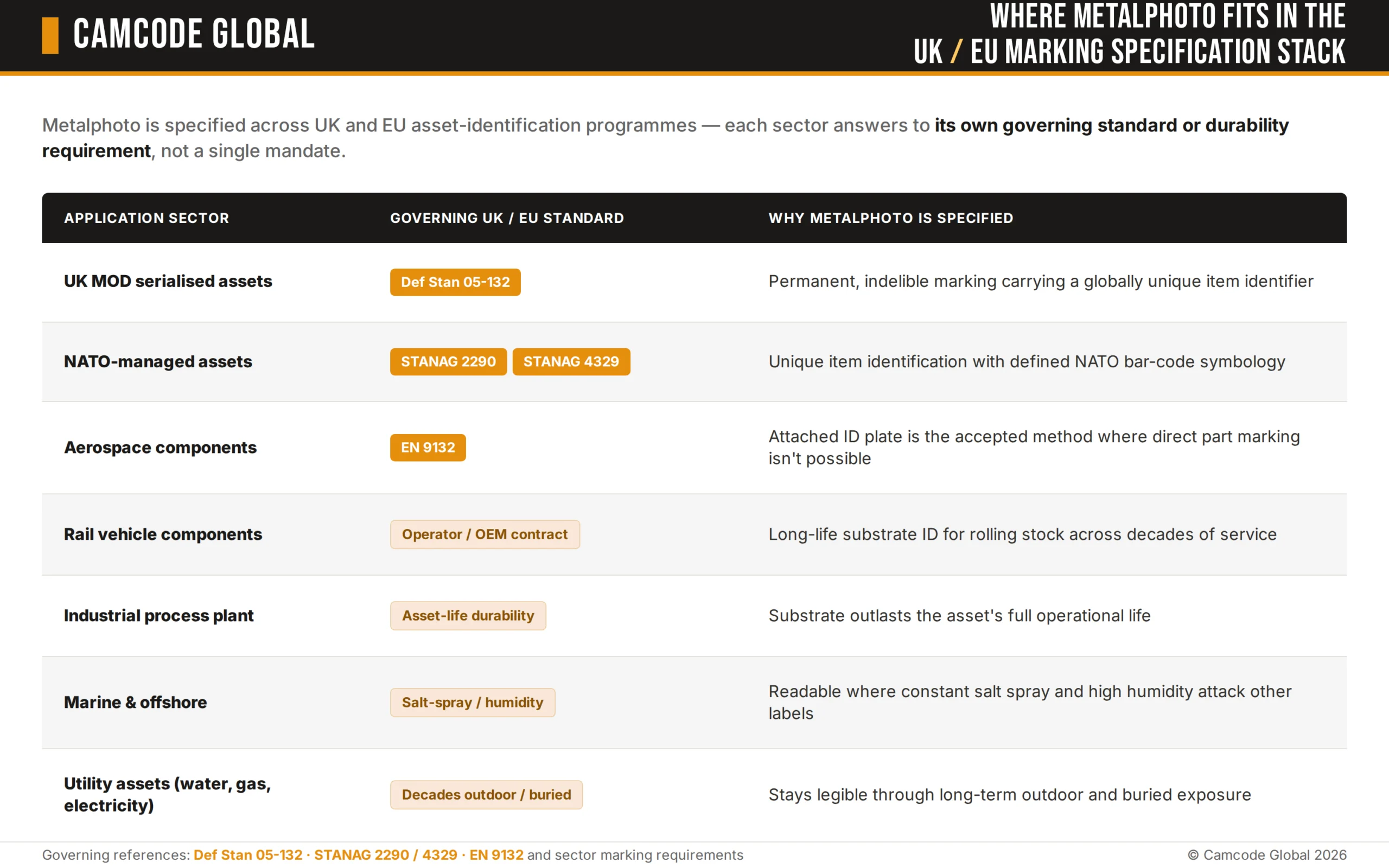
Where UK and EU customers need to specify asset identification, Metalphoto has a long history of use for:
- UK MOD serialised assets: requiring Defence Standard (Def Stan) 05-132 compliance, which requires that assets are permanently marked with indelible marking providing a globally unique item identifier.
- Netherlands MoD assets: Policy document CDS 751 (the Dutch equivalent to Def Stan 05-132) sets out regulations for unique item identification of defence equipment, such as ballistics plates.
- NATO-managed assets: conforming to STANAG 2290 (Unique Identification of Items), which forms the basis for the Alliance’ Unique Item Identifier (IUID) programme and is also cited by Def Stan 05-132 and national equivalents. NATO bar code symbology as used in that system is defined by STANAG 4329. Once marked assets enter service, STANAG 4427 (Allied Configuration Management Documentation) governs how those identified parts are tracked through configuration changes.
- Components used in Aerospace applications: according to EN 9132 (Data Matrix Quality Requirements for Parts Marking), the use of an attached identification plate is considered the correct method when part marking is not possible.
- Rail vehicle components: applicable to all rail vehicle components where long life substrate identification is required for rolling stock. (Note: EN 15380-2 is a vehicle designation and classification standard, not a marking specification. The appropriate marking requirement will usually be outlined in the operator or OEM contract.)
- Durable medical equipment: nameplates for capital hospital equipment carrying UDI content under EU Medical Device Regulation 2017/745, where the mark is designed to survive repeated sterilization processes and decades of use rather than a single-use shelf life.
- Industrial process plant: asset identification where the substrate needs to last as long as the asset’s operational life, supporting the unique identification requirements of BS ISO 55001 asset management systems.
- Marine and offshore: asset identification where salt-spray and high humidity are constant challenges.
- Long-life utility assets (water, gas, electricity): where labels need to be readable for decades of outdoor/buried exposure.
If the substrate needs to last for the life of the asset, Metalphoto is the leading choice.
Metalphoto vs Other Anodised Aluminium Approaches
Several alternatives exist to Metalphoto for marking anodised aluminium:
- Inkjet or laser printing on anodised aluminium. The application of Inkjet or UV prints onto anodised aluminium is cheaper and has quicker turnaround times, but the image is only on the surface rather than trapped under the anodic layer. This makes the inks prone to abrasion as well as attack by solvents and UV degradation.
- Mechanical (rotary) engraving on anodised aluminium. Creates durable readable marks suitable for text and simple graphics. Rotary engraving will cut deeper than laser, typically cutting through the anodised surface right into the base metal and taking the protective layer with it. Achievable cell density is limited by the physical width of the cutter head. Small-cell DataMatrix symbols cannot reliably be engraved at sizes needed to comply with IUID requirements.
- Laser marking of anodised aluminium. There are two distinct processes that are often confused: Laser engraving penetrates through the anodised surface to leave a mark on bare aluminium. Laser etching changes only the colour of the anodised surface (without removing it) so offers continued corrosion resistance. On anodised aluminium, laser marking gives you a crisp high resolution white mark and lends itself to text, serial numbers, barcodes and complex logos very nicely. Laser marking is usable for DataMatrix codes at medium cell sizes but will not achieve the photographic quality available from Metalphoto for dense data containing multiple contents, and definition of edges for small features is limited by the laser beam spot size.
- Standard dye-impregnation of anodised aluminium (not using a photographic emulsion): Works great with solid colours and very basic block graphics. Photosensitive anodised aluminium is unique because it combines a silver halide photographic process into the sealed layer of anodic coating. This gives you the UV stability of anodised aluminum along with the high image resolution of silver photography and the abrasion and corrosion resistance of regular anodised aluminum. Without the silver halide process layer, plain dye-impregnation can’t resolve as finely, which makes it incapable of printing high-density DataMatrix or fine serialised graphics.
Metalphoto remains the material of choice for this unique combination of properties (high resolution DataMatrix + long life outdoors + multi-content layout) throughout UK/EU defence and industrial supply chains, as can be seen in its adoption under Def Stan 05-132, STANAG 2290 and EN 9132 specification compliant programmes and evidenced by the NSWC Corona Division IUID Environmental Survivability Testing Report.
Metalphoto is often the first choice for long-life, high-resolution asset identification for many defence and industrial programmes. However, it is just one of a range of marking technologies available from Camcode Global. Others include laser markable labels, thermal transfer labels, inkjet labels, cut-through plates, woven fabric labels, direct part marking (DPM) and NFC solutions. All have their place depending on the operating environment, production volumes, substrate, durability requirements and the need for on-site marking.
Choosing the correct marking method is an engineering decision, not something we assume from the start. Our engineers understand your application and work through your standards and operational requirements with you to ensure we recommend the best solution. Metalphoto is specified for the majority of assets in most programmes with supplementary marking technology used where necessary due to environmental conditions, production requirements or unique asset characteristics that make another approach more suitable. Visit The Framework to learn more about Camcode Global’s seven-step data cleansing, asset identification, and data optimisation process.
Specifying Metalphoto Plates
A practical specification framework:
- Thickness. Metalphoto sheet stock thicknesses range from 0.08 mm to 3.18 mm thick. The typical working range for asset identification plates is 0.20 mm to 1.60 mm thick. Thin foil stock is typically used for PSA (pressure sensitive adhesive) adhered labels, while a thicker rigid stock is better suited for mechanically attached plates used in harsh environments.
- Content. Nameplate text elements are composed of: the identifier (whether that’s an IUID/UII, UDI, GS1 GIAI, NSN or internal MOD asset code, as discussed above), manufacturer’s part number, CAGE/origin code, serial number, DataMatrix, graphics, and regulatory marks. Ensure all content elements required by your respective standard (Def Stan 05-132, NL CDS 751, MIL-STD-130, EN 9132) are present in the plate design prior to artwork approval.
- DataMatrix grading target. MIL-STD-130 (US DoD) calls out that DataMatrix symbols shall have a verification grade of B or better as per ISO/IEC 15415 (formerly AIM DPM-1-2006) quality grading; AIM DPM-1-2006 was a US-published but internationally used grading methodology. Def Stan 05-132 and EN 9132 utilise the same ISO/IEC 15415 specification document for grading symbols, so the minimum requirement for defense and aerospace contracts is a Grade B, not a Grade C, regardless of which standard is listed on the contract. Grade A should be required for high volume automated scan applications where first-pass read rate is critical.
- Adhesive. Permanent-Pressure Sensitive Adhesive (PSA) adhesives applied to the back of the plate will satisfy most asset identification applications. Specialty adhesives are available for low surface energy plastics, high temperature surfaces, and CARC painted surfaces. CARC stands for Chemical Agent Resistant Coating and is a US military coating specification. As such, it is most relevant to US DoD and NATO interoperable programmes. UK and EU asset owners should determine what coating system is actually used on their assets and specify an adhesive that has been tested to work with that coating.
- Attachment. PSA will work for most fixed asset identification applications; however, rivets or screws should be used for high vibration environments or applications where the asset is removed from its location and reinstalled, and you cannot guarantee the adhesive bond will remain intact for the life of the asset.
- Surface finish. Matte for most industrial and outdoor applications (non-reflective, excellent scan contrast). Satin finish where a more finished appearance is needed. Please note that colour choices other than black have limited UV resistance. For outdoor or long-life applications, black-on-silver or silver-on-black should be specified. Gloss finish is available but only in certain thicknesses. This should not be used outdoors.
Common Metalphoto Procurement Pitfalls
Across UK and EU procurement engagements:
- Selecting Metalphoto for the substrate family but not specifying the DataMatrix target for grading, resulting in under-graded marks which pass inspection at the supplier but fail at audit.
- Not allowing plate real estate for the complete set of Def Stan/MIL-STD content.
- Selecting normal PSA adhesive for outdoor/marine environments when a specialty adhesive is more suitable.
- Considering Metalphoto and Metalphoto-style synonymous. Metalphoto is the photosensitive emulsion which creates the resolution. Not all anodised aluminum plates use this process.
- Requesting markings with a US standard (MIL-STD-130, AS9132, CARC-compatible adhesive) out of habit when the contract calls for the UK/EU standard (Def Stan 05-132, EN 9132, NL CDS 715, STANAG 2290, or whatever locally relevant coating) instead, or vice versa. Double check what jurisdiction standard the contract specifies before locking in your marking spec.
Frequently Asked Questions
What’s the difference between Metalphoto and anodised aluminium?
Metalphoto is photosensitive anodised aluminium. There is a photosensitive emulsion within the oxide layer. All Metalphoto is made from anodised aluminium but not all anodised aluminium is Metalphoto.
Is Metalphoto a brand or a generic process?
Metalphoto is a specific photosensitive anodised aluminium product developed and trademarked by Horizons Imaging Systems Group. Camcode Global is one of the world’s leading manufacturers of Metalphoto plates.
Does Metalphoto meet UK MOD Def Stan 05-132?
Yes. Metalphoto plates are often specified outright to meet Def Stan 05-132, the UK MOD specification. However, it is actually the independent durability data produced against MIL-STD-130 (the US DoD equivalent standard, via aggressive testing by NSWC Corona Division) that enables Metalphoto to satisfy Def Stan 05-132, rather than some automatic cascade of one standard to another. Customers to UK MOD programmes should confirm compliance to Def Stan 05-132 directly with their supplier rather than assuming compliance because the product has been approved to US MIL-STD-130.
How small can text/barcodes be on a Metalphoto plate?
Photographic imaging allows extremely high resolution. DataMatrix down to ~3mm square can be achieved with Grade C or better readability if the plate is properly anodised and sealed. Human-readable characters down to ~1.5mm tall are common for serial numbers.
Is it possible to remove Metalphoto plates without destroying them?
PSA-attached plates can be removed with solvents or heat. Please note that the adhesive is designed to attach the plate permanently. Mechanically-attached plates (rivets, screws, etc.) are considered a service-life attachment.
Camcode Global Delivers Metalphoto Plates and Compliance Consulting
One of the world’s oldest Metalphoto manufacturers, Camcode Global, supplies UK MOD, NSPA and US DoD contracts as well as numerous major European industrial customers. Our UK/EU customers include defence primes, SMEs, aerospace component manufacturers, rail vehicle operators, energy utilities and industrial plant operators.
Selecting the appropriate substrate is just the beginning. Successfully implementing Def Stan 05-132, STANAG 2290/4329, NL MoD CDS 715, or EN 9132 compliant marking throughout an entire fleet or estate (and maintaining the underlying asset data) is where most UK/EU programmes hit their biggest challenges. This is why Camcode Global combines Metalphoto manufacturing with a comprehensive, end-to-end consulting process that includes AIT consultation, engineering and marking-specification development, data remediation and verification, product manufacture and procurement, on-site installation by NATO Security Cleared teams, data reporting and migration, and ongoing asset life cycle management advisory services. Learn more about Camcode Global’s seven-step framework for taking your programme from initial consultation all the way through to installed, verified, audit-ready markings.
Our framework is already producing results for NATO-aligned defence and industrial entities in asset discovery and configuration management, asset life-cycle management, business process automation, NATO interoperability (STANAG 2290), and supply chain management. Discover how our solution has produced results for organisations like yours.
If you are specifying Metalphoto for a UK, EU or NATO programme and want the marking spec, standards compliance and underlying asset data handled by one partner, talk to a Camcode Global expert and request a consultation.